
Quick French Grammar Tips: Common Mistakes to Avoid
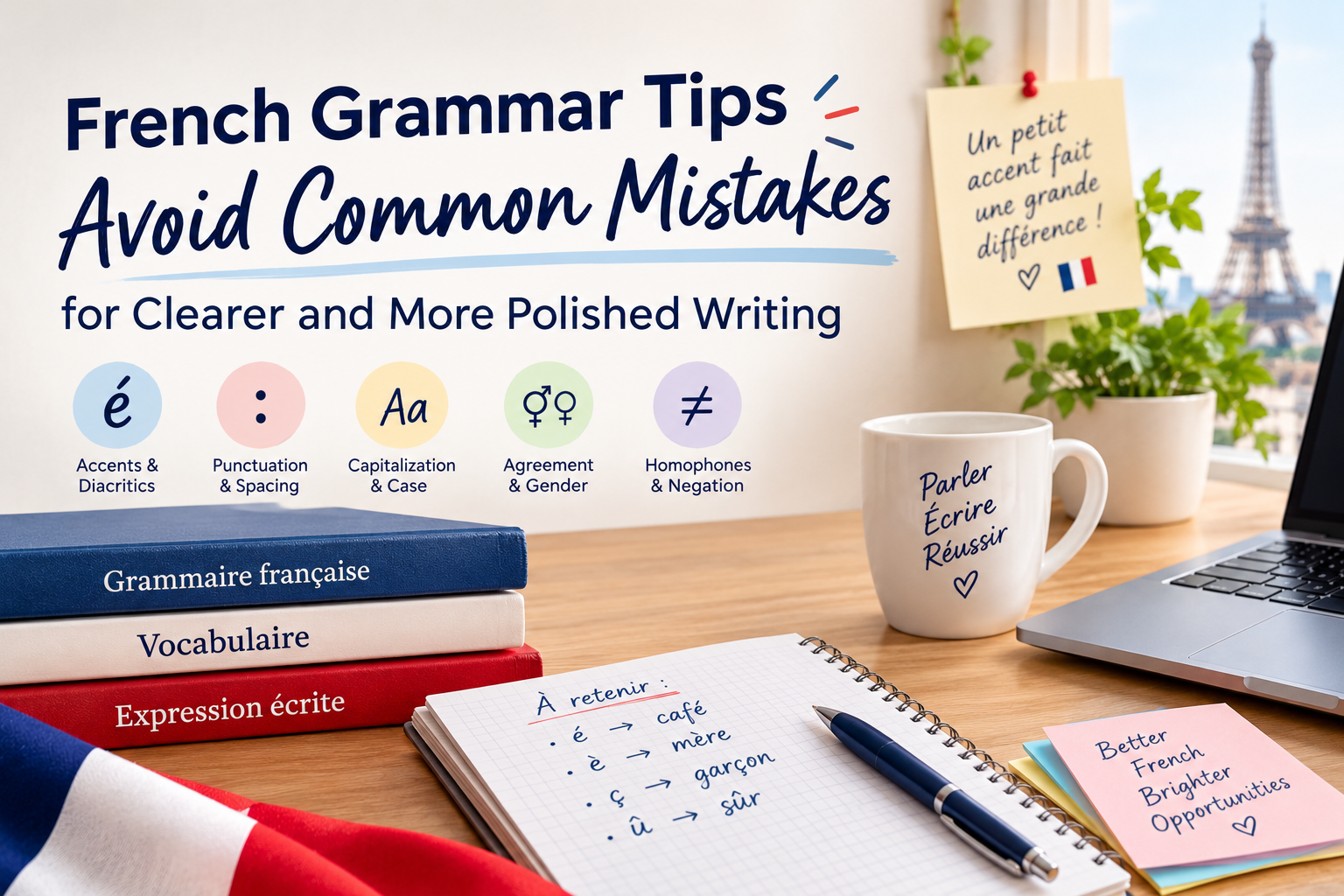
If you want your emails, applications, travel messages, or exam essays to sound polished, you need to avoid common French grammar mistakes. Clear writing opens doors in French speaking contexts, from ordering at a café to sending a formal cover letter. In this guide, you will find fast, example-driven French writing tips that fix the errors learners make most often. We will cover punctuation and spacing, capitalization and accents, tricky homophones, agreement, and negation. Along the way, you will get cultural notes that help you sound natural. If you want a structured path, PrepFrench Classes offers online French classes and step-by-step French lessons to help you learn French with confidence.
Here is how this article is organized: we start with why small grammar details matter, then move through the practical rules you can apply today. You will get quick examples of mistakes to avoid in French and how to correct them. If you want to explore a structured French course or book a free demo with PrepFrench Classes, you will also find helpful links at the right moments. Ready to sharpen your writing quickly?
Free First Step
Take the guesswork out of learning French.
Not sure where to begin, which course fits your goal, or how long it will take? Book a free demo class with PrepFrench Classes and get a personalized plan built around your level, schedule, and goals.
Why Small Grammar Details Matter in French Writing
In French, tiny marks carry big meaning. A missing accent changes a word. A space before a colon or a misused homophone can shift the tone of your sentence. For everyday messages, these details help you sound courteous and clear. For formal writing or exams, they influence your score. Paying attention to small grammar and typography habits prevents your reader from guessing what you meant to say.
The role of grammar in communication
Grammar is more than rules. It is the system that guides how ideas connect. In French writing, agreement endings and accents act like signposts. They point to gender, number, tense, and emphasis. Even if you are a beginner, you can make a strong impression by mastering these visible, high-impact details. In PrepFrench Classes, our French teachers coach learners to build these habits early so your writing improves fast across emails, essays, and messages.
Frequent errors and their impact
Here are common French grammar mistakes that change meaning or weaken your tone. Notice how a single letter or space affects clarity.
- Accents matter: cote vs côté (price vs side), tache vs tâche (stain vs task), sur vs sûr (on vs sure).
- Homophones shift meaning: ou vs où (or vs where), la vs là (the vs there), son vs sont (his/her vs are).
- Spacing communicates tone: Bonjour, Madame vs Bonjour Madame. The comma signals a respectful pause in formal letters.
- Agreement adds precision: Elles sont parties vs Ils sont parti. The first is correct and indicates a group of women who left.
- Negation sets boundaries: Je ne fume pas vs Je fume. A missing ne…pas flips the meaning entirely in writing.
Small habits create big gains. If you want a stronger foundation, explore our structured French courses or reach out for a free demo class. PrepFrench helps you practice the rules that quickly improve clarity and tone.
| Frequent Mistake | Correct Form | Why It Matters |
| Ou est la gare? | Où est la gare ? | Accent on où and space before the question mark follow French punctuation rules. |
| Je suis Francais | Je suis français. | Accent on ç and lowercase for adjective of nationality. |
| Ils sont parti hier. | Ils sont partis hier. | Past participle agrees with the subject with être. |
| Je ne bois pas du café. | Je ne bois pas de café. | Partitive and indefinite become de after negation. |
| C'est livres sont intéressants. | Ces livres sont intéressants. | Homophone confusion changes meaning completely. |
Punctuation & Typography Essentials
French punctuation rules differ from English in subtle but important ways. These habits create a professional and culturally appropriate tone. They are easy to learn, and they make your writing look instantly more native-like.
Correct spacing in sentences
In French, certain punctuation marks take a space before them. The safest habit is to insert a thin or non-breaking space before these marks to prevent line breaks in the wrong place.
- Space before: ; : ? ! « ». Example: Tu viens demain ? Merci !
- No space before: , . ... Example: Bonjour, Paul. À demain.
- Inside French quotes: « Bonjour », dit-elle. Note the spaces inside « and ».
- Colon for lists and explanations: Trois qualités : clarté, cohérence, précision.
- Numbers: French often uses a space as a thousands separator: 1 500, and a comma for decimals: 3,14.
Importance of non-breaking spaces
When possible, use a non-breaking space before high punctuation to keep punctuation attached to the preceding word. This prevents a question mark or exclamation mark from moving to the next line, which looks awkward in French typography. PrepFrench teachers show you simple shortcuts to handle this, even if your keyboard layout is not French.
- Correct: Où habitez-vous ? Incorrect: Où habitez-vous ? with a line break before the question mark.
- Correct: « Merci beaucoup ! » Incorrect: « Merci beaucoup ! » with line break issues.
- Emails and letters: Keep Monsieur, Madame together with the name or title to avoid separation.
Want a deeper practice set on punctuation and layout, especially for test writing or formal emails? See how we handle this in our online French classes.
Capitalization & Accents in French
If you speak English, capitalization habits can mislead you in French. French capitalization rules are more restrained. Accents are not decorative, they are part of the spelling for both lowercase and uppercase letters. Ignoring them is one of the most frequent mistakes to avoid in French.
When to use lowercase for proper nouns
French tends to lowercase general categories and adjectives where English might capitalize. Save capitals for official names and specific titles used as names.
- Months and days: janvier, février, lundi, mercredi. Not January or Monday capitalization.
- Languages and adjectives of nationality: le français, l’anglais, un film français, une étudiante indienne.
- Nouns for nationalities are capitalized for people: les Français, les Indiens. Adjectives stay lowercase: la cuisine française.
- School subjects: l’histoire, la géographie, les mathématiques. Capitalize only official course titles as names.
- Titles: Monsieur, Madame capitalized when addressing, but lowercase in general mentions: un monsieur très gentil.
Common misconceptions about accents
Accents are mandatory, including on capital letters. They change meaning and pronunciation: cote vs côté, des vs dès, mur vs mûr. Skipping accents in formal writing can be seen as careless. In PrepFrench Classes, we drill accent placement through short dictations and quick keyboard hacks that save time.
- Uppercase accents: État, À bientôt, ÇA. Use É, À, Ç instead of E, A, C when needed.
- Acute vs grave: du vs dû (article vs past participle), ou vs où (or vs where).
- Circumflex can signal meaning or vowel quality: sur vs sûr, mur vs mûr.
- On i and u, accents often clarify tense and word families: paraitre vs paraître, coute vs coûte.
For a quick keyboard fix, add a French or international layout on your device, or learn shortcuts. Your writing will immediately look more professional. If you need help setting this up, ask during your free demo class.
Structured French Courses
Stop learning French the slow way.
Apps and random videos keep you stuck at beginner level forever. PrepFrench Classes gives you a structured path, a real teacher, and speaking practice that moves you forward at every lesson.
Available for: beginners · TEF/TCF exam prep · Canadian PR · work and daily French
Common French Grammar Mistakes with Homophones to Double-Check
French is rich in homophones. They sound the same but mean different things, so one letter error can confuse your reader. Here is a focused list to keep near your keyboard, plus simple memory tips. These are classic mistakes to avoid in French, especially in quick messages and exam writing.
List of common homophones
- a vs à: a is verb avoir in present, à is the preposition. Il a un chien. Il va à Paris.
- et vs est: et means and, est is is. Paul et Marie. Il est ici.
- ou vs où: ou means or, où means where. Thé ou café ? Où allez-vous ?
- son vs sont: son means his/her, sont is are. Son livre. Ils sont là.
- la vs là: la is the article the, là is there. La voiture. Viens là.
- ces vs ses vs c’est vs s’est: ces means these, ses means his/her plural, c’est means it is, s’est is reflexive past. Ces idées. Ses amis. C’est bien. Il s’est levé.
- on vs ont: on is one/we, ont is have. On y va. Ils ont fini.
- leur vs leurs: leur for a singular possession by multiple owners or indirect pronoun, leurs for plural possessions. Ils leur parlent. Leurs enfants.
- tout vs tous vs toute vs toutes: Match gender and number. Tout va bien. Tous les jours. Toute la journée. Toutes les semaines.
- du vs dû: du is de + le, dû is past participle of devoir with accent. Le goût du café. Il a dû partir.
- des vs dès: des is plural article, dès means from or as of. Des idées. Dès lundi.
Tips for remembering the correct usage
- Accent trick: Where indicates location or question, so où always takes an accent.
- Verb check: If you can replace the word by avait or étaient in your head, you likely need a or sont.
- Demonstratives: ces often points at something visible or already known: ces documents ci.
- Possessives: ses usually answers whose, while ces answers which ones.
- Past obligation: dû signals a past necessity. If you can say had to, use dû with the circumflex.
Targeted practice makes these pairs automatic. In PrepFrench Classes, we build short dictations and context drills that fix these errors for good. If you are preparing for TCF or TEF writing, this is a high-return skill. See our Full TCF Canada Course for structured writing practice.
Understanding Agreement Essentials
Agreement in French tells your reader who did what, and with what quality. Two areas create the most difficulty for learners: past participle agreement and adjective agreement. Mastering both will immediately raise the level of your writing and reduce ambiguity. Here are French grammar tips for beginners that also serve advanced writers who need a quick refresh.
Past participle agreement with être
With auxiliary être in compound tenses, the past participle agrees with the subject in gender and number. Many movement verbs and all pronominal verbs use être.
- Elles sont arrivées. Ils sont partis. Marie est née en 1995.
- Reflexive verbs: Elle s’est levée tôt. Ils se sont rencontrés hier.
Exception with pronominal verbs: the participle agrees with the direct object if it comes before the verb, otherwise not. Compare these:
- Elles se sont parlé. No agreement, because se is an indirect object with parler.
- Elles se sont vues. Agreement, because se is a direct object of voir.
The role of having direct objects with avoir
With auxiliary avoir, the past participle usually does not agree with the subject. It agrees only if a direct object appears before the participle. This rule often shows up on tests and in formal writing.
- J’ai regardé le film. No agreement.
- Les lettres que j’ai écrites. Agreement with lettres because que is a direct object placed before the participle.
- La chanson qu’ils ont chantée. Agreement with chanson.
- Ils ont parlé à Marie. No agreement, because à Marie is indirect, not direct.
Pro tip: ask two questions in this order. First, what is the direct object of the verb? Second, does it appear before the participle? If yes, agree. If no, do not agree. This two-step check is a staple in PrepFrench writing drills across our French language classes.
Adjective agreement basics
Adjectives agree in gender and number with the noun they describe. Many beginners forget to make both words match, especially when the noun is far from the adjective in longer sentences.
- Un livre intéressant, une histoire intéressante, des idées intéressantes.
- Nationalities as adjectives are lowercase and agree: un étudiant français, une étudiante française, des étudiantes françaises.
- Placement affects nuance: une grande femme vs une femme grande can shift meaning. Learn common adjectives that come before the noun, often size, beauty, age, goodness ranks.
Color and compound adjectives need special care. Simple colors agree, but many color adjectives derived from nouns stay invariable: des robes marron, des chemises orange. Compound colors are usually invariable too: des drapeaux bleu clair. Keep a short list for reference and you will avoid a frequent point loss on exams.
Common Mistakes in Writing Negation
Spoken French often drops ne in casual conversation. Written French, especially for school, work, or exams, uses the full form. Negation is not just ne…pas. It includes several useful pairs that help you express never, nothing, no one, no longer, and more. Here are errors to avoid and models to copy.
Correct negation examples
- Ne…pas: Je ne mange pas de viande. Keep de after negation with indefinite or partitive nouns.
- Ne…jamais: Elle ne voyage jamais en hiver.
- Ne…plus: Nous ne fumons plus. Not anymore.
- Ne…rien: Il n’a rien compris.
- Ne…personne: Je n’ai vu personne. In compound tenses, personne often comes after the participle.
- Ne…que: Ils n’ont que dix minutes. Only ten minutes.
With infinitives, place both parts before the verb: Merci de ne pas fumer. With object pronouns, keep the negation around the conjugated verb: Je ne les ai pas vus. In formal writing, keep ne. If you write informally to a friend, you might drop it, but avoid this in applications or tests.
Common errors people make
- Using du or des after negation: Incorrect: Je ne veux pas des problèmes. Correct: Je ne veux pas de problèmes.
- Placing jamais or rien before the participle in the wrong spot: Correct: Il n’a jamais vu Paris. J’ai rien vu is colloquial speech, not formal writing.
- Forgetting elision: n’ before a vowel, like Je n’aime pas or Elle n’est pas prête.
- Mixing up personne and aucun: Personne for people, aucun for none of a thing: Aucun problème.
A reliable habit is to write the positive sentence first, then insert ne and the negative word around the verb group. This forces correct placement. If you prepare for formal exams, strong control of negation is a quick credibility boost. You can build this skill inside our structured French classes.
PrepFrench Classes
Ready to start French with a clear plan?
Book a FREE demo class and get a personalized roadmap for your level, goal, and timeline. No pressure, no obligation.
Explore courses:
All French Courses · Full TCF Canada Course · Full TEF Canada Course
FAQ: Quick Answers to Writing Pitfalls
What are the top 10 French writing mistakes English speakers make?
Here are ten quick fixes that help you learn French writing faster. 1) Forgetting spaces before ; : ? ! « » in French punctuation rules. 2) Skipping uppercase accents: À, É, Ç. 3) Capitalizing months and languages. 4) Confusing homophones: ou vs où, ces vs ses vs c’est. 5) Missing agreement with être: Elles sont arrivées. 6) Wrong past participle with avoir when a direct object comes before: les lettres que j’ai écrites. 7) Dropping ne in formal writing. 8) Using du or des after negation instead of de. 9) Placing adjectives incorrectly or forgetting agreement. 10) Overusing English commas. Want guided correction? Join our online French classes with PrepFrench.
Do you put a space before ? and ! in French?
Yes. French typography uses a space before high punctuation: ; : ? ! « ». Ideally this is a non-breaking space to avoid awkward line breaks. Examples: Tu viens demain ? Merci beaucoup ! « À bientôt ! ». By building this small habit, your writing will look immediately more polished. Our French lessons include quick formatting drills so your notes, emails, and exam responses match French punctuation rules without slowing you down.
Should capital letters have accents in French?
Yes. Accents are part of the spelling. Write À, É, È, Ç, and Ô on uppercase letters as needed. Omitting accents can change meaning or look careless in formal writing. Example: DU vs DÛ do not mean the same thing. If keyboard input is a struggle, PrepFrench teachers show fast shortcuts across devices during our free demo class, then reinforce them during your French course so the skill sticks.
How do I know when to use c’est vs il est?
Use c’est for identification or with a noun: C’est Marie. C’est un bon livre. Use il est or elle est before an adjective with no article: Il est intéressant. Elle est utile. With professions, use il est or elle est without article: Elle est médecin. With modified professions, use c’est: C’est une excellente médecin. In our French classes, we give quick transformation drills that help you choose instinctively in conversation and writing.
What’s the difference between bon and bien?
Bon is usually an adjective that describes a noun: un bon café, une bonne idée. Bien is usually an adverb that describes a verb, an adjective, or another adverb: Il parle bien, c’est bien utile. Common patterns help: bon for things you can rate as good or bad, bien for how something is done. Fixed expressions exist, like bon appétit and très bien. If you want more clarity with usage, try a PrepFrench French course that includes phrase banks and targeted practice.
Final Thoughts
Strong French writing is built from small, repeatable habits: proper spacing, accurate accents, careful homophones, clean agreement, and full negation. These are the common French grammar mistakes that block clarity and cost marks on exams. With a little deliberate practice, they become automatic. Keep a short checklist near your keyboard and read your sentences out loud to catch errors that your eyes miss.
If you want a faster route, learn French with structure. PrepFrench Classes gives you a path that starts with high-impact fixes, then builds toward polished paragraphs and confident emails. You will practice with a real French teacher, short dictations, and live feedback. Explore our French courses or book a free demo class to see exactly how we can support your goals, from daily writing to exam success.
✅ Next Step: Book a free demo class with PrepFrench Classes and start learning French the right way.
Write two paragraphs this week using the tips above, then self-check for punctuation spacing, accents, capitalization, agreement, and negation. Consistency beats intensity. Small wins today compound into clear, confident French tomorrow.
Written by
Platform Administrator
Practical ideas from the Prep French team for learners building confidence, preparing for exams, and planning their next step in Canada.
Join the discussion
Leave a thoughtful comment.
Your email address will not be published. Comments are reviewed before appearing.