French Pronouns: Types, Rules, Usage & Examples
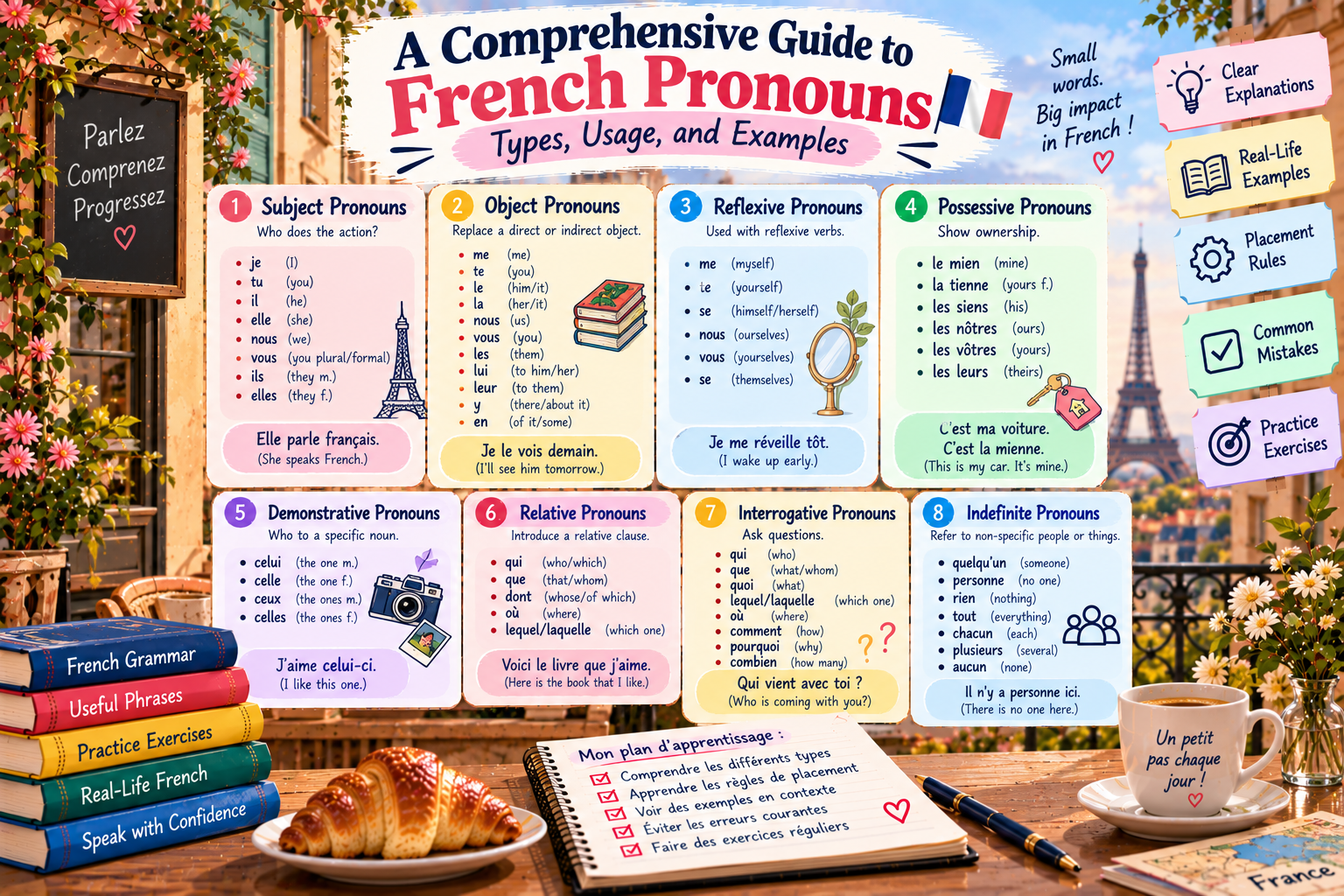
French pronouns are the small, powerful words that keep your sentences clear, efficient, and natural. If you want to speak French fluently, you need to know which pronoun to choose, where to place it, and how it affects meaning and agreement. This guide gives you a complete, practical overview of the types of French pronouns, with placement rules, examples, and the most common mistakes to avoid. You will also find exercises and resources you can use right away in your French classes or self-study.
In simple terms, pronouns replace nouns. They prevent repetition and help your speech flow. Mastering the different types of French pronouns is one of the quickest ways to sound more natural and confident.
- What French pronouns are and why they matter
- All major types of French pronouns with clear examples
- Essential placement rules in statements, negatives, questions, and commands
- Common errors learners make and how to fix them
- Practice exercises and downloadable resources
At PrepFrench, we teach these rules in context. Our French lessons focus on real conversation, accurate French pronunciation, and error correction, so you can use pronouns comfortably in daily speech and exams. If you want structure and feedback from a French teacher, our French courses make the learning curve faster and simpler.
Free First Step
Take the guesswork out of learning French.
Not sure where to begin, which course fits your goal, or how long it will take? Book a free demo class with PrepFrench Classes and get a personalized plan built around your level, schedule, and goals.
Understanding French Pronouns
What are Pronouns in French?
Pronouns replace nouns so that we avoid repeating names and things over and over. In French, pronouns carry essential information such as gender, number, and sometimes case or function. For example:
- Marie voit Paul. Elle le voit. (Marie sees Paul. She sees him.)
- Tu penses à ton voyage. Tu y penses. (You are thinking about your trip. You are thinking about it.)
French pronouns can be subjects, objects, reflexives, demonstratives, possessives, relatives, interrogatives, or even indefinite forms. Each type has a specific role and placement in the sentence. As you progress in a French course, your ability to choose the right pronoun and place it correctly will make your speech cleaner and more accurate.
The Importance of Pronouns in Fluent Speech
Fluent French depends on rhythm and clarity. Pronouns help you speak faster and sound more natural, because you refer to known people and things with short words rather than repeating full nouns. They also interact with key grammar topics such as verb conjugation, object placement, and past participle agreement. In our online French classes, we reinforce pronouns with speaking drills and pronunciation tips, so that forms like le, lui, y, and en become automatic in real conversation.
Types of French Pronouns
There are several main types of French pronouns. Below is a compact overview with common forms and examples you can model. Use this as a reference while working through the examples and exercises later in the article.
| Pronoun Type | Forms | Example |
|---|---|---|
| Subject pronouns | je, tu, il/elle/on, nous, vous, ils/elles | Nous arrivons. (We are arriving.) |
| Direct object pronouns | me, te, le/la, nous, vous, les | Je la connais. (I know her.) |
| Indirect object pronouns | me, te, lui, nous, vous, leur | Je lui parle. (I speak to him/her.) |
| Reflexive pronouns | me, te, se, nous, vous, se | Elle se lève. (She gets up.) |
| Stressed pronouns (toniques) | moi, toi, lui/elle, nous, vous, eux/elles, soi | Pour moi, c’est clair. (For me, it is clear.) |
| Adverbial pronouns | y, en | J’y vais. J’en veux. (I am going there. I want some.) |
| Demonstrative pronouns | celui, celle, ceux, celles; ceci, cela, ça | Celui-ci est meilleur. (This one is better.) |
| Possessive pronouns | le mien, la mienne, les miens, etc. | C’est la mienne. (It is mine.) |
| Relative pronouns | qui, que, dont, où, lequel and forms | La personne qui parle. (The person who is speaking.) |
| Interrogative pronouns | qui, que, quoi, lequel and forms | Lequel veux-tu? (Which one do you want?) |
| Indefinite pronouns | on, quelqu’un, quelque chose, chacun, rien, personne, plusieurs, certains, tout | On dit que..., Rien ne change. (People say that..., Nothing changes.) |
In PrepFrench Classes, we teach these forms with real contexts and pronunciation support, so you know not just what to say, but how to say it smoothly.
Structured French Courses
Stop learning French the slow way.
Apps and random videos keep you stuck at beginner level forever. PrepFrench Classes gives you a structured path, a real teacher, and speaking practice that moves you forward at every lesson.
Available for: beginners · TEF/TCF exam prep · Canadian PR · work and daily French
Pronoun Placement Rules
French pronoun placement follows a fixed order in most sentences. Getting the order and position right will immediately make your French sound more natural. Below are the essential rules with everyday examples.
Correct Order of Pronouns
- Standard order before a conjugated verb: me, te, se, nous, vous + le, la, les + lui, leur + y + en + verb
- Example: Je le lui y envoie. (I send it to him there.)
- With negation: Ne + pronouns + verb + pas
- Je ne le lui y envoie pas.
- With an infinitive: Pronouns usually go before the infinitive they relate to
- Je vais le lui y envoyer. (I am going to send it to him there.)
- Compound tenses: Pronouns come before the auxiliary
- Je les ai vus. Agreement rule applies here for direct objects.
Commands and Questions
- Affirmative imperative: Verb + le, la, les + moi, toi, lui, nous, vous, leur + y + en
- Donne-le-moi. Parlez-lui-en. Va-t’en.
- Note: With en or y, moi and toi become m’ and t’ before them: Donnez-m’en, Va-t’en.
- Negative imperative: Same order as regular sentences, before the verb
- Ne le lui donnez pas. Ne m’en parlez pas.
- Questions with inversion or est-ce que: Pronouns remain before the verb
- Le lui donnez-vous souvent ? Est-ce que tu l’as vu ?
Direct vs indirect objects: direct answers what or whom, indirect comes with à. For example, voir takes a direct object, parler à takes an indirect object. This choice often determines whether you use le or lui. If you want guided practice with this, our coaching sessions at PrepFrench Classes help you automate the right patterns quickly.
Common Mistakes with French Pronouns
Many learners understand forms in isolation, but stumble when combining them in real sentences. Here are the top issues and how to fix them.
Understanding Common Mistakes
- Mixing up y and en
- y replaces a place or à + thing: Tu vas à Paris, tu y vas.
- en replaces de + thing, or indicates quantity: Tu parles de ce livre, tu en parles.
- Past participle agreement with preceding direct objects
- Je l’ai vue. The past participle agrees with la, les if the direct object comes before the verb.
- No agreement with en: Des pommes, j’en ai mangé. (no -es)
- Wrong pronoun order
- Incorrect: Je lui le donne. Correct: Je le lui donne.
- Overusing stressed pronouns instead of objects
- Incorrect: Je parle à elle often. Correct: Je lui parle souvent.
Tips for Avoiding Pronoun Errors
- Identify the verb’s pattern: does it take a direct object or à + person or de + thing?
- Say the full sentence first, then replace the repeated part with the right pronoun.
- Memorize the fixed order: me, te, se, nous, vous + le, la, les + lui, leur + y + en.
- Practice short daily drills. Ten focused minutes help more than one long weekly session.
- Get feedback. In PrepFrench Classes, teachers catch small errors early so they do not become habits.
Advanced Pronoun Usage
Relative pronouns connect ideas without repeating the noun. They are essential if you want to tell stories, explain processes, or write clearly in French.
Relative Pronouns: What You Need to Know
- qui: subject of the relative clause
- La personne qui parle est ma prof. (who is speaking)
- que: direct object of the relative clause
- Le livre que j’ai lu est passionnant. Agreement with lu if que refers to a preceding direct object.
- dont: replaces de + noun
- La femme dont je parle. (the woman I am talking about)
- où: place or time
- Le jour où nous sommes arrivés. (the day when)
- lequel and forms: after prepositions, especially for things
- La solution à laquelle je pense. Les raisons pour lesquelles il a changé.
- ce qui, ce que, ce dont: when there is no stated antecedent
- Ce qui m’intéresse, c’est la phonétique. Ce que je veux, c’est progresser. Ce dont j’ai besoin, c’est de temps.
Practical Applications of Relative Pronouns
If you can choose between qui, que, and dont quickly, your sentences will flow naturally. Try compressing two sentences into one:
- Je connais cette ville. J’y ai grandi. → Je connais la ville où j’ai grandi.
- Elle admire cet auteur. Elle parle de cet auteur. → Elle admire l’auteur dont elle parle.
- Tu m’as recommandé un film. Je l’ai regardé. → Le film que tu m’as recommandé, je l’ai regardé.
In our advanced modules at PrepFrench Classes, we practice these transformations in speaking and writing so you can build complex ideas without hesitation.
Practice Exercises for Mastery
Use these short drills to reinforce your understanding of French pronouns. Speak your answers aloud first, then write them to check spelling and agreement. A downloadable worksheet set is available at the end of this section.
Transformative Exercises
- Replace the underlined part with a pronoun: Je vois Marie. → _______ vois.
- Replace the underlined part: Nous parlons à nos voisins. → Nous _______ parlons.
- Replace with y or en: Tu penses à ce projet. → Tu _______ penses.
- Replace with y or en: Elle a acheté des pommes. → Elle _______ a acheté.
- Turn into a negative with pronoun order: Donne-le-moi. → Ne _______ _______ donne pas.
- Use the correct order: Je donne le livre à Julie. → Je _______ _______ donne.
- Make agreement when needed: Les lettres ? Je _______ ai _______ ce matin.
- Choose qui, que, dont, or où: Le jour _______ nous partons est proche.
- Choose the right form of lequel: La solution à _______ tu penses est intéressante.
- Affirmative imperative with en: Donnez _______ ! (to me, some of it)
Suggested answers:
- 1. Je la vois. 2. Nous leur parlons. 3. Tu y penses. 4. Elle en a acheté. 5. Ne me le donne pas. 6. Je le lui donne. 7. Je les ai reçues. 8. où. 9. laquelle. 10. Donnez-m’en !
Downloadable Resources for More Practice
- Pronoun order cheat sheet with examples
- 30 quick drills mixing le, lui, y, en
- Past participle agreement summary with pronouns
- Relative pronoun mini-quiz with answer key
Want the PDF pack and a guided review? Contact PrepFrench to receive the download and join a free practice session. You can also explore structured French language classes that integrate these drills into a consistent weekly routine.
PrepFrench Classes
Ready to start French with a clear plan?
Book a FREE demo class and get a personalized roadmap for your level, goal, and timeline. No pressure, no obligation.
Explore courses:
All French Courses · Full TCF Canada Course · Full TEF Canada Course
FAQ: French Pronouns and Practical Use
What is the difference between direct and indirect object pronouns in French?
Direct object pronouns (le, la, les) replace the person or thing that receives the action directly. Indirect object pronouns (lui, leur) replace à + a person. For example, Je le vois, I see him or it, is direct. Je lui parle, I speak to him or her, is indirect because parler takes à. Many verbs determine the choice. In PrepFrench Classes, your French teacher will help you learn which verbs take direct objects and which take à, so you can use French pronouns correctly in speech and writing.
How do I know when to use y vs en?
Use y to replace a place or à + a thing: Tu vas à la banque, tu y vas. Use en to replace de + a thing or to express quantity: Tu veux du café, tu en veux. With numbers and quantities, keep the number: J’en ai deux. Both y and en come before the verb in standard sentences. In affirmative commands, they follow the verb with hyphens: Vas-y, Parlez-en. Our online French classes provide quick drills so y and en become automatic.
What is the correct order of two pronouns in a French sentence?
Before a conjugated verb, the fixed order is: me, te, se, nous, vous + le, la, les + lui, leur + y + en. Example: Je le lui donne. In negative form: Je ne le lui donne pas. With an infinitive, pronouns go before that infinitive: Je vais le lui donner. In affirmative commands, the order changes and pronouns follow the verb with hyphens: Donne-le-lui. PrepFrench courses include step-by-step practice with this sequence.
How do pronouns work in negative sentences and questions?
In negative sentences, pronouns stay before the verb: Ne + pronouns + verb + pas. Example: Je ne l’ai pas vu. In questions with inversion, pronouns still come before the verb: Le lui donnez-vous souvent ? With est-ce que, nothing changes for pronoun placement: Est-ce que tu l’as vu ? These patterns are consistent across tenses, which makes them easier to master with regular practice in a French course.
Do I make the past participle agree with pronouns like les, la, and en?
With direct object pronouns (le, la, les) placed before the auxiliary avoir, you make the past participle agree in gender and number: Je l’ai vue, Je les ai prises. With en, there is no agreement: Des idées, j’en ai noté. With être in compound tenses and reflexive verbs, agreement depends on whether the reflexive pronoun is a direct object. These rules can be tricky at speed, so targeted correction in PrepFrench Lessons helps you build reliable accuracy.
Final Thoughts: Mastering French Pronouns
French pronouns are the bridge between beginner sentences and fluent conversation. You have learned the main types of French pronouns, where to place them, and how to avoid the most common errors. The next step is steady practice: short daily drills, targeted review of y and en, and consistent application of the pronoun order in statements, negatives, questions, and commands.
If you want a faster path, structured French courses with PrepFrench remove confusion and build confidence through clear explanations and real speaking practice. Our teachers focus on accuracy, pronunciation, and repetition that sticks, so you can use pronouns naturally in real life, at work, or during exams.
Keep this guide bookmarked, return to the table when you are not sure, and practice the exercises out loud. With the right routine and feedback, you will master French pronouns and enjoy smoother, more precise communication.
✅ Next Step: Book a free demo class with PrepFrench Classes and start learning French the right way.
Keep exploring, keep practicing, and remember: small daily wins compound into real fluency. We are here to help whenever you need structure or feedback.
Written by
Platform Administrator
Practical ideas from the Prep French team for learners building confidence, preparing for exams, and planning their next step in Canada.
Join the discussion
Leave a thoughtful comment.
Your email address will not be published. Comments are reviewed before appearing.