Madame vs Mademoiselle: Meaning, Differences & Usage
Using the right title in French signals respect, cultural awareness, and good manners. If you have ever paused before saying Madame or Mademoiselle, you are not alone. This guide explains the difference, shows when to use each, and clarifies modern etiquette so you can confidently handle Madame vs Mademoiselle in daily life, business, and formal writing. Along the way, you will find practical examples you can use immediately, plus tips from PrepFrench Classes to help you learn French etiquette faster in real conversations.
Here is what you will learn:
- Quick definitions and the modern meaning of Madame and Mademoiselle
- When to use Madame in French as your default, in person and in emails
- When Mademoiselle still appears, and why many people avoid it now
- Regional differences: France, Quebec, Belgium, Switzerland, and beyond
- Common mistakes and easy phrases to stay polite in any situation
If you want structured guidance on etiquette, greetings, and real-life French, consider the French courses at PrepFrench. Our online French classes weave cultural insight into every lesson so you learn what to say and how to say it.
Free First Step
Take the guesswork out of learning French.
Not sure where to begin, which course fits your goal, or how long it will take? Book a free demo class with PrepFrench Classes and get a personalized plan built around your level, schedule, and goals.
Madame vs Mademoiselle: Understanding the Titles
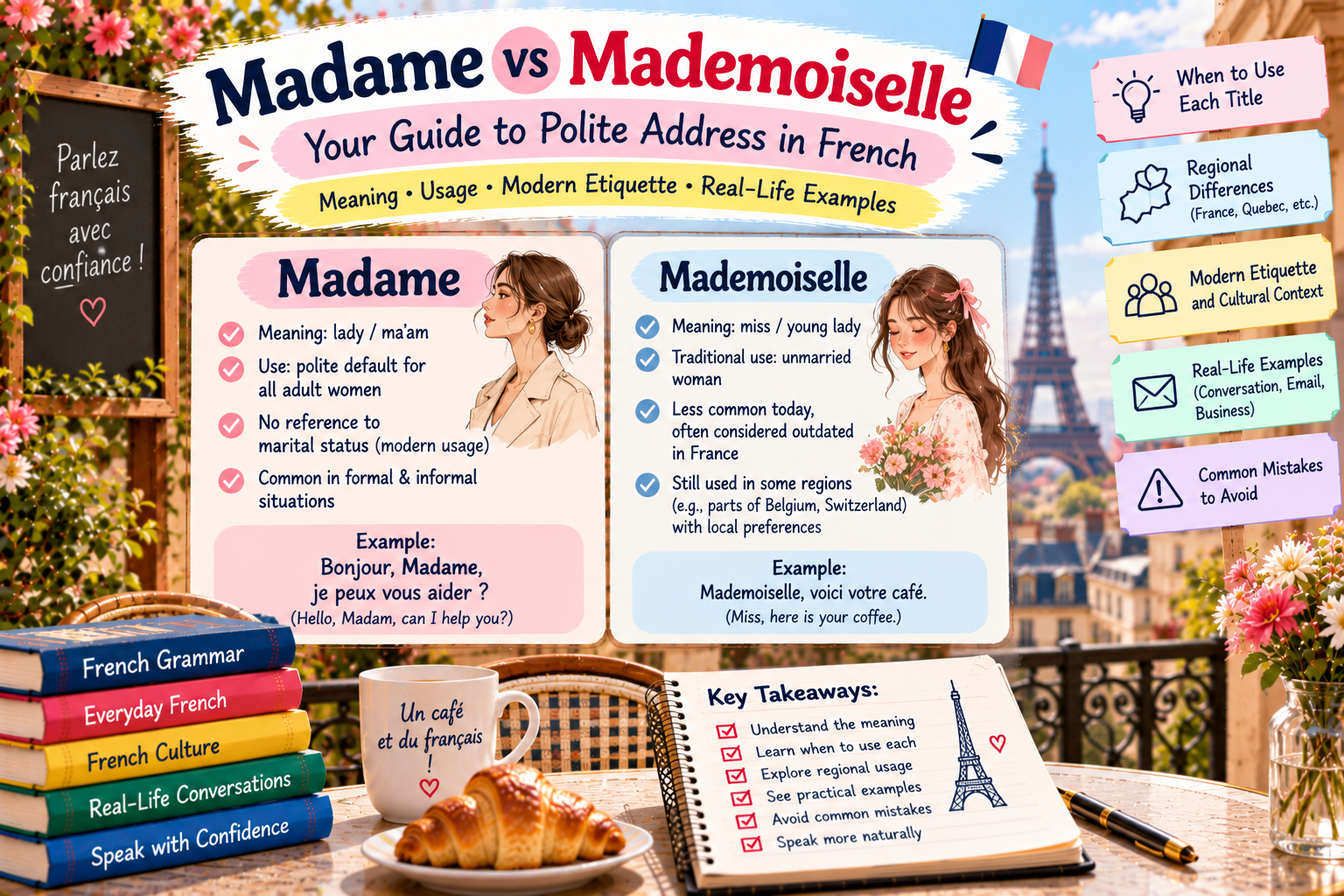
The two most common feminine titles of address in French are Madame and Mademoiselle. Historically, they indicated marital status, but modern practice has shifted toward simplicity and respect regardless of age or marriage. Here is what each title means and how it has evolved.
What Does "Madame" Mean?
Madame literally means “my lady,” and it is the standard respectful title for an adult woman. Today, Madame is the safe default in almost all situations, whether or not you know the person’s marital status.
- Literal sense: lady or ma’am
- Traditional use: married woman, or a woman considered adult
- Modern use: polite default for adult women in professional and social contexts
Examples:
- In a shop: “Bonjour, Madame, je peux vous aider ?”
- On the phone: “Bonjour Madame Dupont, ici Martin de la société Lemaire.”
- In an email: “Madame, je vous remercie pour votre message.”
If you are learning French, focus first on using Madame correctly, then learn the cultural details. In PrepFrench Classes, we build etiquette practice into speaking drills so you remember what to say under real pressure.
What Does "Mademoiselle" Mean?
Mademoiselle traditionally meant “miss,” or “young lady,” often implying that the person was unmarried. In contemporary France, it is widely considered old-fashioned in formal contexts and has been removed from government forms. You might still hear it in some social settings, especially for children or teenagers, but many adults prefer Madame.
- Literal sense: young lady or miss
- Traditional use: unmarried woman or a very young woman
- Modern use: increasingly rare for adults, more common for girls or teens
Examples:
- Addressing a child: “Mademoiselle, tu as oublié ton cartable.”
- Polite teasing among friends: “Alors Mademoiselle, on est en retard ?”
Note for learners who search “Lademoiselle meaning”: the correct French phrase is la demoiselle or Mademoiselle. In modern polite address, prefer Madame for adults unless you are sure the person prefers Mademoiselle.
When to Use "Madame"
When in doubt, choose Madame. It is respectful, neutral regarding marital status, and appropriate for almost every formal or semi-formal interaction. Here are the most common situations with examples you can reuse.
Professional Settings
In the workplace, Madame protects you from assumptions and keeps your tone professional. Use it in meetings, phone calls, and emails, unless invited to use a first name.
- First contact: “Bonjour Madame Martin, enchanté de faire votre connaissance.”
- Reception or service desk: “Bonjour Madame, j’ai rendez-vous à 10h.”
- Email opening: “Madame, je me permets de vous contacter au sujet de...”
In business email, addressing a person as Madame is standard and expected. PrepFrench’s French courses include templates for professional email openings and closings so you can write with confidence from day one.
Social Situations
Use Madame whenever you speak to an adult woman you do not know well. This includes shops, restaurants, taxis, and formal events.
- At a restaurant: “Madame, avez-vous choisi ?”
- On the street: “Excusez-moi Madame, la gare est par où s’il vous plaît ?”
- At a formal gathering: “Bonsoir Madame, merci de votre accueil.”
In many service contexts in France, you will also hear “Bonjour Madame” as a standard greeting. Reply with “Bonjour Monsieur” or “Bonjour Madame” depending on who you are speaking to.
Age Considerations
Age plays a role, but less than before. For adult women, Madame is the norm. For children and teens, Mademoiselle can still be used. If you are unsure about a young adult, you will not offend by choosing Madame. It is safer and more respectful in modern usage.
- Child or early teen: Mademoiselle is acceptable and common.
- Older teen or young adult: Madame is safe, unless you know the person prefers Mademoiselle.
- Any adult in a formal setting: use Madame by default.
Unsure what to use? Ask politely: “Comment souhaitez-vous que je vous appelle ?” This simple sentence, practiced in our online French classes at PrepFrench, helps you navigate delicate moments naturally.
When to Use "Mademoiselle"
Mademoiselle still exists in French, but it now lives in narrower contexts. Understanding where it fits will help you sound modern and respectful across different regions.
Usage for Younger Women
In everyday speech in France, Mademoiselle is common for girls and early teens. In a classroom or family setting, it can sound warm and appropriate. Once a young person reaches late teens or adulthood, Madame becomes safer, especially in public or professional contexts.
- Appropriate: addressing a 10-year-old at a bakery, “Bonjour Mademoiselle, tu veux une chocolatine ou un pain au chocolat ?”
- Borderline: speaking to a 17-year-old cashier, “Merci Mademoiselle.” Some will accept it, others may prefer Madame.
- Not advised: addressing an adult colleague or client as Mademoiselle. Use Madame unless they state a preference.
Cultural Context and Sensitivities
France made a clear move toward Madame in official life. Since 2012, government forms and many institutions have avoided Mademoiselle to remove marital-status assumptions. In everyday conversation, you will still hear Mademoiselle occasionally, but many adults dislike it or find it outdated.
Regional differences matter:
- France: Madame is standard for adults in business and public service. Mademoiselle for children or teens is fine.
- Quebec and Canada: Use Madame for adults. Mademoiselle is rare in professional settings and can feel old-fashioned.
- Belgium and Switzerland: Similar to France. Madame is the default for adults.
- Other Francophone regions: Norms vary. When you are not sure, choose Madame.
Etiquette is not just grammar, it is social intelligence. In PrepFrench Classes, we dedicate time to cultural nuances so you can speak French with confidence in real communities, not only in textbooks. If you want a path that blends language and culture, our French lessons are designed for you.
Structured French Courses
Stop learning French the slow way.
Apps and random videos keep you stuck at beginner level forever. PrepFrench Classes gives you a structured path, a real teacher, and speaking practice that moves you forward at every lesson.
Available for: beginners · TEF/TCF exam prep · Canadian PR · work and daily French
Greetings and Formal Communications
How you address someone changes slightly depending on whether you are speaking face to face or writing an email or letter. Use the phrases below for clear, polite communication in shops, offices, and business correspondence.
In-Person Greetings
In person, pair a friendly greeting with the correct title. Bonjour works almost everywhere during daytime hours. Bonsoir is used in the evening. Add Madame for an adult woman, and Mademoiselle for a child or teen.
- “Bonjour Madame, je cherche le rayon bouchers.”
- “Bonsoir Madame, nous avons une réservation pour deux.”
- “Excusez-moi Madame, est-ce que cette place est libre ?”
- To ask preference: “Comment souhaitez-vous que je vous appelle, Madame ou par votre prénom ?”
Pro tip: In many French-speaking places, a quick “Bonjour” before asking a question is seen as basic politeness. It sets a respectful tone for the rest of the conversation.
Email Protocols
French email openings are concise. If you know the person’s name, write “Madame Dupont,” on its own line, followed by your message. If you do not know the name, use “Madame,” or the combined form “Madame, Monsieur,” for a general salutation. Below is a quick reference.
| Situation | Recommended Opening | Example Closing |
|---|---|---|
| Known contact, formal | Madame Dupont, | Veuillez agréer, Madame, l’expression de mes salutations distinguées. |
| Unknown recipient, formal | Madame, Monsieur, | Cordialement, |
| Known adult woman, neutral-professional | Bonjour Madame, | Bien cordialement, |
| Customer service or public office | Madame, | Respectueusement, |
| Less formal, ongoing relationship | Bonjour Madame Dupont, | Bien à vous, |
If you are preparing for work in a French-speaking environment or for official exams, learning these formulas saves time and avoids awkwardness. See our dedicated email etiquette practice inside the PrepFrench French course catalog to build muscle memory for real communication.
Abbreviations and Plural Forms
Correct abbreviations and plurals will help you write polished emails and invitations. In French typography, abbreviations usually do not take a period, and there are established plurals for group salutations.
Common Abbreviations (Mme / Mlle)
| Full Form | Abbreviation | Notes |
|---|---|---|
| Madame | Mme | Standard French style is without a period. English contexts may write “Mme.” |
| Mademoiselle | Mlle | Used less often now for adults. Prefer Madame in formal writing. |
In most professional settings, write the full word when in doubt, especially in the email salutation line: “Madame,” or “Madame Dupont,” reads crisply and leaves no room for confusion.
Plural Forms (Mesdames / Mesdemoiselles)
When writing to or addressing a group, use the set plural forms:
- Mesdames for a group of adult women.
- Mesdemoiselles for a group of girls or young women, though it is less common in formal contexts today.
- Mesdames, Messieurs is the classic formal opening to address a mixed audience.
Examples:
- “Mesdames, nous allons commencer la réunion.”
- “Mesdames, Messieurs, merci de votre présence.”
Small details like these create a big impression in professional French. Our French tutors at PrepFrench can review your emails and help you polish your tone for work or study.
Common Mistakes and How to Avoid Them
Here are the frequent pitfalls learners face with Madame vs Mademoiselle, along with fixes you can apply immediately.
Age and Marital Status Assumptions
- Mistake: Choosing Mademoiselle because someone “looks young.”
- Why it matters: It can sound outdated or patronizing to an adult.
- Fix: Use Madame for adult women unless you know they prefer Mademoiselle.
How to Address Unknown Recipients
- Mistake: Using a first name or skipping a greeting entirely in formal emails.
- Why it matters: It feels abrupt in French business culture.
- Fix: Use “Madame, Monsieur,” if you do not know the person, or “Madame,” if you know it is an adult woman. Keep a respectful closing formula.
Overusing "Mademoiselle" in Service Interactions
- Mistake: Calling an adult customer Mademoiselle in shops or restaurants.
- Why it matters: Many adults prefer Madame, especially in France and Quebec.
- Fix: Default to “Bonjour Madame.” If the person corrects you, follow their lead.
Ignoring Personal Preference
- Mistake: Sticking to a title someone has rejected.
- Why it matters: Respecting how people wish to be addressed is a key part of polite address in French.
- Fix: Ask once, then use their preference: “Très bien, Madame.”
Pronunciation and Register
- Mistake: Overpronouncing the final “e” in Madame or Mademoiselle.
- Fix: Madame sounds like “ma-dam.” Mademoiselle sounds like “mad-mwah-zel.” Practice with a French teacher to build natural rhythm.
Need tailored feedback on your greetings and emails? Book a free demo with PrepFrench Classes and get a personal plan to master real-life etiquette while you learn French grammar and vocabulary.
PrepFrench Classes
Ready to start French with a clear plan?
Book a FREE demo class and get a personalized roadmap for your level, goal, and timeline. No pressure, no obligation.
Explore courses:
All French Courses · Full TCF Canada Course · Full TEF Canada Course
FAQ: Titles of Address in French
Is "Mademoiselle" considered outdated or rude in France?
In many contexts, yes, Mademoiselle feels outdated in France. Since 2012, the French administration has largely removed Mademoiselle from official forms. In daily life, people still use it for girls or teenagers, but for adult women, Madame is the respectful default. If you want to learn French for real interactions, follow this simple rule: use Madame unless the person clearly prefers Mademoiselle. PrepFrench Classes cover these etiquette details in our French lessons so you sound both polite and current.
Should I use "Mademoiselle" for an adult woman I don’t know?
No. Use Madame as your default for any adult you do not know, especially in professional or public settings. Mademoiselle can feel old-fashioned or patronizing to adults, even if they look young. If you are unsure, politely ask: “Comment souhaitez-vous que je vous appelle ?” In our French courses, you will practice these exact phrases until they feel natural, which is crucial for polite address in French workplaces and services.
What title should I use in Quebec or Canada?
In Quebec and across Canada, Madame is also the standard for adult women in business and public life. Mademoiselle is rare in formal settings and may sound outdated. For children and teens, Mademoiselle is fine. When writing emails, use “Madame,” or “Madame, Monsieur,” if the recipient is unknown. If you plan to work or study in Canada and want to learn French with regional etiquette, our online French classes include cultural notes for Quebec as part of every lesson.
How do I write a professional email greeting in French?
Use a short, respectful salutation followed by a comma on its own line. Examples: “Madame Dupont,” or “Madame,” if you do not know the surname. For unknown recipients, use “Madame, Monsieur,” then start your message. Close with a standard formula such as “Cordialement,” or “Veuillez agréer, Madame, l’expression de mes salutations distinguées.” If you want templates and feedback, PrepFrench Classes includes email-writing practice in our French lessons so you can write confidently from day one.
What are the abbreviations and plurals of Madame and Mademoiselle?
The standard abbreviations are Mme for Madame and Mlle for Mademoiselle, typically without periods in French typography. Plurals are Mesdames for a group of women and Mesdemoiselles for a group of girls or young women. For mixed groups or formal speeches, use “Mesdames, Messieurs.” In professional writing, many people now prefer the full form Madame over abbreviations. For hands-on practice, join a PrepFrench French course and refine your writing with a French tutor.
Final Thoughts
The heart of Madame vs Mademoiselle is simple: choose Madame for adult women unless you know a different personal preference, and reserve Mademoiselle for girls and teens. This approach fits modern etiquette in France, Quebec, Belgium, Switzerland, and most Francophone regions. It also keeps your emails, customer interactions, and first impressions professional and respectful.
As you learn French, practice saying and writing these forms until they feel automatic. The right greeting sets the tone for the conversation that follows. If you want a structured path that blends language, culture, and confidence, the team at PrepFrench is ready to help with clear lessons, real speaking practice, and feedback that accelerates progress.
✅ Next Step: Book a free demo class with PrepFrench Classes and start learning French the right way.
Polite address in French is about more than words. It reflects cultural awareness and respect, which is exactly what solid French classes aim to teach alongside grammar and vocabulary.
Written by
Platform Administrator
Practical ideas from the Prep French team for learners building confidence, preparing for exams, and planning their next step in Canada.
Join the discussion
Leave a thoughtful comment.
Your email address will not be published. Comments are reviewed before appearing.