French Possessive Adjectives: Rules, Examples & Exercises
French possessive adjectives, called adjectifs possessifs, help you show who owns what. They are small words like mon, ma, mes and leur or leurs that appear before a noun. For anyone who wants to learn French with clarity and confidence, these determiners are essential. In this guide, you will discover every form, the agreement rules, subtle exceptions, and common pitfalls that confuse beginners. You will also find practical exercises and self-checks to build real accuracy. If you prefer learning with structure and feedback, PrepFrench Classes offers guided French lessons and complete French courses that cover possessive adjectives step by step. Start here, then continue with our main PrepFrench site to explore more beginner grammar and vocabulary.
Free First Step
Take the guesswork out of learning French.
Not sure where to begin, which course fits your goal, or how long it will take? Book a free demo class with PrepFrench Classes and get a personalized plan built around your level, schedule, and goals.
Understanding French Possessive Adjectives
What are possessive adjectives?
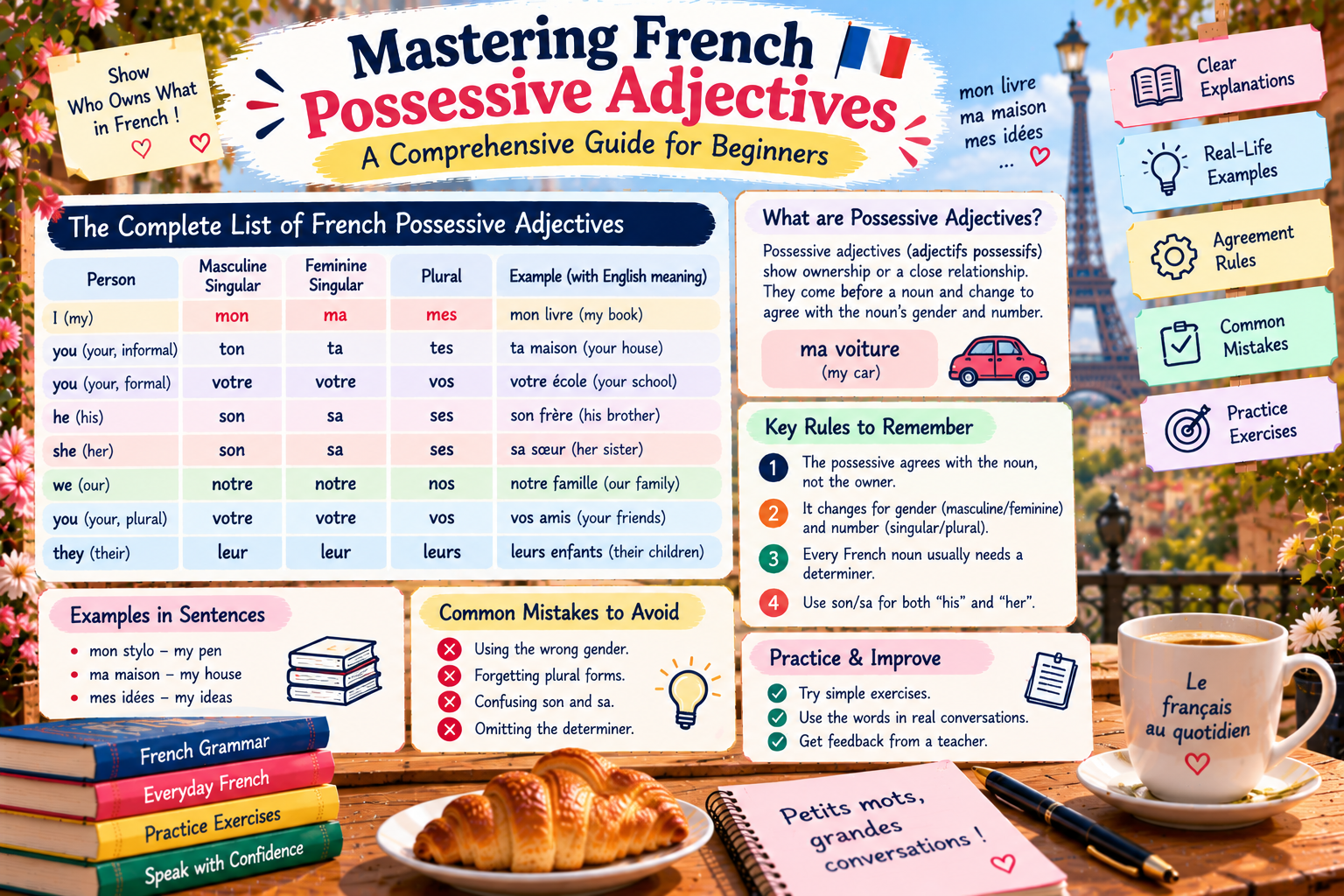
Possessive adjectives in French, also called French possessive determiners, show ownership or close relationship and come directly before a noun. They change to agree with the noun that follows, not with the owner. This is the rule that surprises many English speakers. For example, you say son livre for his book or her book because livre is masculine. These words are vital in daily French conversation and writing, from introducing family to describing your schedule, your home, and your ideas.
The role of determiners in French
Every French noun usually needs a determiner: an article, a demonstrative (ce, cette), a quantifier, or a possessive adjective. Without one, your sentence often sounds incomplete. As you build sentences in beginner French classes or a structured French course, you will constantly choose the right determiner for the noun you want to use. PrepFrench Classes includes targeted lessons on determiners so you can speak and write with natural rhythm.
- mon stylo, my pen
- ma maison, my house
- mes idées, my ideas
- son frère, his or her brother
- sa sœur, his or her sister
- leurs enfants, their children
In each case, the possessive agrees with the noun: gender (masculine or feminine) and number (singular or plural). Keep this principle at the center of your practice.
The Complete List of French Possessive Adjectives
Here is a clear overview of mon, ma, mes and the rest of the adjectifs possessifs. Notice how forms change according to the noun that follows. The table also includes short example sentences so you can see each form in action.
| Owner | Masculine singular | Feminine singular | Plural (any gender) | Example in context |
|---|---|---|---|---|
| je (I) | mon | ma | mes | mon frère, ma sœur, mes amis |
| tu (you, informal) | ton | ta | tes | ton livre, ta voiture, tes idées |
| il/elle/on (he/she/one) | son | sa | ses | son café, sa maison, ses objectifs |
| nous (we) | notre (used for both masculine and feminine) | nos | notre projet, notre amie, nos parents | |
| vous (you, formal or plural) | votre (used for both masculine and feminine) | vos | votre professeur, votre idée, vos enfants | |
| ils/elles (they) | leur (used for both masculine and feminine) | leurs | leur appartement, leur amie, leurs idées | |
Special note: with a feminine noun starting with a vowel or mute h, you use mon, ton, son to make pronunciation smoother: mon amie, ton histoire, son habitude. For h aspiré words, keep the regular feminine form: ma haine, ta hache. We explore this exception more below.
If you like organized reference sheets and guided practice, the possessive adjectives module in our online French classes breaks down each form with speaking drills and instant feedback.
Core Rules for Using Possessive Adjectives
The agreement rule explained
Possessive adjectives agree with the noun possessed, not the owner. Focus on the noun’s gender and number. This is the single most important rule.
- Paul parle de sa voiture. The car is feminine singular, so use sa.
- Paul et Marie adorent leur quartier. One neighborhood, shared ownership, so leur.
- Elle présente ses collègues. Colleagues is plural, so ses.
- J’admire mon professeur. Masculine singular noun professeur, so mon.
Vowel and mute h: mon amie, ton habitude, son histoire
When a feminine noun begins with a vowel or a mute h (h muet), French uses the masculine-looking forms mon, ton, son. This avoids a two-vowel collision that would be awkward to pronounce.
- mon amie, not ma amie
- ton habitude, not ta habitude (h muet)
- son histoire, not sa histoire (h muet)
However, if the h is aspirated (h aspiré), you keep the regular feminine form, and no elision occurs.
- ma haine, not mon haine (h aspiré)
- ta hache, not ton hache (h aspiré)
- le héros, la halle: these block elision and liaison, which signals h aspiré
If you are unsure, a good dictionary labels nouns with h muet or h aspiré. In PrepFrench Classes, we flag these high-frequency words so you build correct habits early.
Disambiguating son, sa, ses: his or her?
French does not distinguish gender of the owner in its possessive adjectives for the third person. Son, sa, ses are chosen according to the noun, not according to whether the owner is male or female.
- Elle aime son frère. Her brother. Brother is masculine, so son.
- Il téléphone à sa mère. His mother. Mother is feminine, so sa.
When it matters and you need clarity, you can add a phrase with à + stressed pronoun:
- son livre à elle, her book
- son livre à lui, his book
Alternatively, use de + name for precision: le livre de Marie, le livre de Paul. This is especially useful in storytelling or formal writing where ambiguity could confuse the reader.
Leur vs leurs
Think of leur as singular and leurs as plural, with a focus on the number of items owned, not the number of owners.
- Ils aiment leur mère. They love their mother, one mother in focus.
- Ils aiment leurs mères. They love their mothers, multiple mothers.
- Elles ont leurs stylos. Each has a pen, pens in total are plural.
Tip: With inanimate nouns, French still uses son, sa, ses. For example, la voiture et ses pneus, the car and its tires. This feels natural in French, even though English uses its.
If you want more guided drills on agreement rules, our grammar fundamentals inside the PrepFrench Courses section include short quizzes and teacher feedback to lock in accuracy quickly.
Structured French Courses
Stop learning French the slow way.
Apps and random videos keep you stuck at beginner level forever. PrepFrench Classes gives you a structured path, a real teacher, and speaking practice that moves you forward at every lesson.
Available for: beginners · TEF/TCF exam prep · Canadian PR · work and daily French
Common Mistakes with Possessive Adjectives
Beginners often transfer English habits directly into French. The result is small but frequent mistakes. Here are the top pitfalls to watch for, with clear examples and quick fixes that will tighten your grammar fast.
Using possessives with body parts
In French, you generally use the definite article with body parts, especially with pronominal verbs, not a possessive. Context already shows whose body part it is.
- Incorrect: Je me lave mes mains.
- Correct: Je me lave les mains. I wash my hands.
- Incorrect: Elle a mal à sa tête.
- Correct: Elle a mal à la tête. She has a headache.
Use a possessive only to emphasize contrast or ownership beyond the obvious: Il a pris sa veste sur son bras, he took his jacket on his own arm, emphasizing possession.
Confusing leur and leurs
This is the most common error with beginners. Remember: choose singular or plural according to the number of items owned, not the number of owners.
- Ils ont leur maison à Lyon. One house, so leur.
- Ils visitent leurs familles ce week-end. Multiple families, so leurs.
Misunderstanding formal vous possessives
Votre is singular before a single noun, and vos is plural before plural nouns, whether you are being formal with one person or speaking to several people.
- Madame, votre réservation est confirmée. One reservation.
- Chers clients, vos chambres sont prêtes. Several rooms.
Here is a quick reference list of typical mistakes to avoid:
- Choosing sa or son based on the owner’s gender. Always agree with the noun: sa voiture, son frère.
- Forgetting the vowel or h muet exception: mon amie, ton habitude, son histoire.
- Using a possessive for body parts in reflexive actions: Je me brosse les dents, not mes dents.
- Mixing up leur vs leurs: focus on the number of items owned.
- Overusing de + noun when a possessive is clearer: son ordinateur is shorter and natural in speech, while l’ordinateur de Paul clarifies ownership if needed.
Practical Exercises and Self-Checks
Practice cements understanding. Try these quick activities, then compare with the answer key. If you want teacher-led correction and speaking drills, our free demo shows you how PrepFrench Classes turns rules into confident conversation.
A. Fill in the blanks
Complete with the correct French possessive adjective. Focus on the noun that follows.
- Je cherche ___ clés. (keys, plural)
- Il adore ___ mère. (mother, feminine sing.)
- Nous avons terminé ___ projet. (project, singular)
- Elle parle à ___ amis. (friends, plural)
- Tu oublies toujours ___ portefeuille. (wallet, masculine sing.)
- Elles respectent ___ professeur. (teacher, singular)
- Vous présentez ___ collègue. (colleague, singular)
- Paul montre ___ appartement. (apartment, singular)
- Marie écrit à ___ amie. (friend, feminine sing., begins with vowel)
- Ils ont perdu ___ billets. (tickets, plural)
B. Translate to French
Translate each sentence, choosing the correct possessive in French.
- My brother and my sisters live in Paris.
- Their mother is a doctor.
- He forgot his keys, again.
- We love our neighborhood.
- She is calling her friend, Anna.
- You (formal) have your passport, sir?
- They never do their homework.
- Her story is inspiring.
Answer Key
A. 1. mes 2. sa 3. notre 4. ses 5. ton 6. leur 7. votre 8. son 9. son amie 10. leurs
B. 1. Mon frère et mes sœurs habitent à Paris. 2. Leur mère est médecin. 3. Il a oublié ses clés, encore. 4. Nous aimons notre quartier. 5. Elle appelle son amie, Anna. 6. Vous avez votre passeport, monsieur ? 7. Ils ne font jamais leurs devoirs. 8. Son histoire est inspirante.
Self-check after practice:
- Did you base your choice on the noun’s gender and number every time?
- Did you switch to mon, ton, son before feminine nouns starting with a vowel or h muet?
- For leur vs leurs, did you focus on how many items are owned?
Final Tips and Resources for Mastery
French possessive adjectives become simple when you repeatedly apply one core logic: agree with the noun. Build from that base and add exceptions, then reinforce with varied examples. If you want a clear path, real feedback, and speaking practice that cements these forms, our structured French courses and free demo class are a great next step.
- Keep a mini chart of mon, ma, mes and ton, ta, tes on your desk for two weeks.
- Say complete phrases aloud: ma voiture, mon ami, mes projets. Then vary owners and nouns.
- Read short French texts and highlight possessive adjectives. Ask why each was chosen.
- Use de + noun when you need absolute clarity: le livre de Marie.
- Practice speaking with a teacher so corrections happen on the spot, which saves time.
PrepFrench Classes
Ready to start French with a clear plan?
Book a FREE demo class and get a personalized roadmap for your level, goal, and timeline. No pressure, no obligation.
Explore courses:
All French Courses · Full TCF Canada Course · Full TEF Canada Course
FAQ: French Possessive Adjectives
Do French possessive adjectives agree with the owner or the noun?
They agree with the noun that follows. The possessive adjective reflects the gender and number of the thing possessed, not the owner. For example, sa voiture could mean his car or her car because voiture is feminine. Likewise, son frère means his brother or her brother because frère is masculine. This rule is central in all French lessons for beginners. If you practice with a structured French course like PrepFrench Classes, you will see this principle reinforced through examples, speaking drills, and quick feedback that makes the choice feel automatic.
Why is it mon amie and not ma amie?
You use mon, ton, son before a feminine noun that starts with a vowel or a mute h (h muet) to avoid a vowel collision. Amie starts with a vowel, so it becomes mon amie for smooth pronunciation. The same applies to son histoire, his or her story, and ton habitude, your habit. If the h is aspirated (h aspiré), you keep the normal feminine form and do not elide: ma haine, not mon haine. In our online French classes we mark common h muet and h aspiré words so you memorize the right pattern early.
How do I tell the difference between leur and leurs?
Choose leur when there is one item owned by several people, and choose leurs when multiple items are owned. The number of owners does not matter here, the number of items does. Examples: Ils ont leur appartement, one apartment, and Ils ont leurs appartements, several apartments. For family nouns, Ils aiment leur mère means one mother in focus, while Ils aiment leurs mères means each person loves their own mother. Practice this contrast in context to make it instinctive while you learn French.
What should I do when using possessive adjectives with body parts?
In French, body parts usually take the definite article, not a possessive adjective, especially with pronominal verbs. You say Je me lave les mains, I wash my hands, and Elle s’est cassé la jambe, she broke her leg. Context shows whose body part it is. Use a possessive only when the owner is not obvious or when you want emphasis. This is a frequent correction point in beginner French classes. A good French teacher will coach you through many examples until it becomes natural.
When should I use a possessive adjective vs. de + noun?
Use a possessive adjective for concise, natural speech: son ordinateur, her or his computer. Use de + noun when you need clarity or emphasis on the owner: l’ordinateur de Marie, Marie’s computer. In writing or storytelling, this can prevent confusion. In everyday conversation, possessive adjectives are typically shorter and more fluid. If you want to practice choosing between these options, consider a structured French course with live speaking practice, such as PrepFrench Classes, to get guided correction in real time.
Final Thoughts
Mastering French possessive adjectives is a high-impact win for beginners. Once you internalize the core rule, agreement with the noun, everything else falls into place. Add the vowel or h muet exception, learn to disambiguate with à lui or à elle when needed, and pay attention to the subtle difference in leur vs leurs. Combine these with steady practice, and you will speak about your world, your family, and your ideas with precision.
Prefer a guided route instead of piecing it together alone? PrepFrench Classes provides structured grammar lessons, speaking drills, and real feedback that help you learn French efficiently. Start with a free demo class, then follow a clear plan designed for your goals, schedule, and level. If you already have momentum, browse our French courses to find your perfect next step.
✅ Next Step: Book a free demo class with PrepFrench Classes and start learning French the right way.
Have questions or want personalized help choosing a French course? Reach out for a quick chat or attend a free demo. We are happy to guide you.
Written by
Platform Administrator
Practical ideas from the Prep French team for learners building confidence, preparing for exams, and planning their next step in Canada.
Join the discussion
Leave a thoughtful comment.
Your email address will not be published. Comments are reviewed before appearing.