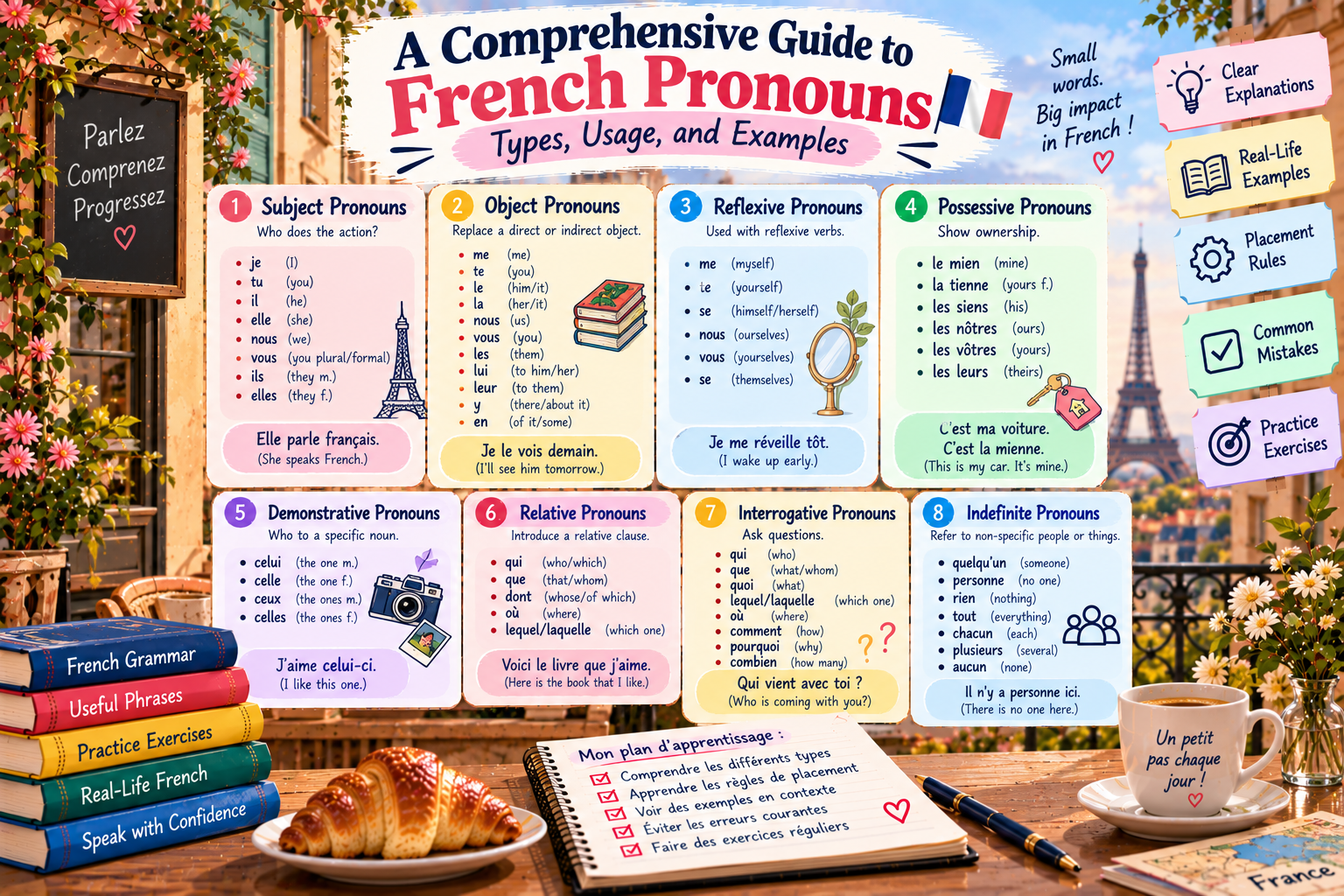
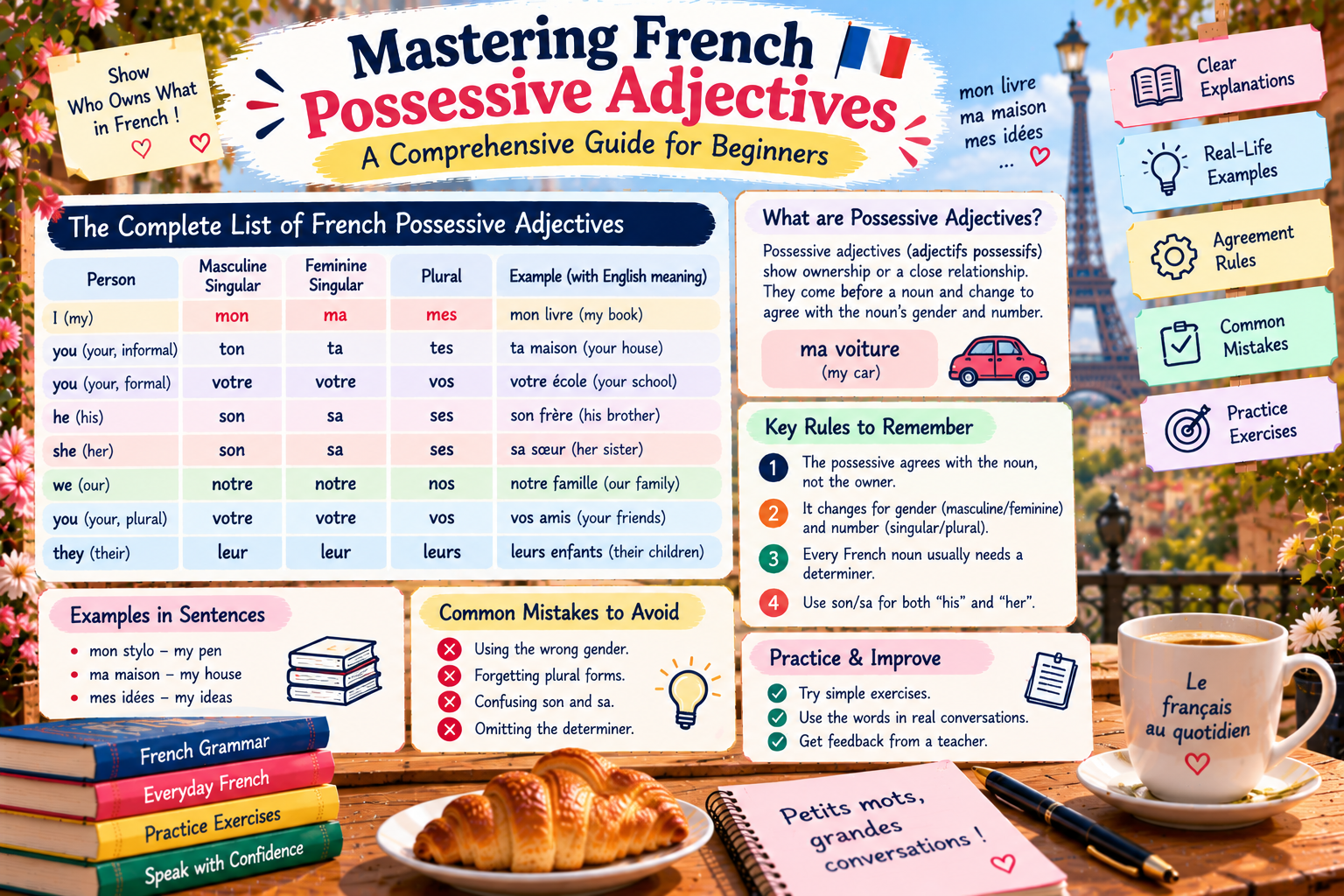
French Demonstrative Adjectives: Ce, Cet, Cette, Ces Guide

French demonstrative adjectives help you say this, that, these, and those with precision. If you have ever wondered when to say ce, when to say cet, or how to choose between cette and ces, this guide is your all-in-one reference. We will explain every rule that matters, including the tricky h aspiré vs h muet distinction, choosing cet before an adjective, and how to add -ci or -là. By the end, you will be able to use French demonstrative adjectives naturally in conversation and writing.
At PrepFrench, we see learners improve fastest when grammar rules connect to real speaking practice. This article gives you a clean framework for ce, cet, cette, ces, then backs it up with examples, common mistakes to avoid, and short exercises you can try today. If you want an expert to check your usage in real time, our French classes include guided drills and feedback on your pronunciation and accuracy.
Use this page as a reference you can return to whenever you hesitate between ce and cet, or when you need a refresher on -ci and -là. For a full learning path that links grammar to conversation, check the structured French courses at PrepFrench Classes or book a quick free demo class to get your personalized plan.
Free First Step
Take the guesswork out of learning French.
Not sure where to begin, which course fits your goal, or how long it will take? Book a free demo class with PrepFrench Classes and get a personalized plan built around your level, schedule, and goals.
Understanding French Demonstrative Adjectives
What are demonstrative adjectives?
Demonstrative adjectives, called adjectifs démonstratifs in French, point to specific nouns: this book, that car, these ideas, those people. In French, they must agree with the noun in gender and number, and they come directly before the noun or any adjective that precedes it.
English uses four words, this, that, these, those. French uses four forms as well: ce, cet, cette, ces. You will also see optional endings -ci and -là added to the noun to make near vs far distinctions clearer, like ce livre-ci for this book and ce livre-là for that book.
The role of demonstrative adjectives in defining nouns
These small words do heavy lifting. They help you refer to exactly the item you mean, connect ideas in a story, and compare choices. Without them, your French sounds vague. With them, you can point, contrast, and clarify naturally in conversation and writing.
Examples in context:
- Ce film est incroyable. Je le recommande. (This movie is incredible. I recommend it.)
- J’aime cette couleur, mais je préfère celle-là. (I like this color, but I prefer that one.)
- Regarde ces chaussures-ci. Elles sont en solde. (Look at these shoes here. They are on sale.)
Note the difference between demonstrative adjectives and demonstrative pronouns. Adjectives modify a noun, like ce livre. Pronouns replace a noun, like celui-ci. Both matter in French grammar, and our French lessons at PrepFrench show you how to switch between them fluently.
The Four Forms of Demonstrative Adjectives
Here is the quick breakdown of ce, cet, cette, and ces with rules and clear examples. The core idea: match gender and number, and pay attention to sound.
Ce: used with masculine nouns
- Form: ce + masculine singular noun starting with a consonant sound.
- Examples: ce livre, ce garçon, ce café, ce grand projet.
- Pronunciation tip: Say [sə] or [sœ], depending on accent and following sound. Keep it short and clean.
Cet: used before vowel sounds and h muet
- Form: cet + masculine singular noun starting with a vowel sound or silent h (h muet).
- Examples: cet arbre, cet ami, cet homme, cet hiver, cet hôtel.
- Why: cet avoids a clumsy consonant-vowel break and makes speech flow smoothly.
Cette: used with feminine nouns
- Form: cette + any feminine singular noun, no matter the initial letter.
- Examples: cette fille, cette idée, cette amie, cette histoire.
- Note: There is no feminine equivalent of cet. It is always cette for feminine.
Ces: used with plural nouns
- Form: ces + any plural noun, masculine or feminine.
- Examples: ces livres, ces hommes, ces femmes, ces idées.
- Pronunciation tip: ces is pronounced [se]. Before a vowel or h muet the liaison creates a [z] sound: ces amis [se z ami].
Quick decision guide:
- Masculine singular, next sound is a consonant: choose ce. Example: ce professeur.
- Masculine singular, next sound is a vowel or h muet: choose cet. Example: cet ami, cet homme.
- Feminine singular: choose cette. Example: cette étudiante, cette heure.
- Any plural: choose ces. Example: ces étudiants, ces heures.
Once the basics are set, practice builds speed. In our PrepFrench online French classes, you will drill these forms in mini-dialogues so that choosing ce, cet, cette, or ces becomes automatic.
Structured French Courses
Stop learning French the slow way.
Apps and random videos keep you stuck at beginner level forever. PrepFrench Classes gives you a structured path, a real teacher, and speaking practice that moves you forward at every lesson.
Available for: beginners · TEF/TCF exam prep · Canadian PR · work and daily French
Special Cases for Using Cet
Two details cause most hesitation with cet: the difference between h aspiré and h muet, and what to do when an adjective comes between the demonstrative and the noun. Master these, and your choices will be fast and confident.
h aspiré vs h muet: which one takes cet?
In French, some words starting with h behave like they start with a vowel (h muet), and some behave like they start with a true consonant (h aspiré). With h muet, elision and liaison happen: l’homme, cet homme, les hommes with [z] sound. With h aspiré, there is no elision and no liaison: le héros, ce héros, les héros without linking sounds.
| Type of h | Common words | With demonstratives | Tip |
|---|---|---|---|
| h muet (silent h) | homme, hiver, habitude, histoire, hôtel, honneur | cet homme, cet hiver, cette histoire, cet hôtel | Elision and liaison allowed: l’homme, les hommes [z] |
| h aspiré (aspirated h) | héros, haricot, hibou, hache, honte, hamburger | ce héros, ce haricot, cette honte | No elision or liaison: le héros, les héros (no linking) |
How to know which h a word has: most dictionaries mark h aspiré with a small symbol or note. You can also test with elision. If l’ + word sounds correct and common, it is likely h muet: l’hôtel, l’histoire. If you always hear le or la and never l’, it is probably h aspiré: le héros, la honte. In our French grammar classes at PrepFrench, you will get curated lists and audio so you do not have to guess.
Intervening adjectives: does ce or cet depend on the next word?
When an adjective comes between the demonstrative and the noun, the choice usually depends on the very next word after the demonstrative. If that next word starts with a vowel sound, use cet for masculine singular. If it starts with a consonant sound, use ce.
- cet ancien ami, but ce grand ami
- cet étrange homme, but ce bel homme
- cet autre exercice, but ce petit exercice
Why this matters: speech flows word to word. French picks cet when you are about to say a vowel sound. If you insert an adjective that starts with a consonant sound, ce returns naturally. Practice with a few pairs to feel the rhythm: cet incroyable artiste vs ce célèbre artiste. Both describe the same noun, artiste, but the form changes with the adjective that follows.
Usage of -ci and -là in French
French often leaves context to decide this vs that. Still, you can add -ci or -là to the noun to make things explicit. Attach them with a hyphen to the noun that follows the demonstrative adjective.
Definition of -ci and -là
- -ci often means this or these near me or just mentioned.
- -là often means that or those farther away, previously mentioned, or contrasted.
Examples:
- J’achète ce pull-ci, pas ce pull-là. (I am buying this sweater here, not that one.)
- Regarde ces photos-ci, elles datent d’hier. (Look at these photos here, they are from yesterday.)
- Tu préfères cette robe-ci ou cette robe-là ? (Do you prefer this dress or that dress?)
When to use -ci or -là in sentences
Use them when:
- You need to contrast two similar things: ce modèle-ci vs ce modèle-là.
- You refer to physical distance: cette table-ci near you, cette table-là across the room.
- You emphasize sequence or recency: ce chapitre-ci for the current chapter.
In everyday speech, French speakers often skip -ci and -là if the meaning is clear. Intonation, pointing, and context do the job. In class, we recommend practicing both ways so you can be precise when you need it. You will get plenty of chances to practice these nuances in PrepFrench conversational French courses.
Common Pitfalls and How to Avoid Them
These are the mistakes we correct most often in PrepFrench Classes. Fix them now and your French will sound more natural tomorrow.
Mixing adjectives and pronouns
- Wrong: Ce est une bonne idée.
- Right: C’est une bonne idée. (Here, c’ is a pronoun that stands for it/that.)
- Right: Cette idée est bonne. (Here, cette is an adjective modifying idée.)
Tip: Use c’est + adjective or c’est + noun when stating general opinions, and use ce/cet/cette/ces + noun when pointing to something specific.
Misusing h aspiré and h muet
- Wrong: l’héros, cet héros.
- Right: le héros, ce héros. (h aspiré, no elision, no cet.)
- Right: l’homme, cet homme. (h muet, elision and cet are correct.)
Solution: Build a small personal list of h aspiré words. Review it weekly. With repetition you will stop second-guessing yourself.
Overuse of -ci and -là
- Risk: Adding -ci or -là every time makes speech heavy.
- Better: Use them for contrast or emphasis. Otherwise, rely on context and intonation.
- Example: Je prends ce dessert, merci. If there are two, clarify: Je prends ce dessert-ci.
Two more quick checks:
- Do not confuse ces with possessive ses. ces = these/those, ses = his/her/its (plural). Compare: ces livres vs ses livres.
- Remember plural liaison: ces amis [se z ami] with a smooth [z] linking sound.
Struggling with any of these? A few live corrections with a PrepFrench teacher can save you weeks of self-doubt.
Practice Exercises for Mastery
Practice turns rules into reflexes. Try these quick sets now. Then, read them aloud to train your pronunciation and liaison.
A. Fill-in-the-blank: choose ce, cet, cette, or ces
- _____ idée est brillante.
- Je préfère _____ hôtel-ci, pas l’autre.
- Tu as vu _____ homme là-bas ?
- _____ amis arrivent ce soir.
- Regarde _____ étrange animal.
- Je veux acheter _____ chemise-là.
- Nous connaissons bien _____ professeur.
- Il adore _____ hiver en montagne.
- _____ haricot n’est pas assez cuit.
- J’hésite entre _____ deux options.
B. Add -ci or -là for clarity
- Je prends ce gâteau, pas l’autre. (Add -ci or -là to both nouns.)
- Tu choisis cette chaise ou cette chaise ? (Make the contrast explicit.)
- Regarde ces photos. Celles de Paris sont mes préférées. (Specify which set of photos.)
C. Translate to French using demonstrative adjectives
- This book is new, but that book is cheaper.
- These shoes are mine, those are yours.
- I like this old friend, not that new colleague.
- Is that hotel open in winter?
- Do you remember those ideas from yesterday?
Suggested answers
A. 1) Cette 2) cet 3) cet 4) ces 5) cet 6) cette 7) ce 8) cet 9) ce 10) ces
B. 1) Je prends ce gâteau-ci, pas ce gâteau-là. 2) Tu choisis cette chaise-ci ou cette chaise-là ? 3) Regarde ces photos-ci. Celles de Paris sont mes préférées. (Or: Regarde ces photos-là de Paris.)
C. 1) Ce livre-ci est nouveau, mais ce livre-là est moins cher. 2) Ces chaussures-ci sont à moi, celles-là sont à toi. 3) J’aime cet ancien ami, pas ce nouveau collègue. 4) Cet hôtel-là est-il ouvert en hiver ? 5) Tu te souviens de ces idées d’hier ?
PrepFrench Classes
Ready to start French with a clear plan?
Book a FREE demo class and get a personalized roadmap for your level, goal, and timeline. No pressure, no obligation.
Explore courses:
All French Courses · Full TCF Canada Course · Full TEF Canada Course
FAQ: Using Ce, Cet, Cette, Ces
When do I use cet instead of ce?
Use cet with masculine singular nouns that begin with a vowel sound or with h muet: cet arbre, cet ami, cet homme, cet hiver. The goal is smooth pronunciation. If the very next word after the demonstrative starts with a vowel, choose cet. When there is an adjective between the demonstrative and the noun, look at that next word: cet ancien ami, but ce grand ami. In all other masculine singular cases where the next sound is a consonant, use ce: ce livre, ce garçon, ce problème. Practice in guided French lessons makes this choice automatic.
How can I tell if a word has h aspiré or h muet?
Check a good dictionary, which often marks h aspiré. You can also test with elision and liaison. If you hear and see l’ and smooth linking to the next vowel, it is h muet: l’homme, cet homme, les hommes [z]. If native usage keeps le or la and blocks liaison, it is h aspiré: le héros, ce héros, les héros without linking. Build a small list of common h aspiré words such as héros, haricot, hibou, honte, and review it. Our PrepFrench teachers will coach you with audio and examples in real time.
Is it necessary to add -ci or -là to express this or that in French?
No, context often makes this vs that clear without -ci or -là. French frequently uses just ce, cet, cette, ces plus intonation or pointing. Use -ci and -là when you need explicit contrast or clarity: ce pull-ci vs ce pull-là. In writing or when comparing two similar items, -ci and -là are very helpful. In daily conversation, use them when ambiguity appears, then drop them when the meaning is obvious. You can practice both patterns in our online French classes to gain flexibility.
Is ces used for both these and those in French?
Yes. French uses one plural form, ces, for both these and those. The difference usually comes from context. If you want to be explicit, add -ci for these and -là for those: ces livres-ci vs ces livres-là. You can also clarify with adverbs or gestures, for example, ici for here and là-bas for over there. In a structured French course, you will learn natural cues that make your intended meaning crystal clear without overusing markers.
How do I pronounce ces before a vowel?
Ces is pronounced [se]. Before a vowel or h muet, French makes a liaison and adds a [z] sound that links to the following word: ces amis is [se z ami], ces idées is [se z ide]. This liaison sounds smooth and is expected in careful speech. Practice minimal pairs such as ces enfants vs ces voisins to build the habit. In PrepFrench Classes, teachers will cue you on liaisons so your pronunciation and rhythm feel native-like while you learn French efficiently.
Final Thoughts
Mastering French demonstrative adjectives, ce, cet, cette, ces, gives your speech clarity and confidence. You now know how to match gender and number, when to choose cet for vowel sounds and h muet, how to handle adjectives that intervene, and how to add -ci and -là when you need extra precision.
The fastest path to mastery is targeted practice. Read short dialogues aloud, listen for liaison with ces, and keep a running list of h aspiré words to avoid slips like l’héros. If you want a structured push, PrepFrench Classes integrates these micro-skills inside real communication tasks so your grammar grows with your speaking ability.
Keep this page as a quick decision guide, and revisit the exercises whenever you hesitate. With a bit of repetition, choosing between ce, cet, cette, and ces will become second nature.
✅ Next Step: Book a free demo class with PrepFrench Classes and start learning French the right way.
Tip: Save this article and review the table of h aspiré vs h muet for one minute a day this week. Small, consistent practice beats long, rare study sessions.
Written by
Platform Administrator
Practical ideas from the Prep French team for learners building confidence, preparing for exams, and planning their next step in Canada.
Join the discussion
Leave a thoughtful comment.
Your email address will not be published. Comments are reviewed before appearing.