French Adverbs: Types, Formation, Rules & Examples
French adverbs are the small but powerful words that bring clarity, precision, and nuance to your sentences. They modify verbs, adjectives, and even other adverbs, so they help you say how, when, where, and to what extent something happens. If you want to sound more natural and fluent when you speak French, mastering adverbs in French is essential. In this practical guide, you will learn what adverbs are, the main types, how to form them, where to place them, and how to avoid common mistakes. You will also find exercises to apply what you learn, and suggestions for structured practice inside PrepFrench online French classes.
As you read, feel free to keep our French courses page open for later. We teach adverbs step by step, always in real conversation contexts. If you prefer a quick personalized plan, you can book a free demo with PrepFrench Classes and see how a structured French course can speed up your progress.
Free First Step
Take the guesswork out of learning French.
Not sure where to begin, which course fits your goal, or how long it will take? Book a free demo class with PrepFrench Classes and get a personalized plan built around your level, schedule, and goals.
What Are French Adverbs?
Definition and Functions of Adverbs
An adverb is a word that modifies a verb, an adjective, another adverb, or even an entire sentence. In French grammar, adverbs answer questions such as how, when, where, and to what extent. They make your meaning more precise: “He speaks well,” “She runs very fast,” “They will arrive tomorrow,” “I am completely sure.”
Why learn them carefully? Because the same verb can feel flat without an adverb, or extremely clear with the right one. In PrepFrench Classes, we introduce adverbs alongside real dialogues so learners hear, practice, and remember them in context.
Examples of Adverbs in Sentences
- Modifying a verb: Il parle bien. (He speaks well.)
- Modifying an adjective: C’est très important. (That is very important.)
- Modifying another adverb: Elle conduit trop vite. (She drives too fast.)
- Modifying the whole sentence: Peut-être qu’il viendra. (Maybe he will come.)
As you build your French vocabulary, keep a small French adverbs list by category. It speeds up recognition when reading and helps you place them correctly when speaking. You can always revisit our courses page for structured grammar practice inside a live French course.
Main Types of French Adverbs
Below are the key types of adverbs in French, with short lists and examples. Learn a few from each group, then expand as you meet them in conversations and reading.
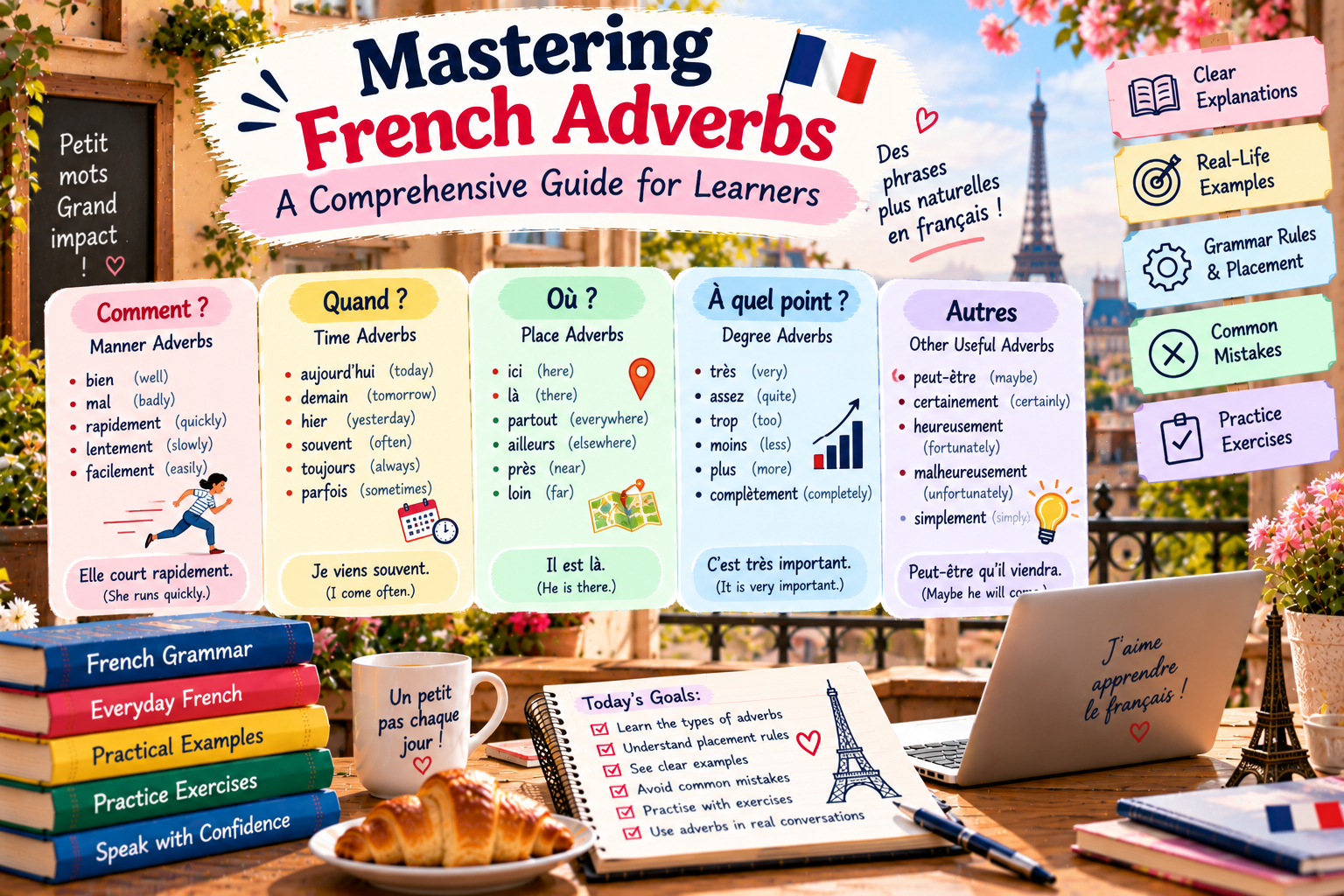
Manner Adverbs (comment?)
These explain how an action happens. Many end in -ment.
- rapidement, lentement, facilement, bien, mal
Examples:
- Il travaille sérieusement. (He works seriously.)
- Elles chantent bien. (They sing well.)
Time Adverbs (quand?)
These situate actions in time.
- aujourd’hui, hier, demain, déjà, bientôt, tard, tôt, encore
Examples:
- Je pars demain. (I leave tomorrow.)
- Il a déjà mangé. (He has already eaten.)
Frequency Adverbs (à quelle fréquence?)
These describe how often something happens, a core set for daily conversations.
- toujours, souvent, parfois, rarement, jamais
Examples:
- Nous sortons souvent. (We go out often.)
- Il ne ment jamais. (He never lies.)
Place Adverbs (où?)
These show where an action occurs.
- ici, là, là-bas, partout, dedans, dehors
Examples:
- Reste ici. (Stay here.)
- Ils voyagent partout. (They travel everywhere.)
Degree Adverbs (à quel degré?)
These express intensity or quantity.
- très, trop, assez, peu, tellement, complètement
Examples:
- C’est très simple. (It is very simple.)
- Il est trop fatigué. (He is too tired.)
Affirmation and Negation
These indicate yes, no, or other shades of certainty.
- oui, non, certainement, sûrement, peut-être, pas
Examples:
- Oui, je comprends. (Yes, I understand.)
- Peut-être qu’il attend. (Maybe he is waiting.)
In PrepFrench Classes, we teach these types through speaking drills, so you learn the meaning and the placement together. You can explore our course list to see how grammar and conversation blend inside each French lesson.
Forming French Adverbs
Most French adverbs of manner are formed from adjectives, often with the -ment ending. Understanding this pattern helps you convert a large set of adjectives into usable adverbs quickly.
General Rules for Formation
- From an adjective ending in a consonant: use the feminine form, then add -ment. Example: lent → lente → lentement.
- From an adjective ending in a vowel: use the masculine form, then add -ment. Example: vrai → vraiment, poli → poliment.
- Adjectives ending in -ant or -ent: replace with -amment or -emment. Examples: constant → constamment, récent → récemment.
- Certain adjectives take -ément: confus → confusément, énorme → énormément, précis → précisément, profond → profondément.
Pronunciation tip: -emment and -amment are usually pronounced the same. Focus on spelling rules while listening to many examples in context during your French lessons.
Key Exceptions
Some very common adverbs are irregular. Learn these early because you will use them often in speech and writing.
- bon → bien
- mauvais → mal
- gentil → gentiment
- bref → brièvement
- meilleur is an adjective, the adverb is mieux
- vite is an adverb, not derived by -ment, it means quickly
Examples of Adverb Formation
| Adjective (masc.) | Feminine (if needed) | Adverb | Note | Example |
|---|---|---|---|---|
| lent | lente | lentement | feminine + -ment | Il marche lentement. |
| vrai | - | vraiment | masculine + -ment | C’est vraiment utile. |
| récent | récente | récemment | -ent → -emment | Il a déménagé récemment. |
| constant | constante | constamment | -ant → -amment | Il progresse constamment. |
| énorme | énorme | énormément | -ément pattern | Ça aide énormément. |
| bon | bonne | bien (irregular) | irregular adverb | Ça sent bien. (It smells nice.) |
| mauvais | mauvaise | mal (irregular) | irregular adverb | Il chante mal. (He sings badly.) |
| gentil | gentille | gentiment (irregular) | irregular adverb | Parle gentiment. (Speak nicely.) |
In PrepFrench online French classes, we practice formation in short speaking bursts, so the rules stick and you use them naturally in conversation. If you want guided correction and real-time feedback, explore our French lessons and book a free demo.
Structured French Courses
Stop learning French the slow way.
Apps and random videos keep you stuck at beginner level forever. PrepFrench Classes gives you a structured path, a real teacher, and speaking practice that moves you forward at every lesson.
Available for: beginners · TEF/TCF exam prep · Canadian PR · work and daily French
Where to Place Adverbs
French adverbs placement is one of the most frequent questions from learners. The good news is that once you master a few core patterns, you will place most adverbs correctly in both simple and compound tenses.
Placement in Simple Tenses
- After the verb for many adverbs of manner, time, and frequency: Je travaille beaucoup. Il mange souvent.
- Before the adjective or adverb they modify: très content, trop vite, assez bien.
- Sentence adverbs often go at the beginning or after the verb: Peut-être qu’il vient. Il vient peut-être.
Examples:
- Elle lit souvent le soir. (She often reads in the evening.)
- Il est très fatigué. (He is very tired.)
- Ils viendront peut-être. (They might come.)
Placement in Compound Tenses
In passé composé and other compound tenses, most short and common adverbs go between the auxiliary and the past participle. Longer adverbs and adverbial phrases usually come after the past participle.
- Common short adverbs inside the auxiliary-participle “sandwich”: bien, mal, déjà, encore, souvent, toujours, trop, assez, beaucoup, presque, sûrement, probablement.
- Longer adverbs after the past participle: Il a parlé rapidement. Nous avons travaillé consciencieusement.
Examples:
- J’ai souvent pensé à toi. (I often thought of you.)
- Il a déjà fini. (He has already finished.)
- Elle a expliqué clairement. (She explained clearly.)
Role of Adverbs in Negation
With negation, ne and pas wrap around the main verb or the auxiliary. Adverbs then adjust accordingly.
- Simple tenses: Je ne parle pas bien. (Adverb comes after pas.)
- Compound tenses: Je n’ai pas encore compris. (encore between auxiliary and participle.)
- Other negatives: plus, jamais, guère, rien, personne follow similar placement rules with the verb or auxiliary.
If you are unsure, read the sentence out loud. If it sounds heavy, move the longer adverb to the end. In our PrepFrench French language classes, we help you internalize these patterns through repetition in real dialogues.
Common Mistakes with French Adverbs
Adverbs bring clarity, yet they are also a source of frequent confusion. Here are the pitfalls learners face most, with quick fixes and examples you can copy.
Bon vs Bien
Bon is an adjective, it modifies a noun. Bien is an adverb, it modifies a verb, an adjective, or another adverb.
- un bon café, une bonne idée (adjective with nouns)
- Elle parle bien. C’est bien fait. (adverb with verbs or as sentence comment)
- Think: bon = quality of a thing, bien = quality of an action or general approval.
Mieux vs Meilleur
Mieux is the comparative adverb of bien. Meilleur is the comparative adjective of bon.
- Il chante mieux. (He sings better.)
- C’est un meilleur café. (This is a better coffee.)
- Shortcut: if it modifies a verb, use mieux. If it modifies a noun, use meilleur.
Special Cases: tout
Tout as an adverb usually does not agree, except before a feminine adjective starting with a consonant or aspirated h. This is a pronunciation-based exception.
- Elle est tout heureuse. (before vowel h, no agreement)
- Elle est toute contente. (feminine adjective starting with a consonant, agreement)
- Elles sont toutes petites. (agreement for euphony)
One more tip: vite and rapidement are close in meaning, but vite is shorter and very frequent in speech. Both are fine, choose based on rhythm and formality.
Practice Exercises for Mastery
Active practice is the fastest route to automaticity. Try the mini-drills below. Speak your answers aloud first, then write them. For more guided practice, join a live French course with PrepFrench Classes.
Fix-the-Error Exercises
- Il parle bon français. → …
- Nous avons mangé souvent ici. → …
- Je ne comprends pas bien jamais. → …
Place-the-Adverb Drills
- (souvent) Ils voyagent en été. → …
- (déjà) Elle a fini. → …
- (peut-être) Il viendra. → …
Choose the Correct Adverb
- Il chante (bon, bien).
- C’est un (meilleur, mieux) plan.
- Elle court (vite, rapidement). Both possible, choose one.
Transform Adjectives to Adverbs
- lent → …
- récent → …
- précis → …
Suggested answers
- Fix: Il parle bien français. Nous avons souvent mangé ici. Je ne comprends jamais bien.
- Placement: Ils voyagent souvent en été. Elle a déjà fini. Peut-être qu’il viendra, or Il viendra peut-être.
- Choice: bien, meilleur, vite or rapidement.
- Formation: lentement, récemment, précisément.
PrepFrench Classes
Ready to start French with a clear plan?
Book a FREE demo class and get a personalized roadmap for your level, goal, and timeline. No pressure, no obligation.
Explore courses:
All French Courses · Full TCF Canada Course · Full TEF Canada Course
FAQ: French Adverbs and How to Use Them
Do French adverbs ever agree in gender/number?
Almost never. Adverbs are invariable in French, unlike adjectives. You will say très grand, très grande, très grands, with très unchanged. The famous exception involves tout used as an adverb before a feminine adjective starting with a consonant or aspirated h, such as toute contente. In most other contexts, tout stays invariable, for example tout heureux, tout intéressant. If you are unsure about agreement, review the sentence and identify whether the word is acting as an adjective or an adverb. In PrepFrench online French classes, we clarify these grey zones with targeted drills.
What’s the difference between bon and bien?
Bon is an adjective, it describes a noun: un bon livre, une bonne idée. Bien is an adverb, it describes actions, adjectives, or other adverbs: Elle danse bien, C’est bien expliqué, très bien. A quick test helps: if the word modifies a noun, choose bon or bonne. If it modifies a verb or functions as a sentence-level comment, choose bien. PrepFrench Classes cover this contrast early because it appears in daily speech. Join a live French course to practice bon vs bien until it becomes automatic.
Where do adverbs go in sentences with passé composé?
Most short and common adverbs go between the auxiliary and the past participle: J’ai déjà mangé, Elle a souvent voyagé, Nous avons bien compris. Longer adverbs and adverbial phrases usually come after the past participle: Il a parlé lentement, Ils ont répondu clairement. In negative sentences, ne and pas surround the auxiliary: Je n’ai pas encore fini, Il n’a jamais bien dormi. If you learn these placement patterns inside a structured French course, you will place adverbs correctly without overthinking.
How are comparatives and superlatives formed for adverbs?
For most adverbs, use plus, moins, or aussi before the adverb for the comparative: Il parle plus vite, Elle travaille aussi sérieusement. The superlative uses le plus or le moins before the adverb: C’est elle qui chante le mieux, Il travaille le plus efficacement. Note the irregular comparative for bien is mieux, and its superlative is le mieux. Inside PrepFrench French lessons, we practice these with quick speaking rounds so you learn the pattern and the rhythm together.
Can I use très with verbs in French?
No. Très modifies adjectives and adverbs, not verbs. You can say très rapide or très bien, but not “très parler.” To intensify a verb, choose an adverb that fits meaning and placement: Il parle bien, Il parle vite, Il parle beaucoup. Another option is a structure like parler très bien, where très modifies bien, not the verb. If you want guided correction to avoid such mistakes, book a free demo with PrepFrench Classes and start with a personalized plan.
Final Thoughts
French adverbs give your sentences shape and precision. By understanding the main types, learning how to form them with -ment, and mastering adverb placement, you can upgrade your fluency quickly. You have seen how adverbs of time, frequency, manner, and degree work in real sentences. You have also seen common pitfalls such as bon vs bien or mieux vs meilleur and how to fix them.
If your goal is to learn French with clarity and momentum, build a habit of noticing adverbs whenever you read or listen. Copy natural patterns into your own speech, then get feedback from a French teacher. PrepFrench Classes provide a structured path, live correction, and targeted drills that make these patterns automatic.
Explore our courses or book a free demo to experience how a guided French course turns grammar points into confident, spontaneous speech.
✅ Next Step: Book a free demo class with PrepFrench Classes and start learning French the right way.
Consistent practice with feedback is the fastest path to mastering French adverbs. Keep a running list by category, read aloud, and recycle new adverbs in short daily sentences.
Written by
Platform Administrator
Practical ideas from the Prep French team for learners building confidence, preparing for exams, and planning their next step in Canada.
Join the discussion
Leave a thoughtful comment.
Your email address will not be published. Comments are reviewed before appearing.