
Exploring Francophone Cultures: A Guide to French-Speaking Communities
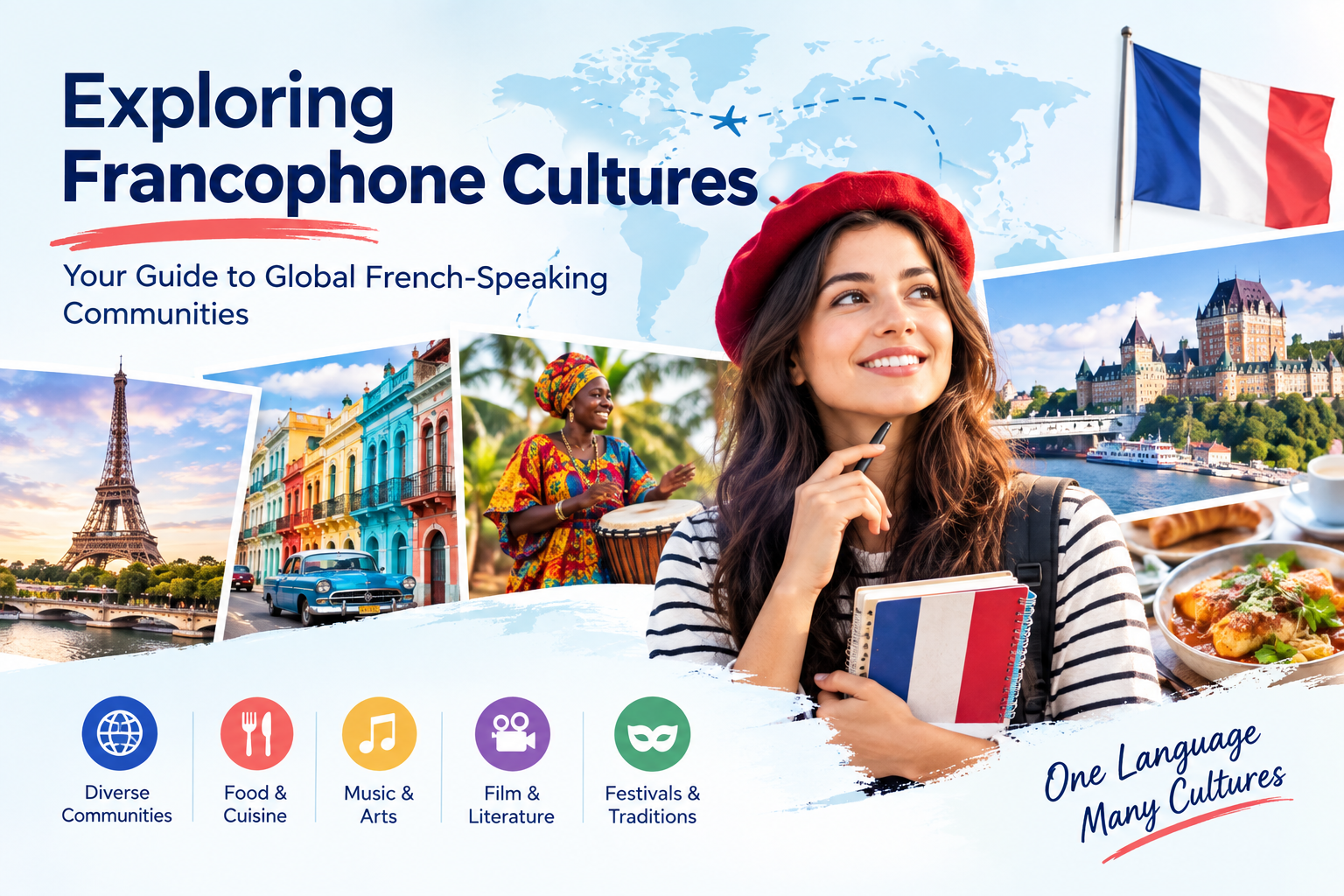
Francophone cultures are far more than a French flag or Parisian café image. They are living, evolving traditions found across Africa, Europe, the Caribbean, North America, and parts of Asia-Pacific, shaped by history and reinvented daily by diverse French-speaking communities. La Francophonie refers to both the global network of people who use French and the international organization that supports collaboration between Francophone countries. If you want to learn French in a way that is meaningful and memorable, understanding Francophone cultures is not optional, it is the heart of real fluency. At PrepFrench, our French classes connect language with context, so you discover how the global French language sounds, looks, and feels in everyday life. In this guide, you will explore where French is spoken today, what “Francophone” really means, and how to engage with the music, food, film, and festivals that make each region unique. Along the way, we will share practical steps and resources you can use right now, whether you study through online French classes, a structured French course, or self-guided immersion.
Free First Step
Take the guesswork out of learning French.
Not sure where to begin, which course fits your goal, or how long it will take? Book a free demo class with PrepFrench Classes and get a personalized plan built around your level, schedule, and goals.
What Does “Francophone” Mean?
Two key terms help orient your journey: Francophone and La Francophonie. Both refer to French speakers worldwide, but they are used in slightly different ways. Understanding them will clarify how language and culture connect across borders and why the global French language remains influential in education, diplomacy, trade, and the arts. At PrepFrench, we often introduce these distinctions early in our French lessons because they shape how students interpret accents, vocabulary choices, and cultural references from different regions. You will also encounter the Organisation internationale de la Francophonie, often shortened to OIF, which coordinates cultural and policy collaboration between member states.
- Francophone: An individual, community, or region that speaks French, whether as a first language, an additional language, or a language of education and public life.
- Francophone cultures: The traditions, arts, cuisines, and social norms of French-speaking communities, shaped by local histories and identities.
- La Francophonie: The international community of French-speaking countries and regions, and the political-cultural organization (OIF) that supports them.
- OIF’s role: Promotes French language education, cultural exchange, human rights, and sustainable development among its member states and observers.
These concepts matter because French is not a single cultural story. It is a bridge language that connects Dakar to Montreal, Port-au-Prince to Brussels, Abidjan to Geneva. If you explore our PrepFrench home page, you will see how our programs and resources integrate La Francophonie into everyday study. Knowing the terms helps you read news beyond France, understand film and music references, and recognize how French adapts within each community.
The Global Landscape of French
French is one of the world’s major languages. According to OIF estimates, there are about 321 million French speakers worldwide, with the largest and fastest-growing populations in Africa. French serves as an official language in parts of Europe, Africa, the Caribbean, and North America, and it remains an important language of diplomacy, higher education, and international business. If your goal is to speak French confidently, seeing the full map helps you choose content and communities that match your interests. If you enroll in a structured French course through PrepFrench Courses, you will notice our lessons often include news clips, music, or short readings from multiple regions, so you learn standard usage while hearing real-world diversity.
| Region | Estimated Share of French Speakers | Examples of Francophone Countries | Notes on Growth |
|---|---|---|---|
| Sub-Saharan Africa | About 50-55% | DR Congo, Senegal, Côte d’Ivoire, Cameroon, Madagascar | Fastest growth due to demographics and education policy |
| North Africa & Middle East | About 15-20% | Morocco, Tunisia, Algeria, Lebanon | Widely used in higher education and business |
| Europe | About 18-20% | France, Belgium, Switzerland, Luxembourg, Monaco | Stable, high-proficiency regions |
| Americas & Caribbean | About 8-10% | Canada (Quebec, New Brunswick), Haiti | Stable to moderate growth in Canada and diaspora |
| Asia & Oceania | About 1-2% | Vietnam, Laos, Cambodia, Vanuatu, New Caledonia | Smaller communities, strong cultural ties |
Wherever you live, you can tailor your practice to these regions. Choose podcasts from Dakar, films from Quebec, or news from Brussels. And if your plan later includes standardized tests, PrepFrench also offers focused paths for goals like TCF Canada, yet we always keep culture at the center so that your French feels human, not mechanical.
Dive Into Francophone Cultures Around the World
Music, cinema, literature, and food are the quickest ways to feel at home inside a language. Below is a tour of Francophone cultures that shows why “learning French” really means learning many worlds at once.
Francophone cultures in Africa
Across Sub-Saharan Africa, French often serves as a lingua franca in multilingual countries. The result is explosive creativity in music and film, with global reach. Congolese rumba and ndombolo fill dance floors, Ivorian coupé-décalé and Senegalese mbalax carry local rhythms, and artists from Mali to Cameroon lead Afropop charts. Cinema is equally dynamic, with major directors and vibrant festivals.
- Key festivals: FESPACO in Ouagadougou, Carthage Film Festival in Tunis.
- What to taste: Yassa poulet (Senegal), attiéké with fish (Côte d’Ivoire), poulet DG (Cameroon).
- Reading ideas: Alain Mabanckou, Léonora Miano, Scholastique Mukasonga.
Quebec and the wider Canadian Francophonie
Quebec’s culture blends North American energy with a strong French heritage. You will hear distinct accents, see bilingual signage, and meet a thriving film and music scene. Beyond Quebec, Acadian and Franco-Ontarian communities sustain rich traditions too.
- Major events: Festival International de Jazz de Montréal, Les Francos de Montréal, Carnaval de Québec.
- Food to try: Poutine, tourtière, sugar-shack maple treats in late winter.
- Artists and authors: Cœur de pirate, Les Cowboys Fringants, Dany Laferrière, Michel Tremblay.
Caribbean Francophone traditions
Haiti, Guadeloupe, and Martinique bring Caribbean rhythms, Afro-diasporic heritage, and French language together. Haitian literature is globally celebrated, kompa and mizik rasin drive dance culture, and carnival season bursts with color and satire.
- Festivals and styles: Kompa music, Labadee and Jacmel carnival traditions, creole food fusions.
- Voices to read: Edwidge Danticat, Frankétienne, Patrick Chamoiseau.
- Signature dishes: Griot with pikliz, accras, Colombo curry blends.
Unique features of European Francophonie
France is only part of Europe’s Francophone picture. Belgium’s Wallonia and Brussels, Switzerland’s Romandie, and Luxembourg all enrich the language with their own idioms and media. From bandes dessinées culture to regional cuisines, you can travel a long way without leaving French behind.
- Events to note: Angoulême International Comics Festival, Cannes Film Festival, Montreux Jazz Festival.
- Regional tastes: Belgian waffles and carbonnade, Swiss fondue and papet vaudois, Provençal bouillabaisse.
- Writers and filmmakers: Amélie Nothomb (Belgium), Jean-Luc Godard (Switzerland), Leïla Slimani (France).
PrepFrench integrates these cultural lenses into lessons, so you can speak French and also recognize references to songs, dishes, or film scenes that native speakers love to quote. If you want classes that bring culture alive, explore our online French classes that pair language skills with curated cultural content.
Structured French Courses
Stop learning French the slow way.
Apps and random videos keep you stuck at beginner level forever. PrepFrench Classes gives you a structured path, a real teacher, and speaking practice that moves you forward at every lesson.
Available for: beginners · TEF/TCF exam prep · Canadian PR · work and daily French
Variations of French in Different Regions
The French language carries local flavors. You will hear shifts in vowel quality, rhythm, and vocabulary that signal where a speaker is from. These variations reflect migration, contact with other languages, and centuries of history. Embracing them does not confuse learners, it accelerates listening skills and cultural literacy. In our French language classes at PrepFrench, we introduce regional voices early, then show you how to navigate differences so your confidence grows anywhere you meet French speakers.
Quebec French vs. France French
Quebec French and Metropolitan French share grammar and a standard written form, but everyday speech differs in pronunciation and vocabulary.
- Vocabulary: “magasiner” (to shop) in Quebec vs. “faire du shopping” or “faire les magasins” in France. “Fin de semaine” in Quebec vs. “week-end” in France. “Char” for car in Quebec vs. “voiture” in France.
- Pronunciation: Quebec French often has more pronounced diphthongs and a different “t” and “d” before high vowels, which you will notice in informal speech.
- Register: Informal Quebec expressions like “c’est plate” (that is boring) or “je suis tanné” (I am fed up) are very common in daily life.
How to adapt: start with standard pronunciation for clarity, then tune your ear with Quebec podcasts and series. PrepFrench teachers provide listening drills that highlight exactly what to expect, so you are never surprised by a new accent.
Haitian Creole and its distinctions from French
Haitian Creole (Kreyòl Ayisyen) is a distinct language, not a “dialect” of French. It has a largely French-derived lexicon but its own grammar, phonology, and orthography.
- Grammar: No gender agreement like French. Tense-aspect markers such as “ap” (progressive), “te” (past), and “pral” (future/going to) clarify time.
- Pronunciation: Spelling is phonetic, which makes reading straightforward once rules are learned.
- Usage: Creole carries Haiti’s national identity, while French is used in administration and some education contexts.
For learners, exposure to both French and Haitian Creole improves comprehension in the Caribbean context and deepens respect for linguistic diversity.
Other regional notes: In West and Central Africa, you will hear French blended with local rhythms of speech and idioms such as “ça va aller” to express reassurance. In the Maghreb, frequent code-switching with Arabic is common in casual conversations. Recognizing these patterns helps you stay flexible when you speak French with people from different backgrounds.
Need a guided way to navigate accents and registers? Our French courses include region-aware listening practice and conversation strategies that keep you relaxed and effective, no matter the variety you encounter.
Practical Ways to Engage with Francophone Cultures
You do not need a plane ticket to start experiencing Francophone cultures. With a few intentional habits, your routine can become a cultural immersion program.
- Explore through music and film: Build playlists with Congolese rumba, Malian desert blues, Quebec indie, and Haitian kompa. Watch films from Burkina Faso, Belgium, and Quebec. Switch on subtitles in French to grow vocabulary.
- Follow Francophone media: Rotate radio and news from France, Belgium, Switzerland, Senegal, and Canada. You could try culture segments, sports talk, or youth programs to hear informal language.
- Read widely: Mix contemporary novels, bandes dessinées, and short stories. Try Aya de Yopougon (Marguerite Abouet), La vie devant soi (Romain Gary), or works by Leïla Slimani and Dany Laferrière.
- Cook the culture: Dedicate one weekend a month to a regional menu, such as yassa poulet, poutine night, or accras with a Caribbean salad. Learn the food words as you cook.
- Engage locally: Join events by Alliance Française or campus Francophone clubs. Offer to volunteer at film nights or conversation cafés. Real community time amplifies your speaking skills.
- Attend festivals and events: Look for Francophone film weeks, jazz concerts, and Francophonie month activities in March. Many cities host pop-up markets and tastings.
- Study with structure: Pair this cultural routine with a teacher. Book a free planning session through our contact page to map your interests to a weekly plan that fits your schedule.
Culture keeps your motivation high and your memory strong. When your playlist and pantry change, your French changes with them. PrepFrench Classes simply organizes the path so momentum never fades.
FAQs About Francophone Cultures
What’s the difference between Francophone and La Francophonie?
Francophone describes people, communities, or regions that speak French. La Francophonie refers to the international community of French-speaking countries and the OIF, the organization that promotes cooperation among them. In other words, Francophone is about speakers and cultures, while La Francophonie is the network and institution. When you learn French with PrepFrench, we expose you to both: the day-to-day language used in different places and the cultural projects supported by La Francophonie. This context makes your French lessons more practical and meaningful.
How many people speak French today, and where is it growing fastest?
OIF estimates suggest around 321 million French speakers worldwide. The largest growth is in Sub-Saharan Africa, where demographics and education policies drive expansion. Europe remains a stronghold with high proficiency, and Canada anchors North America’s Francophonie. If you plan to learn French through online French classes, balancing European media with African and Canadian content will boost your listening range. PrepFrench Courses include regionally diverse materials so you develop an ear for real accents and everyday phrases used across continents.
Which countries have French as an official language?
French is official in countries across Europe (France, Belgium, Switzerland, Luxembourg, Monaco), Africa (DR Congo, Senegal, Côte d’Ivoire, Cameroon, Madagascar, and more), and the Americas (Canada and Haiti). It also has status in territories such as French Polynesia and New Caledonia, and it is widely used in North Africa. If you are choosing a French course, consider your cultural interests too. PrepFrench Classes can tailor reading, listening, and conversation topics toward the region you care about so that you stay engaged and learn faster.
How do Francophone cultures differ across Africa, Europe, Canada, and the Caribbean?
Each region has its own sound, social rhythms, and artistic signatures. African Francophone cultures feature energetic music scenes and major film festivals. Europe brings deep literary traditions and regional cuisines. Canada blends North American life with strong bilingual identity and world-class festivals. The Caribbean highlights Creole influences, carnival culture, and bold flavors. Studying these differences enriches your vocabulary and cultural intuition. In PrepFrench French lessons, we use short cultural segments so you absorb context while practicing grammar, pronunciation, and conversation strategies.
Is Haitian Creole the same as French?
No. Haitian Creole is a distinct language with a French-derived lexicon but its own grammar and phonetic spelling. It uses tense-aspect markers such as “ap,” “te,” and “pral,” and it does not follow French gender agreement. In Haiti, both French and Creole carry cultural value. If you learn French for travel or community engagement, recognizing the difference will help you communicate respectfully. PrepFrench teachers can guide you on basic Creole awareness while keeping your main focus on effective French for real situations.
PrepFrench Classes
Ready to start French with a clear plan?
Book a FREE demo class and get a personalized roadmap for your level, goal, and timeline. No pressure, no obligation.
Explore courses:
All French Courses · Full TCF Canada Course · Full TEF Canada Course
Final Thoughts: Learning the French Language Through Culture
Francophone cultures are a network of voices that make the French language vivid and personal. When you study with a cultural lens, vocabulary sticks, pronunciation improves, and conversations open new doors. From African pop to Quebec literature, from Caribbean carnivals to European film, each region offers a different entry point. The smartest learners do not chase “perfect” accents, they build flexible ears and confident habits.
PrepFrench Classes are designed to make this practical. We combine structured grammar, guided speaking practice, and curated cultural content so that progress feels natural. If your goals include conversation for travel, study, or work, a culture-first approach will take you there faster. Start with one region that fascinates you, then gradually expand. Your French will become a tool for real connection, not just a subject to memorize.
Want a plan that matches your level and interests? Our teachers can map out a weekly routine that blends media, speaking drills, and cultural exploration. You bring the curiosity, and we will bring the structure.
✅ Next Step: Book a free demo class with PrepFrench Classes and start learning French the right way.
Cultural understanding is not a bonus in language learning, it is the engine. Choose one small action from this guide today and make it a habit. Your French will thank you.
Written by
Platform Administrator
Practical ideas from the Prep French team for learners building confidence, preparing for exams, and planning their next step in Canada.
Join the discussion
Leave a thoughtful comment.
Your email address will not be published. Comments are reviewed before appearing.