Animals in French: Vocabulary, Pronunciation & Examples
Learning animals in French is a fast way to grow your everyday French vocabulary. These words come up in small talk, travel, kids’ books, documentaries, zoos, farms, and national parks. This complete guide brings together practical French animal vocabulary with pronunciation tips, gender and plural rules, baby animal names, sounds animals make, and a special spotlight on Canadian wildlife terms you will actually hear in Quebec and across Canada. You will also find clear example sentences, so you know how to use each word right away. If you want a structured push, PrepFrench Classes offers step‑by‑step French courses and live online French classes to help you learn French faster and speak with confidence.
In this guide, you will get: a categorized list of essential animal names in French with gender and plurals, the must‑know grammar behind masculine and feminine forms, how French plurals work for animals, male and female name pairs, baby animals, and animal sounds. We close with a focused list of Canadian species, so you can confidently talk about moose, beavers, and more in French. Use it as a reference, or study it step by step along with your French lessons. If you are new to PrepFrench, start at our homepage for more helpful resources.
Free First Step
Take the guesswork out of learning French.
Not sure where to begin, which course fits your goal, or how long it will take? Book a free demo class with PrepFrench Classes and get a personalized plan built around your level, schedule, and goals.
Must-Know Animal Vocabulary
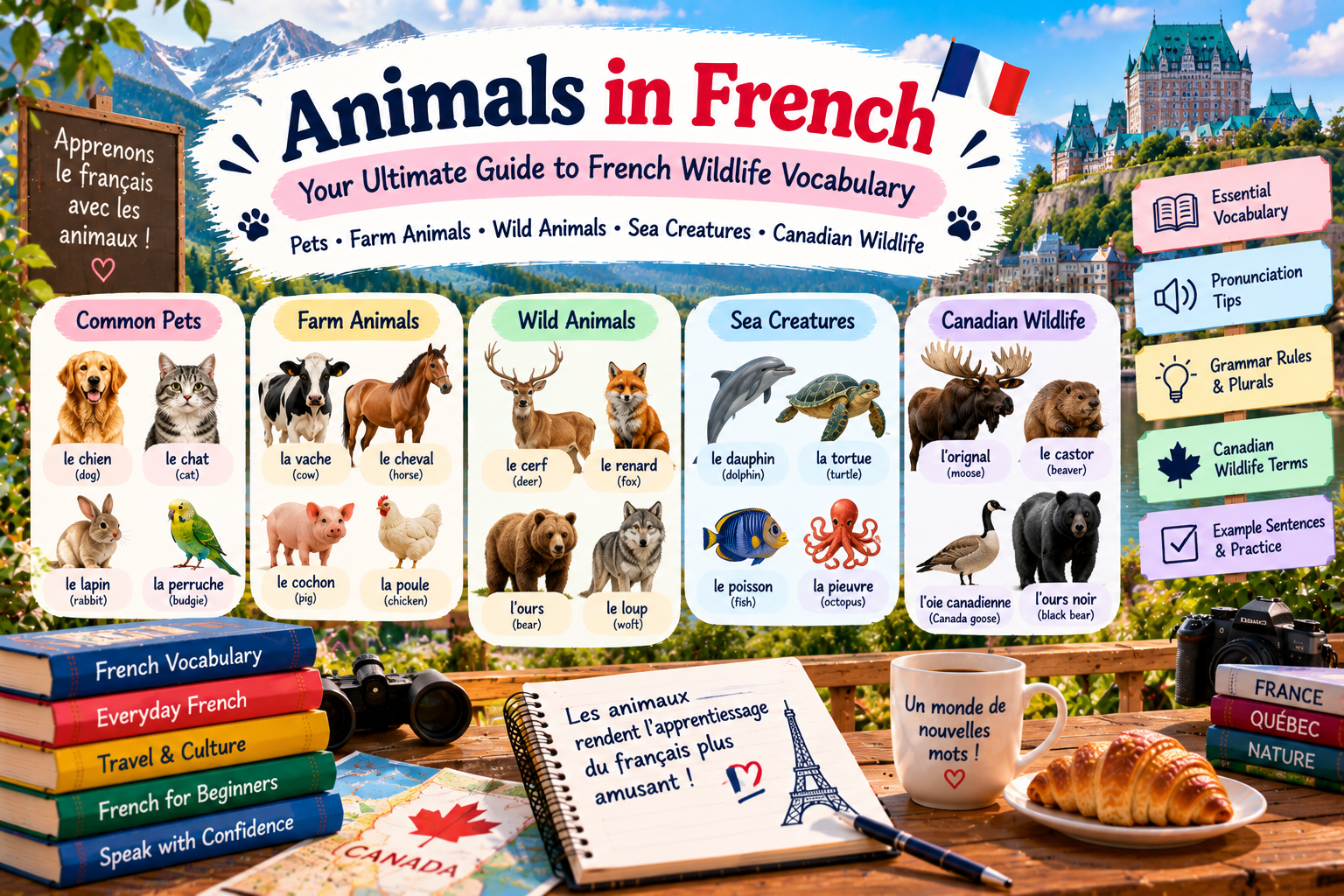
Start with 30 essential animal names in French, grouped by pets, farm animals, wild animals, and sea creatures. Each item shows the article for grammatical gender and the plural form. Pronunciation hints are given in brackets with simple English sounds. For full audio practice and teacher feedback, join our live French classes inside PrepFrench.
Common Pets
- le chien [shyen], pl. les chiens: dog
- le chat [sha], pl. les chats: cat
- la chatte [shat], pl. les chattes: female cat
- le lapin [la-pan], pl. les lapins: rabbit
- le hamster [am-stair], pl. les hamsters: hamster
- la tortue [tor-ty], pl. les tortues: turtle
- le poisson rouge [pwah-son roozh], pl. les poissons rouges: goldfish
- la perruche [peh-roosh], pl. les perruches: budgie
Farm Animals
- la vache [vash], pl. les vaches: cow
- le taureau [toh-ro], pl. les taureaux: bull
- le cheval [shuh-val], pl. les chevaux: horse
- le cochon [ko-shon], pl. les cochons: pig
- la truie [trwee], pl. les truies: sow
- la poule [pool], pl. les poules: hen
- le coq [kok], pl. les coqs: rooster
- le canard [ka-nar], pl. les canards: duck
- l’oie [lwa], pl. les oies: goose
- le mouton [moo-ton], pl. les moutons: sheep
- la chèvre [shev-r], pl. les chèvres: goat
- la dinde [dand], pl. les dindes: turkey (female)
Wild Animals
- le loup [loo], pl. les loups: wolf
- le renard [ruh-nar], pl. les renards: fox
- l’ours [oors], pl. les ours: bear
- le cerf [ser], pl. les cerfs: deer (stag)
- la biche [beesh], pl. les biches: doe
- le sanglier [san-glee-yay], pl. les sangliers: wild boar
- l’écureuil [ay-kuh-roy], pl. les écureuils: squirrel
- le lion [lee-on], pl. les lions: lion
- le tigre [teeg-r], pl. les tigres: tiger
- l’éléphant [ay-lay-fon], pl. les éléphants: elephant
Birds in French
- l’oiseau [wah-zo], pl. les oiseaux: bird
- le hibou [ee-boo], pl. les hiboux: owl
- l’aigle [eg-l], pl. les aigles: eagle
- la mouette [mou-et], pl. les mouettes: seagull
Sea Creatures
- la baleine [ba-len], pl. les baleines: whale
- le dauphin [do-fan], pl. les dauphins: dolphin
- le requin [ruh-kan], pl. les requins: shark
- le phoque [fok], pl. les phoques: seal
- le morse [mors], pl. les morses: walrus
- la pieuvre [pyoev-r], pl. les pieuvres: octopus
- la méduse [may-duz], pl. les méduses: jellyfish
- le crabe [krab], pl. les crabes: crab
- le homard [o-mar], pl. les homards: lobster
- le poisson [pwah-son], pl. les poissons: fish
Tip: In conversation, many animal nouns can be made specific with “mâle” or “femelle” when needed, for example: un ours mâle, une tortue femelle. For guided practice with audio and speaking drills, explore our interactive French course options.
Understanding Gender and Plurals in French
Animal names in French follow the same grammar rules as other nouns: each noun has a grammatical gender, masculine or feminine, and plurals follow common patterns with a few irregular cases. Learning these patterns helps you form correct phrases, choose the right articles and adjectives, and make your French sound effortless.
Basic Rules
- Gender is part of the word itself. You learn the article with the noun: le chien (masculine), la vache (feminine).
- To refer to a female animal with a masculine base word, either the word has a dedicated feminine form, or you add femelle: le chat, la chatte, une girafe femelle.
- Regular plurals: add -s to the noun: le tigre, les tigres. The article also becomes plural: le or la becomes les.
- Adjectives agree in gender and number with the animal: un grand cheval, de grandes vaches.
Common Exceptions
- -al to -aux in the plural: le cheval, les chevaux. Keep this in mind with several animals and other nouns ending in -al.
- -eau to -eaux: le taureau, les taureaux. Same pattern appears in many everyday nouns.
- -ou sometimes becomes -oux: le hibou, les hiboux. Only a small set of -ou words take -oux in plural. Hibou is one of them.
- Animal to animals: un animal, des animaux. This irregular pattern is frequent in French: -al to -aux, plus an x for plural spelling.
- Words that do not change in plural sound: even if you write an -s or -x, the pronunciation often stays the same in plural, for example ours and ours, renard and renards. Listen for liaison with articles to hear the plural.
How to apply this when speaking: say the article first, check if the noun has a known irregular plural, then adjust the adjective ending. For example: un loup gris, des loups gris. Another example: un cheval blanc, des chevaux blancs. With practice, these patterns become automatic. If you want structured drills on gender and plural agreement, book a free demo to see how we train this inside PrepFrench Classes, or browse our French lessons by level.
Male and Female Animal Names
Some animals in French have distinct words for the male and the female. Others use a base word with a feminine ending, or the same word plus “mâle” or “femelle.” Knowing the most common pairs is useful for stories, news, and documentaries.
Frequently Used Pairs
- le lion, la lionne: lion, lioness
- le tigre, la tigresse: tiger, tigress
- le chat, la chatte: tomcat, female cat
- le chien, la chienne: dog, female dog
- le coq, la poule: rooster, hen
- le taureau, la vache: bull, cow
- le bélier, la brebis: ram, ewe
- le bouc, la chèvre: he-goat, she-goat
- le cerf, la biche: stag, doe
- le cheval, la jument: stallion, mare
- le canard, la cane: drake, duck
- l’ours, l’ourse: male bear, female bear
- le dindon, la dinde: male turkey, female turkey
Unique Cases
- Mouton can refer to sheep in general, while brebis refers specifically to a female sheep.
- Porc can refer to pig in general, truie is a sow. For a piglet, use porcelet.
- Chèvre often covers the species, but bouc is the male. In speech, speakers often clarify with mâle or femelle: une chèvre femelle.
Usage examples:
- Cette lionne protège ses petits. She-lion protects her cubs.
- Le bélier est séparé des brebis. The ram is separated from the ewes.
- Ils ont deux chiens, un mâle et une femelle. They have two dogs, a male and a female.
Want to practice with real dialogues and feedback from a French teacher? Our structured French course plans include conversation labs focused on practical usage like this.
Structured French Courses
Stop learning French the slow way.
Apps and random videos keep you stuck at beginner level forever. PrepFrench Classes gives you a structured path, a real teacher, and speaking practice that moves you forward at every lesson.
Available for: beginners · TEF/TCF exam prep · Canadian PR · work and daily French
Baby Animal Vocabulary
Baby animal names are frequent in stories, family conversations, and at the farm or zoo. They also appear in news and nature documentaries. Learn the core set below, then try them in short phrases. Note: many baby animal names are masculine in form, regardless of the baby’s biological sex, so match adjectives to the grammatical gender of the noun.
Common Baby Animals
- le chiot [sho], pl. les chiots: puppy
- le chaton [sha-ton], pl. les chatons: kitten
- l’ourson [oor-son], pl. les oursons: bear cub
- le lionceau [lyon-so], pl. les lionceaux: lion cubs
- l’agneau [a-nyo], pl. les agneaux: lamb
- le veau [vo], pl. les veaux: calf
- le porcelet [por-se-lay], pl. les porcelets: piglet
- le poulain [poo-lan], pl. les poulains: foal
- le caneton [ka-nuh-ton], pl. les canetons: duckling
- le poussin [poo-san], pl. les poussins: chick
- l’oisillon [waz-ee-yon], pl. les oisillons: fledgling
- le faon [fan], pl. les faons: fawn
- le louveteau [loov-to], pl. les louveteaux: wolf cub
- le marcassin [mar-ka-san], pl. les marcassins: wild boar piglet
- le baleineau [ba-lay-no], pl. les baleineaux: whale calf
Practical Usage in Context
- Au parc, les enfants regardent les canetons. At the park, the children watch the ducklings.
- Le berger soigne un agneau blessé. The shepherd cares for an injured lamb.
- Au zoo, on a vu deux lionceaux. At the zoo, we saw two lion cubs.
- Cette ferme élève des veaux au printemps. This farm raises calves in spring.
Practice tip: read the list aloud, then create simple sentences in the present tense using il y a and on. This builds automaticity. If you want feedback on pronunciation and sentence rhythm, book a free demo class with PrepFrench Classes and we will guide you through it.
Animal Sounds and Their Expressions
Talking about animals in French often includes their sounds. French uses dedicated verbs for animal cries and fun onomatopoeias. Learning both helps with pronunciation and brings your French to life in stories and small talk.
Examples of Animal Sounds
- Le chien aboie [a-bwa]. Onomatopoeia: ouaf ouaf or ouah ouah.
- Le chat miaule [mee-ol]. Onomatopoeia: miaou.
- Le coq chante. Onomatopoeia: cocorico.
- La poule caquette. Onomatopoeia: cot cot.
- La vache meugle [mœ-gl]. Onomatopoeia: meuh.
- Le mouton bêle [bel]. Onomatopoeia: bêê.
- Le cheval hennit [ay-nee]. Onomatopoeia: hiii.
- Le cochon grogne [gron-yuh]. Onomatopoeia: grouik or groin groin.
- Le canard nasille or cancane. Onomatopoeia: coin coin.
- La grenouille coasse [ko-as]. Onomatopoeia: croa croa.
- Le hibou hulule [oo-lul]. Onomatopoeia: hou hou.
- Le loup hurle [url]. Onomatopoeia: ouh ouh.
- Les oiseaux gazouillent [ga-zoo-y]. English sense: birds chirp.
- L’abeille bourdonne [boor-don]. Onomatopoeia: bzzz.
- Le lion rugit [roo-zhee]. Onomatopoeia: rraah.
Using Sounds in Sentences
- Le chien du voisin aboie toute la nuit. The neighbor’s dog barks all night.
- On entend les grenouilles qui coassent près du lac. You can hear frogs croaking by the lake.
- Au petit matin, le coq chante: cocorico. At dawn, the rooster crows: cock‑a‑doodle‑doo.
- Quand il pleut, les canards font coin coin. When it rains, the ducks go quack quack.
Pronunciation tip: focus on the verb endings in the present tense, then add the onomatopoeia for fun. This builds ear training and muscle memory. Our online French classes include sound-focused drills that make French pronunciation much easier.
Spotlight on Canadian Wildlife
If you plan to travel, study, or live in Canada, knowing animals in French with Canadian usage is essential. Quebec media, parks, and museums use specific terms. Here are common species and expressions you will hear from Montreal to the Yukon.
Common Canadian Species
- l’orignal [o-ree-nyal], pl. les orignaux: moose (Canadian French standard)
- le caribou [ka-ree-boo], pl. les caribous: caribou
- le castor [kas-tor], pl. les castors: beaver
- le raton laveur [ra-ton la-vœr], pl. les ratons laveurs: raccoon
- la mouffette [moof-et], pl. les mouffettes: skunk
- le porc-épic [por-kay-peek], pl. les porc-épics: porcupine
- le lynx [lanks], pl. les lynx: lynx
- le glouton [gloo-ton], pl. les gloutons: wolverine (also carcajou in Quebec usage)
- le harfang des neiges, pl. les harfangs des neiges: snowy owl
- l’ours polaire, pl. les ours polaires: polar bear
- le béluga [bay-loo-ga], pl. les bélugas: beluga whale
- la bernache du Canada, pl. les bernaches du Canada: Canada goose
Contextual Usage
- Attention aux orignaux sur la route la nuit. Watch out for moose on the road at night.
- On a vu un castor construire un barrage. We saw a beaver building a dam.
- Au parc national, on peut observer des caribous. In the national park, you can observe caribou.
- La bernache du Canada migre en automne. The Canada goose migrates in autumn.
- Les bélugas sont protégés dans le Saint-Laurent. Belugas are protected in the St. Lawrence.
Regional note: outside Canada, “élan” can be used for moose. In Canadian French, orignal is the frequent term. If you want lessons tailored to Canadian life and culture, ask about our Canada‑focused modules when you contact PrepFrench through the demo form.
PrepFrench Classes
Ready to start French with a clear plan?
Book a FREE demo class and get a personalized roadmap for your level, goal, and timeline. No pressure, no obligation.
Explore courses:
All French Courses · Full TCF Canada Course · Full TEF Canada Course
FAQ: Animals in French
What is the plural of “animal” in French?
The plural of animal in French is animaux: un animal, des animaux. It follows a common pattern where many nouns ending in -al switch to -aux in the plural. You see this in cheval to chevaux and journal to journaux. When you study French vocabulary, always learn the singular with its article and note any irregular plural at the same time. PrepFrench Classes builds this into our beginner French lessons, so you develop the habit of saying le or la, then the plural form with les plus the right ending. This makes agreement and sentence building much easier when you speak French.
How do I know if an animal name is masculine or feminine in French?
Gender is part of the word, so learn it with the article: le or la. Some animals have a dedicated feminine form, like le lion and la lionne. Others use the same base word with “mâle” or “femelle,” for example une girafe femelle. A few useful patterns help, yet there are many exceptions, so exposure and repetition matter. In our online French classes, we train learners to always say the article with the noun, plus a sample phrase. Example: la vache noire, les vaches noires. This habit improves your accuracy with French grammar and adjective agreement quickly.
Can you provide examples of male and female animal names in French?
Yes. Common pairs include: le lion, la lionne; le tigre, la tigresse; le chien, la chienne; le chat, la chatte; le coq, la poule; le taureau, la vache; le bélier, la brebis; le bouc, la chèvre; le cerf, la biche; le cheval, la jument; le canard, la cane; l’ours, l’ourse; le dindon, la dinde. Where there is no distinct feminine term, add femelle: un panda mâle, une tortue femelle. Our structured French course includes speaking practice with these pairs, so you can use them naturally in conversation and narratives when you learn French with PrepFrench.
What are common baby animal names in French?
Core baby animal names include: le chiot (puppy), le chaton (kitten), l’agneau (lamb), le veau (calf), le porcelet (piglet), le poulain (foal), le caneton (duckling), le poussin (chick), l’ourson (bear cub), le lionceau (lion cub), le louveteau (wolf cub), le faon (fawn), l’oisillon (fledgling), le marcassin (wild boar piglet), le baleineau (whale calf). These terms are common in children’s books and at farms and zoos. In PrepFrench Classes, you will practice these with sentence frames, for example: On observe des canetons au lac or Le berger soigne un agneau blessé, so you can speak French more fluently in real contexts.
What are the typical sounds animals make in French?
French uses specific verbs and onomatopoeias for animal sounds. Examples: le chien aboie, ouaf ouaf; le chat miaule, miaou; le coq chante, cocorico; la poule caquette, cot cot; la vache meugle, meuh; le mouton bêle, bêê; le cheval hennit, hiii; le cochon grogne, grouik; le canard cancane, coin coin; la grenouille coasse, croa; le hibou hulule, hou hou; le loup hurle, ouh; les oiseaux gazouillent; le lion rugit. Learning both the verb and the sound boosts memory and pronunciation. In our French lessons, we use these fun pairs as a quick drill, which helps learners move from passive vocabulary to active speaking.
Final Thoughts
Mastering animals in French strengthens your everyday French vocabulary and helps you talk about nature, family life, kids’ stories, and travel experiences. The key is to learn each noun with its article, remember plural patterns, and know the most common male and female pairs. Add baby animal names and sounds to round out your French wildlife vocabulary, then practice them aloud with simple sentences.
If you prefer a guided path, PrepFrench Classes gives you structured practice and expert feedback on French pronunciation, grammar, and usage. Combine this article with real speaking time and you will notice faster, more confident progress as you learn French. Browse our courses or book a demo to see which plan fits your goals.
✅ Next Step: Book a free demo class with PrepFrench Classes and start learning French the right way.
Keep exploring: add five new animal words a day, say them with articles and sample sentences, and review them aloud. Small, steady steps compound quickly.
Written by
Platform Administrator
Practical ideas from the Prep French team for learners building confidence, preparing for exams, and planning their next step in Canada.
Join the discussion
Leave a thoughtful comment.
Your email address will not be published. Comments are reviewed before appearing.