
TCF Canada Reading Practice with Authentic French Texts
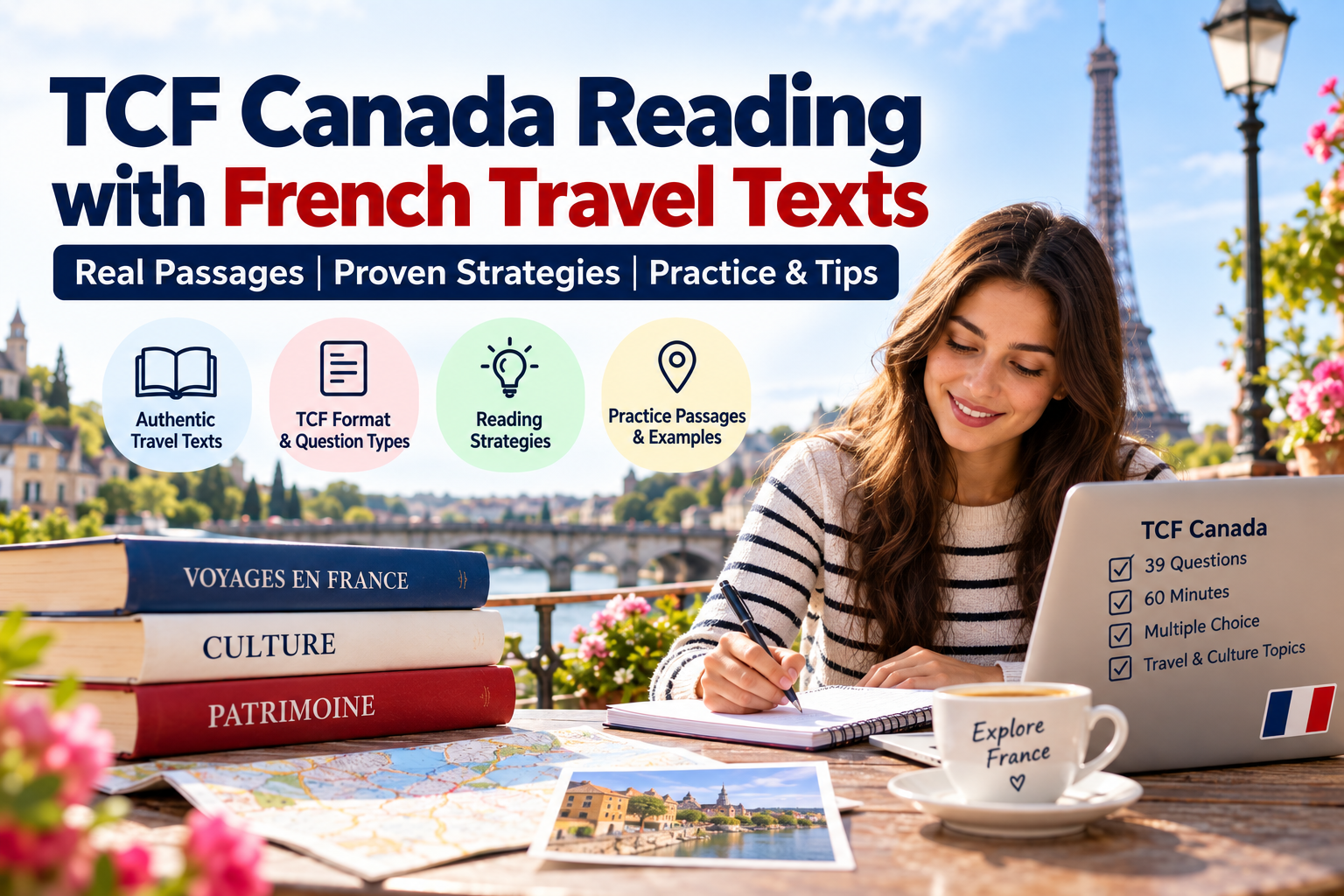
Preparing for the TCF Canada reading test can feel abstract until you bring the language to life. Authentic travel articles about hidden gems in France give you that real-world context, while mirroring the tone, structure, and question types you will meet in the exam. In this guide, you will learn how to transform travel and culture texts into strategic TCF reading practice that builds speed, accuracy, and confidence.
The TCF Canada Reading section requires fast scanning, careful inference, and a broad vocabulary drawn from everyday topics. Travel pieces are perfect: they mix descriptions, practical information, and subtle opinions in formats that echo exam passages. From short notices and museum blurbs to editorial-style features about French regions, you can train with texts that match the exam’s variety.
We will walk through the TCF Canada exam format, practical strategies that actually raise your score, and curated reading ideas featuring under-the-radar French destinations. You will also find mini practice passages that simulate real questions. If you want structured help, PrepFrench offers targeted French classes and a dedicated Full TCF Canada Course that integrates authentic reading materials, vocabulary building, and timed drills.
Free First Step
Take the guesswork out of learning French.
Not sure where to begin, which course fits your goal, or how long it will take? Book a free demo class with PrepFrench Classes and get a personalized plan built around your level, schedule, and goals.
Understanding the TCF Canada Reading Test
Overview of Test Format
The TCF Canada Reading section evaluates your ability to understand written French across a range of everyday themes. It is fully multiple choice, which means you must select the best answer, not produce one from scratch.
- Duration: 60 minutes
- Number of questions: 39 multiple-choice questions
- Question types: short notices, practical information, descriptive paragraphs, opinions, and longer editorial-style texts
- Topics: daily life, travel and culture, services and schedules, advertisements, websites, announcements, and extracts from media
Official details about the TCF format and scoring are published by France Éducation international. For the latest updates, see their overview pages: France Éducation international.
Skills Assessed in Reading
Beyond vocabulary, the TCF Canada exam format tests how fast and accurately you can work with a variety of text types. It checks whether you can identify main ideas, find specific details quickly, and recognize tone or intention.
- Global understanding: recognize topic, purpose, and main argument
- Detail location: scan for names, dates, figures, or place references
- Inference: deduce implied meaning and identify the writer’s stance
- Pragmatics: interpret signs, instructions, schedules, and public notices
- Lexical flexibility: handle synonyms, paraphrases, and unfamiliar words
To build these skills efficiently, your practice should include short functional texts and longer features. That blend creates the same mental switch the exam expects: from quick, targeted scanning to more careful analytical reading.
Levels and Scoring
TCF Canada aligns with CEFR levels from A1 to C2. Your reading performance contributes to your overall language profile, which may be mapped to Canadian Language Benchmarks for immigration or study goals.
- CEFR levels tested: A1 to C2
- Reported result: a level band for Reading, reflecting your score range
- What it means: the test adapts across difficulties, so you may see both simple notices and complex opinion pieces
PrepFrench Classes design their Full TCF Canada Course to mirror this progression. You practice at the right level first, then stretch upward through graded authentic texts, timed sets, and teacher-reviewed strategies.
Why Authentic Travel Texts?
Travel articles and cultural notes are ideal for French reading comprehension practice with authentic texts. They are engaging, full of real-life vocabulary, and written in the same informational or editorial styles you will see in the TCF Reading section. Most importantly, they keep motivation high, which leads to more practice and better retention.
Connect Exam Skills with Real Life
Travel content forces you to do exactly what the TCF asks: catch the gist, recognize specific details, interpret attitudes, and follow practical information. In one short article about a village trail, you might meet opening hours, ticket prices, and a short description of architecture, all of which parallel exam-style questions.
- Public notices: museum schedules, transport updates, guided tour times
- Descriptive passages: landscapes, food specialties, regional crafts
- Opinion signals: recommendations, comparisons, pros and cons
As you work through these text types, you train the same reading muscles that the TCF Canada reading test measures.
Building Vocabulary through Travel
Travel topics pack a rich mix of high-frequency words and useful phrases. You see concrete nouns (ruelle, sentier, remparts), practical verbs (accéder, réserver, découvrir), and connectors (toutefois, en revanche, d’ailleurs). These recur across articles, so you absorb them through repetition in meaningful contexts.
- Places and heritage: abbaye, bastide, belvédère, patrimoine
- Activities: randonnée, dégustation, balades en vélo, visite guidée
- Logistics: horaires, tarifs, réservation, billetterie, accès
- Opinion and tone: paisible, animé, incontournable, pittoresque
PrepFrench integrates themed vocabulary lists into our French courses and uses authentic reading passages to reinforce usage in context. You learn words, then apply them inside real texts with teacher feedback.
Examples of Ideal Articles
Look for short to medium-length articles about lesser-known destinations. They usually combine descriptive passages with concrete tips, which is exactly what you want for TCF reading practice.
- France.fr: official tourism site with clear, well-structured articles on regions and hidden villages
- RFI Savoirs: news and culture resources for learners, sometimes with learning activities
- Regional tourism boards: search in French for “office de tourisme + nom de région” for practical notices and local tips
- Magazine sections like “Voyage” or “Escapades”: compact features that balance description and logistics
For hidden gems, try themes such as the Île d’Yeu on the Atlantic coast, the medieval village of Conques, the Gorges du Tarn, the perched villages of Vercors, or the salt marshes near Guérande. These topics naturally generate vocabulary you will see in authentic exam texts.
Structured French Courses
Stop learning French the slow way.
Apps and random videos keep you stuck at beginner level forever. PrepFrench Classes gives you a structured path, a real teacher, and speaking practice that moves you forward at every lesson.
Available for: beginners · TEF/TCF exam prep · Canadian PR · work and daily French
Strategies for Effective Reading Practice
Strong scores come from technique plus consistent practice. Use the strategies below with authentic travel texts to build speed and accuracy for the TCF reading test.
Skimming and Scanning Techniques
- Preview first: read the title, subheadings, and first sentence of each paragraph. Decide the topic and tone before diving into details. This global view reduces confusion later.
- Skim for structure: mark where descriptions, data, and opinions appear. Travel texts often alternate between poetic description and concrete logistics such as hours and prices.
- Scan for specifics: when a question asks for a date, price, or named location, scan vertically for numbers, capitals, or symbols. Do not reread the entire paragraph slowly.
- Paraphrase the question: restate it in your own words. Then hunt for exact synonyms in the text. The TCF likes to disguise answers by rephrasing.
- Use margins: jot a 2 to 4 word note by each paragraph, for example “history,” “access,” “food tip.” Your notes become a map during questions.
Common MCQ Traps
- Partially true options: one phrase is correct, another is not. The correct answer must match the text entirely.
- Extreme qualifiers: toujours, jamais, tous, aucun. If the text is more nuanced, avoid an absolute answer.
- Synonym switch: the test rephrases an idea with different words. Trust meaning, not only vocabulary overlap.
- Opinion vs. fact: writers may say “certains estiment que…” which indicates it is not the author’s voice. Do not attribute opinions incorrectly.
- Outside knowledge: answer only from the text. Travel content is familiar to many, but prior knowledge can mislead.
Time Management Tips
With 39 questions in 60 minutes, you have roughly 90 seconds per question. That is an average, not a rule. Budget less time for short notices and more for longer articles.
- First pass: answer the quick wins in under 30 seconds per item
- Medium items: spend 60 to 80 seconds, then mark uncertain ones
- Long texts: invest 2 to 3 minutes on global reading before details
- Last 5 minutes: return to marked questions and make educated choices
If you read French around 130 to 160 words per minute, you can still succeed with solid skimming and scanning. Practice sets in our Full TCF Canada Course and online French classes include strict timing and strategy coaching to help you reach a reliable pace.
Thematic Vocabulary for Travel and Heritage
Vocabulary for Different Contexts
- Places and heritage: patrimoine, abbaye, remparts, bastide, beffroi, ruelle, belvédère, hameau
- Nature and geography: littoral, crique, estuaire, massif, gorges, vallée, falaises, marais salants
- Activities: randonnée, escalade, cyclotourisme, balade en bateau, visite guidée, dégustation
- Logistics: horaires, fermeture hebdomadaire, réservation, billetterie, tarif réduit, accès, parking
- Accommodation and food: gîte, chambre d’hôtes, auberge, terroir, spécialités, menu du jour
- Services and signage: guichet, consigne, guichet automatique, correspondance, quai, guichetier
- Opinion and description: pittoresque, paisible, animé, incontournable, méconnu, préservé, escarpé
In PrepFrench Classes, we reinforce each theme through short drills and contextual reading inside the same lesson. You do not just memorize a list, you apply it inside an authentic passage immediately.
Commonly Used Connectors
- Addition: de plus, ensuite, par ailleurs
- Contrast: cependant, pourtant, en revanche, toutefois
- Cause and effect: grâce à, à cause de, donc, ainsi
- Illustration: notamment, par exemple, en particulier
- Conclusion: en somme, finalement, en définitive
- Condition and concession: à condition de, même si, bien que
Watch how connectors guide logic in travel texts. When you encounter “toutefois,” anticipate a contrast, which often signals a detail that answers a tricky MCQ.
Practice Lab: Mini Passage Examples
Passage 1: Description of a Hidden Gem
Niché au large de la côte vendéenne, l’Île d’Yeu reste un secret bien gardé pour ceux qui veulent éviter les stations balnéaires surpeuplées. On y accède par bateau depuis Fromentine ou Saint-Gilles-Croix-de-Vie, avec des traversées plus fréquentes en été. Le littoral alterne entre longues plages et petites criques, tandis que l’intérieur de l’île dévoile des chemins bordés de murets et de maisons blanches aux volets colorés. Le Vieux-Château, perché sur un promontoire, témoigne d’un passé mouvementé, et les pêcheurs locaux proposent encore des spécialités de la mer dans les restaurants du port. Pour préserver le site, la municipalité encourage les déplacements à vélo et limite le stationnement près des plages les plus fragiles. Entre balades, baignades et couchers de soleil, l’île offre une parenthèse paisible, même si les week-ends fériés attirent de plus en plus de visiteurs curieux.
Questions
- Quel est l’objectif principal du texte ?
- A. Dissuader les touristes de visiter l’île
- B. Décrire les charmes et l’accès à l’île
- C. Raconter l’histoire militaire du Vieux-Château
- D. Présenter une polémique locale
- Selon le texte, l’accès à l’Île d’Yeu se fait principalement:
- A. En train depuis Nantes
- B. En bateau depuis deux ports
- C. En avion toute l’année
- D. En voiture par un pont
- Quelle mesure est mentionnée pour protéger l’environnement de l’île ?
- A. Interdiction des restaurants de poisson
- B. Fermeture du Vieux-Château au public
- C. Encouragement de l’usage du vélo
- D. Interdiction totale de la baignade
- Que suggère la dernière phrase à propos de la fréquentation ?
- A. L’île est déserte toute l’année
- B. Les visiteurs ne viennent que l’hiver
- C. Les week-ends fériés attirent plus de monde
- D. L’île est inaccessible pendant les jours fériés
Réponses: 1-B, 2-B, 3-C, 4-C
Explications rapides: le texte est descriptif et pratique, pas polémique. L’accès se fait en bateau depuis Fromentine ou Saint-Gilles-Croix-de-Vie. La municipalité promeut le vélo. La dernière phrase évoque une hausse de fréquentation lors des week-ends fériés.
Passage 2: Cultural Insights from a Lesser-Known Area
Dans le Vercors, certains hameaux conservent un savoir-faire menuisier transmis de génération en génération. À Saint-Julien-en-Vercors, de petites ateliers familiaux ouvrent parfois leurs portes aux visiteurs, surtout pendant la saison estivale. On y découvre le travail du bois local, utilisé pour restaurer des maisons traditionnelles ou fabriquer du mobilier contemporain. Les artisans insistent sur la gestion durable des forêts, un enjeu crucial depuis que les étés deviennent plus secs. Plusieurs parcours proposés par l’office de tourisme relient les ateliers à des belvédères, d’où l’on aperçoit falaises et gorges caractéristiques du massif. Bien que la route d’accès soit étroite par endroits, la signalisation récente facilite l’orientation des voyageurs. Les cafés du village, souvent tenus par des familles du coin, servent des spécialités régionales et partagent volontiers des conseils de visites hors saison, lorsque la lumière met en valeur les reliefs.
Questions
- Quel thème culturel est central dans ce texte ?
- A. La pêche artisanale
- B. La menuiserie traditionnelle
- C. La viticulture de montagne
- D. La cuisine végétarienne
- Que dit le texte à propos de l’accueil des visiteurs ?
- A. Les ateliers restent fermés toute l’année
- B. Les ateliers n’ouvrent que sur invitation privée
- C. Certains ateliers ouvrent surtout en été
- D. Les ateliers sont déjà remplacés par des musées
- Quel est l’impact environnemental mentionné par les artisans ?
- A. La disparition totale des forêts
- B. La nécessité d’une gestion durable
- C. L’interdiction de couper du bois
- D. La reforestation automatique
- Quelle information est donnée sur l’accès routier ?
- A. La route est large et récemment construite
- B. L’accès n’est possible qu’à pied
- C. La route est parfois étroite, mais bien indiquée
- D. Les routes ont été fermées aux visiteurs
Réponses: 1-B, 2-C, 3-B, 4-C
Explications rapides: le cœur du texte est la menuiserie et l’accueil saisonnier des visiteurs. Les artisans défendent une gestion durable des forêts. L’accès routier est étroit mais la signalisation aide les voyageurs.
Want this kind of guided practice every week, with detailed feedback and timed sets? Explore our Full TCF Canada Course and the broader catalog of French courses at PrepFrench.
PrepFrench Classes
Ready to start French with a clear plan?
Book a FREE demo class and get a personalized roadmap for your level, goal, and timeline. No pressure, no obligation.
Explore courses:
All French Courses · Full TCF Canada Course · Full TEF Canada Course
FAQ
How can I best prepare for the TCF Canada reading test?
Combine consistent timed practice with authentic texts that mirror exam styles. Use travel articles, museum notices, and regional guides to build scanning and inference skills. Set weekly goals: two short functional texts plus one longer feature, with 60 minutes of focused review. Keep a vocabulary log for connectors and travel terms. Add structured support through online French classes or a targeted TCF Canada course so a teacher can correct strategy errors. Finally, simulate the full section every two weeks to track your time management and accuracy.
What types of texts are included in the TCF reading section?
Expect a mix: short notices, schedules, small ads, website snippets, practical information about services, and longer descriptive or editorial-style passages. Travel and culture pieces match this variety closely. The exam often tests whether you can identify main ideas quickly, spot specific details like dates or prices, and interpret the writer’s attitude. Practicing with authentic travel texts helps you manage these shifts in style, which is why PrepFrench integrates them into our French lessons for TCF prep.
Are there specific vocabulary lists I should study?
Yes. Prioritize high-frequency connectors, travel vocabulary, public-service terms, and descriptive adjectives. Build sets around themes such as heritage sites, transportation, schedules, and lodging. Keep a rotating deck with 15 to 20 items per week and apply them in reading passages immediately. PrepFrench Classes provide curated lists inside each French course, then reinforce them through guided reading and quick drills so you retain meaning and usage, not just translations.
How do I manage my time effectively during the reading test?
Work with a plan. Spend minimal time on short items, then allocate more minutes to long passages. Use skimming for structure, scanning for details, and paraphrasing to lock the target idea. Mark questions you are unsure about and return in the final 5 minutes. Practicing full sets under time pressure is essential, which is why our TCF Canada course includes timed mock tests and strategy coaching to stabilize your pace.
Can authentic travel articles help improve comprehension skills?
Absolutely. They mirror the TCF’s blend of practical information, description, and subtle opinion, which trains you to switch between global understanding and detail hunting. You also absorb travel-specific French vocabulary naturally. Choose short to medium-length features from trusted sources, annotate for structure, then answer self-made MCQs. In PrepFrench’s French classes, teachers select high-quality texts and create exam-style questions so you build speed and accuracy while staying motivated by engaging content.
Final Thoughts
The fastest way to improve for the TCF Canada reading test is to practice with materials that feel real and interesting. Authentic travel texts about France’s hidden gems deliver exactly that: varied styles, relevant vocabulary, and the right balance between practical details and descriptive language. When you enjoy the content, you naturally read more, which compounds your progress.
Make a simple plan: two short functional texts plus one feature article per week, timed practice every other week, and a vocabulary log that you actively recycle. If you want a guided path, PrepFrench can help you structure your study, correct strategy mistakes, and stay consistent through online French classes that fit your schedule.
With the right strategy and the right texts, your comprehension will sharpen, your reading speed will rise, and your TCF score will follow. Choose a destination, open an article, and start reading with purpose.
✅ Next Step: Book a free demo class with PrepFrench Classes and start learning French the right way.
Questions about TCF Canada preparation or which French course is right for you? Reach out for a quick chat. We are happy to help you build a clear and achievable plan.
Written by
Platform Administrator
Practical ideas from the Prep French team for learners building confidence, preparing for exams, and planning their next step in Canada.
Join the discussion
Leave a thoughtful comment.
Your email address will not be published. Comments are reviewed before appearing.