French Plurals: Rules, Exceptions & Examples for Beginners
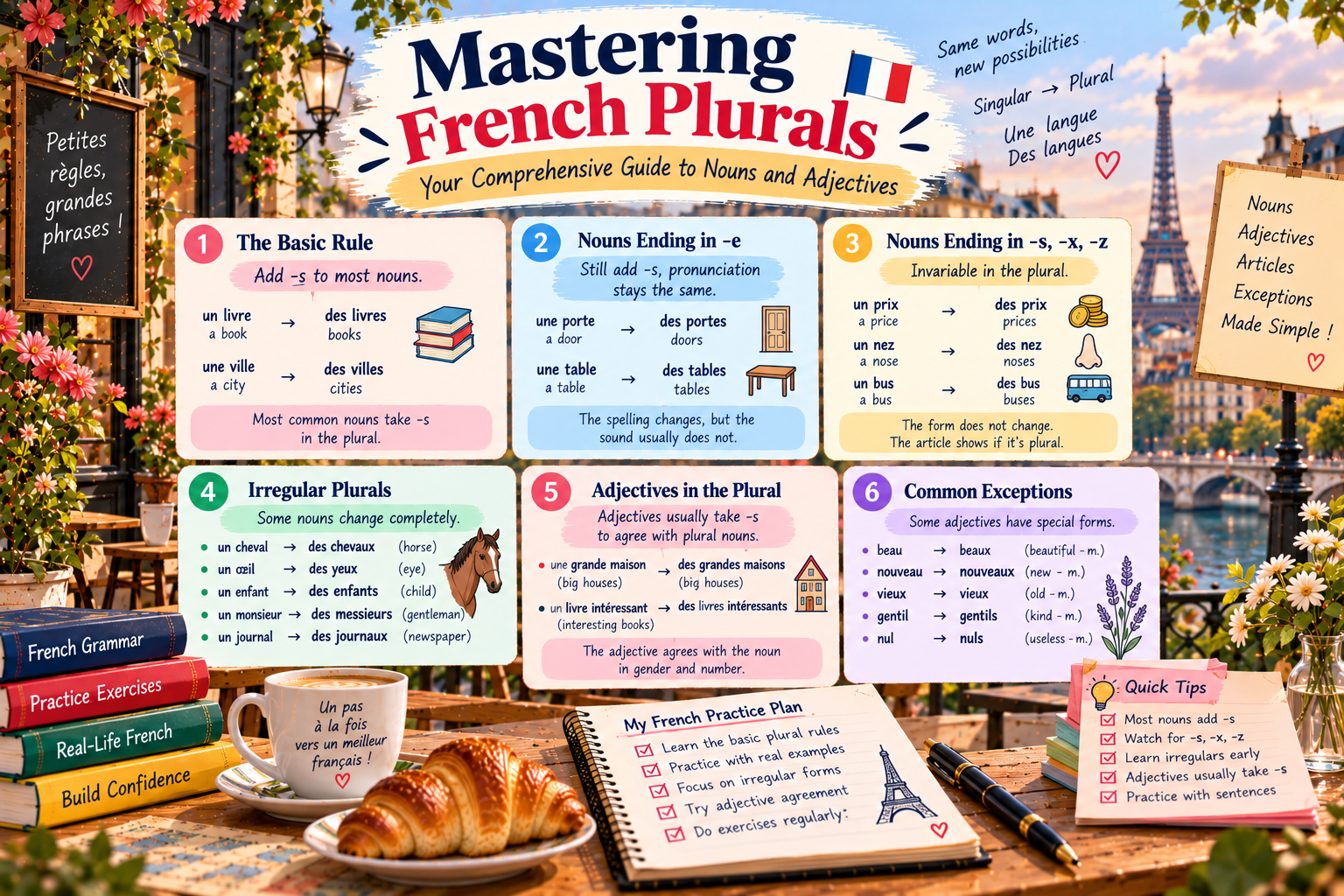
If you want to speak and write confidently, you must get the French plural right. Plurals affect almost everything: nouns, adjectives, articles, and even pronunciation through liaison. The basic idea looks simple, add -s, but real fluency requires more than a single rule. In this guide, you will learn the essential French plurals rules, the key exception groups, how to handle French plural nouns and adjectives, what to do with compound nouns, and where learners most often make mistakes. We will keep it practical with examples you can reuse in your French lessons and daily conversations.
Why focus on plurals now? Because agreement errors distract from your message. When you master the plural in French, your sentences feel correct and natural. You will also stop hesitating in conversation, especially with color adjectives and irregular forms. If you want structured guidance beyond this article, PrepFrench Classes offers clear, step by step French courses with real speaking practice and feedback that fix mistakes early. Explore our French courses to build from a solid grammar base while you learn French in context.
Free First Step
Take the guesswork out of learning French.
Not sure where to begin, which course fits your goal, or how long it will take? Book a free demo class with PrepFrench Classes and get a personalized plan built around your level, schedule, and goals.
Understanding the Basic French Plural Rule
The foundation is straightforward: most common nouns form the French plural by adding -s. Articles and adjectives then agree with that plural noun. You will also meet some invariable endings that do not change at all between singular and plural. Here is the core you must know before learning exceptions or irregulars.
Common rules for noun pluralization
- Most nouns: add -s.
Example: un livre → des livres, une ville → des villes - Nouns already ending in a silent -e: still add -s, pronunciation stays the same.
Example: une porte → des portes - Nouns ending in -s, -x, or -z: invariable in the plural, the form does not change.
Example: un prix → des prix, un nez → des nez - Articles and adjectives must agree: plural article + plural noun + plural adjective.
Example: les petites maisons, des livres intéressants
Apply this basic pattern in your French language classes and daily practice. When you see a new noun, form its plural with -s unless you recognize a known exception. With repetition, your instincts sharpen. In PrepFrench Classes, we build this reflex early with targeted drills and speaking tasks so that agreement becomes automatic.
Overview of invariable endings: -s, -x, -z
Some singular nouns end in a consonant that already looks like a plural. These are invariable in form, so the article tells you whether the word is singular or plural.
- -s: un bus → des bus, un choix? No, that is -x. See next line.
- -x: un choix → des choix, un prix → des prix
- -z: un nez → des nez
Pronunciation tip: the final consonant is usually silent. The plural is heard through the article and sometimes through liaison, for example les amis pronounced [lezami]. If you want deeper practice on pluriel français patterns, our structured French course modules reinforce form and sound together.
Exception Groups and Their Rules
After the basic -s plural, learn the main exception families. These cover a large part of real usage and will save you from guesswork. Focus on endings in -al, -eau, -eu, -au, the -ou group, and special cases in -ail.
Plurals in -al: overview and exceptions
Many nouns ending in -al form their plural in -aux: un journal → des journaux, un cheval → des chevaux. However, several common nouns in -al take a regular -s in the plural. Classic examples include un bal → des bals, un carnaval → des carnavals, un festival → des festivals, un récital → des récitals, un régal → des régals, and un chacal → des chacals.
How to apply: if you have not seen the noun before, default to -aux for -al endings, then check a reliable dictionary or class notes for the small group that keeps -s. In PrepFrench Classes, we group these by theme and frequency, which makes recall faster.
Nouns in -eau and -eu
Most nouns in -eau and -eu take -x in the plural: un bateau → des bateaux, un manteau → des manteaux, un milieu → des milieux. A few short, frequent words take -s instead: un pneu → des pneus, un bleu (a bruise or the color) → des bleus, un émeu → des émeus. Some older or borrowed words in -au also keep -s: un landau → des landaus.
In short, expect -x for -eau and -eu, then learn the handful of high-frequency exceptions as vocabulary items.
Understanding the -ou group and its exceptions
Nouns in -ou usually take -s: un cou → des cous, un trou → des trous. There is a famous group of seven that take -x instead. Memorize them with a quick list:
- un bijou → des bijoux
- un caillou → des cailloux
- un chou → des choux
- un genou → des genoux
- un hibou → des hiboux
- un joujou → des joujoux
- un pou → des poux
Special cases for -ail nouns
Most nouns in -ail take -s: un détail → des détails, un rail → des rails. Several frequent words switch to -aux: un travail → des travaux, un vitrail → des vitraux, un corail → des coraux, un émail → des émaux, un soupirail → des soupiraux, un vantail → des vantaux, un bail → des baux. Learn these specific forms because they are common in real contexts.
| Ending | Typical plural | Common exceptions | Examples |
|---|---|---|---|
| -al | -aux | -s for a small group | journal → journaux, cheval → chevaux, bal → bals, festival → festivals |
| -eau / -eu | -x | -s for a few short words | bateau → bateaux, milieu → milieux, pneu → pneus, bleu → bleus |
| -au | -x | -s for certain loans | manteau → manteaux, landau → landaus |
| -ou | -s | 7 take -x | bijou → bijoux, chou → choux, genou → genoux |
| -ail | -s | several switch to -aux | travail → travaux, vitrail → vitraux, détail → détails |
| -s / -x / -z (singular) | invariable | none | prix → prix, nez → nez, bus → bus |
Spend focused time on these families. A few minutes of targeted drills inside an online French class will pay off every time you write or speak.
Irregular French Plurals You Should Know
Some high-frequency nouns follow their own path. Learn these as fixed pairs so you never pause mid sentence.
Key irregular nouns
- un œil → des yeux
- un ciel → des cieux (the heavens, poetry and religion) or des ciels (skies in art or photography)
- un aïeul → des aïeux (ancestors, often collective)
- un gentilhomme → des gentilshommes
- un bonhomme → des bonshommes
These show how historical forms survive in modern usage. The best strategy is exposure plus spaced review. In our French lessons at PrepFrench, we recycle these in dialogues so you can hear and produce them naturally.
Titles and forms of address
Forms of address are frequently used in real life, so know them well.
- monsieur → messieurs
- madame → mesdames
- mademoiselle → mesdemoiselles
Notice the article pattern in plural: mes + dames, which fuses into the fixed written forms above. If you prepare for professional or daily interactions, mastering these small details makes your French sound polished.
Structured French Courses
Stop learning French the slow way.
Apps and random videos keep you stuck at beginner level forever. PrepFrench Classes gives you a structured path, a real teacher, and speaking practice that moves you forward at every lesson.
Available for: beginners · TEF/TCF exam prep · Canadian PR · work and daily French
Adjectives in the Plural: The Case of Color
Plural adjectives usually add -s and must agree in gender and number with the noun. Colors are where learners hesitate, because some color words are invariable, while others behave like regular adjectives.
Simple color adjectives
Most single-word color adjectives agree: bleu, vert, noir, blanc, gris, rouge, jaune, violet, rose. Examples: une voiture bleue → des voitures bleues, un pantalon noir → des pantalons noirs. Note that rose agrees: des fleurs roses. Châtain, used for hair, commonly agrees in modern usage: des cheveux châtains.
Compound color adjectives
Compound or multi-word colors are invariable. This includes hyphenated pairs and colors that include a second word describing a shade.
- des chemises bleu clair, des murs bleu foncé
- des jupes vert pomme, des sacs bleu marine
In addition, when the color comes from a noun like a fruit or material, it is usually invariable: des chaussures orange, des rideaux marron, des yeux noisette. Treat these as fixed color labels rather than adjectives that agree.
Common pitfalls in adjective agreement
- Forgetting that most colors agree: des robes vertes, not des robes vert.
- Making invariable colors agree: write des chemises orange, not des chemises oranges.
- Plural after plural nouns with compound colors: keep invariable, des voitures bleu clair.
- Adjectives before nouns still agree: de beaux jardins verts, les petits sacs noirs.
If adjective agreement slows you down, practice short, repeated sentence frames. In our French language classes we cycle through everyday contexts so you build speed and accuracy together.
Compound Nouns: Rules for Pluralization
Compound nouns combine parts like noun + adjective, noun + noun with a preposition, or verb + noun. The plural depends on the structure and which parts are meaningful nouns or adjectives. Here are the practical patterns you will meet most often.
Noun + adjective
Pluralize both when both parts carry meaning. Many are hyphenated in modern spelling.
- un coffre-fort → des coffres-forts
- un beau-frère → des beaux-frères
- un haut-parleur → des haut-parleurs
Agreement makes sense here because the adjective describes the noun directly. If the adjective is fixed as part of a label, check a dictionary, but most follow this pattern.
Noun + noun with preposition
When the structure is noun + preposition + noun, the first noun usually takes the plural marking, because it is the head, while the second noun stays invariable.
- un arc-en-ciel → des arcs-en-ciel
- un timbre-poste → des timbres-poste
- un chef-d’œuvre → des chefs-d’œuvre
Variations exist for certain set phrases, but the general idea holds: pluralize the head noun. When in doubt, consult a reputable dictionary or ask your French teacher in class.
Verb + noun combinations
With verb + noun compounds, the verb stays invariable, and the noun usually takes the plural if it can be counted. If the noun is an abstract or uncountable, the whole compound is often invariable.
- un tire-bouchon → des tire-bouchons
- un porte-monnaie → des porte-monnaie
- un ouvre-boîte → des ouvre-boîtes
- un lave-vaisselle → des lave-vaisselle
Some verb + verb or verb + adverb compounds remain invariable: un laissez-passer → des laissez-passer, un savoir-faire → des savoir-faire. The safest strategy is pattern first, dictionary check second. PrepFrench’s structured notes cover the most common compounds you will actually use, so you do not get lost in rare exceptions.
Usage Notes and Common Errors
Once you know the forms, focus on how they sound and where learners typically slip. A few targeted tips will clean up your plural usage fast.
Pronunciation tips for plural nouns
- Final -s and -x are usually silent. Plural is heard through articles and liaison: les amis [lezami], des enfants [dez‿ãfã].
- Make liaison after plural determiners when the next word starts with a vowel or mute h: mes amis, nos idées.
- No liaison before aspirated h: les héros, les haricots. The h blocks liaison.
- Watch vowel changes in irregulars: œil → yeux [jø], cheval → chevaux [ʃəvo].
Pronunciation rules feel easier with quick feedback. A short session with a French tutor helps you lock in liaison and silent consonants. You can book a free demo to check your pronunciation and get a clear plan for improvement.
Common mistakes and how to avoid them
- Adding -x to all -ou nouns. Only the 7 listed take -x. Others take -s.
- Forgetting that nouns in -s, -x, -z are invariable: un prix → des prix, not des prixs.
- Overgeneralizing -al → -aux. Remember the small -s group: bals, festivals, récitals.
- Confusing ciels and cieux. Use cieux for the heavens, ciels for artistic skies.
- Making invariable color adjectives agree: write des manteaux marron, des rideaux orange.
- Pluralizing family names. In French, family names are generally invariable in the plural: les Dupont, not les Duponts, although usage varies informally.
- For compound nouns, pluralizing the wrong element. Identify the head word, then apply the structure rules above.
Build a mini checklist for writing: article, noun, adjective, and any compound structure. A few seconds of review will prevent most errors while you learn French through writing and speaking tasks.
PrepFrench Classes
Ready to start French with a clear plan?
Book a FREE demo class and get a personalized roadmap for your level, goal, and timeline. No pressure, no obligation.
Explore courses:
All French Courses · Full TCF Canada Course · Full TEF Canada Course
FAQ: French Plurals, Exceptions, and Usage
What are the main exceptions to the French plural rule?
The biggest exception groups are: nouns in -al that form -aux (journal → journaux) with a small set that keep -s (bal → bals), nouns in -eau and -eu that take -x (bateau → bateaux, milieu → milieux) with a few -s exceptions (pneu → pneus), nouns in -ou that mostly take -s but seven take -x (bijou, caillou, chou, genou, hibou, joujou, pou), and -ail nouns where several switch to -aux (travail → travaux, vitrail → vitraux). Learn these as families, then reinforce them with exercises in a structured French course or through targeted online French classes.
Which French nouns in -ou take -x in the plural?
Only seven high-frequency words in -ou take -x in the plural: bijou, caillou, chou, genou, hibou, joujou, pou. Everything else in -ou typically takes -s, for example un trou → des trous, un clou → des clous. A simple memory trick helps: repeat the list aloud and write a few sentences for each. If you study with PrepFrench, your French tutor will include them in short speaking drills so the forms become automatic while you learn French in context.
How do you pluralize compound nouns like arc-en-ciel?
For noun + preposition + noun, the first noun usually takes the plural because it is the head. So un arc-en-ciel → des arcs-en-ciel. For noun + adjective, both parts typically agree: un coffre-fort → des coffres-forts. For verb + noun, the verb is invariable and the noun takes the plural if countable: un tire-bouchon → des tire-bouchons. If you are unsure, check a dictionary or ask your French teacher during French lessons, since a few set phrases are invariable by convention.
Are color adjectives plural in French?
Most color adjectives agree in gender and number: une chemise bleue → des chemises bleues, un pantalon noir → des pantalons noirs. Colors that are compounds or derived from nouns are generally invariable: des foulards bleu clair, des rideaux orange, des chaussures marron. Remember that rose, violet, and pourpre do agree. If you find this tricky, consider a short French course module focused on adjective agreement, or join PrepFrench Classes for guided practice in live online French classes.
What is the plural of monsieur and madame?
The plurals are irregular and very frequent: monsieur → messieurs, madame → mesdames, mademoiselle → mesdemoiselles. You will meet these in emails, invitations, and customer interactions. Practice set phrases such as Mesdames et Messieurs to build fluency. If professional communication is your goal, structured French lessons with a tutor will help you use polite forms naturally, and PrepFrench offers targeted practice for real workplace scenarios.
Final Thoughts: Mastering French Plurals with Confidence
French plural forms touch almost every sentence you speak or write. Start with the basic -s rule, then learn the exception families that appear daily. Add the high-frequency irregulars, review color agreement, and master a handful of compound noun patterns. With these tools, your French grammar becomes smoother, and your speaking becomes more confident.
- Default to -s, remember invariable endings -s, -x, -z.
- Know exception groups: -al → -aux, -eau/-eu/-au → -x, seven -ou nouns take -x, special -ail → -aux set.
- Memorize irregulars: yeux, cieux versus ciels, gentilshommes.
- Adjectives agree, but many color terms are invariable when compound or noun based.
- Identify the head word in compounds to place the plural correctly.
If you want a clear path to apply all of this while you learn French, PrepFrench Classes provides structured practice, feedback from a real French teacher, and tailored exercises that transform rules into reflexes.
✅ Next Step: Book a free demo class with PrepFrench Classes and start learning French the right way.
Questions about a specific rule or exception? Send us a message, and we will point you to the exact lesson inside our program that fits your current level.
Written by
Platform Administrator
Practical ideas from the Prep French team for learners building confidence, preparing for exams, and planning their next step in Canada.
Join the discussion
Leave a thoughtful comment.
Your email address will not be published. Comments are reviewed before appearing.