20+ Common French Verbs for Everyday Conversations
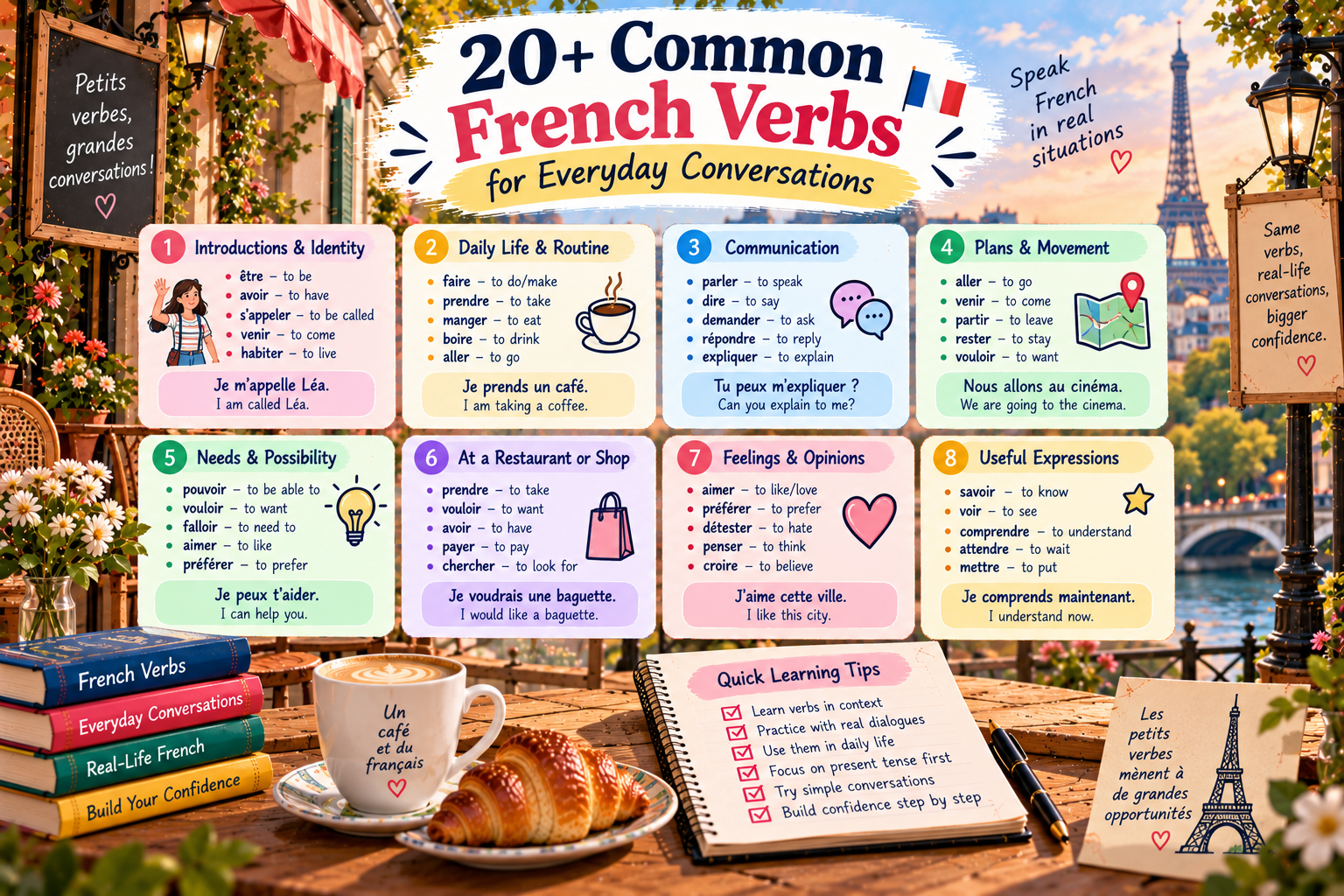
If you want to sound natural in French conversations quickly, build from the ground up with common French verbs. The right 20 to 25 verbs power most daily interactions: saying who you are, asking for help, making plans, and checking information. In this guide from PrepFrench, you will learn how to use the most used French verbs in real situations, organized by function for fast recall. We will give you mini-dialogues, cultural tips, and simple patterns so you can speak French with confidence, not just memorize a verb list.
Why these verbs? They are frequent across spoken French and appear everywhere in beginners’ dialogues, the news, and daily life. You will see a mix of basic French verbs that are regular, like parler, and a few irregular stars, like être, avoir, aller, and faire. Focus on the present tense first, build a few polite request forms, then layer question and negation patterns. This sequence helps you communicate earlier and understand more.
To go further, our French courses and PrepFrench Classes lessons prioritize practical speaking. The article below mirrors how we teach in class: verbs in context, not in isolation. Use it as a mini roadmap while you learn French, and bookmark it for quick practice. When you are ready to practice live, you can book a free demo to see how a structured French course can speed up your progress.
Free First Step
Take the guesswork out of learning French.
Not sure where to begin, which course fits your goal, or how long it will take? Book a free demo class with PrepFrench Classes and get a personalized plan built around your level, schedule, and goals.
Why These 20 Common French Verbs Matter
These verbs show up constantly in spoken French, which is why beginners hear them first in real life and in French lessons. If you master a small set and can conjugate them comfortably in the present, you unlock a big part of conversation: introducing yourself, asking for things, talking about where you live and what you do, and understanding what people ask you. PrepFrench emphasizes these high-frequency verbs early, because they boost your comprehension and speaking speed faster than scattered vocabulary.
Understanding Frequency in Language Learning
Language frequency lists consistently show that a handful of verbs carry a large share of real-world usage. In French, être, avoir, faire, aller, dire, pouvoir, and vouloir sit at the core of everyday talk. Learning these first is efficient: each one plugs into dozens of phrases. For example, with just vouloir and pouvoir, you can make polite requests in shops, restaurants, and offices. This focus leads to better listening too, because you catch the backbone of any sentence even if you miss less common words.
Essential Scenarios for Using Common Verbs
Consider daily scenes: buying coffee, asking for directions, meeting someone, booking a table, or confirming timing. You will rely on vouloir, pouvoir, aller, venir, prendre, and prendre-related phrases. Introductions revolve around s’appeler, être, and habiter. Information checks lean on savoir, connaître, and comprendre. Learn them in context, then practice aloud. If you want a structured path through these scenarios, explore our conversation-focused online French classes.
Core Grouping of Essential Verbs
Here is a practical grouping of basic French verbs you will use every day. Read the examples aloud to build muscle memory and rhythm. In PrepFrench Classes, we tie each group to mini-dialogues so you practice the exact form you need in conversation.
Identity and Basics: être, avoir, s’appeler, habiter, parler
- être (to be): Je suis étudiant. Vous êtes prête. Use for identity, professions, and descriptions.
- avoir (to have): J’ai deux frères. On a un problème. Also used for age: J’ai 20 ans.
- s’appeler (to be called): Je m’appelle Lina. Comment tu t’appelles ? Reflexive pattern you will say on day one.
- habiter (to live): J’habite à Paris. Vous habitez où ? Great for small talk.
- parler (to speak): Je parle un peu français. Vous parlez anglais ? A common -er verb with regular endings.
Mini-dialogue: “Bonjour, je m’appelle Karim, je suis ingénieur. Vous habitez ici ?” “Oui, j’habite près d’ici et je parle un peu espagnol aussi.”
Needs and Requests: vouloir, pouvoir, aimer, devoir
- vouloir (to want): Je voudrais un café, s’il vous plaît. Use the conditional for polite tone.
- pouvoir (can, to be able to): Je peux essayer ? Vous pouvez répéter ? Essential for permission.
- aimer (to like/love): J’aime ce restaurant. Tu aimes la musique française ? Perfect for opinions.
- devoir (must, to have to): Je dois partir. On doit réserver ? Softens suggestions and obligations.
Mini-dialogue: “Vous pouvez m’aider, s’il vous plaît ?” “Bien sûr, que voulez-vous faire ?” “Je dois acheter des billets.”
Daily Actions and Plans: faire, aller, venir, prendre
- faire (to do/make): Je fais du sport. Qu’est-ce que vous faites demain ? Ultra-versatile for activities.
- aller (to go): On va au cinéma. Vous allez où ? Also forms the near future: Je vais manger.
- venir (to come): Tu viens avec nous ? Je viens de Londres. Note “venir de” for origin or recent past.
- prendre (to take): Je prends le métro. On prend un café ? Used widely in food and transport.
Mini-dialogue: “Tu viens ce soir ?” “Oui, je vais prendre le bus et je fais un dessert.”
Information and Understanding: savoir, connaître, comprendre
- savoir (to know how/that): Je sais parler un peu. Tu sais où c’est ? For facts and skills.
- connaître (to be familiar with): Je connais ce quartier. Vous connaissez Marie ? For people and places.
- comprendre (to understand): Pardon, je ne comprends pas. Vous comprenez l’anglais ? Key for clarity.
Mini-dialogue: “Vous connaissez ce musée ?” “Oui, je sais qu’il ouvre à 10h, mais je ne comprends pas le site.”
Movement and Time: partir, arriver, aller, venir
- partir (to leave, set off): Je pars bientôt. On part à 9h ? Focus on departure.
- arriver (to arrive, happen): Elle arrive à midi. Qu’est-ce qui arrive ? Arrival and events.
- aller and venir: Together they track direction to or toward the speaker. Tu viens chez moi ou tu vas chez Paul ?
Extra high-frequency helpers: dire (to say), voir (to see), mettre (to put), donner (to give). These four appear everywhere, so notice them in listening practice.
In our conversation modules inside PrepFrench Classes, you practice these groups with controlled speaking drills, then jump into role plays, like ordering at a café or making a doctor’s appointment. It is a clear, confidence-first path to speak French.
Structured French Courses
Stop learning French the slow way.
Apps and random videos keep you stuck at beginner level forever. PrepFrench Classes gives you a structured path, a real teacher, and speaking practice that moves you forward at every lesson.
Available for: beginners · TEF/TCF exam prep · Canadian PR · work and daily French
Polite Requests and Everyday Interaction
French culture values polite phrasing in daily life, especially with strangers. Two verbs carry most of the load: vouloir and pouvoir. The present tense is fine for direct questions with friends: Tu peux m’aider ? With staff or strangers, switch to the conditional for warmth: Je voudrais or pourriez-vous feels gentle and respectful. Add s’il vous plaît in formal contexts and s’il te plaît with friends.
Using vouloir and pouvoir for Requests
- Je voudrais un café, s’il vous plaît. (I would like a coffee, please.)
- Pourriez-vous répéter, s’il vous plaît ? (Could you repeat, please?)
- Je peux essayer cette veste ? (May I try this jacket on?)
- On peut payer par carte ? (Can we pay by card?)
Making Requests: Formal vs. Informal Contexts
- Café or bakery: “Je voudrais un croissant et un café, s’il vous plaît.”
- Shop fitting room: “Excusez-moi, je peux essayer celle-ci ?”
- Asking directions: “Pourriez-vous m’indiquer la gare, s’il vous plaît ?”
- At work or with neighbors: “Vous pouvez me dire quand la réunion commence ?”
- With friends: “Tu peux venir plus tôt ? On doit partir à 7h.”
Notice how devoir softens obligations when used in questions. “On doit réserver ?” is a polite suggestion, not a command. Practice building short, reusable chunks that mix verbs and polite markers. If you want guided speaking drills on request-making, join our practical conversation workshops inside the French course library.
How to Ask Questions and Use Negation
Question formation and negation let you manage any exchange: confirm prices, check timings, clarify meaning, and signal what you did not catch. Here are the patterns that matter most in everyday French.
Typical Question Structures: est-ce que and intonation
- Intonation: You can often keep the sentence order and raise your voice. “Vous habitez ici ?” “Tu viens demain ?” Fast and friendly.
- Est-ce que: Adds clarity, great for learners. “Est-ce que vous parlez anglais ?” “Est-ce qu’on peut payer en espèces ?”
- Inversion (more formal): “Parlez-vous anglais ?” “Pouvez-vous répéter ?” You will hear this in customer service and announcements.
- Question words in front: “Où habitez-vous ?” “Quand arrive-t-il ?” “Pourquoi tu pars si tôt ?” Keep it simple and consistent.
Tip: practice with a template. “Est-ce que + subject + verb + complement ?” Try it with the common verbs you know to build fluency, for example “Est-ce que tu prends le métro aujourd’hui ?”
Negation Patterns: ne…pas and other variations
- ne…pas for simple not: “Je ne comprends pas.” “On ne veut pas partir maintenant.” In speech, ne is often dropped, but keep it in writing and practice both.
- ne…jamais for never: “Je ne prends jamais le bus.”
- ne…plus for no longer: “Il ne travaille plus ici.”
- ne…rien for nothing: “Je ne vois rien.”
- ne…personne for nobody: “Je ne connais personne ici.”
Combine questions and negation for realistic checks. Examples: “Vous ne prenez pas la carte, c’est ça ?” “Est-ce que tu ne peux vraiment pas venir ce soir ?” For deeper practice, our online French classes run short listening drills where you identify negation patterns and repeat them aloud for automaticity.
Common Pitfalls: Savoir vs Connaître and More
Some pairs in French look similar in English, but they split meaning in useful ways. Getting them right makes you sound accurate and confident. Below is a compact guide to the most common confusions with examples that mirror real conversation.
| Pair | Use it for | Correct example | Common mistake to avoid |
|---|---|---|---|
| savoir vs connaître | savoir: facts, how to do, that-clauses. connaître: familiarity with people, places, things. | Je sais nager. Je sais que le magasin ferme à 19h. Je connais Marie. Je connais ce quartier. | Avoid “Je connais nager.” Say “Je sais nager.” |
| sortir vs partir | sortir: to go out, exit. partir: to leave, set off for elsewhere. | Je sors ce soir. On part à 8h pour Lyon. | Do not say “Je pars avec mes amis” if you mean “going out with friends.” Say “Je sors avec mes amis.” |
| aller vs venir | aller: moving away from the speaker. venir: coming toward the speaker or joining the speaker’s location. | Tu vas chez Paul, moi je viens chez toi. Tu viens ce soir ? | Avoid mixing direction. If the destination is where the speaker is, prefer venir. |
| prendre vs apporter / emmener | prendre: to take, also to have food or transport. apporter: bring something. emmener: take someone along. | Je prends le métro. J’apporte un dessert. J’emmène mon ami. | Avoid “Je prends un ami.” Use “J’emmène un ami.” |
| devoir vs falloir (il faut) | devoir: someone must do something. il faut: it is necessary, general obligation. | Je dois partir. Il faut réserver à l’avance. | Avoid “Je faut.” The subject for falloir is always “il.” |
When you listen to native audio, focus on these contrasts. Repeat the correct form out loud while pointing to the context: people, places, objects, direction, or obligation. In our grammar clarity sessions inside the PrepFrench course library, you get quick drills that make the differences automatic.
PrepFrench Classes
Ready to start French with a clear plan?
Book a FREE demo class and get a personalized roadmap for your level, goal, and timeline. No pressure, no obligation.
Explore courses:
All French Courses · Full TCF Canada Course · Full TEF Canada Course
FAQ
What are the most common French verbs for beginners?
The best starter set includes être, avoir, faire, aller, parler, s’appeler, habiter, vouloir, pouvoir, aimer, devoir, prendre, venir, comprendre, savoir, connaître, dire, voir, mettre, donner, partir, and arriver. With these common French verbs, you can manage introductions, requests, directions, daily plans, and basic small talk. In PrepFrench Classes, we teach them by scenario so you practice the exact phrases you need in real life. If you want a structured start, browse our French courses and join a free demo class.
How do you conjugate être and avoir in the present tense?
Être and avoir are irregular and essential. Être: je suis, tu es, il/elle est, nous sommes, vous êtes, ils/elles sont. Avoir: j’ai, tu as, il/elle a, nous avons, vous avez, ils/elles ont. Learn them first, then plug them into common phrases: Je suis étudiant, j’ai faim, il est prêt, nous avons un rendez-vous. In our online French classes, you get short, guided drills that make these patterns automatic so you can focus on speaking, not searching for forms mid-sentence.
When do I use savoir versus connaître?
Use savoir for facts and skills: Je sais nager. Je sais que le bus arrive à 10h. Use connaître for familiarity with people, places, or things: Je connais Paris. Tu connais Marie ? A quick test: if you can replace the object with “that” or “how to,” you likely want savoir. If you can replace it with “someone or somewhere I am familiar with,” choose connaître. PrepFrench teachers reinforce this with real-life examples until it sticks.
How can I make polite requests in French using vouloir and pouvoir?
Use the conditional for soft, polite tone: Je voudrais un café, s’il vous plaît. Pourriez-vous m’aider ? You can also use present tense with a polite marker: Vous pouvez m’indiquer la gare, s’il vous plaît ? In friendly settings, present tense without the conditional is fine: Tu peux venir à 19h ? Practice three reusable frames: Je voudrais + item, Est-ce que je peux + action, and Pourriez-vous + verb in the infinitive. Get feedback on your tone in a free demo lesson.
What are typical mistakes to avoid when using these verbs?
Common slips include: using connaître for skills instead of savoir, confusing sortir and partir, forgetting articles with prendre in food orders, using aller where venir is required for direction toward the speaker, and dropping “il” with falloir. Another pitfall is skipping polite forms with staff, which can sound abrupt. Fix these by drilling short, clear sentences and speaking them aloud. Our French lessons include targeted corrections that clean up these errors quickly.
Final Thoughts
Mastering a compact set of common French verbs multiplies your speaking power. You do not need hundreds of verbs to have real conversations. You need a solid twenty, practiced in the present, wrapped in clear question and negation patterns, and delivered with polite forms when the context calls for it. That is exactly how we teach in PrepFrench Classes: frequency first, function first, then expansion.
As you learn French, keep this simple habit: build phrases you can use today, repeat them out loud, then add one small variation tomorrow. This creates momentum without overwhelm. The verbs in this guide will carry you through cafés, shops, transport, and friendly introductions. Add a few connectors, keep listening daily, and you will feel the jump in comprehension and confidence within weeks.
When you are ready for a clear plan and a supportive teacher, explore our French language classes. We will help you turn these verbs into natural, automatic speech.
✅ Next Step: Book a free demo class with PrepFrench Classes and start learning French the right way.
Keep these verbs close, practice them with real mini-dialogues, and do short daily speaking reps. If you want expert guidance, a structured French course with PrepFrench will give you the feedback and momentum you need.
Written by
Platform Administrator
Practical ideas from the Prep French team for learners building confidence, preparing for exams, and planning their next step in Canada.
Join the discussion
Leave a thoughtful comment.
Your email address will not be published. Comments are reviewed before appearing.