How to Play Pétanque: Rules, Setup, Scoring & Strategy
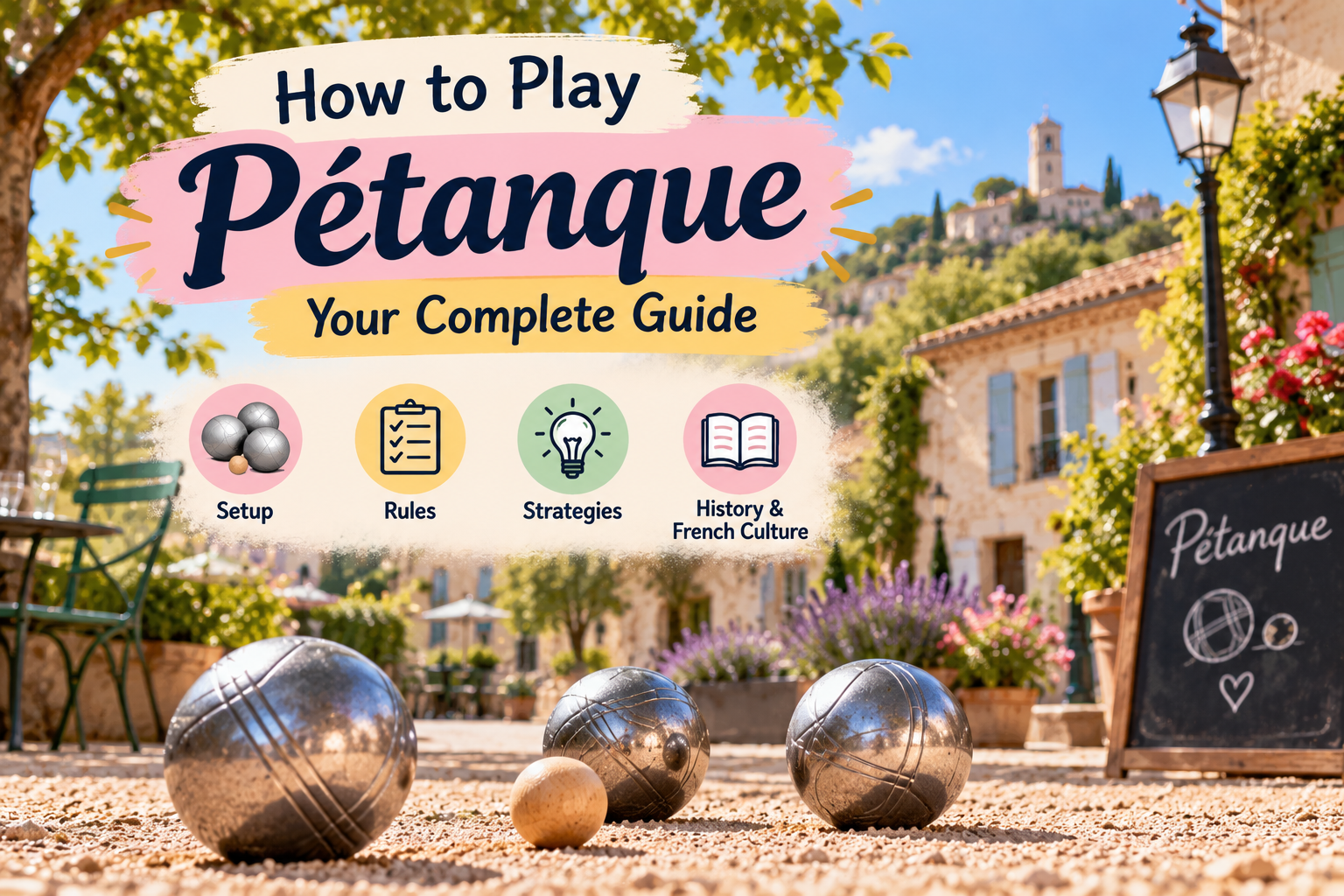
If you have ever strolled through a French square on a sunny afternoon, you have probably seen a friendly circle of players, a small wooden ball on the ground, and a few shiny metal balls landing with a satisfying clink. That is pétanque. In this practical, culture-rich guide, you will learn exactly how to play pétanque, including pétanque setup, official rules, scoring, strategy, and a bit of French culture to make your experience authentic. Whether you want to play in a park with friends or understand the game you see in Provence, this guide will give you everything you need to start.
Pétanque is more than a pastime. It is a social ritual that pairs perfectly with conversation, a café, or an apéro at sunset. For learners who want to connect with French culture and language, pétanque is a fun entry point. At PrepFrench, our French classes often include mini-cultural lessons that bring vocabulary to life, from café etiquette to games like pétanque. If you want to learn French with real-world context, blending language with culture is a smart and motivating approach.
Free First Step
Take the guesswork out of learning French.
Not sure where to begin, which course fits your goal, or how long it will take? Book a free demo class with PrepFrench Classes and get a personalized plan built around your level, schedule, and goals.
What is Pétanque?
Pétanque is a French boules game where players throw hollow metal balls, called boules, aiming to land them closer to a small wooden target ball, the jack, than the opponent. The core objective is simple: point your boules near the jack or shoot the opponent’s boules away. It is usually played on compacted gravel or sandy soil, and it can be enjoyed casually or at a competitive level governed by international rules.
The origin of the name and the game
The name comes from the Provençal phrase “pès tancats” or “pieds tanqués,” which means “feet planted.” The game, in its modern form, was codified in the early 1900s in La Ciotat, near Marseille, adapting older games known as “jeux provençaux.” Players throw while standing still with both feet inside a circle, a design that made the game more inclusive and less physically demanding than its predecessors. If you enjoy the stories behind words, this is a great example of how language and sport meet, a topic we often explore in our French courses.
Key terms you will hear
- Boule: The hollow metal ball you throw.
- Jack (also called cochonnet, “little pig”): The small wooden target ball.
- Circle: The throwing circle, 35 to 50 cm in diameter, where players stand to throw.
- Point: A gentle throw intended to land close to the jack.
- Shoot: A throw aimed to strike and move an opponent’s boule.
- Carreau: A perfect shot where your boule replaces the one it hits.
Compared with bocce, pétanque usually uses smaller metal boules, is played on rougher ground, and uses a stand-still throw from a circle. Bocce often uses a longer, rectangular court with walls and a rolling delivery. We will compare the two in detail later.
Equipment and Setup for Pétanque
Getting started is easy. You need a set of boules, a jack, and something to measure distances. A basic measuring string, a tape, or even a simple ruler works. For casual play, any flat, compacted surface outdoors is fine. For official play, the International Pétanque Federation (FIPJP) provides guidelines that help standardize games worldwide.
Essential pétanque equipment
- Boules: For adults, official boules measure roughly 70.5 to 80 mm in diameter and weigh 650 to 800 g. Leisure sets are fine for beginners. In singles and doubles, each player uses three boules. In triples, each player uses two.
- Jack: A small wooden ball, usually 30 mm in diameter, bright colored for visibility.
- Throwing circle: A foldable plastic circle is convenient, or draw a circle on the ground that is 35 to 50 cm in diameter.
- Measuring tool: Tape, caliper, or string to settle close calls.
- Optional: A magnet string pickup for easier boule retrieval and a cloth to wipe boules clean.
Ideal terrain and pétanque court dimensions
The best terrain is firm but not paved: compacted gravel, decomposed granite, or sandy soil with light pebbles. Slight irregularities make the game more tactical. For clubs and competitions, the commonly used lane dimensions are about 4 m wide by 15 m long. For friendly games, a space of about 12 to 15 m in length and 3 to 4 m in width is comfortable. The jack for adults is thrown 6 to 10 meters from the circle, which guides the practical length of your playing area.
Quick setup for a casual game
- Mark or place a throwing circle on level ground.
- Toss the jack 6 to 10 meters away from the circle, ensuring it is at least 1 meter from any obstacle or boundary.
- Check that your playing lane is clear of hazards and has enough space behind the jack.
- Decide teams: singles, doubles, or triples. Distribute boules accordingly.
- Keep a measuring tape handy for tight calls.
If you want recommendations for beginner-friendly gear, speak with your French teacher during online French classes at PrepFrench. We often share practical links and tips so you can focus on learning and enjoying the game.
How to Play Pétanque: Official Rules and Scoring
Here is the short version: teams alternate throws, trying to be closer to the jack than the opponent. A “round” is called an end. After all boules are thrown, the team with the closest boule to the jack scores one point for each of its boules that lie closer than the opponent’s nearest. Games are typically played to 13 points.
Basic flow of play
- Flip a coin to decide who throws first. That team places the circle and throws the jack at a distance of 6 to 10 meters.
- The same team throws the first boule. Try to place it near the jack.
- From then on, the team that is not closest to the jack throws until they take the point or run out of boules. Play alternates based on who is currently behind.
- When all boules are thrown, measure if necessary, count points, and record the score.
- The team that scored starts the next end by placing the circle around where the jack was at the end of the previous round, then throwing the jack again.
How scoring works
- Only one team scores per end.
- That team scores one point for every boule closer to the jack than the opponent’s nearest boule.
- Standard game target: 13 points. For quick games, you can agree on 7 or 11.
- Example: If Team A’s two boules are closer than Team B’s nearest, Team A scores 2 points for that end.
In singles and doubles, each player uses three boules. In triples, each player uses two. This keeps both teams with a total of six boules per end, which balances strategy and pace.
Common fouls and simple ways to avoid them
- Foot faults: Both feet must be inside the circle and on the ground while throwing. Solution: Plant your feet, pause, then throw.
- Out-of-bounds jack: The jack must be 6 to 10 meters from the circle and at least 1 meter from obstacles. If it is invalid, the opponent sets the jack within valid limits.
- Time limit: Once it is your turn, you typically have one minute to throw. Get ready while the opponent is throwing to avoid delays.
- Measuring prematurely: Do not touch boules or the jack until measuring is complete and both teams agree.
- Distraction and etiquette: Do not talk loudly or stand directly in the thrower’s line of sight. Basic courtesy keeps the game enjoyable.
If you want a concise French vocabulary set for these rules, your PrepFrench teacher can include a short glossary during your free demo lesson. Learning phrases like “à toi” (your turn) or “mesure” (measure) makes games with French speakers both smoother and more fun.
Structured French Courses
Stop learning French the slow way.
Apps and random videos keep you stuck at beginner level forever. PrepFrench Classes gives you a structured path, a real teacher, and speaking practice that moves you forward at every lesson.
Available for: beginners · TEF/TCF exam prep · Canadian PR · work and daily French
Strategy for Beginners: Tips and Common Roles
Strategy in pétanque starts with one key decision on every throw: should you point or should you shoot? For beginners, a solid pointing game, good jack placement, and consistent distance control win many ends. As you gain confidence, you will add shooting to remove threats and flip positions late in the round. Most teams adopt informal roles, which makes learning smoother and more enjoyable.
Understanding the roles
- Pointer: Opens the end and usually aims to land the boule very close to the jack. Prioritizes accuracy and reading terrain.
- Shooter: Removes opponent boules that threaten the point. Trains precision, calm focus, and repeatable technique.
- Milieu: The all-rounder who adapts: points when needed, shoots when the situation calls for it. Manages momentum and decision-making mid-end.
At a beginner level, pick a preferred role but practice both pointing and shooting. You will improve more quickly if you can adapt to different teammates and terrains.
Simple drills to build your pétanque skills
- Pointing ladder: Place the jack at 6, 7, 8, 9, and 10 meters. Throw two boules at each distance. Count how many finish within 30 cm. Aim for gradual improvement each week.
- Landing spot practice: Mark a 20 cm circle 1 meter in front of the jack. Practice landing your boule on the spot, letting it roll to finish close. This trains trajectory and speed control.
- Backstop control: Use a small object behind the jack as a “backstop.” Try to land a boule that slows and rests gently against it without pushing the jack.
- Basic shooting: Place an opponent boule 7 to 8 meters away. Aim for a clean hit. Start with a gentle arc and practice both “tire au fer” (a direct hit with minimal bounce) and a controlled hop.
- Carreau challenge: Once hitting becomes reliable, see how often your boule can replace the hit boule. This builds confidence for tight ends.
Want feedback on your technique vocabulary in French, like “pointer,” “tirer,” or “carreau”? Ask your instructor during a PrepFrench course. Turning drills into French lessons is an easy win for motivation and memory.
Pétanque vs Bocce: What’s the Difference?
People often confuse pétanque and bocce because both are boules games played with a small target ball. The feel and flow, however, are different. Pétanque is typically played on open, rough ground with metal boules and a stand-still throw. Bocce is usually played on a walled, rectangular court with larger balls that are often rolled rather than tossed. Here is a quick comparison.
| Aspect | Pétanque | Bocce |
|---|---|---|
| Playing surface | Open gravel or compacted soil, irregular terrain is common | Rectangular, walled court with smooth surface |
| Balls | Hollow metal boules, smaller diameter | Larger, often solid composite or wood balls |
| Throwing style | Stand in a circle with feet planted, toss underhand | Longer approach within court, often rolled with low arc |
| Jack distance | 6 to 10 meters from the circle | Varies with court rules, generally set within court length |
| Team formats | Singles, doubles, triples, 6 boules per team each end | Singles or teams, number of balls varies by ruleset |
| Scoring | Only one team scores per end, to 13 points in standard play | Similar closest-ball scoring, target total can differ |
If you already play bocce, you will adapt quickly to pétanque. What changes is your touch on rough ground and the stand-still throw. For travelers and French learners, understanding both games adds cultural vocabulary and gives you an easy way to make friends in parks from Paris to Marseille. Your French lessons can easily include this cultural context so you feel at home on holiday and in conversation.
A Brief History and Cultural Significance of Pétanque
Pétanque’s modern rules emerged in the early 20th century in La Ciotat, a coastal town in Provence. The design was inclusive from the start: players threw with their feet planted to reduce running or long approaches. The game spread quickly through southern France, then throughout the country, then to francophone regions and beyond.
Key milestones
- Early 1900s: Modern pétanque codified in La Ciotat, inspired by older “jeux provençaux.”
- Mid-20th century: Formation of clubs and regional federations across France.
- FIPJP era: International competitions and world championships help standardize rules and grow the sport globally.
- Today: Pétanque is part of daily life in many French towns, from Côte d’Azur promenades to Parisian parks, and is played in dozens of countries.
Where to experience pétanque in France
- Paris: Place Dauphine near Pont Neuf, Parc des Buttes-Chaumont, and local club boulodromes are lively in summer.
- Provence: Village squares in Aix-en-Provence and Avignon, as well as coastal spots like La Ciotat and Marseille’s Parc Borély.
- Côte d’Azur: Nice’s Promenade du Paillon and nearby towns often host casual evening games.
Learning a few phrases will help you blend in: “On joue?” (Shall we play?), “Bien pointé” (well pointed), or “Bien tiré” (well shot). Our French language classes combine conversation with culture, so you can confidently join a game and a chat afterward. That is the sweet spot: language that unlocks real experiences.
PrepFrench Classes
Ready to start French with a clear plan?
Book a FREE demo class and get a personalized roadmap for your level, goal, and timeline. No pressure, no obligation.
Explore courses:
All French Courses · Full TCF Canada Course · Full TEF Canada Course
Pétanque FAQs
What equipment do I need to start playing pétanque, and what size or weight should I choose?
To begin, you need a set of boules, a wooden jack, and a simple measuring tool. Adult boules typically range from 70.5 to 80 mm in diameter and weigh between 650 and 800 g. For casual play, a standard leisure set is fine. If you have smaller hands, choose a smaller diameter for comfort. As your technique grows, you can tailor your choice by role: pointers often prefer slightly smaller diameters for control, while shooters may choose a bit heavier for stability. Ask a PrepFrench French teacher for vocabulary tips so you can buy with confidence in France.
How big should a pétanque court be, and can I play in a backyard or park?
Yes, you can absolutely play in a backyard or park. A comfortable casual lane is about 12 to 15 meters long and 3 to 4 meters wide. Competitive lanes often use 4 by 15 meters. The terrain should be firm and slightly rough: compacted gravel, decomposed granite, or sandy soil. Avoid deep grass or soft soil that kills roll. Keep the jack at least 1 meter from any obstacles. If you want to improve your French while you practice, our online French classes at PrepFrench can include quick cultural notes and game terms.
How far do you throw the jack, and what happens if it goes out of bounds?
For adults, the jack is thrown between 6 and 10 meters from the throwing circle, and at least 1 meter from any obstacle. If the jack is out of range or too close to a boundary, it is invalid. Typically, the opposing team then places the jack at a valid distance. If the jack later gets knocked out of bounds during play, specific rules apply depending on your local or club rules. The usual solution is to declare the end “dead” and replay it. Your free demo with PrepFrench can include a mini French glossary for these rulings.
How is scoring calculated in pétanque?
Only one team scores per end. After all boules are thrown, the team with the closest boule to the jack scores one point for each of its boules that are closer than the opponent’s nearest. Standard games are played to 13 points. Example: if your two closest boules are both nearer to the jack than the opponent’s nearest, you score 2. This simple system makes pétanque easy for beginners. If you want to learn the French terms for scoring and calls during play, join a structured French course and practice them aloud.
What are the main differences between pétanque and bocce?
Pétanque uses hollow metal boules and is played on open, rough ground. Players throw from a circle with feet planted. Bocce uses larger balls and is usually played on a long, walled court with a smoother surface, often with a rolling delivery. Both use a small target ball and closest-ball scoring, but the feel is different: pétanque emphasizes adapting to irregular terrain and a toss with varied arcs. Learning both adds great cultural context if you plan to travel or learn French for real-world use.
Final Thoughts
Pétanque is simple to learn, endlessly replayable, and deeply woven into daily life in France. Now that you know what pétanque is, the basic equipment and pétanque setup, the key pétanque rules and scoring, and a few beginner strategies, you are ready to play. You do not need a perfect court to start. A patch of compacted ground in a park or backyard is enough, and a leisure set of boules will do the job.
If your goal is to connect more meaningfully with French culture, pétanque is a friendly gateway. The game gives you fun, shared moments and a natural reason to practice French vocabulary and small talk. PrepFrench Classes can help you link those experiences with tailored French lessons so you build confidence as you play, travel, and chat with new friends. When language meets real life, progress accelerates and motivation sticks.
Grab a set of boules, learn a few phrases, and invite a friend to the park. You will be surprised how quickly you pick up the rhythm of the game, and how easily a simple throw can turn into a great conversation in French.
✅ Next Step: Book a free demo class with PrepFrench Classes and start learning French the right way.
Tip: Bring a small notebook to your next game. Jot down a few French phrases you hear, like “bien joué” or “à toi,” and practice them during your next online French class.
Written by
Platform Administrator
Practical ideas from the Prep French team for learners building confidence, preparing for exams, and planning their next step in Canada.
Join the discussion
Leave a thoughtful comment.
Your email address will not be published. Comments are reviewed before appearing.