French Subject Pronouns: Rules, Examples & Exercises
French subject pronouns are small words with a big job. They tell us who is doing the action, they control how you conjugate the verb, and they help your sentences sound natural and fluent. If you want to speak French with confidence, mastering personal pronouns like je, tu, il/elle, on, nous, vous, ils/elles is a must. In this guide, you will learn what each pronoun means, how to use them correctly, and how to avoid common pitfalls such as tu vs vous, on vs nous, and c’est vs il/elle est. You will also get quick mini-exercises to reinforce your learning, just like we use inside PrepFrench Classes. If you are building a foundation or polishing your French grammar, this step is essential for clear, accurate communication.
At PrepFrench, we teach practical rules you can use in real conversations, not just theory. If you prefer a structured French course with a real teacher, you can explore our French courses or visit the PrepFrench home page to see how our online French classes work. This article is your reference guide, and our classes help you put everything into action.
Free First Step
Take the guesswork out of learning French.
Not sure where to begin, which course fits your goal, or how long it will take? Book a free demo class with PrepFrench Classes and get a personalized plan built around your level, schedule, and goals.
Understanding French Subject Pronouns
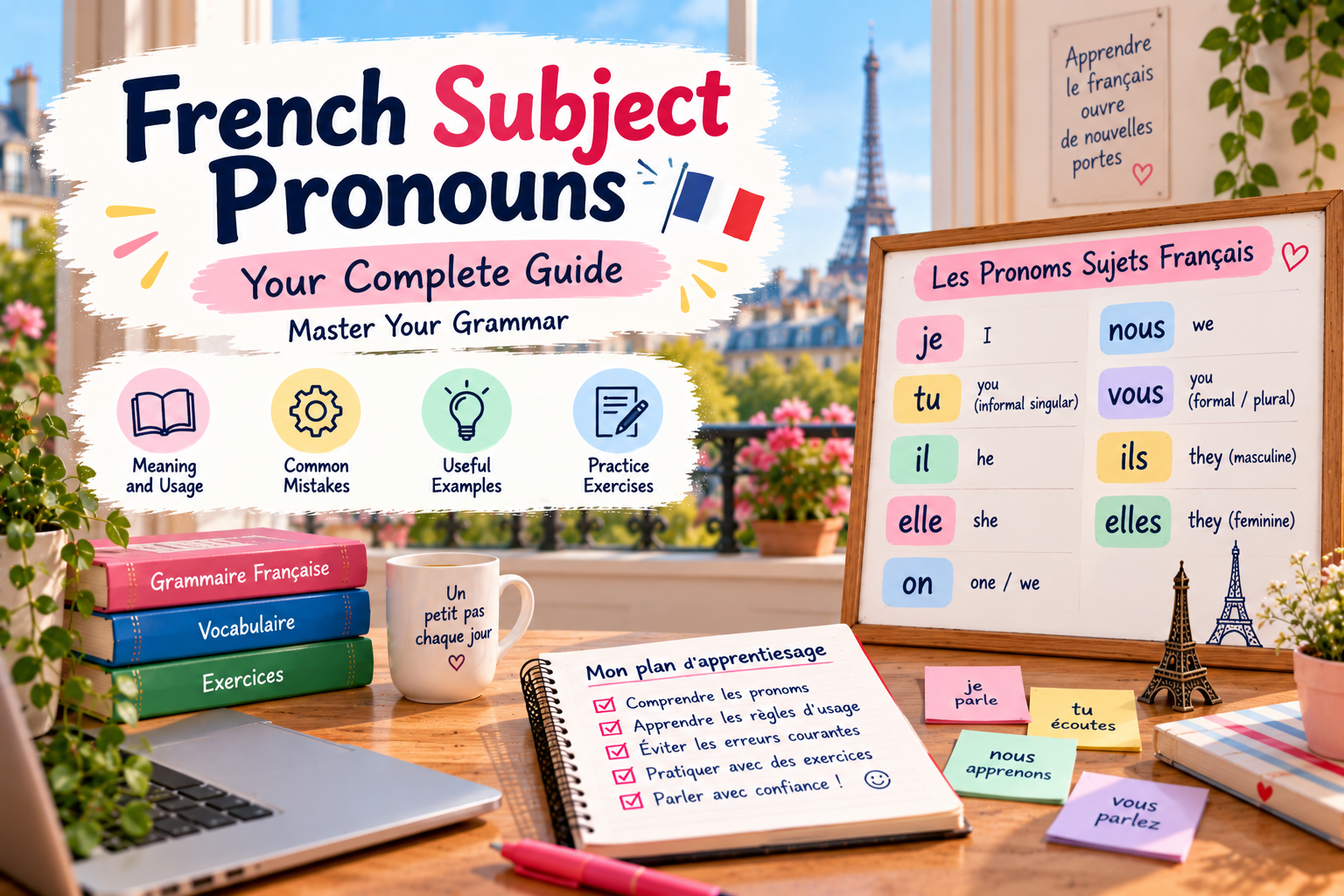
French personal pronouns, called pronoms sujets français, tell us who the subject is and decide the verb ending. In other words, if you know the pronoun, you know how to conjugate. There are nine personal subject pronouns in standard French. Some, like on, have more than one use depending on context. Others, like vous, double as both formal singular and plural you. Here is a quick reference to keep handy as you learn French and build sentences with accuracy.
| Pronoun | Meaning | Notes |
|---|---|---|
| je | I | Becomes j’ before vowel or mute h: j’aime |
| tu | you, singular informal | Used with friends, family, children |
| il / elle | he, she, it (things) | Also used for things: le livre, il...; la table, elle... |
| on | one, we, people in general | Often replaces nous in speech, verb is always 3rd person singular |
| nous | we | More common in writing than in speech, where on is frequent |
| vous | you, plural or formal singular | Used with strangers, in professional settings, and for groups |
| ils / elles | they (masc. or mixed) / they (fem.) | Masculine is the default for mixed groups |
The Nine Personal Subject Pronouns
Examples in context:
- Je parle français. I speak French.
- Tu étudies ce soir. You are studying tonight, informal.
- Il travaille à Paris. He works in Paris.
- Elle arrive bientôt. She is arriving soon.
- On mange vers midi. We eat around noon, everyday speech.
- Nous aimons voyager. We like to travel, more formal or written.
- Vous êtes prêts. You are ready, plural or formal.
- Ils habitent ici. They live here, masculine or mixed group.
- Elles sont en retard. They are late, all feminine group.
The Meaning and Use of Il/Elle and on
Il and elle refer to both people and things. For objects, choose the pronoun that matches the noun’s gender: le livre, il est lourd; la chaise, elle est confortable. The pronoun on is versatile. It can mean people in general, one, or we in conversational French. On always takes a third person singular verb: on va, on fait, on peut. In real-life conversation, on is extremely frequent.
Agreement Considerations
Subject pronouns control verb endings: tu parles, nous parlons, ils parlent. With compound tenses, agreement is with the subject when the auxiliary is être: elles sont parties. With avoir, the past participle usually does not agree with the subject. Focus on choosing the right subject pronoun first, then match your verb form to it. As you progress, your French teacher will help you integrate agreement rules smoothly.
Mini-exercise: Choose the correct subject pronoun.
- ... habite à Lyon. (my sister) → Answer: elle
- ... sommes contents. (my friend and I) → Answer: nous or on in speech
- ... parlez français, Madame ? → Answer: vous
- ... pleut beaucoup aujourd’hui. → Answer: il, impersonal
Need a guided path through these rules with practice and feedback? Explore our online French classes to learn with a structured sequence and real conversation tasks.
Nuances of Tu vs Vous
Tu vs vous is both a grammar and culture question. Tu is informal singular you, used with friends, family, and peers in relaxed settings. Vous is either formal singular or plural you. Choosing the right one shows respect and social awareness, which is part of speaking natural French. When in doubt, start with vous. Native speakers will let you know if tu is welcome, often by saying on peut se tutoyer, which means we can use tu.
Informal vs Formal Address
- Use tu with close friends, siblings, children, pets, and sometimes colleagues of the same age in a casual context.
- Use vous with older adults you do not know, in customer service situations, in professional settings, with teachers, doctors, or any new acquaintance where formality is appropriate.
- Remember: vous is also the plural you even in casual situations: Vous venez ce soir, les amis ?
Social Context: Cultural Norms
- In workplaces, start with vous. Some teams quickly move to tu, others keep vous. Let the other person set the tone.
- In service settings, vous is the safe choice: Bonjour, vous désirez ?
- Among students and young adults, tu is common. Still, if you are unsure, begin with vous and switch if invited.
Examples:
- Tu viens au cinéma ce soir ? Are you coming to the cinema tonight? Informal.
- Vous désirez autre chose, Monsieur ? Would you like anything else, sir? Formal.
- Vous prenez l’escalier ou l’ascenseur ? Are you taking the stairs or the elevator? Plural or formal singular.
Mini-exercise: Choose tu or vous.
- Talking to your new neighbor you just met: ... habitez ici depuis longtemps ? → vous
- Texting your best friend: ... peux m’aider demain ? → tu
- Addressing a group of classmates: ... êtes prêts pour la présentation ? → vous
These social choices are easier when you practice speaking with a teacher who gives feedback. In our French lessons at PrepFrench, we coach you through real scenarios so you always know how to address people appropriately.
Structured French Courses
Stop learning French the slow way.
Apps and random videos keep you stuck at beginner level forever. PrepFrench Classes gives you a structured path, a real teacher, and speaking practice that moves you forward at every lesson.
Available for: beginners · TEF/TCF exam prep · Canadian PR · work and daily French
The Versatility of On
On is one of the most useful and interesting subject pronouns in French. It can mean people in general, one, or we. In everyday conversation, on often replaces nous because it sounds lighter and more natural. Remember a key rule: on always takes a third person singular verb, even when it means we. That is why you say on va, not on allons.
When to Use On Instead of Nous
- Everyday we: On y va à 14h. We are going there at 2 pm.
- General statements: En France, on déjeune plus tard. In France, people have lunch later.
- Vague or unspecified subject: On frappe à la porte. Someone is knocking at the door.
Nous is still correct and common in writing, formal speech, and for emphasis. In conversation, many native speakers default to on for a friendly, natural tone.
Agreement Rules with On
- Verb agreement: on + third person singular verb, always: on fait, on prend, on peut.
- Past participle agreement in writing: when on clearly means a group including the speaker, some writers make past participle agreement in adjectives or participles that reflect the group in context. In conversation, you will mostly hear the singular verb agreement only.
Examples:
- On commence à huit heures. We start at eight.
- On dit que c’est facile. They say it is easy, or people say it is easy.
- On peut se tutoyer ? Can we use tu?
Mini-exercise: Rewrite with on where natural.
- Nous partons à 9h. → On part à 9h.
- Nous va au marché le samedi. Correct it and use on. → On va au marché le samedi.
- Nous pense que c’est une bonne idée. Correct it and use on. → On pense que c’est une bonne idée.
If on vs nous still confuses you, a short targeted lesson clears it up fast. You can book a free demo with PrepFrench to see how our French course plan would look for you.
The Impersonal Use of Il
The pronoun il also appears in impersonal expressions where there is no real person or thing acting as the subject. In these cases, il translates to it or there in English, and it never changes to elle. You will hear the impersonal il with weather, time, general statements, and the expression il y a.
Common Impersonal Expressions
- Il pleut. It is raining.
- Il neige. It is snowing.
- Il fait beau. The weather is nice.
- Il est tard. It is late.
- Il est trois heures. It is three o’clock.
- Il faut étudier. It is necessary to study or one must study.
- Il y a du monde ici. There are a lot of people here.
Difference Between Il and Il/Elle
When referring to things, use il or elle to match the noun’s gender:
- Le film, il est long. The film, it is long.
- La voiture, elle est neuve. The car, it is new.
In impersonal expressions, il does not replace a specific noun. It is just part of the fixed construction: il pleut, il y a, il faut. Learners sometimes mix these up by saying c’est pleut or elle pleut, which are not correct. Think of impersonal il as a special tool for weather, time, existence, and necessity.
Mini-exercise: Choose the correct impersonal expression.
- ... froid aujourd’hui. → Il fait froid.
- ... deux cafés sur la table. → Il y a deux cafés sur la table.
- ... d’étudier pour réussir. → Il faut étudier pour réussir.
Our online French classes include conversation practice that uses these expressions naturally. Real dialogues help you remember them without translating in your head.
C’est vs Il/Elle Est
C’est and il/elle est both translate to it is or he/she is, but they follow different rules. Use c’est before a noun, a pronoun, or for emphasis. Use il/elle est before an adjective, a profession or nationality without an article, or a prepositional phrase. Once you learn the patterns, your sentences will sound much more native-like.
Use Cases for C’est
- Before a noun with an article: C’est un médecin. He is a doctor.
- Before a proper name or pronoun: C’est Marie. C’est moi.
- Before a demonstrative or strong identification: C’est incroyable. C’est la vérité.
- To comment on a situation broadly: C’est difficile de choisir.
When to Use Il/Elle est
- Before an adjective describing a known subject: Elle est intelligente.
- Before a profession or nationality without article: Il est avocat. Elle est française.
- Before prepositional phrases: Il est à la maison. Elle est en réunion.
Examples side by side:
- C’est un bon film. It is a good film, general identification. Il est bon. It is good, quality of a known film.
- C’est ma prof de français. That is my French teacher. Elle est prof. She is a teacher.
- C’est intéressant. That is interesting, general comment. Il est intéressant. It is interesting, about a specific thing already identified.
Mini-exercise: Choose c’est or il/elle est.
- ... une idée brillante. → C’est une idée brillante.
- ... tard. → Il est tard.
- ... musicienne. → Elle est musicienne.
- ... mon frère. → C’est mon frère.
If you would like guided practice with immediate feedback, our French lessons include targeted drills that make these choices automatic in conversation.
Common Mistakes with Subject Pronouns
Even strong learners slip on small details. Knowing the traps helps you avoid them and speak more naturally. Here are frequent errors with French subject pronouns, plus quick tips to fix them.
Common Error Scenarios
- Using vous only for formality, forgetting it is also plural: Vous êtes prêts, les amis ? can be plural informal.
- Confusing on and nous: saying on allons instead of on va. Remember on + third person singular.
- Mixing impersonal il with c’est: not c’est pleut, but il pleut.
- Forgetting elision: not je aime, but j’aime; not je habite, but j’habite.
- Choosing il/elle for things incorrectly: match the grammatical gender, not what you think the object should be. La voiture is elle, le livre is il.
- Defaulting to il est for all comments: use c’est with nouns and broad judgments, like c’est une bonne idée or c’est super.
Practical Tips to Avoid Mistakes
- Start formal with vous when meeting someone. Switch to tu if invited.
- Say on in everyday we sentences to sound natural: On se voit demain ?
- Memorize impersonal anchors: il pleut, il fait, il y a, il est + time, il faut + infinitive.
- Practice elision out loud: j’aime, j’habite, j’ai, j’écoute. Your pronunciation improves at the same time.
- Learn noun gender with a mental tag. Always file new words with le or la.
- Use c’est + article + noun, but il/elle est + adjective or profession without article.
Mini-exercise: Fix the sentence.
- Je aime Paris. → J’aime Paris.
- On allons au café. → On va au café.
- C’est pleut aujourd’hui. → Il pleut aujourd’hui.
- Le film, elle est ennuyeuse. → Le film, il est ennuyeux.
- Il est un bon professeur. → C’est un bon professeur. Or, Il est bon.
In PrepFrench Classes, we spot these issues quickly and correct them with short drills, dialogues, and targeted speaking tasks. You get a clear explanation, then immediate practice to lock the rule in place.
PrepFrench Classes
Ready to start French with a clear plan?
Book a FREE demo class and get a personalized roadmap for your level, goal, and timeline. No pressure, no obligation.
Explore courses:
All French Courses · Full TCF Canada Course · Full TEF Canada Course
FAQ: French Subject Pronouns
What are the French subject pronouns and what do they mean?
The nine French subject pronouns are je, tu, il, elle, on, nous, vous, ils, elles. Je means I, tu is you singular informal, il/elle are he/she and also it for things, on means one, we, or people in general, nous means we, vous is you plural or formal singular, ils is they for masculine or mixed groups, and elles is they for all feminine groups. Mastering these pronoms sujets français helps you choose the correct verb endings and speak French clearly in conversation and in writing.
When should I use tu vs vous in French?
Use tu for informal one-to-one situations, like with friends, family, or peers. Use vous when speaking formally to one person, such as a stranger, a teacher, or a professional contact, and always for groups, since vous is the plural you. When unsure, start with vous. People often invite you to switch to tu by saying on peut se tutoyer. In PrepFrench Classes, we practice tu vs vous in common scenarios so you develop the right instinct in real conversations.
Does French have a pronoun for “it”? How to choose il vs elle?
French does not have a separate pronoun that only means it. For things, use il or elle based on the grammatical gender of the noun. Example: le train, il est rapide, la porte, elle est ouverte. If you are making an impersonal statement like weather or time, use the fixed impersonal il: il pleut, il est trois heures, il faut travailler. Learning the gender of nouns as you go is key, and our online French classes include strategies to memorize and apply gender naturally.
What does on mean in French and how does it differ from nous?
On can mean one, people in general, or we in everyday French. It always takes a third person singular verb: on va, on mange. Nous also means we and is common in writing or formal contexts, with first person plural verbs: nous allons, nous mangeons. In casual speech, many native speakers prefer on to sound natural and fluid. PrepFrench lessons show you when to choose on vs nous so your spoken French feels authentic.
Why does je become j’ in certain situations?
French uses elision, which drops a final vowel before another vowel or mute h for smooth pronunciation. Je becomes j’ before a vowel sound: j’aime, j’habite, j’écoute. You will also see ce become c’, such as c’est, and le/la become l’ before vowels: l’ami, l’école. Practicing elision helps both grammar and pronunciation at once. If you want guided drills, book a free demo to see how a PrepFrench course builds this habit quickly.
Final Thoughts
French subject pronouns are your roadmap for verb conjugation and natural speech. Once you are comfortable with je, tu, il/elle, on, nous, vous, ils/elles, you will notice how much easier it becomes to build full, accurate sentences. Pay special attention to social choices like tu vs vous, everyday shortcuts like on instead of nous, and fixed expressions with impersonal il. Keep your ear tuned to c’est vs il/elle est, and your grammar will sound cleaner right away.
Learning in the right order matters. Start with clear rules, layer on real examples, then practice them in short, focused speaking tasks. That is the PrepFrench approach. If you want a structured path with accountability, a real French teacher, and lessons that move you forward every week, explore our French courses or book a free demo. We will help you apply these pronoun rules in real conversations so you can speak French with confidence.
✅ Next Step: Book a free demo class with PrepFrench Classes and start learning French the right way.
Keep this guide handy and revisit the mini-exercises. Short, consistent practice builds automatic recall. If you want expert guidance, PrepFrench Classes is here to help you progress step by step.
Written by
Platform Administrator
Practical ideas from the Prep French team for learners building confidence, preparing for exams, and planning their next step in Canada.
Join the discussion
Leave a thoughtful comment.
Your email address will not be published. Comments are reviewed before appearing.