French Partitive Articles: Rules, Examples & Common Mistakes
If you want to speak French naturally at cafés, markets, or dinner tables, you must master partitive articles in French. These small words help you talk about “some,” “any,” or an unspecified amount: du, de la, de l’, and des. In conversation, they appear constantly with food, drink, shopping, and daily routines. In this guide, you will learn exactly when to use each form, how they behave in negative sentences, and how to avoid the most common mistakes learners make. At PrepFrench, we focus on clear explanations and step-by-step practice, so you can apply the rules with confidence in your French classes and real conversations.
By the end, you will have a simple decision framework that helps you choose between du vs de la vs des, recognize when to switch to de or d’, and understand how quantity expressions affect article choice. We will also compare partitive and indefinite articles side by side, so you always know whether to say du pain or un pain, des pommes or de belles pommes. If you want more structured help beyond this article, explore our French courses designed to build strong French grammar, vocabulary, and speaking habits from day one.
Free First Step
Take the guesswork out of learning French.
Not sure where to begin, which course fits your goal, or how long it will take? Book a free demo class with PrepFrench Classes and get a personalized plan built around your level, schedule, and goals.
What Are Partitive Articles in French?
Partitive articles indicate an unspecified quantity of something: some bread, some water, some apples. Think about things you normally do not count one by one, like bread or water, or when you do not specify how many apples you are taking. In French articles grammar, the partitive fills that “some” or “any” space, especially with mass nouns, food, and drinks.
Forms of Partitive Articles
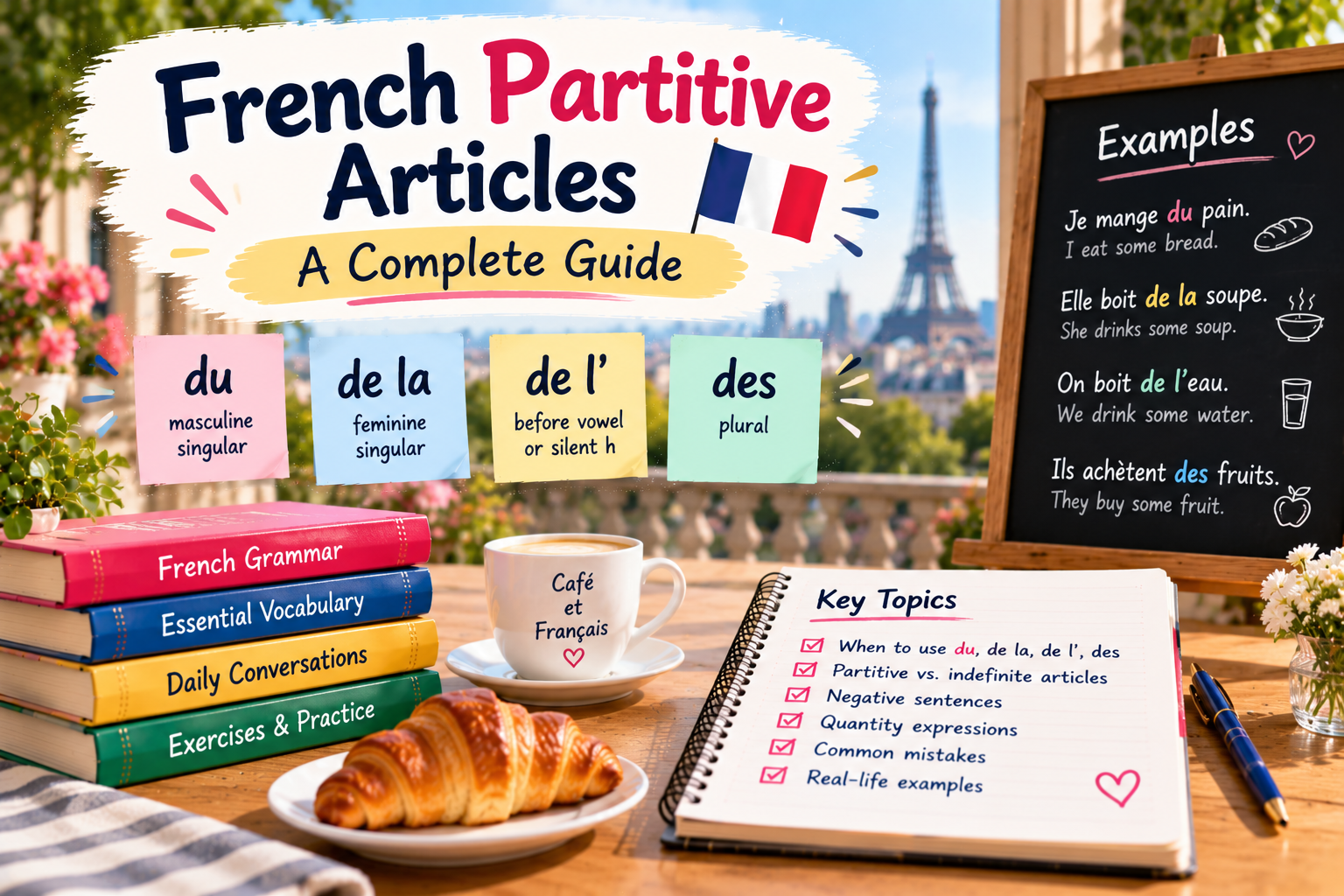
- du = de + le, used before masculine singular nouns starting with a consonant: Je mange du pain. (I eat some bread.)
- de la, used before feminine singular nouns starting with a consonant: Elle boit de la soupe. (She drinks some soup.)
- de l’, used before singular nouns that start with a vowel or silent h: Nous buvons de l’eau. (We drink some water.)
- des, used before plural nouns when the quantity is not specified: Ils achètent des tomates. (They are buying some tomatoes.)
Many grammars treat des as the plural indefinite article rather than a strict partitive. In everyday French, des serves the same function as “some” for plural items, so learners often group it with partitives for simplicity. In this guide, you will see how des behaves in comparison with true partitives and with indefinite articles.
Role in Mass Nouns
Partitives are crucial with mass nouns, the nouns you usually think of as a substance rather than as individual units: bread, water, rice, cheese, coffee. You would not say “one water” in English. You would say “some water.” The same idea exists in French, and that is where the partitive article shines.
Examples:
- Je mange du pain le matin. (I eat some bread in the morning.)
- Tu prends de la confiture avec tes crêpes. (You have some jam with your crepes.)
- On boit de l’eau pétillante. (We are drinking some sparkling water.)
- Ils achètent des fruits pour le dessert. (They are buying some fruit.)
At PrepFrench, our beginner French classes build these patterns early so that choosing du, de la, de l’, or des becomes automatic during conversation practice.
When and How to Use Partitive Articles
Use partitive articles when you refer to an unspecified amount of something or to “some” items without stating a precise number. They often appear after everyday verbs related to eating, drinking, buying, having, cooking, or wanting.
Here is a simple decision framework you can apply every time you choose an article:
- Step 1: Are you talking about a general preference or a whole specific item? If yes, you probably need the definite article (le, la, les) or an indefinite (un, une, des). If no, go to step 2.
- Step 2: Are you referring to an unspecified amount of a mass noun? If yes, choose a partitive: du, de la, or de l’.
- Step 3: Are you referring to some plural items without counting them? If yes, use des.
- Step 4: Is the sentence negative or is there a quantity expression? If yes, switch to de or d’ after the verb or quantity word.
- Step 5: Is the verb a verb of preference such as aimer or préférer? If yes, use le, la, les for general statements.
Common Verbs with Partitive Articles
These verbs frequently take partitive articles because they describe having, consuming, or obtaining an unspecified amount:
- manger, boire, prendre
- acheter, vendre
- avoir, commander
- préparer, cuisiner
- apporter, servir
- vouloir, demander
- goûter, déguster
Typical patterns:
- Je prends du café. (I am having some coffee.)
- Elle veut de la salade. (She wants some salad.)
- Nous préparons de l’ailoli. (We are making some aïoli.)
- Ils achètent des épices. (They are buying some spices.)
Examples in Everyday Conversations
At the bakery:
- - Bonjour, vous avez du pain complet aujourd’hui ?
- - Oui, et nous avons aussi de la brioche fraîche.
At a café:
- - Je voudrais de l’eau minérale, s’il vous plaît.
- - Et pour moi, des cacahuètes avec mon apéritif.
Shopping for dinner:
- - On a besoin du saumon ?
- - Non, mais on a besoin de la salade et des tomates.
To build these automatic choices, practicing with a teacher in online French classes helps you get quick feedback and correct habits early.
Structured French Courses
Stop learning French the slow way.
Apps and random videos keep you stuck at beginner level forever. PrepFrench Classes gives you a structured path, a real teacher, and speaking practice that moves you forward at every lesson.
Available for: beginners · TEF/TCF exam prep · Canadian PR · work and daily French
The Negation Rule: Transforming Partitive Articles
In negative sentences, partitive and indefinite articles usually become de or d’ after the verb. This is one of the most important rules for French negation with articles.
General rule in negatives:
- Je mange du pain. → Je ne mange pas de pain.
- Elle boit de la soupe. → Elle ne boit pas de soupe.
- On prend de l’eau. → On ne prend pas d’eau.
- Ils achètent des fruits. → Ils n’achètent pas de fruits.
This change to de or d’ also happens with other negative words such as ne… jamais and ne… plus:
- Je ne bois jamais de café le soir. (I never drink coffee in the evening.)
- Nous ne mangeons plus de sucre. (We no longer eat sugar.)
Common Mistakes in Negation
- Keeping the original partitive: Incorrect: Je ne bois pas du café. Correct: Je ne bois pas de café.
- Forgetting d’ before a vowel: Incorrect: Je ne bois pas de eau. Correct: Je ne bois pas d’eau.
- Changing definite articles after verbs of preference. With general statements, keep le, la, les: Je n’aime pas le café.
Key exceptions and clarifications:
- With verbs of preference expressing general likes or dislikes, use le, la, les even in negatives: Je n’adore pas le chocolat noir.
- With ne… que (only), there is no real negation, so keep the normal article: Je ne bois que du thé. (I only drink tea.)
- With the verb être, indefinite articles usually do not change: Ce n’est pas un problème. This rule targets identity, not partitives. For mass nouns with être, consider the natural phrasing, which often avoids a partitive with être.
To practice negation patterns in context, our teachers at PrepFrench build real-life dialogues into every French lesson, so you hear and use the rhythm of French negation repeatedly until it sticks.
Quantity Expressions and Their Impact
Expressions of quantity require de or d’ directly before the noun, not the partitive. This is true even in affirmative sentences. The quantity word already tells you “how much,” so you do not need the partitive again.
List of Common Quantity Expressions
- beaucoup de, peu de, assez de, trop de, autant de, plus de, moins de
- un peu de, pas mal de, plein de
- une tasse de, un verre de, une bouteille de, une boîte de, un sac de
- un kilo de, une livre de, une tranche de, une cuillère de
- une douzaine de, une poignée de, une pincée de
Effects on Article Usage
Examples with quantity expressions:
- Je bois beaucoup de café. (I drink a lot of coffee.)
- Elle mange peu de sucre. (She eats little sugar.)
- Nous achetons une bouteille de vin. (We are buying a bottle of wine.)
- Ils prennent un kilo de pommes. (They are taking a kilo of apples.)
In negative sentences, de remains de:
- Je ne bois pas beaucoup de café. (I do not drink a lot of coffee.)
- Nous n’achetons pas de bouteille de vin aujourd’hui. (We are not buying a bottle of wine today.)
Takeaway: after a quantity expression, use de or d’, not du, de la, de l’, or des. This single habit fixes many struggles around French mass nouns article choices and keeps your sentences clean and precise.
Partitive vs. Indefinite Articles: Key Differences
French has several article types. Learners often confuse partitives with indefinite articles because both can translate as “some” in English. Use this table to tell them apart quickly, then apply the rules in your next French course session or study practice.
| Type | Forms | Meaning | Used For | Examples | Negation |
|---|---|---|---|---|---|
| Partitive | du, de la, de l’ | some, an unspecified amount | Mass nouns or non-count amounts | Je bois du lait. Elle prend de la salade. On veut de l’eau. | → de or d’: Je ne bois pas de lait. |
| Indefinite (singular) | un, une | a, an, one | A single countable item | Je veux un café. Elle prend une pomme. | → de or d’: Je ne veux pas de café. |
| Indefinite (plural) | des | some, unspecified number of items | Plural countable items | Nous achetons des tomates. Ils lisent des livres. | → de: Nous n’achetons pas de tomates. |
| Definite (for preferences) | le, la, les | the, in general statements | General likes, dislikes, truths | J’aime le café. Elle préfère la soupe. Ils adorent les pommes. | Stays le, la, les: Je n’aime pas le café. |
In practice: if you mean a whole countable item, choose un or une. If you mean an unspecified amount of a mass noun, choose du, de la, or de l’. If you refer to an unspecified number of plural items, choose des. If you state a general preference, use le, la, les. This clarity speeds up your choices in fast conversations inside and outside your French language classes.
Special Cases, Exceptions, and Common Errors
Even with a strong decision framework, a few special cases can trip you up. Here are the pitfalls that learners often meet, plus the corrections that keep your French clean and natural.
Common Errors in Article Use
- Using partitive after verbs of preference: Incorrect: J’aime du café. Correct: J’aime le café. Use definite articles to express general likes or dislikes.
- Forgetting des changes to de before adjectives: On buys “beautiful flowers.” Correct: J’achète de belles fleurs, not des belles fleurs. Before a plural noun with a preceding adjective, des becomes de.
- Confusing de as a preposition with de as a partitive marker: Je reviens du supermarché means “I am coming back from the supermarket,” not “some supermarket.” That du is de + le for the preposition “from the.”
- Using a partitive after a quantity word: Incorrect: beaucoup du pain. Correct: beaucoup de pain.
- Skipping the change to de in negatives: Incorrect: Je ne mange pas du riz. Correct: Je ne mange pas de riz.
Essential Exceptions to Remember
- Definite articles in negation for preferences: Je n’aime pas le fromage. Keep le, la, les.
- Ne… que keeps the normal article: Je ne bois que de l’eau. You are not negating existence, you are limiting choice.
- Sans usually drops the article: Je prends mon café sans sucre. No article is needed after sans in most cases.
- Ni… ni… usually drops articles: Je n’ai ni frère ni sœur. With mass nouns, context can add clarity: Je ne prends ni café ni thé.
- Sports and activities with faire: On fait du sport, du vélo, de la natation. In the negative: On ne fait pas de sport.
If you want guided drills that convert these rules into reflexes, join a structured French course with PrepFrench Classes. You will practice target patterns repeatedly, get instant corrections, and feel your confidence grow week by week.
PrepFrench Classes
Ready to start French with a clear plan?
Book a FREE demo class and get a personalized roadmap for your level, goal, and timeline. No pressure, no obligation.
Explore courses:
All French Courses · Full TCF Canada Course · Full TEF Canada Course
FAQ: Partitive Articles in French
Is des a partitive article or an indefinite article? How do I tell the difference?
Formally, des is the plural indefinite article. In everyday French, it often translates as “some” for plural items, which is why many teachers mention it alongside partitive articles. Use des for an unspecified number of plural countable nouns: J’achète des pommes. In negatives it becomes de: Je n’achète pas de pommes. For mass nouns or substances, use true partitives: du, de la, de l’. If you want guided practice choosing between des and du or de la, join our online French classes at PrepFrench.
Why do we use le/la/les after aimer or préférer, but du/de la when eating or buying?
Verbs of preference, such as aimer, adorer, détester, and préférer, describe general likes and dislikes. French uses the definite article for general truths: J’aime le café. Elle préfère la soupe. When you talk about consuming, having, or buying an unspecified amount, switch to partitives: Je bois du café, Elle achète de la soupe. This contrast is essential in French lessons because it separates general taste from specific quantity. PrepFrench Classes include drills where you alternate between both patterns until it becomes automatic.
In negative sentences, do I always change to de/d’? Are there exceptions?
With partitive and indefinite articles, yes: they typically become de or d’ after ne… pas, ne… jamais, and ne… plus. Examples: Je ne mange pas de pain, Elle ne boit jamais d’eau. Exceptions: keep le, la, les with preferences in negation, for instance, Je n’aime pas le café. Another special case: ne… que is not true negation, so you keep the normal article, for example, Je ne bois que du thé. In PrepFrench French classes, you will practice these patterns with immediate feedback.
When does des change to de before adjectives, and is that mandatory?
Before a plural noun that has a preceding adjective, French usually changes des to de. This keeps the phrase lighter and more natural: des fleurs becomes de belles fleurs, des idées becomes de bonnes idées. This is a standard grammar point taught in every solid French course. In speech, you might hear des with adjectives, but in writing and exams you should use de. Our PrepFrench teachers will help you adopt the correct form early, so it feels natural in both speaking and writing.
Do I use the partitive after quantities like beaucoup or a kilo?
No. Quantity expressions take de or d’ directly before the noun. The quantity word already provides the amount, so the partitive is unnecessary. Correct examples: beaucoup de café, un kilo de pommes, une bouteille de vin, trop de sucre. In negative sentences, de remains de: Je ne bois pas beaucoup de café. If you want to learn French with clarity, this is one of the quickest wins to improve accuracy. Review more examples in our French courses and apply them in guided speaking practice.
Final Thoughts
Partitive articles in French help you express real life: some coffee in the morning, some bread at lunch, some advice for a friend. Use du, de la, and de l’ for unspecified amounts of mass nouns, use des for some plural items, switch to de or d’ in negative sentences, and keep le, la, les for general preferences. Add the quantity expressions rule, and you already sound more natural and precise.
When you study with structure, choosing between du vs de la vs des stops being a puzzle. In PrepFrench Classes, we explain the logic simply, then drill it with realistic dialogues and feedback. If you want to learn French with a plan that actually builds speaking confidence, we would love to help.
✅ Next Step: Book a free demo class with PrepFrench Classes and start learning French the right way.
Looking for more clarity on French articles grammar or other beginner topics? Save this guide and revisit it after a few practice sessions. Repetition plus clear explanations will make these forms second nature.
Written by
Platform Administrator
Practical ideas from the Prep French team for learners building confidence, preparing for exams, and planning their next step in Canada.
Join the discussion
Leave a thoughtful comment.
Your email address will not be published. Comments are reviewed before appearing.