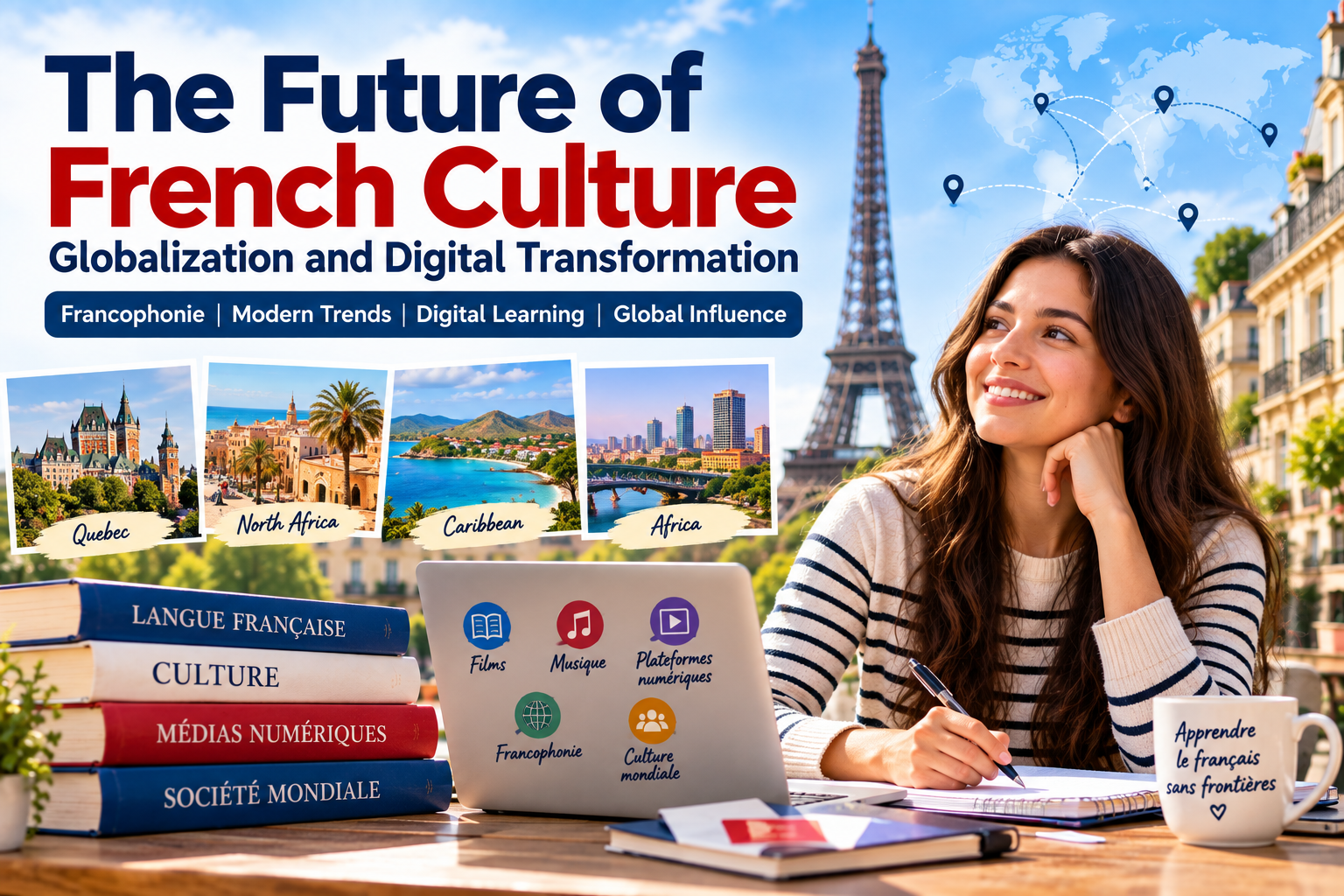
Future of French Culture: Globalization & Digital Change
The future of French culture is being shaped by two powerful forces: globalization and digital transformation. Understanding these shifts helps you do more than passively consume content. It guides how you learn French, how you prepare for exams like TEF or TCF, and how you build a real-life connection to the Francophone world. Today, cultural production in French is transcontinental, the globalization of the French language is accelerating in Africa, and digital platforms are redefining how we access films, music, news, and learning materials. If you want to speak French confidently, your study plan should reflect this reality.
In this future-oriented guide, we explore what is changing and why it matters for learners. You will find practical strategies, digital French learning resources, and a structured immersion routine you can follow over eight weeks. We also show how PrepFrench Classes weaves modern cultural trends into each French course, so you are preparing for life and exams at the same time. If you are ready to learn French with intention, these insights will help you choose the right path, from online French classes to focused TEF Canada or TCF Canada preparation.
Free First Step
Take the guesswork out of learning French.
Not sure where to begin, which course fits your goal, or how long it will take? Book a free demo class with PrepFrench Classes and get a personalized plan built around your level, schedule, and goals.
The Landscape of French Culture in the Global Context
Francophonie Today: Cultural and Linguistic Growth
French culture is no longer centered only in Paris. It is a mosaic shaped by Quebec, Africa, the Caribbean, North Africa, Belgium, Switzerland, and growing diasporas in Europe and North America. According to the Organisation internationale de la Francophonie, there are now well over 320 million French speakers worldwide, with the largest growth coming from Africa. This growth is influencing not only vocabulary and accents, but also the subjects, rhythms, and aesthetics that define contemporary French films, music, and literature.
- Francophone Africa is the demographic engine of the Francophonie future, with youthful populations driving music, cinema, and digital content.
- Quebec shapes media, comedy, and policy conversations, often emphasizing linguistic identity and everyday bilingual realities.
- Belgium and Switzerland contribute distinctive registers and cultural exports, from pop music to public media formats.
- Globalization of the French language creates cross-border collaborations, shared slang, and hybrid storytelling forms.
For learners in PrepFrench Classes, this matters directly. The French you hear from a journalist in Montreal or a rapper in Abidjan is part of the same language ecosystem as a Parisian TV host. Exposure to varied registers and accents accelerates comprehension and helps prepare for real conversations and exam listening tasks.
The Rise of African Influences on French Culture
From Dakar to Abidjan to Kinshasa, African creators are recentering French cultural trends. Afropop and rap artists dominate French charts, Congolese rumba and Ivorian coupé-décalé influence club sounds, and filmmakers from Senegal, Mali, and Morocco gain global recognition. On the literary side, recent major prizes have celebrated writers from across the Francophone world, which signals a long-term shift in who tells the stories that define contemporary French.
What this means for you: expect more diverse French on your screen and in your earbuds. Expect new slang, references, and accents. Embrace them. They are not obstacles, they are insight into where the culture is heading, and they are part of your learning toolkit if you want to speak French naturally.
Digital Transformation: Shaping French Culture and Language Learning
Popular Platforms for Cultural Immersion
Digital transformation puts the entire Francophone world one click away. Use this to your advantage with curated platforms that combine authenticity and accessibility:
- TV5MONDE and TV5MONDE Afrique: news, culture, and documentaries with subtitles. Great for comprehension at B1-B2.
- RFI and RFI Savoirs: international radio and learning modules. The “Journal en français facile” is ideal for daily listening.
- France 24 and Franceinfo: up-to-date news videos for opinion-building and note-taking practice.
- ARTE: high-quality documentaries and cultural programs with clear narration.
- Radio-Canada and Télé-Québec: essential for Quebec accents, policy debates, and cultural trends.
- Culturethèque: the Institut français digital library for ebooks, comics, and magazines.
- Podcasts: Affaires Sensibles, Transfert, Programme B, and Radio-Canada audio series for narrative listening.
- Short-form media: Brut and Konbini for micro-stories, interviews, and youth culture snapshots.
These platforms reflect French culture digital transformation in real time. You get accents from multiple regions, current expressions, and context for the news topics that often appear in exams and interviews.
Digital Learning Resources for Modern French Language Learners
Blend immersion with guided practice so you do not just watch and forget. Pair cultural consumption with active study using these digital French learning resources:
- TV5MONDE Langue Française: graded exercises linked to current clips, excellent for vocabulary and listening.
- RFI Savoirs and FLE activities: structured lessons built around real radio segments.
- Culturethèque reading: alternate between short articles and bande dessinée for stamina and pleasure.
- France Culture podcasts: pick a thematic series, transcribe a 2-minute excerpt, then shadow it for pronunciation.
In PrepFrench Classes, teachers fold these tools into your French lessons: one week might focus on Quebec media for accent training, the next on an ARTE documentary for structured speaking. The result is a French course that feels alive and anchored in what you will actually hear and discuss in the coming years.
Structured French Courses
Stop learning French the slow way.
Apps and random videos keep you stuck at beginner level forever. PrepFrench Classes gives you a structured path, a real teacher, and speaking practice that moves you forward at every lesson.
Available for: beginners · TEF/TCF exam prep · Canadian PR · work and daily French
Evolving Language Trends: Registers and Inclusive Writing
What is Inclusive Writing?
French is evolving as speakers seek language that represents everyone more clearly. Inclusive writing, often called écriture inclusive, aims to show gender diversity in nouns and job titles that have traditionally defaulted to the masculine. It appears most often in media, academia, NGOs, and some workplaces, while standards and acceptance vary by region and institution.
- Point médian: étudiant·e·s to include all genders in plural forms.
- Double forms: les étudiants et les étudiantes to ensure visibility of both forms.
- Epicene or neutral terms: la direction instead of le directeur when referring to a role generically.
- Titles and jobs: autrice, cheffe, écrivaine used more frequently in many contexts.
Knowing these patterns helps you read modern content fluently and adapt your writing for the audience you want to reach.
The Debate: Tradition vs Modern Usage
The Académie française favors tradition and readability, while many institutions and publishers experiment with inclusive styles. Government guidance differs by country and by sector, which creates a living debate. For learners, the practical takeaway is simple: match your register to your context. Use neutral or standard forms for formal exams and administrative writing, understand inclusive variants to read widely, and be ready to mirror the tone of your workplace or community.
Also pay attention to register beyond inclusion. Youth slang, verlan, Quebec idioms, and African French expressions are part of the global sound of French. You will hear eux-autres in Quebec, n’importe quoi in everyday Parisian speech, and borrowed English in tech spaces. PrepFrench teachers train you to shift gears: formal in a TEF speaking Part B, casual in a conversation with friends, regionally aware when listening to news from Abidjan or Montreal. This flexibility is a future-proof skill.
Preparing for French Proficiency Exams: Adapting to Cultural Context
Aligning Learning with Exam Expectations
TEF and TCF assess how you process authentic language: unfamiliar accents, current issues, and spontaneous tasks. Cultural awareness reduces panic and raises your score because you already know the kinds of topics and framing you are likely to encounter. Expect segments on education, environment, technology, work culture, immigration, and public services, all delivered in a variety of registers.
- Listening: train with news clips from multiple regions to normalize different accents.
- Speaking: build a toolbox of opinion phrases, argument structures, and linking words tied to everyday civic topics.
- Reading: practice skimming for structure, then scanning for key data and viewpoints.
- Writing: draft concise outlines before paragraphs, then add examples that reflect contemporary life.
Avoid a common mistake: memorizing generic templates without content. Examiners reward clarity, coherence, and relevant examples, not robotic recitation. Cultural references, when used sparingly and appropriately, help you demonstrate understanding and nuance.
Resources That Blend Culture and Language Skills
Use structured media to build both knowledge and language in one study block:
- TV5MONDE “7 jours sur la planète”: weekly themes, vocabulary lists, and comprehension tasks.
- RFI “Journal en français facile”: daily 10-minute listen, note 5 key facts, then summarize aloud in 90 seconds.
- France 24 debate programs: extract pros and cons, then practice a 2-minute position statement.
- Radio-Canada “Découverte”: science and society topics with clear visuals, great for B1-B2 listening.
PrepFrench integrates these into mock exams and live speaking drills. If your goal is Canada PR, explore our dedicated Full TEF Canada Course and Full TCF Canada Course. We simulate real prompts, prepare you for accent diversity, and coach you to produce structured, culturally aware answers that score at CLB 7 and above.
Mapping the Future of French Culture: An 8-Week Immersion Routine
Week-by-Week Learning Goals
This routine combines culture, communication, and exam logic. Plan for 45 to 60 minutes on weekdays and one focused 90-minute session on weekends.
-
Week 1: Set your media foundation. Choose two daily sources: one news audio (RFI facile or Franceinfo) and one short video (TV5MONDE). Track unknown words in a spaced-repetition list. Goal: summarize one story in 90 seconds each day.
-
Week 2: Accents and clarity. Add Radio-Canada or Télé-Québec for Quebec French. Shadow 2 minutes of audio daily. Record yourself and compare rhythm and vowel length. Goal: reduce hesitations, improve liaison and intonation.
-
Week 3: Documentary deep dive. Watch one ARTE documentary in two sittings. After part one, write a 120-word abstract. After part two, add a 120-word opinion. Goal: produce a clear synthesis and a stance.
-
Week 4: Conversation and role-plays. Join a speaking session in your online French classes or a conversation group. Role-play situations: housing, banking, healthcare, workplace norms. Goal: use polite register and repair strategies when you do not understand.
-
Week 5: Writing precision and inclusivity. Practice two short emails: one formal, one neutral-inclusive. Replace masculine generics with neutral phrasing where appropriate. Goal: accuracy in greetings, closings, and tone matching.
-
Week 6: Africa focus, global lens. Follow France 24 Afrique and a West or Central African music playlist. Note 5 expressions you had not seen, then confirm meanings through reliable sources. Goal: widen vocabulary range and cultural references.
-
Week 7: Exam simulation blocks. Two times this week, do a 30-minute TEF or TCF-style task set: listening, reading, and a short speaking prompt about a topical issue. Goal: move from passive understanding to structured performance.
-
Week 8: Capstone presentation. Prepare a 3 to 4 minute talk on a French cultural trend 2030: streaming and co-productions, inclusive language norms, climate-themed storytelling, or AI in media workflows. Record, self-assess for structure and clarity, then share with your French teacher for targeted feedback.
Combining Language Practice with Cultural Exposure
The key to results is consistency and feedback. Keep a simple tracker: minutes listened, words recorded, speaking minutes, and weekly reflection. When your plan is built into your French course, progress is faster because you get correction and accountability. In PrepFrench Classes, your tutor adapts tasks to your level, suggests relevant clips, and aligns practice with your TEF or TCF timeline. Small adjustments, like switching a source to train a hard accent or adding one argumentative connector per day, compound quickly.
PrepFrench Classes
Ready to start French with a clear plan?
Book a FREE demo class and get a personalized roadmap for your level, goal, and timeline. No pressure, no obligation.
Explore courses:
All French Courses · Full TCF Canada Course · Full TEF Canada Course
FAQ
How is French culture changing with the rise of African Francophone creators?
African Francophone creators are shaping the future of French culture through music, cinema, fashion, and literature. Sounds from Abidjan, Kinshasa, and Dakar influence French charts, and filmmakers from Senegal and Morocco win global attention. This shift broadens accents, slang, and storytelling perspectives you will hear in media and daily life. For learners in online French classes, exposure to West and Central African media strengthens listening and cultural fluency. PrepFrench integrates Africa-focused content into French lessons so you learn real vocabulary, references, and pronunciation that reflect the Francophonie future.
What digital platforms offer authentic, up-to-date French cultural content for learners?
Start with TV5MONDE, RFI and RFI Savoirs, France 24, ARTE, and Radio-Canada. These combine credible reporting, cultural features, and high-quality documentaries. Add Culturethèque for ebooks and comics, plus podcasts such as Affaires Sensibles and Transfert for narrative listening. Build a routine: one 10-minute news audio plus one short video daily. In PrepFrench Classes, teachers select clips that match your level and goals, then turn them into speaking, grammar, and pronunciation tasks inside your French course.
Does AI help or hinder learning authentic French?
AI can help when used with intention: quick vocabulary checks, transcript generation, or pronunciation feedback to complement real inputs. It can hinder if it replaces authentic listening, speaking with a teacher, or reading diverse sources. For best results, pair AI tools with human-guided French lessons, real media, and feedback cycles. PrepFrench focuses on live teaching and structured practice first, then uses digital tools to accelerate, not replace, the core skills you need to speak French with confidence.
How can cultural immersion improve TEF/TCF scores?
Cultural immersion makes exam tasks feel familiar. Regularly hearing news clips from France, Quebec, and Africa builds accent tolerance and gives you ready-made examples for speaking and writing. You will know common public topics, phrases for opinion, and how to structure arguments. In a targeted French course, teachers connect cultural content to exam formats: timed summaries, note-taking from videos, and concise position statements. This alignment boosts listening, reading, and production scores efficiently.
How do Quebec's language policies affect daily life for newcomers?
Quebec promotes French in public life, signage, and many workplaces, which means newcomers benefit from practical French quickly. You will encounter local accents, regional expressions, and administrative processes in French. For integration, prioritize communication skills for housing, healthcare, and employment. Online French classes with Quebec content, Radio-Canada listening, and role-plays prepare you for real tasks. PrepFrench includes Quebec-focused modules in French courses and TEF/TCF prep so you build confidence for daily interactions and official requirements.
Final Thoughts
The future of French culture is plural and connected: African music shaping Paris playlists, Quebec debates framing language policy, and digital platforms linking everyday learners with creators across the world. For anyone who wants to learn French, this is good news. Authentic material is easier to access, and your French classes can mirror the real voices and topics you will meet in work, travel, and exams.
Choose a French course that integrates culture, structure, and feedback. PrepFrench Classes builds this blend into every lesson: targeted grammar and pronunciation, plus curated clips and tasks tied to your goals. Explore our courses or return to the homepage to see how we help learners progress with clarity, not randomness. Digital transformation is rewriting access, and you can ride that wave with a plan.
✅ Next Step: Book a free demo class with PrepFrench Classes and start learning French the right way.
Remember that exploring modern French culture will enrich your language learning and integration experience.
Written by
Platform Administrator
Practical ideas from the Prep French team for learners building confidence, preparing for exams, and planning their next step in Canada.
Join the discussion
Leave a thoughtful comment.
Your email address will not be published. Comments are reviewed before appearing.