French Tech Industry: Innovation, Startups and Opportunities
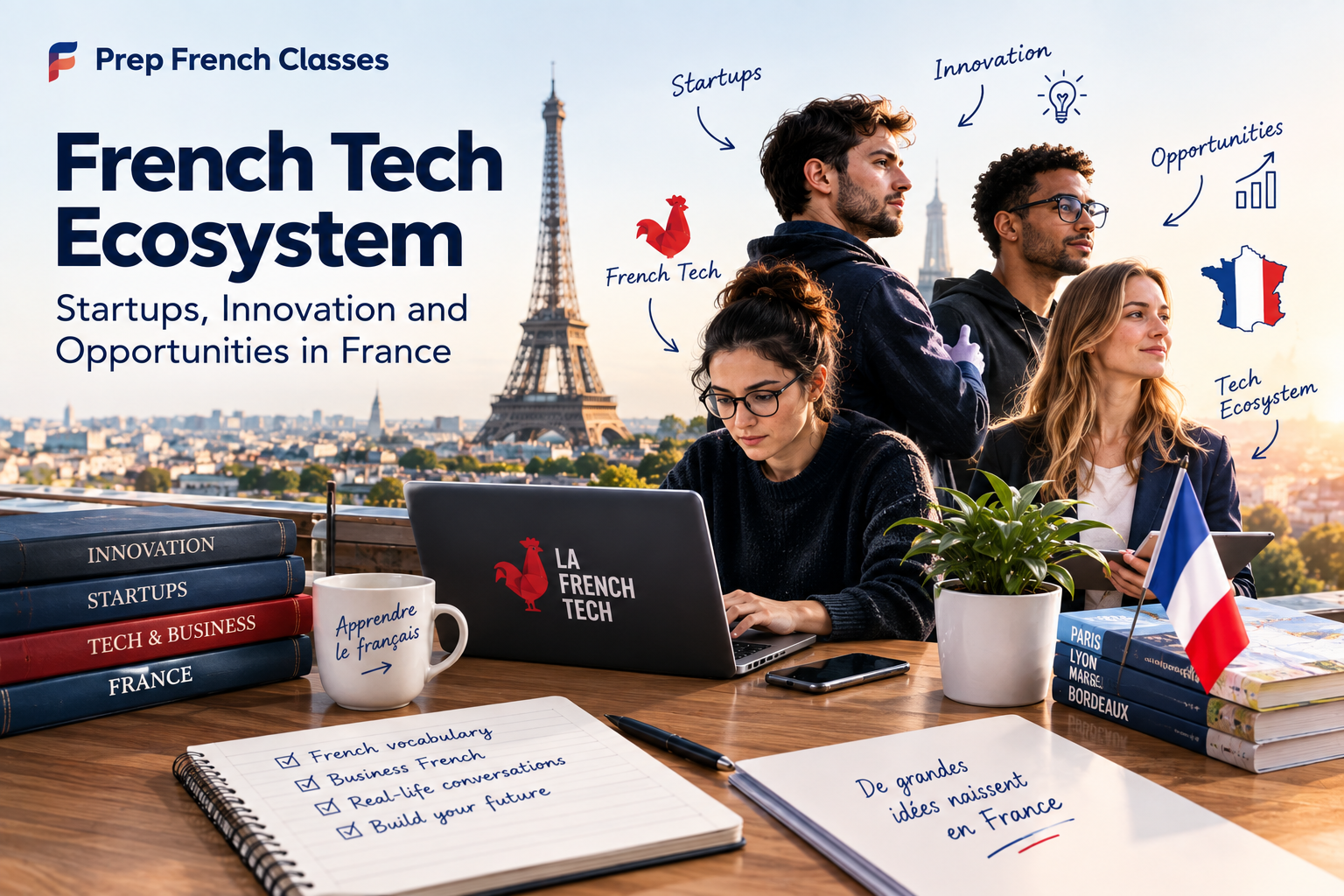
France has transformed itself into one of Europe’s most dynamic innovation hubs, with the French tech industry now competing on the global stage. Under the banner of La French Tech, the country blends ambitious policy, strong funding instruments, and a robust startup culture to support everything from deeptech and AI to fintech, healthtech, and GreenTech. For international founders and professionals, the opportunity is real: clear visa pathways, a fast-growing ecosystem, and a network of local hubs that welcome collaboration. Language skills multiply these advantages. If you can speak French with clients, investors, or regulators, you reduce friction, accelerate trust, and understand the nuance behind decisions that shape deals. That is where targeted French classes and a structured plan from PrepFrench can be the difference between admiring the ecosystem and thriving within it. Explore the ecosystem below, then build your language toolkit with a practical, career-focused French course that fits your goals. You can also start with the PrepFrench Classes homepage to see how we help professionals integrate language learning with real work scenarios.
Free First Step
Take the guesswork out of learning French.
Not sure where to begin, which course fits your goal, or how long it will take? Book a free demo class with PrepFrench Classes and get a personalized plan built around your level, schedule, and goals.
What is La French Tech?
Overview of La French Tech
La French Tech is a government-backed movement and brand that unites startups, scaleups, investors, corporates, incubators, and public agencies across France and abroad. It provides visibility to French digital innovation, advocates for pro-startup policies, and connects founders to resources through a nationwide network of hubs. Whether you are in Paris, Lyon, Lille, Nantes, Bordeaux, Toulouse, Marseille, or overseas communities, La French Tech aims to make the country one of the easiest places to launch and scale a company.
The initiative is more than a logo. It is a platform that coordinates support programs, talent pipelines, and access to public services. Community events, mentor networks, and collaboration spaces create the social fabric where deals start and partnerships grow. Strong English is common in many circles, yet the day-to-day of these hubs often benefits from French. If you want to unlock spontaneous conversations and read official guidance quickly, pairing your market entry with practical French lessons is a smart move.
Major Programs and Initiatives
Several national programs sit under La French Tech. Here are highlights worth knowing:
- Next40 and French Tech 120: Two flagship cohorts that spotlight the most promising French startups and scaleups, providing access to a dedicated account manager, faster administrative support, and high-level visibility.
- French Tech Visa: A streamlined residence pathway for startup founders, employees, and investors. It provides up to four years of renewable status, helping international talent integrate into the ecosystem faster.
- French Tech Central: A program that connects startups to public services and regulators inside major hubs. It simplifies navigation of legal, tax, and administrative topics.
- French Tech Tremplin: An inclusion initiative that supports founders from underrepresented backgrounds with funding and training.
- French Tech Seed and Deeptech support: Often delivered with Bpifrance, these programs fuel early-stage and high-risk research commercialization.
These initiatives show why the French tech industry has momentum: strong public support, coordinated resources, and communities designed for real progress. If you plan to work from these hubs, prepare practical phrases, presentation vocabulary, and pitch language. Tailored French courses focused on meetings and demos help you find your voice faster in this environment.
The Policy & Funding Backbone of the French tech industry
The France 2030 Innovation Plan
France 2030 is a long-term investment strategy that directs tens of billions of euros into strategic technologies and industrial revival. The plan targets areas where France can lead: clean energy, hydrogen, low-carbon transport, space, health, semiconductors, robotics, AI, and agritech. The objective is clear: accelerate R&D, shorten the path from lab to market, and build sovereign capabilities in critical sectors.
For startups and scaleups, France 2030 unlocks grants, equity co-investments, and state aid administered largely through Bpifrance and other operators. It also funds test beds, pilot lines, and industrialization steps that are often difficult to finance with private capital alone. If your technology aligns with these priorities, you can benefit from a pipeline of calls for projects and programs over multiple years, which helps planning and hiring.
Funding Landscape: Bpifrance and Other Sources
Bpifrance, the French public investment bank, is the central financial engine for innovation. It offers a continuum of support: non-dilutive innovation grants, recoverable advances, zero-interest loans for innovation, co-investments with VCs, and guarantees for bank loans. On top of this, EU programs such as Horizon Europe and the EIC Accelerator bring additional capital and prestige. Tax incentives like the Research Tax Credit (CIR) and Innovation Tax Credit (CII) reduce the cost of R&D as teams scale.
| Funding Type | Typical Range | Best For | Where to Start |
|---|---|---|---|
| Bpifrance innovation grants and recoverable advances | €30k to €1M+ depending on program | Early technical validation, prototypes, feasibility studies | Bpifrance regional office or online portal |
| Bpifrance Deeptech programs | Often €100k to several million in staged support | Research-heavy startups, lab-to-market projects | Bpifrance Deeptech pages and incubator partners |
| French Tech Seed co-investment | Matching private funds, varies by deal | Early-stage deeptech with tech transfer backing | Labelled tech-transfer and seed partners |
| EU grants: Horizon Europe, EIC Accelerator | €500k to €2.5M+ grants, blended finance available | High-impact, scalable innovation with EU relevance | National Contact Points, EU Funding & Tenders portal |
| Tax incentives: CIR and CII | Credits against eligible R&D spend | R&D-intensive teams scaling headcount and labs | Speak with your accountant, consult tax authority guides |
Application forms, calls for projects, and guidance notes often appear first in French. If you plan to submit on a tight timeline, prepare your language workflow early: templates for a “lettre de motivation,” a technical “note de synthèse,” and a concise pitch deck in French. Short, intensive online French classes tailored to funding applications can save days of back-and-forth and help you answer reviewers precisely.
Structured French Courses
Stop learning French the slow way.
Apps and random videos keep you stuck at beginner level forever. PrepFrench Classes gives you a structured path, a real teacher, and speaking practice that moves you forward at every lesson.
Available for: beginners · TEF/TCF exam prep · Canadian PR · work and daily French
Digital Infrastructure & Cybersecurity
The Role of ARCEP in Telecommunications
ARCEP is France’s telecoms regulator. It manages spectrum, fosters competition, and monitors coverage for mobile and fixed networks. For startups delivering data-heavy services, understanding the connectivity landscape is key to user experience and deployment cost. Recent policy efforts have accelerated fiber-to-the-home and 5G rollout, which opens new doors for IoT, edge computing, and real-time applications.
- 5G availability has expanded across major urban areas, with ongoing densification to improve capacity and latency-sensitive use cases.
- France remains a European leader in fiber coverage, which supports cloud adoption, remote work, and high-quality video services.
- Open data from ARCEP helps teams plan infrastructure-dependent products and benchmark performance by region.
When selling to local enterprises or public bodies, French terminology around service-level agreements, security requirements, and telecom compliance will appear in contracts. A focused French course that builds technical vocabulary will help your team negotiate confidently.
Overview of ANSSI’s Cybersecurity Framework
ANSSI, the National Cybersecurity Agency of France, defines standards and certifies solutions for critical systems. It also publishes guidance for incident response, risk management, and cloud security. For cloud providers and SaaS companies selling to regulated sectors, the SecNumCloud framework is a reference point. For hardware and IoT, certification pathways and best practices help reduce procurement friction with large customers.
What this means for startups and scaleups:
- Security by design is rewarded: robust policies, encryption practices, and incident reporting make enterprise sales easier.
- French language documentation matters: technical annexes, “homologation” reports, and security policies often need to be submitted in French.
- Collaborate with the cyber community: France hosts cyber campuses and events that connect founders with CISOs, integrators, and public buyers.
If you plan to pursue ANSSI-relevant certifications, schedule internal training on security terms in French early. It speeds up compliance work, avoids misunderstandings, and builds executive credibility in local meetings.
Key Sectors to Watch
Overview of AI and Fintech Growth
AI and data platforms have surged in France, backed by research strength in mathematics, computer science, and public research institutes. Global attention on French AI labs and model makers illustrates the country’s technical depth. Applied AI is active across customer support, healthcare diagnostics, predictive maintenance, and supply chain optimization.
- AI: Model development, MLOps tooling, and vertical AI for health, manufacturing, and retail. Enterprise readiness and trust are current differentiators.
- Fintech: Neobanking, payments, regtech, and SME banking continue to scale. B2B financial services, APIs, and compliance automation are hot areas.
- Cybersecurity: Identity, device security, encryption, and threat intelligence see steady demand from mid-market and large enterprises.
Pitching AI or fintech in France often requires precise wording on data governance, GDPR, model transparency, and risk controls. Practicing these explanations in French helps align with local procurement and regulator expectations.
GreenTech and Sustainability Initiatives
France’s climate and industrial policies are creating long-term opportunities in GreenTech. Energy storage, hydrogen, circular economy, low-carbon mobility, and building efficiency are investment priorities. Healthtech remains a pillar too, supported by hospital partnerships and a large domestic market.
- GreenTech: Batteries, hydrogen systems, carbon accounting platforms, and recycling technologies get policy tailwinds and funding attention.
- Healthtech: Telemedicine, medical devices, AI-assisted imaging, and EHR interoperability advance through pilots and public-private partnerships.
- Quantum and photonics: Hardware startups, quantum computing, and sensing systems leverage research ecosystems in Paris-Saclay, Grenoble, and other clusters.
- Industry 4.0 and robotics: Automation, logistics robotics, and advanced manufacturing support Europe’s reindustrialization efforts.
Across these sectors, mastering sector-specific French vocabulary pays off. Technical “dossiers,” partnership MoUs, and site visits become smoother when your team can hold the conversation in either language.
Hubs, Talent & Entry Points
Spotlight on Station F
Station F in Paris is often called the world’s largest startup campus. It brings together hundreds of startups, partner programs, VCs, and corporate innovation arms under one roof. The density of talent and services makes it ideal for early customer discovery, fundraising, and pilot projects. Many community events occur in French, with English increasingly common. Founders who can switch between both languages enjoy broader conversations and warmer intros.
Beyond Station F, look to regional powerhouses: Paris-Saclay for research and deeptech, Sophia Antipolis for IT and telecom, Grenoble for semiconductors and photonics, Toulouse for aerospace, and Lille’s Euratechnologies for digital commerce and retail tech. Each hub has its own specialty and investor network.
Events to Attend in the French Tech Space
Consistent event presence helps you build trust and pipeline. Put these on your calendar:
- VivaTech (Paris): Europe’s largest tech event for enterprise partnerships, brand showcases, and global visibility.
- France Digitale Day (Paris): A scaleup-focused summit that connects founders, policymakers, and investors.
- Paris Fintech Day or Paris Fintech Forum: A strong place for fintech deals, partnerships, and press.
- BIG by Bpifrance: A massive gathering of entrepreneurs, corporates, and public actors.
- Web2Day (Nantes): Product, marketing, and startup culture with a western France network.
- SIDO (Lyon): IoT, AI, and robotics with industrial partners.
- Forum InCyber Europe (Lille): Formerly FIC, a major cybersecurity conference with CISOs and solution providers.
- Hello Tomorrow Global Summit (Paris): Deeptech showcase with scientists, investors, and tech transfer leaders.
Events are where off-agenda opportunities happen. A clear self-introduction in French, a sharp “une phrase d’accroche,” and a concise pitch can be the difference between a quick goodbye and a follow-up meeting. If you want a tailored plan to practice those lines, see our structured French lessons designed for professionals who network and present often.
How to Engage: Practical Steps
Utilizing Official Resources
Start with La French Tech hub pages for programs and contacts. Explore Bpifrance for financing tools, and scan France 2030 calls for projects that fit your roadmap. For EU-level grants, review Horizon Europe work programs early, then align your consortium and KPIs. Keep a running glossary of key French terms across legal, tax, and technical documents. It will reduce translation time and help non-native teammates follow meetings more easily.
Preparing for the French Tech Visa
The French Tech Visa streamlines residence for founders, startup employees, and investors. Eligibility usually requires a French host entity or partnership and proof of resources or salary. Documentation can be assembled in English and French depending on your case, yet providing high-quality French versions for employment contracts, job descriptions, and company documents often speeds local administrative steps.
- Clarify your France plan: Choose a landing hub, define your first 6 to 12 months, and list the partners you need to meet. Align goals with the strengths of the local ecosystem.
- Map programs to milestones: Identify which La French Tech or Bpifrance programs address your next product or go-to-market step. Prepare a simple tracker of deadlines and required attachments.
- Choose your entity path: Discuss with a lawyer or startup clinic which structure fits: SAS for flexibility is common. Ensure shareholder and IP agreements are clear in French and English.
- Build a funding mix: Combine non-dilutive support, co-investments, and VC interest. For deeptech, plan both technical validation and industrialization budgets.
- Prepare the French Tech Visa file: Gather employer certificates, job offers, or founder documentation. Keep clean versions of your “K-bis,” company bylaws, and payroll documents.
- Set your compliance baseline: For regulated sectors, prepare GDPR mapping, security policies, and any ANSSI-relevant documentation in French.
- Join a hub and events: Apply to an incubator or accelerator in your priority region. Book a presence at two major events within your first quarter in France.
- Level up French systematically: Create a focused language plan: 2 to 3 weekly sessions, targeted vocabulary for pitches, emails, and procurement, with regular mock calls. Book a free demo at PrepFrench Classes to match lessons to your meetings calendar.
- Recruit with intent: Leverage internships and apprenticeships that France is known for. Align job ads in French and English, and prepare interview scripts in both.
- Track progress and iterate: Every 6 weeks, review program fit, pipeline, and language comfort. Adjust your French course focus as your role shifts from fundraising to delivery.
If TEF or TCF scores are part of your long-term plan, you can prepare with specialist programs like the Full TCF Canada Course or the Full TEF Canada Course. Even if exams are not mandatory for work, structured preparation builds precision in grammar, vocabulary, and pronunciation that transfers directly into professional communication.
PrepFrench Classes
Ready to start French with a clear plan?
Book a FREE demo class and get a personalized roadmap for your level, goal, and timeline. No pressure, no obligation.
Explore courses:
All French Courses · Full TCF Canada Course · Full TEF Canada Course
FAQ
What is La French Tech, and how does it support startups?
La French Tech is a national movement that unites France’s startup community. It promotes the French tech industry, supports high-potential companies, and coordinates resources through local hubs. Signature programs include the Next40 and French Tech 120 for scaleups, the French Tech Visa for international talent, and French Tech Central for access to public services. The initiative connects founders to funding tools like Bpifrance and provides visibility at events. If you want to plug in faster, take targeted French lessons or an online French class to handle intros, pitches, and emails smoothly. PrepFrench offers a structured French course for professionals entering this ecosystem.
Which sectors lead in the French tech industry?
AI, fintech, healthtech, GreenTech, cybersecurity, and deeptech areas such as quantum and photonics are among France’s strongest growth engines. Public investment through France 2030, Bpifrance deeptech programs, and EU grants fuels research translation into products. Industrial tech, robotics, and logistics solutions are also expanding as Europe reindustrializes. Success in these sectors often requires fluent communication with regulators, enterprise buyers, and research partners. Working with a French teacher, joining structured French classes, and learning industry-specific vocabulary help your team close deals faster and navigate procurement steps more easily.
How does the French Tech Visa work for international professionals?
The French Tech Visa offers a simplified residence route for founders, startup employees, and investors tied to the French ecosystem. It can provide up to four years of renewable status, with criteria that include a local employer or host entity, proof of resources, and role relevance. Documentation may involve employment contracts, company registration, and evidence of innovation activity. While many documents can be prepared in English, offering high-quality French versions often speeds administrative processing. If you need language support, an online French course with PrepFrench helps you build the vocabulary for HR, contracts, and official forms, reducing back-and-forth with authorities.
What funding opportunities are available for tech startups in France?
Funding spans non-dilutive grants, zero-interest innovation loans, co-investments, VC partnerships, and tax incentives like the CIR and CII. Bpifrance is the main operator for innovation financing, with programs for early validation, deeptech, and industrial scale-up. France 2030 adds large strategic calls for projects, and EU programs like Horizon Europe and the EIC Accelerator target high-impact innovation. Successful applicants submit clear technical roadmaps and market plans. Since many calls and templates are in French, concise language is a competitive asset. Consider specialized French lessons that focus on proposals, technical notes, and reviewer Q&A.
How can language skills benefit someone working in the French tech ecosystem?
Language skills reduce friction across every touchpoint: investor meetings, enterprise sales, partnership negotiations, and regulatory compliance. Speaking French lets you read guidance first, respond precisely in RFPs, and handle corridor conversations at events like VivaTech. It also strengthens trust with public bodies and helps you manage HR and onboarding documents without delay. For busy professionals, structured online French classes with PrepFrench deliver targeted practice: email templates, pitch scripts, technical vocabulary, and mock calls. This focused approach moves you from translation dependency to confident participation in the French tech industry.
Final Thoughts
The French tech industry is no longer a hidden gem. Backed by La French Tech, France 2030, and Bpifrance, it blends scientific strength with pragmatic programs that help startups grow. Digital infrastructure is solid, cybersecurity expectations are clear, and sector momentum in AI, fintech, healthtech, GreenTech, and deeptech is tangible. Entry points exist at every stage, from incubators and Station F to national calls for projects and European grants.
Your edge comes from preparation: a crisp plan, well-matched programs, and the ability to communicate effectively in French and English. That is why pairing market entry with a structured French course is so powerful. PrepFrench Classes helps professionals build the exact vocabulary and speaking confidence they need for intros, pitches, negotiations, and compliance tasks. If you want a realistic, step-by-step language plan that supports your work calendar, we are ready to help.
Use the resources linked here, connect with a local hub, and start small with the next relevant event. Momentum in France is built through consistent conversations, and language fluency is the multiplier that makes every meeting count.
✅ Next Step: Book a free demo class with PrepFrench Classes and start learning French the right way.
Keep an eye on updates from La French Tech, Bpifrance, and sector events, and refresh your French vocabulary as your role evolves. Small, steady progress in language skills pays off in every meeting and application you submit.
Written by
Platform Administrator
Practical ideas from the Prep French team for learners building confidence, preparing for exams, and planning their next step in Canada.
Join the discussion
Leave a thoughtful comment.
Your email address will not be published. Comments are reviewed before appearing.