French Political System: A Guide to Governance and Heritage
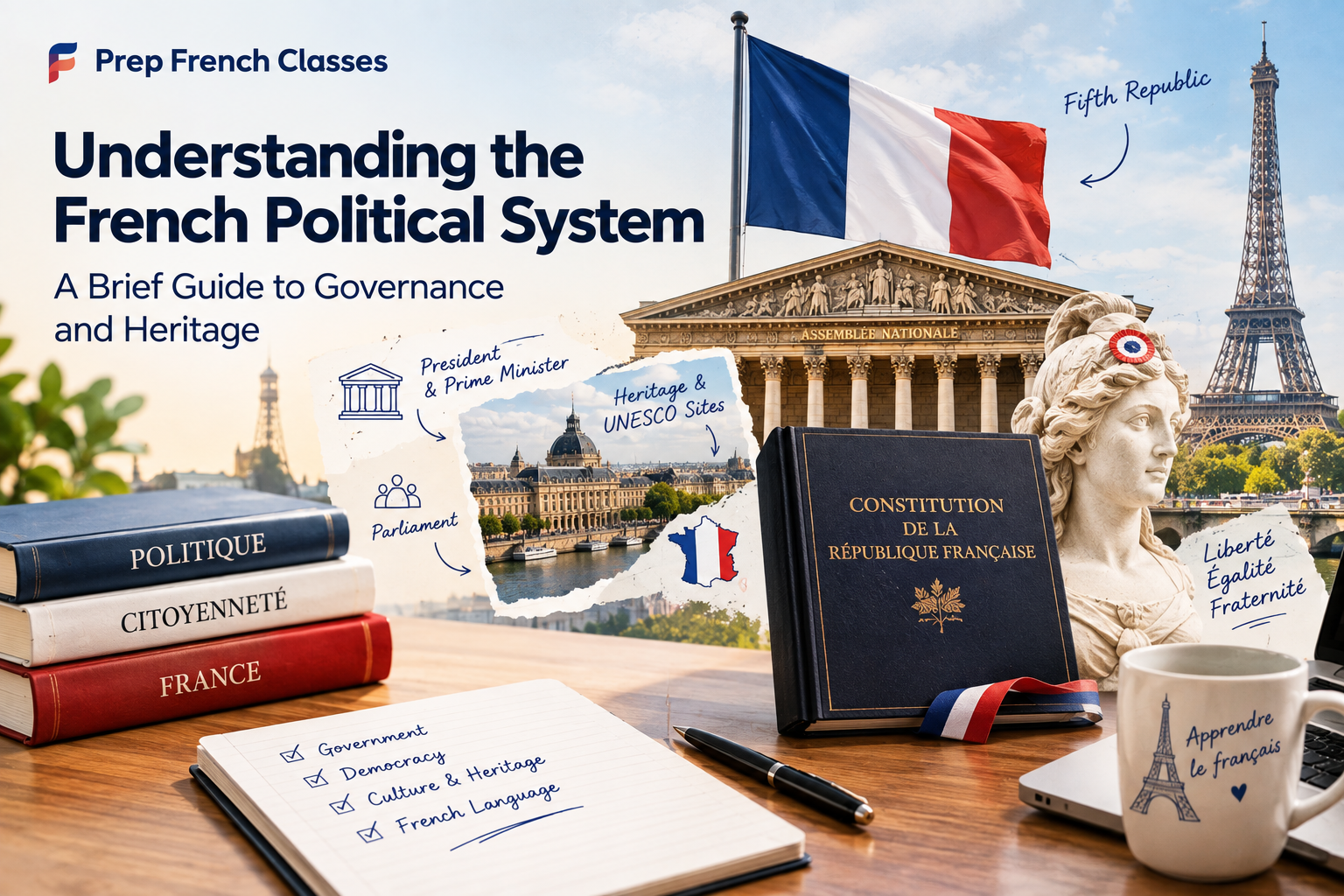
The French political system sits at the heart of how France organizes power, debates national identity, and protects its celebrated cultural heritage. Under the Fifth Republic France has a semi-presidential system that blends a strong presidency with a parliamentary government. Knowing how this framework functions helps you follow French news, discuss current events, and even plan smarter travel. It also deepens your appreciation of French language and culture, which is exactly why PrepFrench Classes integrates governance and heritage topics into our French classes and online French classes.
- Fifth Republic France: a constitution dating from 1958 that stabilizes institutions.
- Semi-presidential system France: an elected President alongside a Prime Minister supported by Parliament.
- Key bodies: the National Assembly, the French Senate, and the Constitutional Council.
- Core principles: laïcité in France and ongoing decentralization shaping local life.
- Connection to heritage: governance frameworks protect UNESCO sites and Monuments Historiques.
As you learn French, understanding governance gives context to vocabulary, headlines, and everyday conversations. If you want a guided path, visit our home page to see how a structured French course can connect language skills with real French life and culture.
Free First Step
Take the guesswork out of learning French.
Not sure where to begin, which course fits your goal, or how long it will take? Book a free demo class with PrepFrench Classes and get a personalized plan built around your level, schedule, and goals.
What Defines the French Political System?
At a glance, the French political system is semi-presidential, which means executive power is shared by a President and a Prime Minister. It is framed by the Constitution of the Fifth Republic France, adopted in 1958 to bring stability after a turbulent postwar era. These two features shape daily politics, election cycles, and the rhythm of government change.
Understanding Semi-Presidentialism
In a semi-presidential system, voters directly elect the President, while members of Parliament are elected to represent constituencies. The President appoints a Prime Minister who must retain the confidence of the National Assembly. Policy-making is therefore a balance: the President sets major national directions and foreign policy, and the Prime Minister leads government action and manages domestic legislation with the Cabinet.
- Dual executive: President of the Republic and Prime Minister share executive authority.
- Parliamentary responsibility: the Government can be brought down by a vote of no confidence.
- Flexibility: when the President’s party holds a majority in the National Assembly, the President wields greater influence.
Overview of the Fifth Republic
The Fifth Republic strengthened the executive to avoid the chronic instability of earlier republics. Over time, several reforms fine-tuned the system. A key shift in 2000 shortened the presidential term from seven to five years, aligning it more closely with the legislative term. Since 2002, legislative elections usually follow the presidential race, which often reduces the chance of divided government.
Even so, tools like dissolution of the National Assembly remain. For instance, the presidential power to dissolve has been used to reset the political agenda and seek a new mandate from voters. Understanding these levers helps you interpret breaking news and political strategy, especially when you are learning political vocabulary in French. For guided practice, our French courses include modules that make news comprehension actionable.
Distinction Between President and Prime Minister
Although they share power, their roles differ:
- President: head of state, guardian of the Constitution, and leader on foreign affairs and defense. The President appoints the Prime Minister and can submit some laws to referendum.
- Prime Minister: head of government who directs government action, coordinates ministries, and presents bills to Parliament. The Prime Minister answers to the National Assembly.
When the President’s party lacks a parliamentary majority, cohabitation can occur, with a Prime Minister from a different political camp. France has experienced cohabitation periods that reshaped the balance within the executive. For learners who follow French news, this explains shifts in tone between presidential speeches and government policies. PrepFrench integrates real articles and broadcasts in French lessons so you build both vocabulary and context quickly.
The Key Institutions of French Governance
The French government structure revolves around the legislative branch, the executive, and constitutional review. Three bodies are especially central to lawmaking and legal oversight: the National Assembly, the Senate, and the Constitutional Council.
The National Assembly and Its Role
The National Assembly France is the lower house of Parliament, made up of 577 deputies elected in single-member constituencies. It is the chamber that can bring down a government through a motion of no confidence, which gives it significant political weight.
- Legislation: deputies propose bills, amend government proposals, and vote on final texts.
- Oversight: question time, investigative committees, and budget scrutiny hold ministries accountable.
- Final say: when the two chambers disagree after several readings, the Assembly can have the last word on many ordinary laws.
The Government can accelerate lawmaking under certain conditions, such as using Article 49.3 to pass a bill unless a no-confidence vote succeeds. You will often see 49.3 referenced in headlines, which is why it appears in news-centered lessons inside PrepFrench Classes.
The Senate: Composition and Function
The French Senate is the upper house of Parliament and represents local governments such as communes, departments, and regions. Senators are elected indirectly by an electoral college and serve six-year terms, with half the chamber renewed every three years. The Senate reviews and amends legislation, particularly valuing territorial perspectives and long-term policy stability.
- Institutional stability: slower renewal provides continuity during political shifts.
- Local voices: senators maintain close links with mayors and local councils, influencing laws on urban planning, culture, and transport.
- Legislative ping-pong: the Senate and Assembly often exchange versions of a bill, a process called the navette, before final adoption.
The Constitutional Council and Judicial Review
The Constitutional Council France ensures that laws comply with the Constitution. It has nine members appointed for nine-year, non-renewable terms, with a third replaced every three years. It can review bills before promulgation or after, through a mechanism called the Priority Question of Constitutionality (QPC) that was introduced in 2008.
- Pre-enactment review: political actors can refer a bill to the Council to test its constitutionality before it becomes law.
- QPC: during a trial, any citizen may argue that a law violates constitutional rights, which can trigger review.
- Checks and balances: the Council protects fundamental freedoms, including principles like equality before the law.
When French media announce a law was partially struck down, they are usually reporting on a Constitutional Council decision. Understanding these steps will help you navigate articles and broadcasts with ease. If you want practice with institutional vocabulary, browse our courses page for lessons that pair news clips with guided exercises.
Structured French Courses
Stop learning French the slow way.
Apps and random videos keep you stuck at beginner level forever. PrepFrench Classes gives you a structured path, a real teacher, and speaking practice that moves you forward at every lesson.
Available for: beginners · TEF/TCF exam prep · Canadian PR · work and daily French
Elections: The French Political Cycle
Elections in France center on a two-round system that applies to presidential and legislative races. While the President is elected directly by citizens, members of the National Assembly are elected in single-member districts. This structure shapes campaign strategies, alliances between parties, and voter behavior.
Presidential Elections: A Two-Round System
To win the presidency, a candidate must secure an absolute majority. If no one achieves this in the first round, the top two face a runoff. The period between rounds often leads to endorsements, realignments, and intense media debates. For French learners, this is a prime time to follow televised interviews, read op-eds, and practice opinion phrases. PrepFrench French lessons include expressions for agreement, disagreement, and weighing pros and cons to help you discuss politics naturally.
Understanding Parliamentary Elections
Legislative elections choose the 577 deputies of the National Assembly using a similar two-round model. Candidates who cross certain thresholds in the first round can continue to the second, which sometimes creates three-way contests. Since 2002, these elections typically follow soon after the presidential vote, often reinforcing the winning presidential coalition in Parliament. Still, snap elections are possible if the President dissolves the Assembly.
Voter Participation and Engagement
Turnout fluctuates by election type. Presidential races generally mobilize more voters than parliamentary contests. In recent cycles, second-round presidential turnout hovered around the low 70 percent range, while legislative turnouts have been markedly lower. Understanding these dynamics helps you interpret headline narratives about legitimacy and momentum.
- Presidential campaigns: heavy media coverage, televised debates, large rallies, and strong opinion polling.
- Legislative focus: local candidates, constituency concerns, and coalition-building after the presidential result.
- Civic education: schools and media emphasize republican values and participation, which is a great context for vocabulary building.
To prepare for conversations about elections, review political vocabulary and role-play interviews. Our online French classes include news-based speaking tasks and debate activities that fit real-life media formats.
Fundamental Principles: Laïcité and Decentralization
Two enduring principles shape how France organizes public life and local governance: laïcité, which anchors the secular character of the Republic, and decentralization, which redistributes responsibilities from Paris to regions and communes.
Understanding Laïcité in France
Laïcité is the constitutional principle that the state is neutral regarding religion and guarantees freedom of belief. Its modern legal foundation comes from the 1905 law separating churches and the state. In practice, it requires public institutions, especially schools and the civil service, to remain neutral in matters of faith. Policies limiting conspicuous religious symbols in schools and face coverings in public spaces reflect ongoing debates about social cohesion, equality, and individual freedoms.
- Neutral public space: civil servants cannot promote religious views while on duty.
- Freedom of conscience: individuals may believe or not believe, with equal protection under the law.
- Active debate: laïcité frequently appears in election platforms and Constitutional Council reviews.
Grasping laïcité helps learners understand vocabulary on rights, identity, and education, which are part of advanced conversation topics in PrepFrench Classes.
The Impact of Decentralization on Local Governance
Since the 1980s, decentralization France has transferred meaningful powers to local authorities. Regions, departments, and communes manage areas like transportation, urban planning, certain education infrastructures, and cultural programming. This shift made local councils more prominent in economic development, heritage preservation, and everyday services.
- Regions: manage transport networks, vocational training, and regional development.
- Departments: focus on social services, roads, and local infrastructure.
- Communes: handle primary schools, libraries, local culture, and city planning.
For travelers, decentralization explains why regional festivals, museum funding, and local heritage trails vary by location. For learners, it clarifies headlines about mayors, prefects, and regional councils. If you want to learn the phrases that appear in news coverage on these topics, explore our French language classes tailored to current events and culture.
Cultural Heritage and Governance in France
Governance in France is deeply linked to cultural heritage, or patrimoine. Laws, budgets, and administrative bodies protect historic buildings, landscapes, and living traditions. This is part of why cities and villages are so rich in well-preserved architecture and why cultural events remain central to community life.
Overview of Heritage Protection Mechanisms
France classifies sites as Monuments Historiques, supports renovation through regional cultural directorates (DRAC), and maintains national inventories of artifacts and architecture. Planning permissions often include reviews by Architectes des Bâtiments de France to ensure that new projects respect protected views and materials.
- Monuments Historiques: from cathedrals to industrial sites, many structures receive legal protection.
- Urban heritage zones: protection rules shape facades, signage, and building heights.
- Intangible heritage: culinary traditions, craftsmanship, and festivals also receive recognition, including UNESCO listings.
Role of the Ministry of Culture
The Ministry of Culture funds restoration work, supports museums and performing arts, and coordinates national heritage policy. It works closely with local governments that co-finance projects, especially for regional museums, archives, and theaters. Budgets for heritage can fluctuate with national priorities, but cross-level cooperation is a constant feature of French cultural governance.
Connection Between Governance and Heritage Preservation
Why does the political system matter for heritage? Because sustainable funding, clear legal protections, and active local governments keep historic centers vibrant. City halls apply building rules that preserve skyline silhouettes, regional councils co-finance restorations, and the Constitutional Council arbitrates when heritage rules intersect with property or economic freedoms.
France also shines internationally through UNESCO World Heritage Sites. There are more than forty-five recognized sites across the country, ranging from medieval marvels to prehistoric caves. Here are a few that show how governance and culture intertwine:
- Mont-Saint-Michel and its Bay, Normandy: a masterpiece of medieval architecture and tidal landscapes.
- Paris, Banks of the Seine: a living urban ensemble of monuments, bridges, and public spaces shaped by centuries of planning.
- Historic Site of Lyon: Roman roots and Renaissance urbanism supported by careful municipal policies.
- Prehistoric Sites and Decorated Caves of the Vézère Valley: strict protections preserve fragile art.
- Loire Valley between Sully-sur-Loire and Chalonnes: châteaux and river landscapes maintained through regional and national coordination.
If you love traveling, pairing heritage visits with language learning multiplies the experience. In PrepFrench French classes, we use museum texts, walking-tour vocabulary, and real info panels from UNESCO sites, so your French improves as you explore France’s patrimoine.
Stay Informed: Following French Politics and News
To build confidence in political French, combine trusted media sources, essential vocabulary, and low-pressure practice. A little structure goes a long way.
Best Media Sources for French Politics
- National dailies: Le Monde, Le Figaro, Libération for diverse editorial lines.
- Public media: Franceinfo and France Inter for balanced coverage and high-quality audio content.
- International channels in French: France 24 for global politics in a clear format.
- TV news: JT de 20h on France 2 or TF1 for current events and election nights.
- Websites: elysee.fr, assemblee-nationale.fr, senat.fr, and conseil-constitutionnel.fr for official texts.
- Podcasts: “Affaires sensibles,” “Le Phone Call Politique,” and daily news briefings for commute-friendly practice.
Essential Vocabulary for Political Discussions
- La Ve République: the Fifth Republic.
- Le scrutin à deux tours: the two-round voting system.
- Le Premier ministre / le Président de la République: Prime Minister and President.
- L’Assemblée nationale / le Sénat: National Assembly and Senate.
- Une motion de censure: vote of no confidence.
- Le Conseil constitutionnel / une QPC: Constitutional Council and Priority Question of Constitutionality.
- La laïcité: secularism in the public sphere.
- La décentralisation / une collectivité territoriale: decentralization and a local authority.
Engaging in Political Conversations in French
Start with short, clear opinions, then add one supporting reason. Practice with headlines and 60-second summaries to keep your speech focused. Record yourself, then compare with a radio segment to adjust pronunciation and rhythm. If you want feedback, book a session through our contact page and a French teacher will help you refine arguments, grammar, and pronunciation in real time.
PrepFrench Classes
Ready to start French with a clear plan?
Book a FREE demo class and get a personalized roadmap for your level, goal, and timeline. No pressure, no obligation.
Explore courses:
All French Courses · Full TCF Canada Course · Full TEF Canada Course
FAQs: The French Political System, Elections, and Heritage
What are the key features of the French political system?
The French political system is semi-presidential, combining a directly elected President with a Prime Minister who is accountable to the National Assembly. It operates under the Constitution of the Fifth Republic, adopted in 1958. Power is shared between the executive and Parliament, and the Constitutional Council reviews laws for constitutionality. Principles such as laïcité shape public life, while decentralization gives regions and communes significant responsibilities. If you want to learn French while understanding these institutions, PrepFrench Classes integrates political vocabulary, news analysis, and debate practice in our structured French courses to help you speak confidently about current events.
How do elections work in France?
France uses a two-round system for presidential and legislative elections. If no presidential candidate wins an absolute majority in round one, the top two face a runoff. Legislative elections choose 577 deputies in single-member constituencies, also with two rounds when needed. The President appoints the Prime Minister, who must maintain the Assembly’s confidence. Understanding the cycle, from campaign debates to results night vocabulary, helps learners follow the news with ease. Our online French classes include election-focused lessons so you can practice real headlines and interviews while you learn French.
What role does laïcité play in French governance?
Laïcité, or state secularism, ensures neutrality of public institutions and protection of freedom of conscience. It comes from the 1905 law separating church and state and influences policy in schools, public administration, and civic spaces. You will encounter laïcité in debates on rights, identity, and equality before the law. For learners, it is a key concept that appears in articles, interviews, and classroom discussions. PrepFrench Classes teaches the vocabulary and phrases you need to understand and discuss laïcité clearly in French, with examples drawn from contemporary media and civic education materials.
How is cultural heritage protected in France?
France safeguards heritage through Monuments Historiques classifications, regional cultural agencies, and funding from the Ministry of Culture and local governments. Urban planning rules protect sightlines and facades around historic sites, while UNESCO listings highlight global significance. Intangible heritage such as gastronomy and craftsmanship is also recognized. If you plan to travel and learn French, understanding these rules helps you appreciate why town centers look the way they do and why museums are so well curated. Our French lessons often use museum texts, audio guides, and real signage so you build vocabulary for travel and culture together.
Where can I learn more about French political vocabulary?
The fastest route is a guided French course that pairs news content with conversation. In PrepFrench Classes you will learn terms like motion de censure, Conseil constitutionnel, and scrutin à deux tours in context, then practice them in debates and summaries. Complement your lessons with reputable media such as Franceinfo and Le Monde, and visit official sites like assemblee-nationale.fr for primary sources. To get a personalized plan for your goals, book a free demo on our contact page, or browse all French courses to get started.
Final Thoughts
Understanding the French political system is more than a civics exercise. It unlocks the context behind headlines, museum labels, and conversations in cafés, and it explains how France sustains its exceptional cultural heritage. The Fifth Republic’s semi-presidential balance clarifies why presidents and governments act the way they do, while laïcité and decentralization show how core principles and local decision-making shape daily life across regions.
As you learn French, tying vocabulary to governance and patrimoine deepens retention and confidence. PrepFrench Classes is designed to help you connect language with culture through structured lessons, real media, and guided speaking practice. Explore our resources, build your political and cultural vocabulary, and enjoy France with a clearer view of how history, institutions, and identity fit together.
✅ Next Step: Book a free demo class with PrepFrench Classes and start learning French the right way.
Tip: Pair French news with short, structured speaking practice. Ten minutes a day with clear topics can transform your listening and speaking in just a month.
Written by
Platform Administrator
Practical ideas from the Prep French team for learners building confidence, preparing for exams, and planning their next step in Canada.
Join the discussion
Leave a thoughtful comment.
Your email address will not be published. Comments are reviewed before appearing.