French Literature Masterpieces: Authors, Movements & More
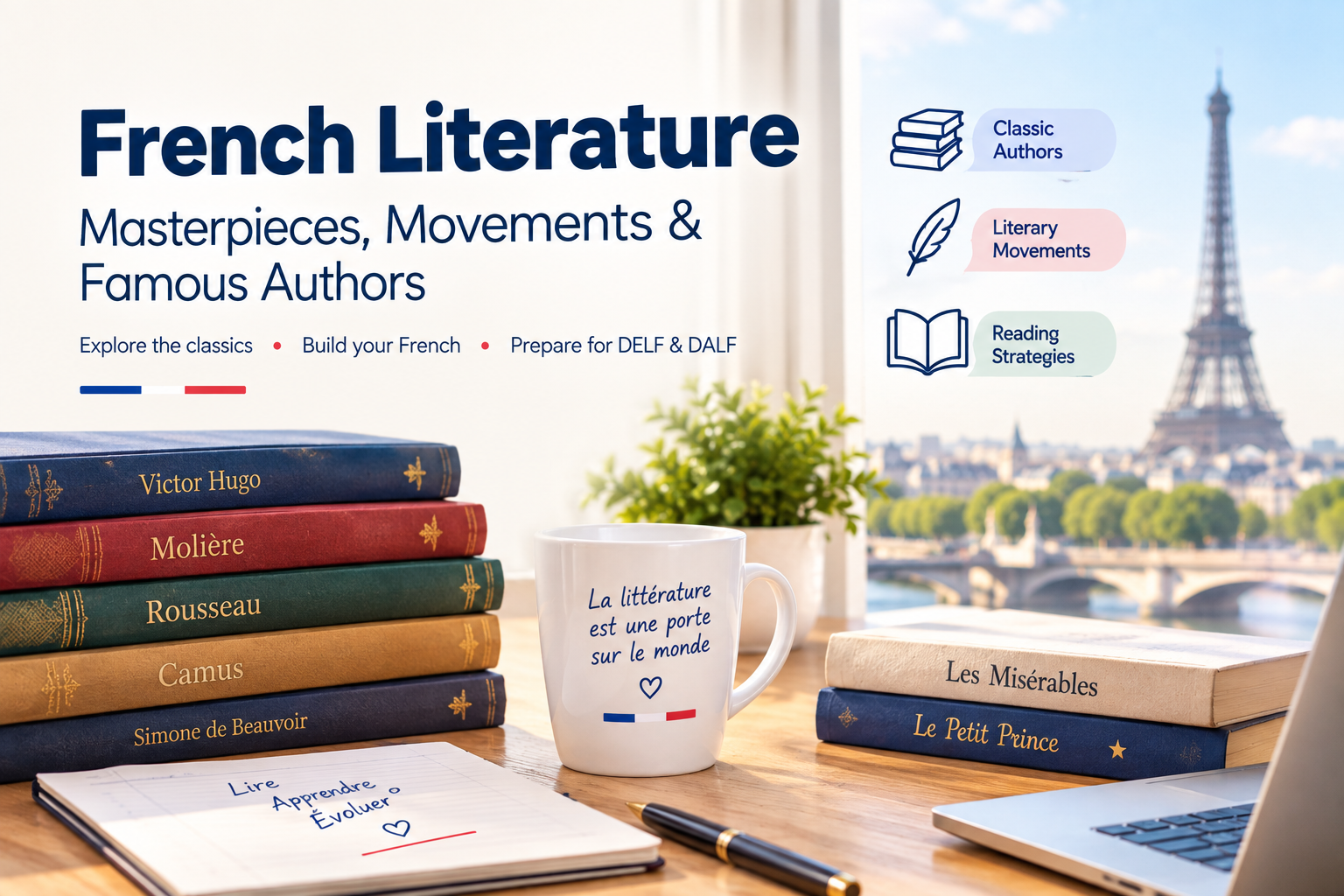
French literature is a gateway to culture, history, and refined language. Studying French literature masterpieces is also a smart way to learn French with depth and purpose. From Molière’s biting comedies to Proust’s meditations on memory, classic French novels and poems sharpen reading skills, enrich vocabulary, and prepare you for real exam tasks in DELF and DALF. In this guide, you will explore key French literary movements, meet famous French authors, and discover a level-by-level reading path that turns literature into a practical study tool. You will also find strategies to read actively and resources to access free French classics legally. At PrepFrench, we often integrate short authentic passages into our French classes so learners can build confidence with style, tone, and argumentation while improving French grammar, vocabulary, and pronunciation. If you want a clear learning path with expert guidance, check our French courses or book a free demo to get a personalized plan.
Free First Step
Take the guesswork out of learning French.
Not sure where to begin, which course fits your goal, or how long it will take? Book a free demo class with PrepFrench Classes and get a personalized plan built around your level, schedule, and goals.
The Evolution of French Literature: A Timeline of Masterpieces
Understanding French literary movements is like reading a cultural map. You will see how ideas move from courtly restraint to passionate revolt to modern ambiguity. This historical lens helps you decode tone, perspective, and argument, which is crucial for DELF/DALF reading and writing tasks.
Classical Foundations
Classicism valued order, clarity, and moral purpose. It set the stage for French as a language of precision and style.
- 17th century, Age of Louis XIV: theater flourishes with strict rules of time, place, and action.
- Molière: comedies like Le Misanthrope and Tartuffe explore human folly with sharp wit.
- Racine and Corneille: tragedies of passion and honor, written in elegant alexandrines.
- La Fontaine: fables that blend playful storytelling with moral lessons.
The Enlightenment’s Impact
Reason, tolerance, and critique shape the 18th century. Literature becomes a tool for social and philosophical inquiry.
- Voltaire: Candide critiques optimism and authority with biting irony.
- Diderot: Encyclopédie spreads knowledge, while Jacques le fataliste experiments with narrative voice.
- Rousseau: Confessions and Émile redefine selfhood, education, and authenticity.
The Rise of Romanticism
Emotion, imagination, and freedom surge in the early 19th century. Romantic writers elevate the individual and the sublime.
- Victor Hugo: Les Misérables and Notre-Dame de Paris blend epic storytelling with social conscience.
- Alphonse de Lamartine: lyrical poetry that centers on inner life and nature.
- George Sand: pioneering female voice, exploring identity and independence.
From Realism to Existentialism
After Romantic excess, literature turns to social detail, then to psychology, and finally to freedom and absurdity.
- Realism and Naturalism: Balzac’s La Comédie humaine and Zola’s Germinal document social forces and class dynamics.
- Symbolism and Modernism: Baudelaire’s Les Fleurs du mal transforms urban experience into modern poetry.
- 20th century existentialism: Sartre and Camus probe freedom, responsibility, and the search for meaning.
- Late 20th century to today: voices like Marguerite Duras, Patrick Modiano, and Annie Ernaux fuse memory, history, and identity with spare elegance.
As you move through this French literature timeline, pay attention to tone and structure. These movement cues help you read exam texts quickly and respond with nuance. In our online French classes, we map short readings to DELF/DALF tasks so you practice the right skill at the right time.
Literary Giants of French Literature
These famous French authors define key eras and themes. Exploring even a few pages from each will give you a powerful feel for style, argument, and rhythm in the French language.
Victor Hugo: The Poet of Humanity
Victor Hugo stands at the heart of Romanticism. Les Misérables is not only a story of redemption, it is also a panorama of justice, poverty, and hope. Notre-Dame de Paris links architecture, history, and destiny through unforgettable characters like Quasimodo and Esmeralda. Hugo’s sentences stretch and sing, yet his moral vision is crystal clear.
“La liberté commence où l’ignorance finit.”
Charles Baudelaire: The Alchemist of Modernity
With Les Fleurs du mal, Baudelaire turns the city into a site of beauty and decay. He captures the shock of modern life, the tension between spleen and ideal, and the struggle to make art from the ordinary. His compact, musical French stretches your sense of imagery and metaphor, a gift for advanced learners who want to read and write with texture.
“Tu m’as donné ta boue et j’en ai fait de l’or.”
Marcel Proust: Memory and Time
Proust’s À la recherche du temps perdu is a universe of memory, sensation, and social observation. Long sentences mirror the way thought unfolds, while themes of time, art, and identity echo across seven volumes. You do not need to read it all. A carefully chosen passage can teach you how French handles digression, subordinate clauses, and subtle irony.
“Le véritable voyage de découverte ne consiste pas à chercher de nouveaux paysages, mais à avoir de nouveaux yeux.”
Jean-Paul Sartre: Freedom and Responsibility
Sartre’s Nausea and his essays on existentialism ask what it means to exist freely and bear the weight of choice. His plays like Huis-clos stage ethical conflict with razor clarity. For exam preparation, Sartre’s argumentative style is invaluable: he frames questions, tests ideas, and advances claims with strong transitions, a model for DALF C1 and C2 writing.
“L’homme est condamné à être libre.”
Simone de Beauvoir: The Feminist Voice
In Le Deuxième Sexe, de Beauvoir exposes how culture constructs femininity. Her novels, including Les Mandarins, examine intellectual life, love, and politics. She models a precise, lucid prose that you can emulate in analytical writing. Reading short excerpts strengthens your ability to summarize arguments and comment on sociocultural questions often found in DELF/DALF prompts.
“On ne naît pas femme: on le devient.”
Contemporary Voices: Annie Ernaux and Beyond
Nobel Laureate Annie Ernaux writes with striking simplicity about class, gender, and memory. Works like La Place and Les Années mix personal narrative with social history, creating a clean, direct style ideal for learners stepping into authentic modern prose. Around her stand other contemporary giants: Patrick Modiano’s dreamlike pasts, Leïla Slimani’s psychological realism, and Édouard Louis’s fierce social diagnosis. These authors show how today’s French articulates identity and power in accessible yet profound ways.
PrepFrench Classes often design reading packs with short extracts from these literary giants, paired with guided analysis and speaking tasks. If you want to build a consistent literature routine with teacher feedback, explore our online French classes or book a free demo.
Structured French Courses
Stop learning French the slow way.
Apps and random videos keep you stuck at beginner level forever. PrepFrench Classes gives you a structured path, a real teacher, and speaking practice that moves you forward at every lesson.
Available for: beginners · TEF/TCF exam prep · Canadian PR · work and daily French
CEFR-Aligned Reading Recommendations
Choosing the right book at the right time is key. Here is a practical path from French literature for beginners to advanced texts that match DELF/DALF competencies.
Reading for Beginners (A2-B1)
- Graded readers (A2): short adaptations of classics with glossaries. Build basic grammar and high-frequency vocabulary with confidence.
- Le Petit Prince, Antoine de Saint-Exupéry (B1): poetic yet accessible allegory. Ideal for theme identification and simple inference.
- Short stories by Marcel Aymé or René Goscinny’s Le Petit Nicolas (B1): clear narration and everyday humor for narrative tenses and dialog.
Transitioning to Authentic Literature (B2)
- L’Étranger, Albert Camus: concise style and existential themes. Great for summary and opinion essays in DELF B2.
- Cyrano de Bergerac, Edmond Rostand: theatrical energy supports speaking practice with rhetorical devices and register shifts.
- La Place, Annie Ernaux: sober autobiographical voice that trains you in precise argument, social context, and cohesive writing.
Mastering Complex Texts (C1-C2)
- Les Fleurs du mal, Charles Baudelaire: dense imagery. Perfect for stylistic commentary and nuanced interpretation.
- À la recherche du temps perdu, Marcel Proust (selected passages): advanced syntax and discourse analysis, ideal for DALF C1-C2.
- Le Deuxième Sexe, Simone de Beauvoir (selected chapters): argumentative clarity for building strong, evidence-based essays.
PrepFrench curates reading packets with comprehension questions, vocabulary banks, and mini-writing prompts matched to CEFR levels. See our course options or reach out for a customized plan via our contact page.
Active Reading Strategies for DELF/DALF Success
Literature can do more than inspire. With the right strategies, it can hardwire exam-ready skills for reading comprehension, synthesis, and argumentation.
- Skim with purpose: identify genre, topic, and tone in 30 to 60 seconds. For poetry, scan the imagery. For essays, find the thesis and key claims.
- Scan for structure: track paragraph function with margin notes, such as example, contrast, counterargument, conclusion.
- Annotate actively: highlight connectors, modal verbs, and words that signal stance. Mark quotes you could reuse in commentary.
- Build a vocabulary bank: record 10 to 15 high-yield words per text with example sentences in your own words.
- Summarize by stages: first 1 sentence, then 3, then 5. This develops synthesis, a core task in DELF/DALF writing.
- Mirror the style: write a short paragraph imitating a sentence pattern or tone from the text. This improves register control.
- Discuss aloud: turn main ideas into a 60 second oral summary, then add your opinion with two reasons. This maps to oral production tasks.
Example application with Camus’s L’Étranger: skim chapter openings to catch the minimalist tone, scan for expressions of indifference, annotate transitional phrases like pourtant and cependant, log key vocabulary around perception and judgment, then write a 5 sentence synthesis and a short opinion paragraph. For poetry, try the same with a single Baudelaire poem: list images, track contrasts, reformulate the theme, and record three powerful adjectives that shape mood.
In PrepFrench Classes, your French teacher guides you through this workflow, correcting pronunciation when you read aloud, tightening grammar in your summaries, and showing how to transform notes into a clear outline for exam writing. We also provide timed drills, such as 10 minute summary tasks or 90 second oral monologues, so you practice under gentle pressure, the same conditions you will face in DELF or DALF.
Skimming and Scanning Techniques
Use headings, paragraph openers, and punctuation to identify the skeleton of meaning. For plays, track who speaks and how they shift the scene. For novels, isolate turning points. For essays, list claims and evidence. This helps you answer comprehension questions fast and accurately.
Notetaking and Annotation Tips
Color code: blue for main ideas, green for connectors, red for key quotes. Keep margins clean and actionable. Write questions to yourself, such as Why this example here, and What is the author pushing back against. Your notes should turn directly into exam-ready outlines.
Building a Vocabulary Bank
Create clusters around themes, such as justice, identity, or memory. For each word, add a synonym, an antonym, and a collocation. Review with spaced repetition two or three times per week. This habit boosts your active recall during speaking and writing tasks.
Exploring Resources: Where to Find French Literature
You can access many classic French texts legally and for free. Pair them with audio versions to support comprehension and pronunciation.
Gallica and Project Gutenberg
- Gallica (Bibliothèque nationale de France): digitized originals, scans, and searchable texts of classics, periodicals, and manuscripts.
- Project Gutenberg: free French eBooks in clean text formats. Great for Hugo, Zola, Maupassant, and more.
- Tip: copy short passages into a notes app, add glossed words, and reread over a week for spaced exposure.
Culturethèque and Local Libraries
- Culturethèque: often accessible via your local Alliance Française membership. E-books, comics, magazines, and audiobooks.
- City libraries: many offer French sections or interlibrary loans. Ask for bilingual editions if you are transitioning to authentic texts.
- Tip: combine a short print extract with an audiobook clip, then shadow read for pronunciation and rhythm.
The Power of Audiobooks (Librivox)
- Librivox: volunteer recordings of public domain works. Listen while following the text to strengthen decoding and prosody.
- Modern platforms: if available in your country, paid audiobook services often feature contemporary authors like Ernaux and Modiano.
- Tip: slow playback to 0.8x for poetry or complex prose. Mark one paragraph to repeat daily for a week.
In our PrepFrench reading activities, we link students to these platforms and provide pre-reading and post-reading tasks for maximum progress. To get a curated plan based on your level, explore our French courses.
PrepFrench Classes
Ready to start French with a clear plan?
Book a FREE demo class and get a personalized roadmap for your level, goal, and timeline. No pressure, no obligation.
Explore courses:
All French Courses · Full TCF Canada Course · Full TEF Canada Course
FAQ: French Literature, DELF/DALF, and Smart Study
Which French classics are suitable for B1/B2 levels?
At B1, use graded readers and approachable texts like Le Petit Prince or short stories by Maupassant. At B2, move to concise authentic works: L’Étranger by Camus, La Place by Ernaux, or Cyrano de Bergerac by Rostand. These titles combine clear prose with rich themes, perfect for DELF B2 style summaries and opinion essays. If you prefer structure, join PrepFrench Classes where a French teacher selects excerpts that match your level and builds speaking and writing tasks around them.
How can literature improve DELF/DALF reading skills?
Literature trains you to read for tone, structure, and argument. Skimming a novel chapter or scanning an essay helps you spot thesis, evidence, and connectors fast. Annotating quotes strengthens synthesis and commentary, both essential in DELF/DALF. Use short passages for 5 sentence summaries, then practice 90 second oral recaps. PrepFrench integrates these steps into each French course so you build exam-ready habits while enjoying great writing.
Where can I find free French classics legally?
Start with Gallica, the digital library of the Bibliothèque nationale de France, and Project Gutenberg for public domain French eBooks. Culturethèque, often accessible via Alliance Française, provides e-books and audiobooks. Librivox offers free audiobook recordings of many classics. Combine text and audio for better comprehension. PrepFrench Classes point you to the right edition and add vocabulary banks and tasks that fit your level, saving you time and guesswork.
Should I use bilingual or graded editions when starting?
For A2 to early B1, graded readers are often best because they include glossaries and cultural notes. As you advance to late B1 or B2, try bilingual editions for difficult passages while keeping most of your reading in French. By C1, stick to original texts and rely on targeted dictionary checks. In our online French classes, we help you transition smoothly so you do not get stuck at the adaptation stage.
How do contemporary Francophone authors fit into French literature?
Francophone literature, from North and Sub-Saharan Africa to the Caribbean and Quebec, expands what “French literature” means today. Authors like Leïla Slimani, Dany Laferrière, Scholastique Mukasonga, and Alain Mabanckou bring fresh perspectives on identity, migration, and memory. Reading them improves modern vocabulary, cultural literacy, and exam-relevant themes. PrepFrench includes Francophone voices in our French lessons so you speak French with a global, contemporary lens.
Final Thoughts
French literature masterpieces are not just cultural trophies. They are training grounds for real language growth. When you read with a plan, you absorb authentic phrasing, sharpen your ear for tone, and learn to organize ideas, exactly what DELF and DALF expect. From Classicism to contemporary memoir, each movement and author adds a new lens for reading and thinking in French.
Choose texts that fit your current level, then stretch gently. Use active reading strategies to transform pages into skills. Lean on free, legal resources to build a sustainable routine, and get guidance from a French tutor when you need a clearer path. At PrepFrench, we combine literature with structured practice so you can enjoy the journey and make steady, measurable progress.
If you are ready to learn French with a literature-forward approach, explore our courses or book a free demo class to map out your next steps.
✅ Next Step: Book a free demo class with PrepFrench Classes and start learning French the right way.
Tip: Consider joining a literature-focused PrepFrench reading club to keep your momentum and discuss themes with a teacher and peers.
Written by
Platform Administrator
Practical ideas from the Prep French team for learners building confidence, preparing for exams, and planning their next step in Canada.
Join the discussion
Leave a thoughtful comment.
Your email address will not be published. Comments are reviewed before appearing.