
French Healthcare Vocabulary: Essential Phrases & Guide
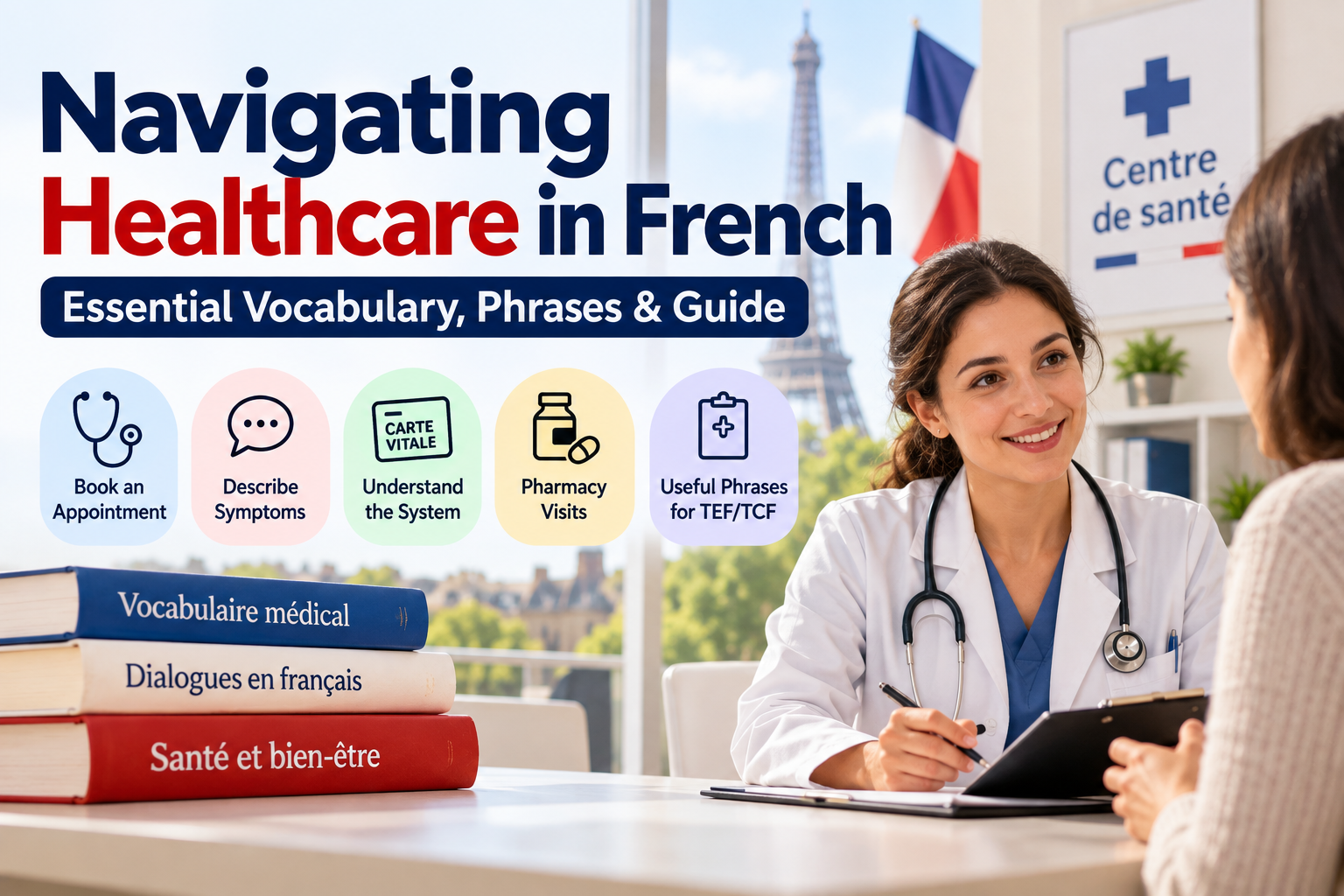
If you plan to live, study, or travel in a Francophone region, mastering French healthcare vocabulary is more than an academic exercise. It is a life skill. From booking a medical appointment to explaining symptoms, the right words help you get care quickly and confidently. This guide blends cultural insight into the French healthcare system with practical phrases that also prepare you for TEF or TCF tasks. You will find realistic dialogue models, key terms, and wellness language that appear often in exam prompts and real life. If your goal is to learn French for daily life or for TEF/TCF scores, this is your roadmap.
In France, universal coverage, the médecin traitant system, and the Carte Vitale shape how patients access care. Understanding this context makes conversations with receptionists, nurses, and doctors much easier. It also improves your performance in exam scenarios, since health and wellness topics are common in speaking and listening tasks. For structured practice, the Full TCF Canada Course and the Full TEF Canada Course at PrepFrench integrate real-life scenarios like appointments, pharmacy visits, and emergencies inside guided French lessons.
Use this article as a reference during your French course or your self-study. Save the phrases, revisit the scenarios, and practice out loud. If you want a teacher to correct your pronunciation and help you personalize your vocabulary for work or family needs, PrepFrench Classes can support you with online French classes designed for everyday speaking confidence.
Free First Step
Take the guesswork out of learning French.
Not sure where to begin, which course fits your goal, or how long it will take? Book a free demo class with PrepFrench Classes and get a personalized plan built around your level, schedule, and goals.
Understanding the French Healthcare System
France’s healthcare model is universal and mixed. Public insurance, called Assurance Maladie, reimburses a large share of costs. Many residents also hold a complementary plan known as a mutuelle to cover remaining fees. Care is patient-centered and structured through the médecin traitant: your chosen general practitioner who coordinates care, refers you to specialists, and keeps your medical record organized. For payments and reimbursements, most residents use the green smart card known as the Carte Vitale. Learning how these pieces fit together will save you time at reception and help you speak French with clarity in clinics.
The Importance of the Médecin Traitant
The médecin traitant is your main doctor. Declaring one unlocks faster reimbursements and smoother access to specialists through the coordinated care pathway, called le parcours de soins. Without a declared médecin traitant, reimbursements are often lower. In practical terms, your médecin traitant is your first contact for most health needs, from annual checkups to follow-up on lab results.
- How to declare: at your first visit, the doctor can submit an electronic declaration using your Carte Vitale. You can also complete a paper form.
- Why it matters: you get better reimbursement rates, coordinated referrals, and a clear medical history with one primary contact.
- Exam angle: TEF/TCF role-plays often involve explaining why you need a referral or asking for an appointment with your GP.
How to Use the Carte Vitale
The Carte Vitale is a microchipped health insurance card. Present it at the doctor’s office or pharmacy. Your visit details are sent directly to Assurance Maladie for reimbursement. When third-party payment, called le tiers payant, applies, you pay less upfront or sometimes nothing onsite. Bring your mutuelle card as well, since many clinics can process both.
- Key terms: Carte Vitale, tiers payant, remboursement, mutuelle, feuille de soins (paper form used if the card cannot be read).
- Quebec note: in Quebec, the equivalent of the Carte Vitale is the RAMQ health card, called la carte d’assurance maladie du Québec. If you are preparing to live or study there, learning the basic French vocabulary around the RAMQ card helps you handle registration and renewals.
- Helpful practice: in PrepFrench Classes, you will rehearse presenting your card, confirming your details, and asking about reimbursement timelines using natural French phrases.
Navigating Medical Visits: Key French Healthcare Vocabulary and Phrases
Medical interactions follow clear steps: book the appointment, check in at reception, explain symptoms, and confirm next actions. Below are phrases that work in clinics, hospitals, and during exams that test your spoken French. Keep sentences short and precise. Doctors value clarity over complexity.
Booking a Doctor’s Appointment
Whether you call the cabinet médical or book online, you need to state who you are, why you are calling, and when you are available.
- Bonjour, je voudrais prendre rendez-vous avec le docteur Martin, s’il vous plaît.
- C’est pour une consultation rapide / un renouvellement d’ordonnance / un suivi.
- Je suis disponible mardi matin ou jeudi après-midi. Avez-vous un créneau libre ?
- J’ai une carte Vitale et une mutuelle. Faut-il apporter autre chose ?
- Pouvez-vous me confirmer l’adresse et le tarif de la consultation ?
Mini-dialogue example:
- Patient: Bonjour, je voudrais un rendez-vous pour des douleurs au dos.
- Secrétaire: D’accord. Vous préférez matin ou après-midi ?
- Patient: Plutôt l’après-midi, jeudi si possible.
- Secrétaire: Jeudi 15 h 30 avec le docteur Martin. Votre nom et votre numéro de téléphone, s’il vous plaît ?
Describing Symptoms Effectively
Structure helps. Start with where it hurts, then describe pain type, intensity, duration, triggers, and associated symptoms. This approach is ideal for TEF/TCF speaking tasks too.
- J’ai mal à la tête / au ventre / au dos / à la gorge.
- La douleur est plutôt: légère, modérée, intense, constante, par moments.
- Depuis quand: Depuis hier soir, depuis trois jours, depuis deux semaines.
- Type de douleur: une douleur aiguë, une douleur sourde, une brûlure, des crampes, des picotements.
- Symptômes associés: fièvre, toux, nausées, vomissements, fatigue, essoufflement, éruption cutanée.
- Déclencheurs: cela empire quand je marche, quand je mange, quand je respire profondément.
Mini-dialogue example:
- Docteur: Qu’est-ce qui vous amène ?
- Patient: J’ai de fortes douleurs au bas du dos depuis trois jours. La douleur est constante et s’aggrave quand je me penche.
- Docteur: Avez-vous de la fièvre ou des fourmillements dans les jambes ?
- Patient: Pas de fièvre, mais j’ai parfois des picotements dans la jambe droite.
Exam tip: health vocabulary for TEF/TCF often appears in role-plays, announcements, or opinion tasks. You might have to explain an absence from work due to illness, summarize a radio segment about vaccination, or give advice on a healthier routine. Practice with a teacher in structured French courses to get fast, targeted feedback.
Structured French Courses
Stop learning French the slow way.
Apps and random videos keep you stuck at beginner level forever. PrepFrench Classes gives you a structured path, a real teacher, and speaking practice that moves you forward at every lesson.
Available for: beginners · TEF/TCF exam prep · Canadian PR · work and daily French
The Role of Pharmacies in France: What You Need to Know
In France, pharmacists are highly accessible health professionals. The green cross outside indicates a pharmacy is open. You can request advice for minor ailments, ask for over-the-counter options, or present an ordonnance for prescription medication. Pharmacies often provide services like blood pressure checks, vaccination, and smoking cessation support. At night or on holidays, a pharmacie de garde remains available in your area.
Understanding Prescription and Over-the-Counter Medications
Medicines require a valid ordonnance from a doctor or hospital to be dispensed. Many common treatments for pain, colds, or allergies are available without a prescription, but pharmacists still ask questions to ensure safety. You can also request a generic version, called un générique, which is often cheaper. Always check the posologie, which is the dosage and schedule.
- Key terms: ordonnance, médicament, générique, posologie, effets secondaires, contre-indications, renouvellement.
- Process: present your ordonnance and Carte Vitale, confirm your mutuelle, and ask how to take the medication. The pharmacist can print dosage instructions.
- Cultural note: pharmacists may refer you to a doctor if they judge that your symptoms need medical evaluation rather than self-medication.
Essential Pharmacy Phrases
- J’ai cette ordonnance à renouveler, s’il vous plaît.
- Je préfère le générique si c’est possible.
- Comment dois-je prendre ce médicament ? Avant ou après le repas ?
- Quels sont les effets secondaires les plus fréquents ?
- Est-ce compatible avec mon traitement actuel ?
- Où se trouve la pharmacie de garde la plus proche ce soir ?
Pro tip: bring a written list of your current medications. In PrepFrench French classes, learners practice short, accurate questions like these, which are ideal for both real pharmacies and TEF/TCF role-plays.
Emergency Situations: Language and Key Contacts
Emergencies require calm, simple language. Know the numbers, state what happened, indicate your location, and mention risks such as difficulty breathing or bleeding. In France, the main medical emergency number is 15, which connects you to the SAMU, the emergency medical service. You can also dial 112 from any phone across the European Union.
Identifying Emergency Services
- 15: SAMU (medical emergencies)
- 18: Pompiers (fire brigade, also respond to accidents)
- 17: Police secours
- 112: EU-wide emergency number, connects to local services
Phrase toolkit:
- Je vous appelle pour une urgence médicale.
- La personne a du mal à respirer / saigne beaucoup / a perdu connaissance.
- Je me trouve au 12, rue Victor Hugo, à Lyon, 69002.
- Nous sommes au troisième étage, sans ascenseur.
- Elle est allergique à la pénicilline. Elle a 68 ans.
Common Scenarios When Calling for Help
Be ready to answer rapid-fire questions: Who is affected, what happened, where are you, and what is the current state. Keep your phone line free after the call. For TEF/TCF, you might need to simulate a short emergency call or report an incident. Practicing this structure builds confidence quickly.
- Qui: un homme, 35 ans, conscient mais très pâle.
- Quoi: douleur thoracique depuis 10 minutes, transpiration, vertiges.
- Où: parc Monceau, près de l’entrée principale.
- Etat: respiration courte, douleur intense, parle difficilement.
- Action: nous avons allongé la personne et desserré ses vêtements.
Real-world advice: if you are unsure which service to call, dial 112. The operator will route you. In class, simulate describing directions, building access codes, or landmarks so you can give precise information under pressure.
Wellness Culture in France: Preventive Practices and Language
France invests in prevention and public health campaigns. You will hear messages about balanced eating, movement, mental health, and screenings. The PNNS, Programme National Nutrition Santé, promotes simple habits like Manger bouger, which means eat and move. Doctors may also prescribe physical activity, called sport sur ordonnance, as part of chronic disease management. Learning this vocabulary helps you follow advice from professionals and discuss wellness topics for TEF/TCF speaking and writing tasks.
Understanding Public Health Initiatives
- Prévention: vaccination, dépistage, bilan de santé, médecine du travail, sensibilisation aux risques.
- PNNS: campagne Manger bouger, recommandations nutritionnelles, réduction du sel et du sucre.
- Sport sur ordonnance: activité physique prescrite par un médecin pour maladies chroniques.
- Santé mentale: prise en charge psychologique, téléconsultation, suivi régulier.
- Hygiène de vie: sommeil régulier, gestion du stress, limitation de l’alcool et du tabac.
Sample phrases for wellness conversations:
- Je voudrais améliorer mon hygiène de vie et mon alimentation.
- Mon objectif est de marcher 30 minutes par jour, cinq jours par semaine.
- Mon médecin m’a conseillé un dépistage et une prise de sang annuelle.
- Je pratique la méditation et j’essaie de réduire le stress au travail.
Key Vocabulary for Nutrition and Fitness
- Nutrition: les fibres, les protéines, les glucides, les lipides, les vitamines, l’hydratation.
- Repas: le petit-déjeuner, le déjeuner, le dîner, une collation, cuisiner maison, produits frais.
- Habitudes: s’étirer, s’échauffer, récupérer, s’entraîner, faire du cardio, musculation, yoga.
- Objectifs: perdre du poids, gagner en endurance, améliorer le sommeil, réduire le stress.
- Exam link: vous pourriez être invité à donner des conseils à un ami sur l’activité physique ou à résumer un article sur la nutrition.
To build natural fluency with this French health and wellness vocabulary, practice short monologues with a French tutor, then turn them into dialogues. PrepFrench Classes integrate voice feedback and targeted corrections so your ideas are clear and convincing during exam tasks.
PrepFrench Classes
Ready to start French with a clear plan?
Book a FREE demo class and get a personalized roadmap for your level, goal, and timeline. No pressure, no obligation.
Explore courses:
All French Courses · Full TCF Canada Course · Full TEF Canada Course
FAQ: French Healthcare Vocabulary and Practical Questions
How do I describe common symptoms in French?
Use a simple structure: where, what type, how strong, since when, and with what other signs. For example: J’ai mal à la tête depuis hier soir, la douleur est modérée et j’ai un peu de fièvre. Add specifics such as une douleur aiguë, des nausées, des vertiges, or une toux sèche. In online French classes, practice short descriptions, then expand with causes or triggers like cela s’aggrave quand je mange. PrepFrench French lessons help you build clear, exam-ready sentences for TEF/TCF role-plays and real appointments.
What is the Carte Vitale and how do I use it?
The Carte Vitale is the French health insurance smart card. Present it at the doctor’s office, lab, or pharmacy. It allows invoices to be sent directly to Assurance Maladie for reimbursement. If tiers payant applies, you pay less upfront. Bring your mutuelle card as well. If the card cannot be read, you may receive a feuille de soins to mail in. In a French course, simulate handing over the card, confirming identity, and asking about remboursement timing to gain confidence for real visits.
How do I book a medical appointment in French?
State your request, reason, and availability. For example: Bonjour, je voudrais prendre rendez-vous pour un renouvellement d’ordonnance. Je suis disponible mercredi matin. Avez-vous un créneau ? Be ready to give your name and phone number. If it is urgent, say c’est assez urgent or j’ai une douleur intense. PrepFrench Classes include booking-call role-plays, so you learn to handle accent, speed, and common questions smoothly during TEF/TCF tasks and real life.
What’s the difference between médecin traitant and spécialiste in France?
The médecin traitant is your primary doctor who manages routine care, referrals, and follow-up. A spécialiste focuses on a specific field, such as cardiology or dermatology. To get full reimbursement, you often need a referral from your médecin traitant before seeing a specialist, which is part of the parcours de soins. In French language classes, practice asking for a referral and explaining your symptoms concisely. This is useful both for the healthcare system and for TEF/TCF speaking sections.
How do pharmacies work in France?
Show your ordonnance and Carte Vitale for prescription medicines. For minor issues, you can ask a pharmacist for over-the-counter advice. You may request a generic option, called un générique. Always confirm the posologie, possible effets secondaires, and interactions with your current treatment. For nights or holidays, ask for la pharmacie de garde. PrepFrench French lessons include pharmacy dialogues to help you ask clear, practical questions in French and feel confident when you need care.
Final Thoughts
Healthcare is personal, and having the right words in French turns stress into clarity. With a solid base of French healthcare vocabulary, you can book appointments, describe symptoms, understand prescriptions, and respond in emergencies. You also gain an advantage in exam preparation, since health and wellness are frequent themes across listening, reading, and speaking tasks for TEF and TCF.
If you want a fast, structured path, PrepFrench Classes combine real-life healthcare scenarios with targeted exam strategies. You will learn how the French healthcare system works, how to use essential phrases, and how to speak naturally under time pressure. For a guided plan, explore the Full TCF Canada Course or the Full TEF Canada Course. The right French course can help you communicate with confidence in clinics, pharmacies, and everyday wellness conversations.
Keep this guide as your reference. Practice a little each day, speak out loud, and use a French teacher to correct your pronunciation and sentence flow. The result is both practical and empowering: you will speak French clearly when it matters most.
✅ Next Step: Book a free demo class with PrepFrench Classes and start learning French the right way.
Language opens doors to quality healthcare and confident living. Pair vocabulary with cultural understanding, and your French will serve you in every appointment and exam.
Written by
Platform Administrator
Practical ideas from the Prep French team for learners building confidence, preparing for exams, and planning their next step in Canada.
Join the discussion
Leave a thoughtful comment.
Your email address will not be published. Comments are reviewed before appearing.