French for Kids: Fun Activities, Learning Tips & Progress
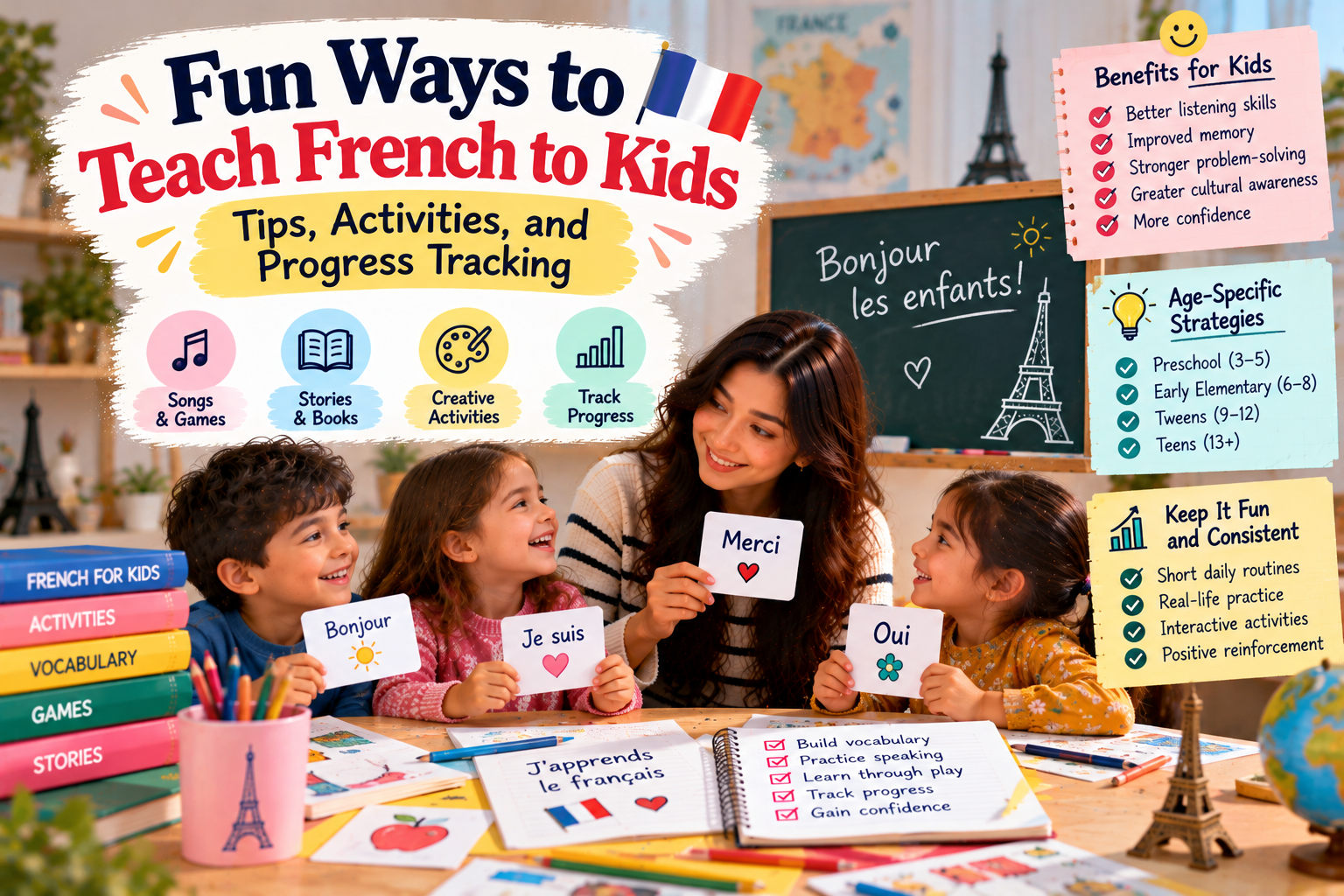
French for kids works best when learning feels like play. Young brains are wired to learn languages through songs, movement, stories, and real-life interaction. Research consistently shows that children who learn an additional language early build stronger listening skills, better problem-solving habits, and more flexible thinking. If you want your child to learn French for kids at home, the secret is not longer study sessions, it is small, joyful routines that they look forward to. PrepFrench Classes helps families design those routines with a simple plan, age-appropriate activities, and ongoing support from a real French teacher. New to our resources and French classes? Explore our homepage or browse our courses to get a feel for how we teach.
In this guide, you will find age-specific strategies, creative French activities for kids, recommendations for French songs, games, and books, and a practical system for tracking progress. We will also cover safety for digital resources, so you can use apps and videos wisely without overloading screen time. If you prefer a guided start, PrepFrench Classes offers structured online French classes and kids’ French lessons that keep learning fun while still building real skills.
Free First Step
Take the guesswork out of learning French.
Not sure where to begin, which course fits your goal, or how long it will take? Book a free demo class with PrepFrench Classes and get a personalized plan built around your level, schedule, and goals.
French for Kids: Why Learning French is Beneficial for Kids
Cognitive Benefits of Learning French
Early language learning strengthens core executive functions: attention control, memory, and cognitive flexibility. Studies of bilingual children show advantages in task switching and creative problem-solving. For a child, practicing new sounds, connecting words to actions, and recalling phrases in context is a healthy brain workout. Learning French also gives kids a new phonetic system that improves listening discrimination. This helps not only with French pronunciation but with reading and spelling in their first language because they become more sensitive to sound patterns.
Because French shares roots with English and other Romance languages, kids often pick up vocabulary links quickly: television, animal, music. These connections build confidence. Real confidence grows from speaking often in low-stress moments. PrepFrench Classes builds that habit through short speaking bursts, role-play, and simple routines so kids experience frequent small wins.
Social and Cultural Impact of Learning Languages
Language carries culture. When children learn French, they also discover new stories, songs, food words, and traditions. This builds curiosity and respect for difference. Socially, kids who practice a second language tend to be better listeners, partly because they learn to pay attention to tone, gesture, and context. That empathy transfers to school and friendships.
French is spoken in more than two dozen countries. Even a basic ability to greet, introduce themselves, and share what they like opens doors to friendships across borders. In PrepFrench Classes, culture is part of the lesson: mini virtual trips to French-speaking places, kid-friendly traditions, and comparisons with the child’s home culture. This approach keeps motivation strong because kids see language as a bridge, not just a subject.
Age-Specific Techniques to Introduce French
Every age learns differently. Below you will find practical ways to start teaching French to kids by stage, using methods that match attention span, fine motor skills, and curiosity level. The goal is a flexible plan that fits your family rhythm. If you want a ready-made path, our age-targeted kids’ French courses build from play to projects with teacher feedback.
Preschool (3-5 years): Play-Based Learning
At this stage, movement and imitation are your best tools. Use Total Physical Response (TPR): you say a French verb, and your child does the action. Keep sessions short and repeat often.
- Action songs: Head, Shoulders, Knees and Toes in French, or Au feu les pompiers. Do the actions together.
- TPR mini-games: sauter (jump), tourner (turn), toucher (touch), courir (run), s’asseoir (sit). Make it silly and fast.
- Toy labeling: put small stickers on favorite toys with words like voiture, ours, livre. Say and touch the word together.
- Color hunts: Trouve quelque chose de rouge. Race to find objects and name colors.
- Storytime with gestures: point to pictures and repeat key words: chat, chien, dormir. Keep stories short.
Digital safety tip: if you use videos, choose ad-free options or download playlists in advance. Sit with your child, pause often, and repeat words together. Co-watching turns screen time into conversation time.
Early Elementary (6-8 years): Interactive Activities
Children can now follow simple rules and enjoy pattern discovery. Mix movement with early reading and writing, but keep handwriting light. Focus on listening, speaking, and word recognition.
- Call-and-response routines: Bonjour, ça va, merci, s’il te plaît at the start and end of the day.
- Simple board games: roll a die, say the word you land on. Use picture-only cards for animals, food, or school items.
- Craft-and-say: draw and label five fruits in French, then make a mini menu and do a pretend café.
- Sing and act: pick two French songs per week, practice lyrics slowly, and perform for family on weekends.
- Word detective: highlight repeated words in a short French poem. Kids love to find patterns.
Use short spaced practice: 10 minutes, twice a day, beats one long weekend session. Our age-appropriate PrepFrench lessons include quick speaking bursts, so your child gets frequent wins that stick.
Tweens (9-12 years): Engaging Multimedia Content
Tweens like purpose and projects. Blend games with real-world tasks and multimedia. Give them choices to build ownership, and set clear weekly goals.
- Project ideas: design a French café menu with prices, record a 60-second room tour in French, or create a mini travel guide for Paris, Montréal, or Dakar.
- Subtitled clips: watch short kids’ shows or sports highlights in French with French subtitles. Pause to note three new words, then use them in a sentence.
- Vocabulary sets: build 10-word sets per week on topics they enjoy: gaming, pets, football, art. End with a quick speaking challenge.
- Pen pals and voice notes: exchange child-safe audio messages through a teacher-moderated group. Speaking to real peers increases motivation.
- Light grammar with context: introduce gender, articles, and a few high-frequency verbs (avoir, être, aimer). Practice through mini-dialogues.
Digital hygiene for tweens: use kid-safe platforms, disable DMs with strangers, and set a weekly screen plan. Ten to fifteen minutes of targeted video with active tasks is more effective than unlimited passive watching.
Structured French Courses
Stop learning French the slow way.
Apps and random videos keep you stuck at beginner level forever. PrepFrench Classes gives you a structured path, a real teacher, and speaking practice that moves you forward at every lesson.
Available for: beginners · TEF/TCF exam prep · Canadian PR · work and daily French
Fun and Engaging French Activities at Home
Short, consistent interactions beat long lessons. Below are simple French games for kids, French songs for kids, book ideas, and everyday routines that build vocabulary naturally.
Creative Games and Songs
- Simon dit (Simon Says): practice body parts and actions: Simon dit touche ta tête. Make it speedy and fun.
- Freeze dance vocab: play a French song, pause it, and hold up a picture card. Kids say the word to unfreeze.
- Rhythm claps: clap out syllables for words like ani-mal, cho-co-lat, ba-na-ne, then say them together.
- Song bank: pick 6 to 8 French songs for kids to rotate across a month. Repeat often. Add a dance or prop.
- Scavenger lists: find and say five objects around the house in French. Great for colors, shapes, and rooms.
Reading and Storytelling Ideas
- Picture-walk storytelling: look at images first, guess the story in any language, then read key words in French.
- Echo reading: you read a sentence in French slowly, your child repeats. Switch roles for a confidence boost.
- Dual-language cards: write one or two target words from the story on sticky notes. Place them on the correct page or object.
- Character voices: assign a voice for each character. This invites repetition and makes pronunciation memorable.
- Weekend retells: your child retells the story using three target words. Celebrate effort, not perfection.
Incorporating French into Daily Life
- Micro-routines: greet in French at breakfast, count stairs in French, say merci after dinner.
- Labels at home: fridge, door, table, chair. Touch-and-say daily for a week, then rotate labels.
- Choice prompts: Veux-tu le jus ou l’eau, le rouge ou le bleu. Two-choice questions invite real answers.
- Cooking together: narrate simple steps in French: coupe, mélange, ajoute. Name ingredients as you go.
- Play pretend: supermarket, veterinarian, or school role-plays build useful phrases in context.
When used smartly, online resources reinforce what you already practice. If you learn a song or dialogue in a PrepFrench lesson, repeat it during the week at home. This loop, lesson to home to lesson, accelerates retention and keeps kids proud of their progress.
Tracking Progress in French Learning
Progress with kids looks like comfort and curiosity growing over time. Expect plateaus, spurts, and repeat practice. The key is to capture small wins, then nudge the next step. Use can-do statements such as I can greet and say how I feel or I can name five foods I like in French. For older kids, you can align to beginner benchmarks like DELF Prim levels, which recognize basic listening and speaking skills appropriate for children.
Simple Milestones to Aim For
- Month 1: can greet, say name and age, understand a few classroom instructions.
- Month 2: can name 20 to 40 words across 3 topics, sing along to two songs, answer yes or no questions about likes.
- Month 3: can describe favorite things in short phrases, ask one or two questions, follow a simple story with pictures.
- Months 4 to 6: can hold a 60 to 90 second conversation with prompts, read and label simple sentences, write a postcard style message with support.
For families interested in certifications later, DELF Prim offers child-friendly recognition at levels A1.1 and A1. If that is a long-term goal, keep learning light and joyful today. Certifications are easier when the foundation is fun.
Creating a Progress Checklist
Use a visible tracker on the fridge or in a notebook. Add stickers for completed tasks, and record a 20-second audio sample every two weeks. Below is a sample checklist you can adapt. In PrepFrench Classes, we provide simple trackers and teacher feedback so you always know the next step.
| Age Group | Listening | Speaking | Reading | Writing | Timeframe | Suggested Check |
|---|---|---|---|---|---|---|
| 3-5 | Understands greetings, colors, 3 to 5 TPR actions | Says name, age, 10 words with prompts | Recognizes key words in picture books | Traces or copies a few labels | 6-8 weeks | Short video of a color hunt using French words |
| 6-8 | Follows 1 to 2 step classroom instructions | Answers simple questions about likes and school items | Reads short phrases with picture support | Writes labels and a 2 to 3 sentence description with help | 8-12 weeks | One-minute show-and-tell in French on a favorite toy |
| 9-12 | Understands short videos with familiar topics and subtitles | Holds 60 to 90 second conversation using practiced phrases | Reads short paragraphs and finds target info | Writes a postcard or mini profile with model sentences | 12-16 weeks | Recorded room tour or café menu presentation in French |
Tools that help: a simple sticker chart, a voice memo album for speaking samples, a vocabulary notebook, and a rotating set of flashcards for 5 to 10 words at a time. If you want outside structure plus gentle benchmarks, PrepFrench teachers can align your child’s plan to DELF Prim milestones while keeping the play-first mindset.
Overcoming Common Obstacles in Learning French
Families often face the same hurdles when working with French at home. Here is how to move through them with less stress and more fun.
Strategies for Diverse Learning Levels
- Mixed proficiency at home: if one child is ahead, make them the helper. They choose the word set or track points in games.
- Shy speakers: start with choral responses and echo reading. Move to paired speaking with you, then quick 10-second solo turns.
- Parents who do not speak French: focus on cues and consistency. Use audio models from songs or teacher recordings. Your job is the routine keeper.
In our curriculum, we design layered tasks: the same activity can be attempted at two or three levels so everyone participates. For example, in a café role-play, beginners label items, intermediates take orders with sentence frames, and confident kids add polite phrases or a joke in French.
Tips for Maintaining Engagement
- Short attention spans: use 5 to 10 minute blocks. Switch modes: sing, move, read, speak, create.
- Screen time balance: set a weekly menu for digital content, not a buffet. Choose two videos and one song list, then reuse them in offline play.
- Motivation dips: bring in a project with a public finish, like a mini performance or a postcard to a grandparent.
- Forgetting words: reintroduce in new contexts. If you learned fruits, use them in a store role-play or in a smoothie recipe the next day.
PrepFrench Classes integrates these engagement patterns into each French lesson. We rotate input types, build toward a visible product, and recycle vocabulary in playful ways. This rhythm keeps kids excited while steadily expanding their French vocabulary and confidence.
PrepFrench Classes
Ready to start French with a clear plan?
Book a FREE demo class and get a personalized roadmap for your level, goal, and timeline. No pressure, no obligation.
Explore courses:
All French Courses · Full TCF Canada Course · Full TEF Canada Course
Conclusion: Keep It Fun, Keep It Consistent
The most effective way to help kids learn French is joyful consistency. Ten minutes of singing, a quick game while setting the table, two labels on the fridge, a short story before bed. These tiny habits compound. Celebrate micro-wins: your child used merci without a prompt, they asked a choice question in French, they remembered a word from last week. Those moments matter far more than perfection.
If you would like guidance, real feedback, and a structured plan that makes learning light yet effective, our French classes and online French lessons for kids can help. PrepFrench brings research-backed routines, child-safe resources, and progress tracking into every French course. You keep the fun at home, and we keep the roadmap clear.
Ready to learn French together with less guesswork and more smiles? Book a free demo to see how we personalize French for kids by age, interests, and goals through PrepFrench Classes.
FAQ: French for Kids
What age is best to start learning French for kids?
Any time from age three onward is great for learning French, but you can start even earlier with songs and simple words. The method changes by age. Preschoolers thrive on movement games, songs, and stories. Early elementary kids enjoy call-and-response, easy readers, and role-play. Tweens benefit from projects, short videos with subtitles, and weekly goals. The key is routine, not age. With PrepFrench Classes, we match activities to each stage so kids build confidence and speaking habits in short, fun bursts. If you want a plan built for your child, try a free demo.
How many minutes per day should kids practice French for meaningful progress?
For most families, 10 to 15 minutes a day on weekdays is enough to see steady growth. Split it if you can: five minutes of a song and movement in the morning, five to ten minutes of a game or story later. Add a longer, playful session on the weekend. Short, frequent contact outperforms long sessions once a week. In PrepFrench lessons, we use micro speaking bursts and spaced repetition to lock in vocabulary. If you can support a short daily routine at home, your child will progress quickly through beginner French.
Can non-French-speaking parents assist with language learning at home?
Absolutely. Your role is the routine coach. You set the time, choose a small activity, and keep it fun. Use audio models from songs or teacher recordings to guide pronunciation. Focus on simple prompts: Bonjour, merci, s’il te plaît, tu veux. Point-and-say labeling, TPR actions, and picture books do not require you to speak fluently. PrepFrench Classes provides parents with scripts, audio files, and kid-safe playlists, so even non-French speakers can lead effective mini sessions. Your consistency and encouragement matter more than your accent or vocabulary size.
What are some effective screen-free French activities?
Try Simon dit, scavenger hunts for colors and objects, card matching games, charades with action verbs, and role-play like café or market pretend play. Add song-and-dance routines, echo reading with picture books, and craft-and-say activities such as drawing and labeling favorite animals. Daily life is full of screen-free chances: counting stairs in French, naming foods during cooking, or asking two-choice questions at snack time. PrepFrench lessons include printable games and offline activities that match each unit, so home practice stays interactive without relying on devices.
How can I track my child’s French learning progress simply?
Use a sticker chart for daily habits, a small notebook for new words, and a voice memo every two weeks to capture speaking growth. Create can-do checklists: I can greet, I can name five foods, I can ask Do you like…. Revisit old words often, then add a few new ones. If you want a soft target, aim for 30 to 60 words and a 60-second speaking sample after two to three months. PrepFrench Classes shares easy trackers and, if you wish, aligns progress to child-friendly benchmarks like DELF Prim for extra motivation.
✅ Next Step: Book a free demo class with PrepFrench Classes and start learning French the right way.
Keep a light heart. A little French each day, a lot of smiles, and steady encouragement will take your child further than you think.
Written by
Platform Administrator
Practical ideas from the Prep French team for learners building confidence, preparing for exams, and planning their next step in Canada.
Join the discussion
Leave a thoughtful comment.
Your email address will not be published. Comments are reviewed before appearing.