French Cinema: Vocabulary and TEF/TCF Speaking Tips
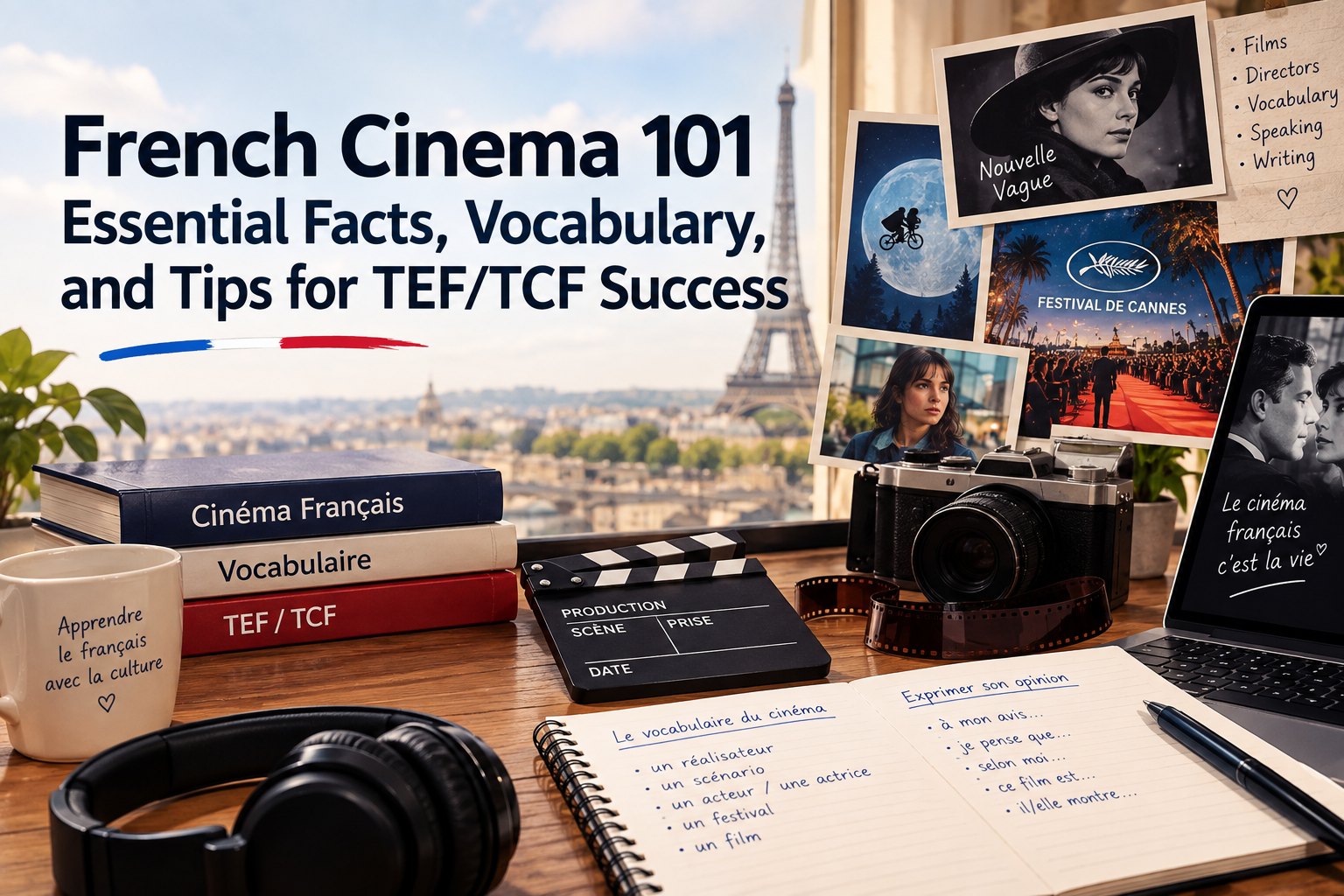
French cinema is more than entertainment. It is a cultural pillar and a brilliant way to enrich your French vocabulary, improve listening, and shine in TEF or TCF tasks. In this guide, you will learn the essentials of French cinema vocabulary for TEF/TCF, discover key moments in French film history, understand how the French film industry is structured, and get ready-made speaking and writing examples you can adapt on exam day. At PrepFrench Classes, we weave culture into every French course, because cultural literacy helps you speak French with confidence and nuance.
Why does this matter for your exam? TEF and TCF often include prompts where you describe a film, debate cultural policies, or comment on a festival. Referencing the Lumière brothers, the Nouvelle Vague, or the Cannes Film Festival instantly elevates your answer. By the end of this article, you will be equipped to talk about classic and contemporary French films, use precise vocabulary, and structure convincing opinions in B1 or B2 French. If you want to go further, our French courses give you guided practice with real exam-style questions.
Free First Step
Take the guesswork out of learning French.
Not sure where to begin, which course fits your goal, or how long it will take? Book a free demo class with PrepFrench Classes and get a personalized plan built around your level, schedule, and goals.
The Evolution of French Cinema
Origins of French cinema
France is one of the birthplaces of cinema. On 28 December 1895 in Paris, the Lumière brothers organized the first paid public film screening, showing short “actualités” like La Sortie de l’usine Lumière. Early French cinema thrived with pioneers such as Georges Méliès, who introduced special effects and imaginative storytelling with films like Le Voyage dans la Lune. During the silent era, French filmmakers experimented with technique and genre, laying the groundwork for a film culture that values authorship, innovation, and artistic risk.
Major movements: Nouvelle Vague explained
In the late 1950s and early 1960s, a new generation of critics-turned-directors launched the Nouvelle Vague, or New Wave, which reshaped global cinema. Directors like François Truffaut, Jean-Luc Godard, Agnès Varda, Claude Chabrol, and Éric Rohmer embraced lightweight cameras, location shooting, non-linear storytelling, and jump cuts. The idea was to prioritize the director’s voice as an “auteur,” which influenced film industries worldwide. If you need a quick explanation for TEF or TCF: the Nouvelle Vague broke traditional rules to create more personal, innovative films, and it helped define the concept of the director as the film’s author.
Key films and directors
Several titles are worth memorizing for cultural discussions:
- Les Quatre Cents Coups (1959, Truffaut): A semi-autobiographical coming-of-age story, iconic for its final freeze-frame.
- À bout de souffle, or Breathless (1960, Godard): Famous for jump cuts and fresh street-level style.
- Cléo de 5 à 7 (1962, Varda): A real-time portrait of a singer waiting for medical results, praised for its feminist perspective.
- La Haine (1995, Kassovitz): Social drama focused on youth, police, and banlieue identity.
- Amélie, original title Le Fabuleux Destin d’Amélie Poulain (2001, Jeunet): A whimsical modern classic.
- Intouchables (2011, Toledano and Nakache): A massive hit about friendship across class and ability.
- Portrait de la jeune fille en feu, or Portrait of a Lady on Fire (2019, Sciamma): A lyrical romance exploring gaze, art, and freedom.
- Les Misérables (2019, Ly): An intense look at contemporary tensions in the suburbs of Paris.
Contemporary French cinema remains vibrant, from arthouse auteurs to global crowd-pleasers. Streaming platforms and co-productions broaden the audience for French-language films, which is helpful when you want to practice listening and speaking in your French lessons. In our Full TEF Canada Course and Full TCF Canada Course, PrepFrench teachers often assign short clips or trailers so you can practice real-world comprehension and review vocabulary efficiently.
The Structure of the French Film Industry
Overview of CNC and its role
The Centre national du cinéma et de l’image animée (CNC) is the backbone of France’s film ecosystem. It regulates, supports, and promotes cinema, television, and new media. The CNC administers public funds to encourage creation, production, distribution, and preservation. For TEF or TCF discussions, you can say: the CNC ensures a steady pipeline of diverse films by reinvesting industry taxes into future projects, which protects cultural diversity.
Public funding mechanisms and the “cultural exception”
France is known for its “exception culturelle,” a policy mindset that treats culture as more than a market product. The idea is to defend cultural diversity and national production through smart regulation and funding. How does money flow into cinema?
- Ticket levy (TSA): A small tax on cinema tickets helps finance future productions through the CNC.
- Broadcaster and platform investment: TV channels and streaming services contribute to European and French production.
- Selective and automatic support: Grants and automatic schemes reward success and reinvest in new films.
These mechanisms keep French film production robust and independent, which explains the steady output of author-driven films. This is a strong point for debate in exams: cultural policies can preserve diversity, even if some argue that the market should decide which films get made.
Cannes Film Festival and its significance
The Cannes Film Festival is one of the most prestigious film events in the world. It features the main Competition, Un Certain Regard, Directors’ Fortnight, Critics’ Week, and the Marché du Film, which is a massive film market. The top prize is the Palme d’Or. Mentioning Cannes in your answer shows cultural awareness, especially if you can cite a recent Palme d’Or winner or a French film that made headlines. If you forget titles, at least explain the festival’s role: Cannes boosts careers, drives international sales, and sets the conversation for world cinema every year.
Beyond Cannes, Unifrance promotes French cinema abroad, helping French films reach audiences worldwide. This international dimension is useful to mention if you are asked about globalization, soft power, or cultural exports in the TEF or TCF.
Structured French Courses
Stop learning French the slow way.
Apps and random videos keep you stuck at beginner level forever. PrepFrench Classes gives you a structured path, a real teacher, and speaking practice that moves you forward at every lesson.
Available for: beginners · TEF/TCF exam prep · Canadian PR · work and daily French
French Cinema Vocabulary for TEF/TCF: Essential Terms to Discuss Films
Describing films: plot, characters, cinematography
- Le scénario, l’intrigue, le synopsis, le dénouement
- Le personnage principal, le protagoniste, l’antagoniste, les rôles secondaires
- La mise en scène, le cadrage, les plans, la lumière, la bande-son, le montage
- Un film d’auteur, un film engagé, un drame social, une comédie romantique
- Un chef-d’œuvre, un classique, une œuvre marquante, un film culte
- La performance des acteurs, la direction, le rythme, l’ambiance
Example: Ce film propose une mise en scène sobre et une lumière naturaliste. Le protagoniste évolue lentement, mais le dénouement est très puissant.
Opinion phrases: agree, disagree, preferences
- À mon avis, selon moi, je trouve que, il me semble que
- Je suis d’accord, je ne suis pas d’accord, je partage cette opinion
- Ce qui m’a plu, c’est…, ce que j’ai moins aimé, c’est…
- J’ai été touché par…, j’ai été déçu par…, j’ai adoré…, j’ai détesté…
- Je préfère les films qui…, je recommande vivement ce film, je déconseille ce film
Example: À mon avis, la force du film réside dans le jeu des acteurs. En revanche, le rythme est parfois inégal, surtout au milieu.
Connectors for structured argumentation
- D’abord, ensuite, enfin, pour commencer, pour conclure
- De plus, en outre, par ailleurs, cependant, pourtant, malgré
- Par exemple, en effet, c’est pourquoi, ainsi, donc
- Bien que, quoique, afin que, pour que, à condition que
Example: D’abord, le scénario est original. Ensuite, la mise en scène souligne la solitude du personnage. Cependant, certaines scènes sont prévisibles, ce qui affaiblit l’impact final.
In PrepFrench Classes, your French teacher will help you memorize and practice these connectors in short speaking drills, so you can structure a clear response under exam time pressure.
Classic and Contemporary Films to Mention
Classic French films
- Les Quatre Cents Coups (1959): A foundational Nouvelle Vague film about adolescence and freedom.
- À bout de souffle, or Breathless (1960): Stylish, improvised energy that changed cinematic language.
- Cléo de 5 à 7 (1962): Feminist, poetic, and rich in Parisian atmosphere.
- Le Salaire de la peur (1953, Clouzot): High-tension thriller that influenced modern action cinema.
- Les Enfants du Paradis (1945, Carné): An epic romance, often called the French “Citizen Kane.”
How to use them in TEF or TCF: learn one or two concise summaries. For example: “Les Quatre Cents Coups raconte l’errance d’un adolescent à Paris. Le film capte le sentiment de révolte avec une mise en scène libre et sensible.”
Modern films to know and discuss
- Amélie (2001): A feel-good portrait of kindness and imagination in Montmartre.
- La Haine (1995): Still relevant for conversations about social inequality and police relations.
- Intouchables (2011): A friendship story that combines humor with social themes.
- Mustang (2015, Turkish-French co-production): A powerful coming-of-age tale with French support.
- Portrait de la jeune fille en feu (2019): A modern classic of desire, art, and autonomy.
- Les Misérables (2019): A tense drama about community and authority in modern France.
Tip: If a non-French favorite comes to mind, connect it to France through influence or style. For instance, you can mention how global musicals were inspired by Jacques Demy’s Les Demoiselles de Rochefort. Then pivot back to a truly French title for your main example. In our French classes, you will practice building these bridges so your answer sounds informed and coherent.
TEF/TCF Applications: Speaking and Writing
Speaking prompts with model answers
-
Prompt: Parlez d’un film français que vous avez aimé. Expliquez pourquoi.
Model answer (B1/B2): J’ai beaucoup aimé Intouchables. À mon avis, ce film est touchant et drôle à la fois. Le scénario raconte l’amitié entre un homme handicapé et son aide à domicile, issu d’un milieu populaire. Ce qui m’a plu, c’est la complicité entre les acteurs et le rythme du film, qui alterne des scènes émouvantes et des moments comiques. De plus, le film aborde des sujets sérieux comme le handicap et la différence, sans tomber dans le pathos. Je le recommande, car il est accessible et profondément humain.
-
Prompt: Faut-il soutenir le cinéma avec de l’argent public en France, selon vous ?
Model answer (B2): Je pense que le financement public est nécessaire pour préserver la diversité culturelle. Grâce au CNC et aux mécanismes comme la taxe sur les billets, la France peut produire des films d’auteur et des œuvres innovantes qui ne seraient pas forcément rentables immédiatement. Cela soutient la création et l’émergence de nouveaux talents. Cependant, il est important d’évaluer régulièrement l’efficacité des aides pour éviter les abus. En résumé, je suis pour, à condition d’avoir une gestion transparente et des critères clairs.
-
Prompt: Le Festival de Cannes est-il vraiment utile pour le public ?
Model answer (B1/B2): Oui, à mon avis, Cannes est utile, même si c’est un événement très professionnel. D’abord, le festival met en lumière des films qui, sans cela, resteraient invisibles. Ensuite, il attire l’attention des médias, ce qui donne envie au public d’aller au cinéma. Enfin, le Marché du Film permet aux distributeurs de découvrir des œuvres du monde entier, donc cela améliore l’offre en salle et sur les plateformes. On peut critiquer le côté mondain, mais l’impact culturel est réel.
Writing prompts with structure templates
-
Prompt: Rédigez une critique courte d’un film français récent que vous avez vu.
Template: Introduction du film, brève description de l’intrigue, évaluation des points forts et faibles, conclusion et recommandation.
Model paragraph (B2): Portrait de la jeune fille en feu est un film sensible et maîtrisé. L’intrigue suit la relation entre une peintre et son modèle, sur une île isolée. La mise en scène épurée et la lumière naturelle créent une atmosphère intime. De plus, la bande-son minimale renforce l’émotion des regards. En revanche, certains spectateurs pourraient trouver le rythme lent. Malgré cela, c’est un chef-d’œuvre visuel et une réflexion profonde sur le regard. Je le recommande vivement.
-
Prompt: “Aujourd’hui, les plateformes de streaming menacent la salle de cinéma.” Donnez votre avis.
Template: Thèse, arguments pour, arguments contre, exemple, conclusion.
Model paragraph (B1/B2): Selon moi, les plateformes ne menacent pas la salle, elles la transforment. D’une part, elles offrent un accès facile à un grand catalogue et soutiennent parfois des productions françaises. D’autre part, l’expérience en salle reste unique, surtout pour les films d’auteur et les festivals. Par exemple, les avant-premières et les débats avec les réalisateurs créent un lien social. En conclusion, il faut trouver un équilibre, en protégeant la salle tout en valorisant la complémentarité avec le streaming.
-
Prompt: “Faut-il enseigner l’histoire du cinéma à l’école ?” Argumentez.
Template: Introduction, deux arguments avec exemples, contre-argument, conclusion.
Model paragraph (B2): Je pense que l’histoire du cinéma devrait être enseignée. Premièrement, cela développe l’analyse critique, par exemple en étudiant la Nouvelle Vague et la notion d’auteur. Deuxièmement, le cinéma fait partie de notre patrimoine culturel, comme la littérature ou la peinture. Certains diront que le programme est déjà chargé. Cependant, des modules courts, avec des extraits et des débats, suffiraient. En conclusion, intégrer le cinéma à l’école encouragerait la créativité et l’ouverture d’esprit.
For guided practice and personalized feedback on your writing, you can join our TCF Canada preparation or TEF Canada preparation and work directly with a French tutor who reviews your structure, connectors, and style.
PrepFrench Classes
Ready to start French with a clear plan?
Book a FREE demo class and get a personalized roadmap for your level, goal, and timeline. No pressure, no obligation.
Explore courses:
All French Courses · Full TCF Canada Course · Full TEF Canada Course
FAQ: French Cinema, Vocabulary, and TEF/TCF
How can I describe and evaluate a film in French at B1/B2 level for TEF/TCF speaking?
Use a simple structure: introduction, brief plot, two strengths, one weakness, and a recommendation. Rely on connectors like d’abord, ensuite, cependant, en conclusion. Include cinema vocabulary such as mise en scène, bande-son, jeu des acteurs, et scénario. Example: D’abord, l’intrigue est prenante. Ensuite, la mise en scène souligne la tension. Cependant, le rythme est inégal au milieu. En conclusion, je recommande ce film pour son message. Practicing with a French teacher in online French classes helps you sound natural and stay within time limits.
What quick facts about French cinema (Cannes, CNC, Nouvelle Vague) can I use to enrich my answers?
Mention that Cannes awards the Palme d’Or and drives global film buzz. Explain that the CNC funds creation through levies on tickets and platforms, which protects cultural diversity. For the Nouvelle Vague, say it emerged around 1959 to 1963 with Truffaut and Godard, privileging the director as auteur and using innovative techniques like jump cuts and location shooting. These facts show cultural knowledge and fit well into TEF or TCF prompts about film, media, or public policy. PrepFrench Classes covers all these points in our culture-based French lessons.
What are some classic French films that I should reference in my TEF/TCF writing?
Keep a short list ready: Les Quatre Cents Coups and À bout de souffle for the Nouvelle Vague, Cléo de 5 à 7 for a feminist perspective, Les Enfants du Paradis as a poetic classic, and Le Salaire de la peur for tension and craft. For modern references, add La Haine, Amélie, Intouchables, Portrait de la jeune fille en feu, and Les Misérables. Learn one or two lines of commentary per title. In a TEF preparation course, your French tutor can help you refine summaries and memorise key phrases.
How can public funding for cinema in France be debated in an exam setting?
Present both sides. For: public funds through the CNC preserve cultural diversity, support first films, and maintain an industry independent from purely commercial logic. Against: risk of bureaucracy, potential inefficiencies, or funding films with limited audiences. Conclude with a balanced view, for example: je soutiens le financement public, à condition d’une évaluation régulière et transparente. Use connectors like d’une part, d’autre part, en revanche, en conclusion. Practicing this balanced structure in French lessons makes your argument clear and convincing.
What vocabulary should I know to write a French film review effectively?
Focus on: scénario, intrigue, dénouement, mise en scène, cadrage, montage, bande-son, jeu des acteurs, rythme, ambiance, chef-d’œuvre, film d’auteur, drame social. Opinion tools: à mon avis, je trouve que, ce qui m’a plu, cependant, en revanche, je recommande. Example sentence: La mise en scène minimaliste et la bande-son discrète créent une ambiance intimiste, cependant le rythme peut sembler lent. You will practise these in PrepFrench Classes, especially if you are preparing for TEF or TCF writing tasks in our TCF course.
Final Thoughts: Bring French Cinema into Your TEF/TCF Preparation
French cinema offers a perfect blend of culture, language, and inspiration. You can explore the Lumière origins, explain the Nouvelle Vague, and cite Cannes Film Festival facts, while building the exact French vocabulary you need to describe a film at B1 or B2 level. When you integrate these references into your speaking and writing, your TEF or TCF responses become clearer, richer, and more persuasive.
Use the vocabulary lists above to structure opinions, connect ideas, and evaluate films. Memorise a few classic and contemporary titles, plus two or three sentences about their significance. Then practice under time pressure with a teacher who can refine your pronunciation, connectors, and argument logic. If you want a guided path with feedback and exam-style drills, join PrepFrench Classes and move forward with a structured French course that includes cultural topics at every stage.
Culture is not extra. For French learners, culture is a shortcut to better comprehension, richer vocabulary, and more confident speaking. Bring cinema into your study routine and you will not only pass tests, you will also enjoy French far more.
✅ Next Step: Book a free demo class with PrepFrench Classes and start learning French the right way.
Personalize your TEF or TCF preparation with cultural insights from French cinema. A focused plan, consistent practice, and expert feedback will raise your score and your confidence.
Written by
Platform Administrator
Practical ideas from the Prep French team for learners building confidence, preparing for exams, and planning their next step in Canada.
Join the discussion
Leave a thoughtful comment.
Your email address will not be published. Comments are reviewed before appearing.