French Athletes and Sports in France: A Guide for Learners
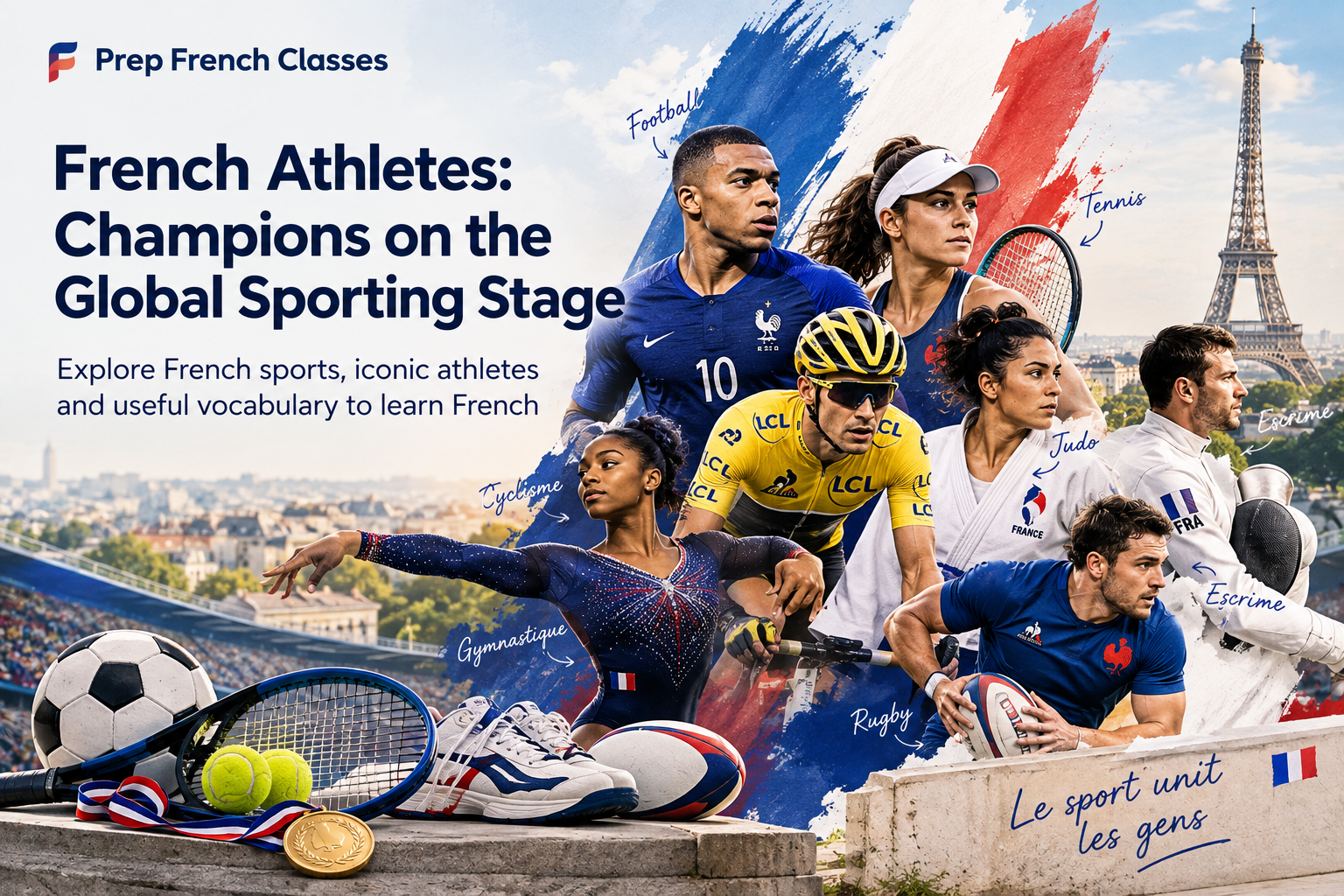
From packed stadiums in Marseille to mountain passes in the Alps, French athletes embody a mix of artistry, resilience, and relentless preparation that has captivated the world. French sports culture runs deep, and understanding it opens a window into the country’s values, history, and daily conversations. In this guide, we explore the landscape of sports in France, the iconic names who shaped it, and how you can use this passion for sport to learn French faster with PrepFrench Classes. If you love football, cycling, tennis, or judo, you already have a rich entry point to French vocabulary, listening practice, and cultural fluency. Start here, then take the next step with our PrepFrench resources and structured French courses.
Free First Step
Take the guesswork out of learning French.
Not sure where to begin, which course fits your goal, or how long it will take? Book a free demo class with PrepFrench Classes and get a personalized plan built around your level, schedule, and goals.
The Role of Sports in French Culture
Historical Overview of Sports in France
The story of sports in France is woven into the nation’s modern identity. In the late 19th and early 20th centuries, France helped formalize global competitions that still define the calendar today. Pierre de Coubertin championed the revival of the modern Olympic Games. The Tour de France, first held in 1903, turned cycling into an epic annual showcase of endurance and landscape. As radio and later television connected the country, Sunday matches and summer stages became weekly rituals, shaping regional rivalries and national heroes.
Postwar France invested in clubs, school sports, and national training centers, creating a pipeline that nurtured talent consistently. This infrastructure, combined with a culture that admires both flair and tactical intelligence, produced world-beating teams in football and handball, and icons across judo, athletics, fencing, motorsport, and tennis.
Major Sports That Define French Identity
While interests vary by region, a few disciplines stand out for their cultural weight and devoted followings. If you plan to learn French, these sports offer ready-made content for listening practice and vocabulary building.
- Football: The global language, with two FIFA World Cup titles and a deep club culture.
- Rugby Union: Particularly strong in the southwest, known for passion and flair.
- Handball: A dynasty in both men’s and women’s competitions.
- Cycling: The Tour de France is a national institution each July.
- Tennis: Roland-Garros brings clay-court drama and elegant French commentary.
- Judo and Fencing: Technical sports where France regularly excels.
- Motorsport: From Le Mans to Formula 1 legends and rally kings.
- Biathlon and Alpine Sports: Winter disciplines with loyal audiences.
For learners, discussing sports in French connects vocabulary to something you already love. PrepFrench Classes often use match highlights, athlete interviews, and event previews to turn passive viewing into active learning. When you can talk about a last-minute goal or a mountain stage in French, cultural fluency starts to click.
France's Achievement in Team Sports
Football: The Kings of La Coupe
French football has given the world artistry and cold-blooded finishing, expressed in two generations of champions. The national team, Les Bleus, lifted the FIFA World Cup in 1998 and 2018, and reached the final in 2006 and 2022. European titles in 1984 and 2000, plus the UEFA Nations League in 2021, reinforce a record of consistent excellence.
- World Cup: Champions 1998 and 2018, finalists 2006 and 2022.
- European Championship: Winners 1984 and 2000.
- UEFA Nations League: Winners 2021.
For vocabulary practice, follow a Ligue 1 matchday preview or post-match interviews. Words like le but (goal), une passe décisive (assist), and le sélectionneur (head coach) appear everywhere and are easy to memorize in context.
Handball Dynasties: Men's and Women's Teams
France set the standard in international handball. The men’s team dominated world championships in the 2000s and 2010s, and added Olympic gold at Tokyo 2020. The women’s team has its own legacy, including a world title in 2017, a European title in 2018, and Olympic gold in Tokyo 2020. Together they created a culture of excellence built on defense, speed, and clinical finishing.
- Men: Multiple World Championships, Olympic gold in 2020, and a reputation for clutch performances.
- Women: World champions 2017, European champions 2018, and Olympic gold in 2020.
Try listening to a quick highlight reel with French commentary. Note terms like l’ailier (wing), le pivot, la défense, and un tir puissant (a powerful shot).
Rugby Union Pedigree: Success on the World Stage
Rugby is deeply rooted in French regions like Occitanie and Nouvelle-Aquitaine. Les Bleus were Rugby World Cup finalists in 1987, 1999, and 2011, and often thrill neutral fans with offloading and counterattacking rugby. Recent momentum included a Six Nations Grand Slam in 2022, highlighting a new generation of leaders and elite kicking games.
- Rugby World Cup: Finalists three times, regular contenders.
- Six Nations: Multiple titles, Grand Slams in 2002, 2004, 2010, and 2022.
Learn match-day phrases like l’essai (try), la transformation (conversion), un en-avant (knock-on), and la mêlée (scrum). Match reports in French are concise and packed with useful verbs, perfect for intermediate reading practice.
Basketball: European Strength and Global Presence
French basketball feeds the NBA and powers competitive national teams. The men’s team won EuroBasket in 2013, Olympic silver in 2020, and World Cup bronze in 2019. The women’s team remains a European force, earning multiple podiums over the last decade. Youth academies and strong clubs help produce skilled guards and versatile bigs.
- EuroBasket: Men’s gold in 2013, frequent podiums for both teams.
- Olympics: Men’s silver in 2020, a breakthrough moment against elite opposition.
Keep an ear out for le tir à trois points (three-pointer), le rebond (rebound), la passe, and le contre (block). These terms appear in every highlight package you watch in French.
Structured French Courses
Stop learning French the slow way.
Apps and random videos keep you stuck at beginner level forever. PrepFrench Classes gives you a structured path, a real teacher, and speaking practice that moves you forward at every lesson.
Available for: beginners · TEF/TCF exam prep · Canadian PR · work and daily French
Individual Sports and Iconic French Athletes
Judo: French Dominance and Major Champions
France sits at the top tier of world judo. Teddy Riner, a global superstar, owns multiple world titles and three Olympic gold medals across London 2012, Rio 2016, and the mixed team event at Tokyo 2020. Clarisse Agbégnénou is another powerhouse, with multiple world championships and an Olympic gold in 2020. Their careers define France’s blend of technique, discipline, and mental control.
- Teddy Riner: Multiple-time world champion, triple Olympic gold medalist.
- Clarisse Agbégnénou: Multi-world champion, Olympic gold in 2020.
- Guillaume Chaine, Amandine Buchard, and others: Key roles in France’s mixed team success.
Practice vocabulary: l’ippon (full point), le tatami (mat), la catégorie (weight class), la prise (grip), and le judoka.
Tennis: The Legacy of Roland-Garros
The French Open, or Roland-Garros, is a clay-court epic that shapes the tennis year. French champions like Yannick Noah (Roland-Garros 1983), Mary Pierce (Roland-Garros 2000), and Amélie Mauresmo (Australian Open and Wimbledon 2006) brought elegance and power to the global stage. Contemporary figures like Caroline Garcia, Gaël Monfils, and Richard Gasquet keep France competitive in singles and doubles, while French doubles teams often excel in Grand Slams and the Davis Cup.
- Yannick Noah: Last French men’s singles champion at Roland-Garros, 1983.
- Mary Pierce and Amélie Mauresmo: Grand Slam champions who inspired a generation.
- Caroline Garcia: WTA Finals champion in 2022, a leader in modern French tennis.
Useful terms: la terre battue (clay), le revers (backhand), un amorti (drop shot), and la balle de break (break point).
Athletics: Celebrating France's Track and Field Legends
French athletics mixes sprint heritage with technical mastery. Marie-José Pérec became a national icon with Olympic golds in the 400 m at Barcelona 1992 and in both 200 m and 400 m at Atlanta 1996. Renaud Lavillenie soared to Olympic pole vault gold in 2012. Decathlete Kevin Mayer set the world record in 2018 and won world titles, showcasing consistency across ten events. In endurance and biathlon, Martin Fourcade stands tall as a multiple-time Olympic champion and World Cup overall winner.
- Marie-José Pérec: Triple Olympic champion, a legend of the 400 m.
- Kevin Mayer: Decathlon world record holder in 2018 and world champion.
- Renaud Lavillenie: Olympic gold in 2012, multiple European titles.
- Martin Fourcade: Biathlon great with multiple Olympic golds and globes.
Try following French interviews with athletes. Listen for une série (heat), un record personnel (personal best), la finale, la récupération (recovery), and le mental (mindset).
| Mini Glossary: Talking about Sports in French | English Meaning |
| un match serré | a close game |
| marquer un but / un essai | to score a goal / a try |
| la défense solide / l’attaque efficace | solid defense / efficient offense |
| remporter le titre / la médaille | to win the title / the medal |
| le palmarès de l’athlète | the athlete’s track record |
| le mental fait la différence | mindset makes the difference |
| une performance historique | a historic performance |
| les prolongations / la séance de tirs au but | extra time / penalty shootout |
Use this mini glossary during your next match reaction. In our online French classes, your teacher will help you turn phrases like ces athlètes sont impressionnants into real conversation, not just flashcards.
The Underlying Structures of French Sports Success
INSEP: The Heart of Athlete Development
The Institut National du Sport, de l’Expertise et de la Performance (INSEP) in Paris is a central hub for elite French athletes. It brings together training facilities, sports science, performance analysis, medical support, nutrition, and education under one roof. The goal is holistic: prepare the athlete, the person, and the student for sustained excellence.
- World-class facilities: strength rooms, technical halls, and video analysis suites.
- Integrated support: physiotherapy, psychology, nutrition, sleep labs, and injury prevention.
- Dual-career support: schooling and university partnerships so athletes can study while training.
- Data and analytics: biomechanics and performance tracking to optimize training loads.
When you read French articles about INSEP, expect terms like la préparation physique (strength and conditioning), l’encadrement (support staff), and le suivi médical (medical monitoring). Our teachers at PrepFrench often assign short INSEP features as listening homework to help you learn French in a real-world context.
Federations and Clubs: Fostering Talent
Each sport has a national federation that sets rules, funds development, and selects national teams. Beneath that, a vast network of clubs offers coaching for children and adults. It is common for French athletes to rise from a local club to a regional center, then to national training hubs like INSEP or sport-specific centers around the country.
- Grassroots to elite: clubs feed regional academies, which channel talent to national teams.
- Coaching pathways: certified French coaches progress through structured levels.
- Talent ID: regular competitions and regional trials keep the pipeline active.
- Education: sport-études programs balance schooling and training for young athletes.
Understanding this system helps language learners decode headlines such as la Fédération annonce sa liste or un jeune espoir rejoint le pôle espoirs. If you are preparing for TEF or TCF, weaving sports articles into your study plan keeps reading practice enjoyable. You can also explore our dedicated exam programs: Full TEF Canada Course and Full TCF Canada Course.
Major Sporting Events Hosted by France
France regularly stages events that capture a global audience. For learners, these competitions are perfect for building both cultural knowledge and French listening habits. You can follow live commentary, read match reports, and pick up idiomatic phrases that do not show up in textbooks.
Tour de France: Cycling’s Grand Showcase
The Tour de France transforms the country into a rolling stadium each July. Three weeks, 21 stages, mountain battles in the Alps and Pyrenees, time trials, and sprint finishes, all against a backdrop of castles and countryside. Historically, French legends like Bernard Hinault and Laurent Fignon defined eras. In recent years, stars like Julian Alaphilippe have thrilled home crowds with attacking rides and stage wins.
- Key jerseys: le maillot jaune (yellow), le maillot à pois (polka dot), le maillot vert (green), and le maillot blanc (white).
- Common terms: l’échappée (breakaway), le peloton (main group), la bordure (crosswind echelon), la descente (descent).
Tip: Watch short French summaries each evening. Pause to repeat new vocabulary out loud and jot down one memorable sentence per stage. This simple habit compounds quickly.
The Impact of Roland-Garros on Tennis
Roland-Garros is more than a tennis tournament. It is a cultural moment that blends precision analysis with poetic turns of phrase from French commentators. Each late spring, Paris becomes tennis city, with clay-court storylines that sharpen tactical vocabulary and listening skills.
- Follow daily highlights en français to learn set scoring and tactic words naturally.
- Read match previews that use future tense and conditionals, which are essential for intermediate learners.
You will hear phrases such as il a imposé son rythme or elle a sauvé des balles de break. Bring these lines to your next PrepFrench lesson and practice retelling a match in your own words.
Le Mans: Endurance Racing's Premier Event
The 24 Hours of Le Mans is the pinnacle of endurance racing, fusing engineering, strategy, and stamina. Teams juggle tire wear, fuel strategy, driver rotations, and changing weather. France’s motorsport heritage also includes Formula 1 champions like Alain Prost and rally giants Sébastien Loeb and Sébastien Ogier, each a master of different terrain.
- Core vocabulary: l’endurance, le ravitaillement (pit stop), la fiabilité (reliability), la stratégie, and le relais (stint).
- Learning angle: technical French is clear and concise, perfect for building precise listening skills.
Try summarizing a race segment in French: Qui mène la course, quelle est la stratégie des leaders, and quels incidents ont tout changé. Small recaps build speaking confidence.
PrepFrench Classes
Ready to start French with a clear plan?
Book a FREE demo class and get a personalized roadmap for your level, goal, and timeline. No pressure, no obligation.
Explore courses:
All French Courses · Full TCF Canada Course · Full TEF Canada Course
Conclusion: Learn French Through the Power of Sport
Sport explains more than scorelines in France. It reveals national character, regional identities, and the value placed on education, teamwork, and craft. From Les Bleus in football and handball to the legends of judo, athletics, tennis, and motorsport, French athletes have shaped the global conversation about performance and style. For language learners, this is a gift. It means you can make steady progress by following what you love: match recaps, interviews, documentaries, and live commentary in French.
PrepFrench Classes builds on that motivation with structure. We turn sports content into lessons that improve listening, build real-world vocabulary, and give you confident speaking practice. Whether your goal is daily conversation or a French exam, a sports-first approach keeps you consistent and curious. Explore our French courses, book a free demo, and start using the energy of French athletes to accelerate your learning. As you cheer, argue, and analyze in French, the language becomes a natural part of your routine.
FAQ: French Athletes and Sports in France
What sports is France traditionally strongest in, and why?
France is traditionally strong in team sports like football, handball, and rugby union, and in individual disciplines such as judo, fencing, cycling, and athletics. The reasons are structural and cultural. A nationwide club system gives kids early access to coaching, while elite centers like INSEP provide world-class support in sports science and education. Federations coordinate talent identification and competition schedules. Add regular exposure through major events like the Tour de France and Roland-Garros, and you get a culture that celebrates performance and creates steady pipelines to the top. Use this content in your French lessons to build vocabulary that sticks.
Who are the most famous French athletes across different sports today?
A few headline names help learners build context fast. In judo, Teddy Riner and Clarisse Agbégnénou are global icons. In football, Kylian Mbappé and Antoine Griezmann carry the torch for Les Bleus. In track and field, Kevin Mayer and Renaud Lavillenie remain reference points for decathlon and pole vault. Cycling fans follow Julian Alaphilippe. In tennis, Caroline Garcia leads the current generation. Motorsport legends include Alain Prost, plus rally greats Sébastien Loeb and Sébastien Ogier. When you read or watch interviews in French with these athletes, your listening comprehension grows rapidly.
What major international sports events does France host every year?
Three of the biggest annual events are the Tour de France (July), Roland-Garros, also known as the French Open (late May to early June), and the 24 Hours of Le Mans (June). Each offers a unique learning experience. The Tour supplies daily highlight reels with clear, repeated vocabulary about stages and strategies. Roland-Garros blends technical tennis terms with expressive commentary. Le Mans provides concise, technical French about fuel, tires, and weather strategy. Follow official websites and French broadcasts, then bring your notes to an online French class for guided practice.
How does INSEP support elite French athletes?
INSEP centralizes everything elite athletes need: training halls, recovery areas, medical support, nutrition, sleep and biomechanics labs, as well as academic programs. This integrated model reduces friction in an athlete’s day, so they can train, study, recover, and analyze performance efficiently. INSEP also supports coaches through research and professional development, which raises standards across the system. For French learners, INSEP’s public materials and interviews are excellent for advanced listening. You will encounter practical terms like l’encadrement, la prévention des blessures, and le suivi de la charge d’entraînement, which are useful beyond sports.
What are essential French phrases for talking about sports?
Start with phrases that appear in every recap. For football and rugby: Quel but magnifique, l’équipe a dominé la seconde mi-temps, and ils ont marqué en contre. For tennis: il a sauvé deux balles de break and elle a dicté l’échange avec son coup droit. For cycling: il a attaqué dans la montée and le peloton a repris l’échappée. Add general lines like c’était un match serré, la défense a tenu, and une victoire méritée. Practice these in a short voice note after each game. A PrepFrench teacher will help you refine pronunciation and build variety.
✅ Next Step: Book a free demo class with PrepFrench Classes and start learning French the right way.
Join our sports-themed French classes to become fluent while enjoying the exciting world of sports. Turn every match, stage, and interview into a practical French lesson with guidance from a real teacher.
Written by
Platform Administrator
Practical ideas from the Prep French team for learners building confidence, preparing for exams, and planning their next step in Canada.
Join the discussion
Leave a thoughtful comment.
Your email address will not be published. Comments are reviewed before appearing.