Family Members in French: Vocabulary, Meanings & Examples
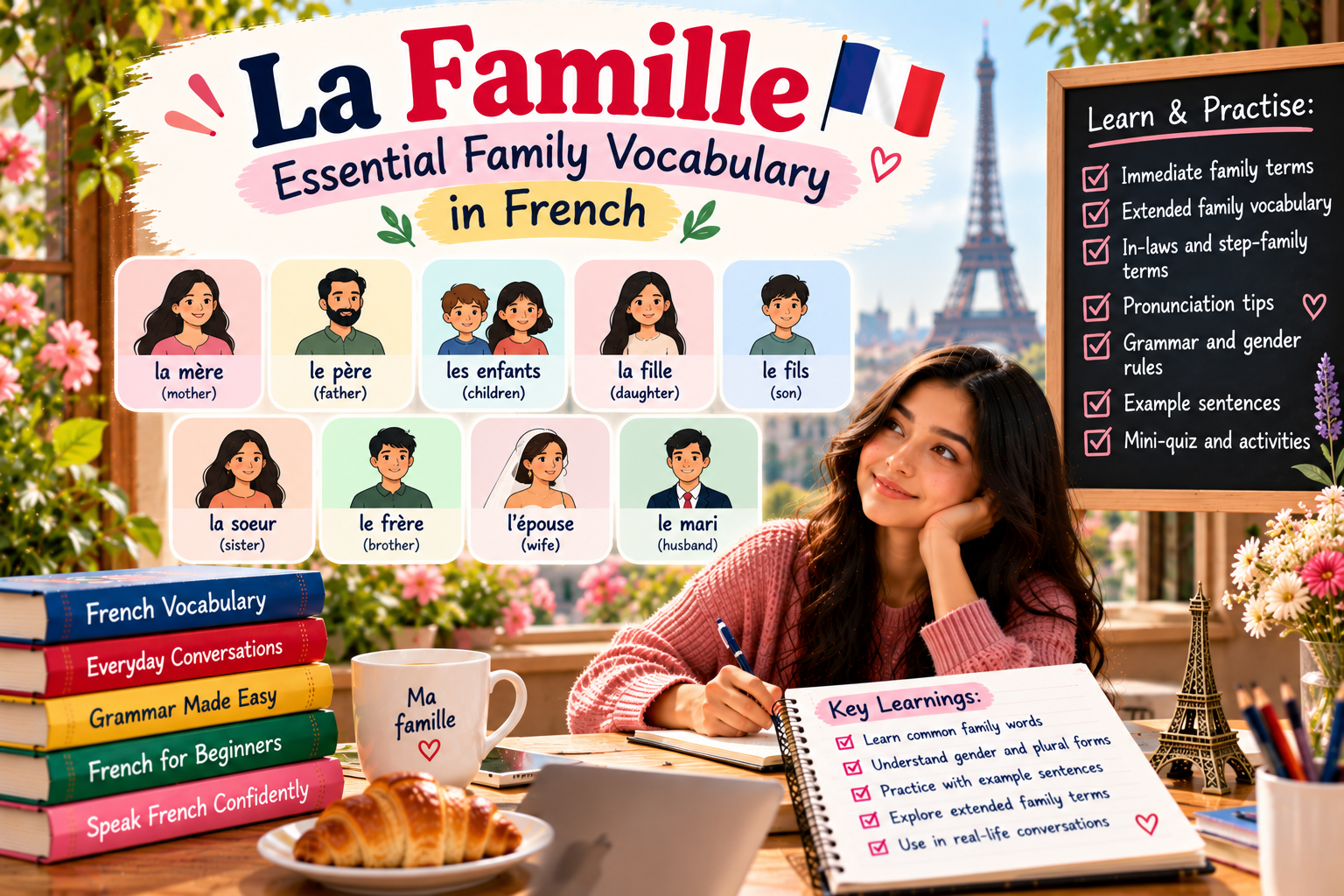
Talking about the people you love is one of the first real conversations you will have in any new language. Mastering family members in French gives you the confidence to introduce yourself, describe your background, and connect with native speakers on a personal level. In this complete guide to French family vocabulary, you will learn the most common words, see how to use them correctly, and understand the cultural nuances that matter in real life. We will cover immediate and extended relatives, in-laws and step-family terms, affectionate forms, and how to use possessives with la famille en français. You will also find a mini-quiz and practical activities you can try today.
If you want a structured path to learn French with guidance from a real teacher, PrepFrench Classes can help you build a strong foundation and use these words in speaking practice. You can browse our French courses or book a free demo class to get a custom plan. Let’s get you comfortable with la famille, one of the most useful everyday topics in the French language.
Free First Step
Take the guesswork out of learning French.
Not sure where to begin, which course fits your goal, or how long it will take? Book a free demo class with PrepFrench Classes and get a personalized plan built around your level, schedule, and goals.
Basic Family Members in French
Immediate Family Terms
Start with the people closest to you. These are the most common family words you will use when introducing yourself and describing who is in your household. The short pronunciation notes in slashes are approximations to help you say them clearly.
- la mère [la mehr] - mother
- le père [luh pehr] - father
- les parents [lay pah-ron] - parents
- la fille [la fee-y] - daughter
- le fils [luh fees] - son
- les enfants [lay zon-fon] - children
- la soeur [la sur] - sister
- le frère [luh frehr] - brother
- l’épouse [lay-pooz] - wife
- le mari [luh mah-ree] - husband
Example sentences:
- C’est ma mère. Elle s’appelle Julie. (This is my mother. Her name is Julie.)
- Voici mon père et mes soeurs. (Here are my father and my sisters.)
- Nous avons deux enfants, un fils et une fille. (We have two children, a son and a daughter.)
Pronunciation and Gender Notes
French nouns have gender, so family words use le or la. When plural, use les. Watch out for liaison, the link between final consonants and the next word that begins with a vowel, like in les enfants, which sounds like [lay zon-fon]. Also remember: les parents means parents, not relatives. For relatives in general, use la famille or les proches.
As you learn these essentials, practicing out loud helps you internalize patterns. In our beginner-friendly online French classes, your teacher corrects your pronunciation and helps you build fluent, confident sentences that you can use right away.
Extended Family Vocabulary
Extended Family Terms
To talk about your wider family tree, add these useful French words for relatives. You will use them often when describing visits, holidays, or your background.
- la grand-mère - grandmother
- le grand-père - grandfather
- les grands-parents - grandparents
- la petite-fille - granddaughter
- le petit-fils - grandson
- les petits-enfants - grandchildren
- la tante - aunt
- l’oncle - uncle
- le cousin / la cousine - cousin (m/f)
- le neveu - nephew
- la nièce - niece
- l’arrière-grand-mère - great-grandmother
- l’arrière-grand-père - great-grandfather
Simple sentences:
- Ma grand-mère habite à Lyon. (My grandmother lives in Lyon.)
- J’ai trois cousines et un cousin. (I have three female cousins and one male cousin.)
- Nous dînons chez mon oncle dimanche. (We are having dinner at my uncle’s on Sunday.)
A simple family tree example:
- Grands-parents
- Grand-père Paul + Grand-mère Anne
- Leurs enfants:
- Pierre (frère) - marié à Sophie
- Julie (soeur) - mariée à Marc
- Petits-enfants:
- Enfants de Pierre et Sophie: Louis (fils), Clara (fille)
- Enfant de Julie et Marc: Hugo (fils)
Cultural Notes on Usage
In many French-speaking families, relatives are close and see each other often on weekends and holidays. You will hear affectionate nicknames like papi and mamie for grandparents. When introducing adults to others, French speakers usually prefer first names after saying the relationship: C’est ma tante, Chantal. If you want more cultural insights woven into practice, PrepFrench Classes include real-life dialogues and role plays so you learn vocabulary in meaningful contexts.
In-laws and Step-family Vocabulary
Understanding In-Laws and Steps
This is where learners often feel unsure. Many French terms cover both in-law and step relationships, which means context is essential. The table below compares the most common words, clarifies meanings, and gives natural example sentences for reference.
| French Term | Relationship | Notes | Example Sentence |
|---|---|---|---|
| beau-père | father-in-law or stepfather | Context decides which meaning applies. | Mon beau-père vient dîner ce soir. |
| belle-mère | mother-in-law or stepmother | Same ambiguity as beau-père. | J’aime beaucoup ma belle-mère. |
| beau-frère | brother-in-law | Can be your spouse’s brother or your sibling’s husband. | Mon beau-frère s’appelle Karim. |
| belle-soeur | sister-in-law | Can be your spouse’s sister or your sibling’s wife. | Voici ma belle-soeur, Ana. |
| gendre | son-in-law | Formal but common. | Mon gendre travaille à Bordeaux. |
| belle-fille / bru | daughter-in-law | Bru is more traditional, belle-fille is widely used. Belle-fille can also mean stepdaughter. | Ma belle-fille est médecin. |
| beau-fils | son-in-law or stepson | Ambiguous without context. | Mon beau-fils a 16 ans. |
| demi-frère | half-brother | Shares one parent with you. | J’ai un demi-frère plus jeune. |
| demi-soeur | half-sister | Shares one parent with you. | Ma demi-soeur vit à Montréal. |
| par alliance | by marriage (in-law) | As in un oncle par alliance. | C’est ma tante par alliance. |
Common Confusion Clarified
The words with beau- and belle- can describe both in-laws and step-relatives. Native speakers rely on context. If you need to be precise, add extra detail: beau-père, le père de ma femme (my father-in-law), or belle-fille, la fille de mon mari (my stepdaughter). In conversation, follow-up questions help: Tu parles de ton beau-père du côté de ta femme ou de ton beau-père parce que ta mère s’est remariée ?
If you want support using these terms accurately in conversation, a live teacher in a structured French course can guide your practice and correct mistakes early.
Structured French Courses
Stop learning French the slow way.
Apps and random videos keep you stuck at beginner level forever. PrepFrench Classes gives you a structured path, a real teacher, and speaking practice that moves you forward at every lesson.
Available for: beginners · TEF/TCF exam prep · Canadian PR · work and daily French
Informal and Affectionate Family Terms
Common Informal Terms
In daily conversations, French speakers use friendly nicknames, especially with children and close relatives. These lighten the tone and make speech sound natural.
- maman, papa - mom, dad
- papi, papy / papi - grandpa
- mamie - grandma
- tonton - uncle (affectionate)
- tata - aunt (affectionate)
- frangin, frangine - bro, sis (informal slang)
- beau-papa, belle-maman - affectionate forms for in-laws or step-parents
- p’tit frère, grande soeur - little brother, big sister (spoken contractions are common)
- fiston - sonny, lad (colloquial for a boy)
Usage in Conversations
You will hear these forms at home, with friends, and in informal chats. In more formal contexts, switch back to the standard terms: mère, père, grand-mère, grand-père, etc. Here are short everyday dialogues to show how they sound:
A: Tu viens chez mamie ce soir ?
B: Oui, je passe avec papa vers 19 h.
A: Tonton Paul arrive quand ?
B: Demain matin, il prend le train de 9 h.
A: Je dîne chez belle-maman ce week-end.
B: Super, embrasse-la pour moi.
The choice between formal and informal words depends on your audience. In our conversational French lessons, you will practice switching registers, so you can greet a friend naturally and still sound professional at work or in class.
Demonstrating Possession: Using French Possessives with Family Vocabulary
Forms of Possessive Adjectives
Possessive adjectives agree with the noun that follows, not with the owner. Here are the core forms with family words:
- mon, ma, mes - my: mon père, ma mère, mes parents
- ton, ta, tes - your (informal singular): ton frère, ta soeur, tes cousins
- son, sa, ses - his or her: son père, sa mère, ses enfants
- notre, nos - our: notre tante, nos grands-parents
- votre, vos - your (formal or plural): votre oncle, vos nièces
- leur, leurs - their: leur fille, leurs petits-enfants
Two tips:
- Use mon before a feminine noun that begins with a vowel or silent h for easier pronunciation: mon amie, mon épouse, mon arrière-grand-mère. The noun stays feminine, only the possessive changes to avoid a vowel clash.
- To show someone’s relative, French often uses de: la mère de Paul, le cousin de Marie. Example: C’est la soeur de Thomas. (That is Thomas’s sister.)
Common Errors
Avoid literal translations from English. Do not say Il est mon père. Use C’est mon père. Do not confuse ses and ces: ses means his or her, while ces means these. For example, Elle adore ses enfants means She loves her children. Ces enfants means These children. Another frequent slip is with parents vs relatives. Remember: parents are mother and father. For relatives more broadly, say la famille, les proches, or les membres de la famille.
If you want guided practice on agreement and everyday usage, join a structured French course with PrepFrench to get immediate feedback and clear corrections in each lesson.
Practical Exercises and Mini-Quiz
Mini-Quiz
Test your understanding of French family tree vocabulary and possessives. Write your answers on paper, then check with the key below.
- Choose the correct word: C’est _____ mère. (mon / ma / mes)
- Translate: My grandparents live in Paris.
- Fill in: Elle parle avec _____ cousin. (son / sa / ses)
- True or False: Les parents means relatives.
- Choose the best option: _____ oncle arrive demain. (Notre / Nos)
- Translate: This is my sister-in-law.
- Clarify meaning: beau-père can refer to which two relationships?
- Rewrite with de: That is Marie’s aunt.
- Choose the correct possessive: Il aime beaucoup _____ enfants. (ses / ces)
- Translate: We have one nephew and two nieces.
Answer key:
- ma
- Mes grands-parents habitent à Paris.
- son
- False. It means parents.
- Notre
- C’est ma belle-soeur.
- Father-in-law or stepfather.
- C’est la tante de Marie.
- ses
- Nous avons un neveu et deux nièces.
Suggested Practice Activities
- Family map: Draw your family tree and label each person using French words for relatives. Add three sentences for each generation.
- Introduce three people: Record yourself saying C’est mon..., Elle s’appelle..., Il a..., using correct possessives and ages.
- Role play: With a partner or teacher, practice small talk about family: Combien de frères et soeurs as-tu ? Où habitent tes parents ?
- Listening boost: Watch a short French vlog that mentions family, then write five new phrases you heard and copy their pronunciation.
- Real life check: In your next PrepFrench class, share your family story in two minutes. Get feedback on pronunciation and fluency.
Consistent, focused practice turns vocabulary into active speaking skills. If you need a clear structure, a live demo class will show you how PrepFrench can organize your learning for steady progress.
PrepFrench Classes
Ready to start French with a clear plan?
Book a FREE demo class and get a personalized roadmap for your level, goal, and timeline. No pressure, no obligation.
Explore courses:
All French Courses · Full TCF Canada Course · Full TEF Canada Course
FAQ: French Family Vocabulary and Usage
What is the difference between “parents” and “relatives” in French?
In French, les parents means parents, specifically your mother and father. It does not mean relatives. To talk about relatives in general, use la famille, les proches, or les membres de la famille. For example: Mes parents habitent à Nice, but Toute ma famille vit en Bretagne. This distinction matters for clarity in conversations and on written tests. If you would like to practice common mistakes like this with feedback, join our French classes and get targeted correction in each lesson.
How do you say “daughter-in-law” in French?
The most common term is belle-fille. It can also mean stepdaughter depending on context. Another, more traditional word is bru, which you may hear from older speakers. To remove any ambiguity, add a clarifier: ma belle-fille, la femme de mon fils (my daughter-in-law, my son’s wife) or ma belle-fille, la fille de mon mari (my stepdaughter). In conversation practice during a PrepFrench demo class, you can learn to choose the right wording smoothly.
Are possessive adjectives different when used with family terms?
The rules are the same as with other nouns: the possessive agrees with the noun it modifies. Say mon père, ma mère, mes enfants. Use mon before a feminine word beginning with a vowel sound for easier pronunciation, like mon épouse or mon arrière-grand-mère. To indicate someone else’s relative, use de: la soeur de Pierre. Learners often mix up ses and ces. Practice with short sentences to make the pattern automatic, or work with a French teacher in structured online French classes.
Can you describe your family using French terms?
Yes. Here is a model to copy: Je m’appelle Lina. J’ai une petite soeur et un grand frère. Mes parents habitent à Marseille. Ma grand-mère, que j’appelle mamie, vit près de nous. Mon beau-père est très sympathique. Nous dînons souvent chez ma tante et mon oncle. Adapt it to your life and add details like ages, cities, or jobs. If you want feedback on pronunciation and flow, join a French course at PrepFrench and practice this paragraph aloud with a teacher.
What are some informal terms for family members in French?
Common affectionate terms include maman and papa for parents, mamie and papi for grandparents, tonton and tata for uncle and aunt, and frangin or frangine for sibling in slang. You can also hear beau-papa and belle-maman for step-parents or in-laws in a warm tone. Use these forms with family and friends, not in formal writing. To practice when to switch between formal and casual language, try a live session with PrepFrench Classes and build confidence through guided speaking exercises.
Final Thoughts
Family is a natural entry point into real conversation. By learning the core family members in French, the extended French family tree vocabulary, in-law and step terms, and affectionate words, you can introduce the people in your life with ease. Add the possessive patterns and you will handle common small talk like a pro: C’est ma mère, voici mon frère, nous dînons chez ma tante ce soir.
The key is steady practice with real speaking. If you want a clear path that blends vocabulary, pronunciation, and conversation, PrepFrench Classes offers structured French courses with a teacher who guides every step. Build from essentials to natural dialogue and make your learning stick.
Keep this guide handy, revisit the mini-quiz, and try introducing your family the next time you meet a French speaker. Small, consistent steps create big results.
✅ Next Step: Book a free demo class with PrepFrench Classes and start learning French the right way.
Want more helpful resources on la famille en français and everyday conversation topics? Browse our course catalog or say hello via the contact page. We are here to help you speak French with confidence.
Written by
Platform Administrator
Practical ideas from the Prep French team for learners building confidence, preparing for exams, and planning their next step in Canada.
Join the discussion
Leave a thoughtful comment.
Your email address will not be published. Comments are reviewed before appearing.