Essential French Phrases for Everyday Use: Speak Naturally

Knowing a handful of common French phrases can transform your next trip, coffee chat, or online exchange into a confident conversation. Instead of memorizing isolated words, focus on everyday French phrases you can plug into real situations. You will sound more natural, make fewer mistakes, and feel ready when someone speaks back quickly. If you are just starting to learn French, pairing phrases with short dialogues and pronunciation tips is the fastest path to speaking. You can also practice these interactions with a real teacher in structured French classes so they become automatic. PrepFrench Classes helps you rehearse, correct, and build flow until the phrases feel like second nature.
In this guide, you will get practical dialogues, clear register notes for formal vs informal, and quick pronunciation hints. From greeting a neighbor to ordering a croissant, you will learn useful French phrases for beginners that actually show up in daily life. Keep these simple scripts handy and update them with your own details as you grow. Ready to sound more local already?
Free First Step
Take the guesswork out of learning French.
Not sure where to begin, which course fits your goal, or how long it will take? Book a free demo class with PrepFrench Classes and get a personalized plan built around your level, schedule, and goals.
Top 25 Common French Phrases to Know First
Start with a tight set of essential French phrases you can mix and match all day. Use the register tags to adjust your tone, and watch the mini context notes so you choose the right phrase at the right time. For deeper practice, add these into short dialogues in your notebook or in a live class at PrepFrench.
Greetings and Goodbyes
- Bonjour (hello, good morning) [neutral] /bohn-zhoor/
- Salut (hi, bye) [informal] /sa-ly/
- Bonsoir (good evening) [neutral] /bohn-swahr/
- Au revoir (goodbye) [neutral] /oh ruh-vwahr/
- À plus (see you later) [informal] /ah plu/
- À demain (see you tomorrow) [neutral] /ah duh-manh/
- Enchanté(e) (nice to meet you) [neutral] /ahn-shahn-tay/
- Bienvenue (welcome) [neutral] /byan-vuh-nu/
Polite Expressions
- S'il vous plaît (please) [formal] /seel voo pleh/
- S'il te plaît (please) [informal] /seel tuh pleh/
- Merci (thank you) [neutral] /mehr-see/
- Merci beaucoup (thank you very much) [neutral]
- De rien (you are welcome) [neutral] /duh ryan/
- Pardon (sorry, excuse me in passing) [neutral]
- Excusez-moi (excuse me to get attention) [formal]
- Je suis désolé(e) (I am sorry) [neutral]
- Bon appétit (enjoy your meal) [neutral]
Basic Conversations
- Ça va ? (how is it going) [informal]
- Comment ça va ? (how are you) [neutral]
- Je m'appelle... (my name is...) [neutral]
- Je ne comprends pas (I do not understand) [neutral]
- Parlez-vous anglais ? (do you speak English) [formal]
- Où sont les toilettes ? (where is the restroom) [neutral]
- Combien ça coûte ? (how much is it) [neutral]
- Je voudrais... (I would like...) [polite request]
Want a structured list to review each week, plus audio? Browse our French vocabulary lessons inside PrepFrench Courses and practice these phrases in guided dialogues.
Formal vs. Informal: Understanding Tu and Vous
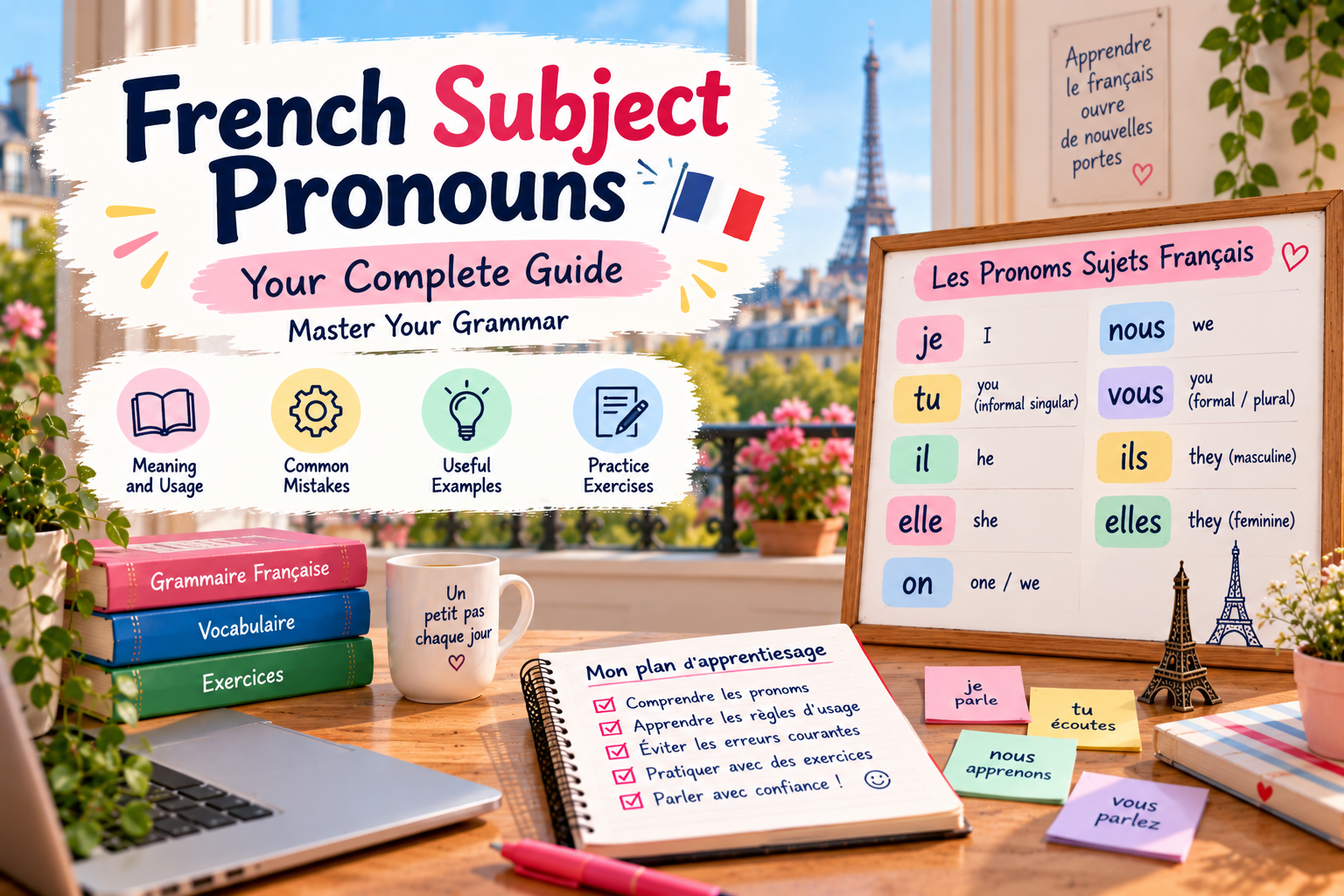
French has two ways to say “you”: tu and vous. Getting this right is part courtesy, part context. Vous is formal or plural. Use it with strangers, older people, professionals, or anytime you want to be respectful. Tu is informal and signals closeness, similar age, or relaxed settings. When in doubt, start with vous. If the other person switches to tu or invites you to say tu with On peut se tutoyer ? (Can we use tu), switch.
Here is how it plays out in daily situations. Pay attention to the verbs too, because tu and vous change the conjugation.
Situations for Using Tu
- Friends, classmates, and peers the same age.
- Children and teens, unless the context is very formal.
- Co-workers after mutual agreement, often in start-ups or casual teams.
- Family or acquaintances after you are invited to switch: On se tutoie ?
- Online communities and social apps, but match the group’s tone.
Situations for Using Vous
- Shop staff, receptionists, servers, and taxi drivers at first contact.
- Teachers, doctors, police officers, and officials.
- Job interviews or any professional setting with hierarchy.
- Emails and messages to people you do not know well.
- Any time you speak to a group: Vous allez bien ?
Example switch in context: you enter a café and start with vous, Bonjour, vous avez une table pour deux (Hello, do you have a table for two). If the server uses tu at a very casual bar, you can mirror it. Unsure what to choose in a new environment? Start respectful with vous. For more cultural notes and usage norms, explore resources on the PrepFrench site or review with your teacher in live class.
Practical French Phrases for Travel
Here are everyday French phrases for travel that cover transportation, dining, and shopping. Try saying each phrase aloud three times, then use it in a short two-line dialogue. Consistency builds confidence.
Directions and Transportation
- Où est la station de métro la plus proche ? Where is the nearest metro station?
- Je voudrais un ticket, s'il vous plaît. I would like a ticket, please.
- Aller simple / Aller-retour One-way / Round-trip.
- C'est quelle ligne pour... Which line goes to...
- Je descends au prochain arrêt. I get off at the next stop.
- Pouvez-vous m'indiquer le chemin ? Can you show me the way? [formal]
- À pied ou en bus ? On foot or by bus?
Mini-dialogue: Excusez-moi, pour la Gare du Nord, c'est quelle ligne ? — Ligne 4, direction Porte de Clignancourt.
Dining Out
- Une table pour deux, s'il vous plaît. A table for two, please.
- La carte, s'il vous plaît. The menu, please.
- Qu'est-ce que vous recommandez ? What do you recommend?
- Je suis végétarien(ne). I am vegetarian.
- Sans gluten / sans lactose Gluten-free / lactose-free.
- Je voudrais l'addition, s'il vous plaît. I would like the bill, please.
- C'était délicieux, merci. That was delicious, thank you.
Mini-dialogue: Bonjour, une table pour deux ? — Bien sûr. À l'intérieur ou en terrasse ?
Shopping and Bargaining
- Je regarde seulement, merci. I am just looking, thanks.
- Vous l'avez en taille M ? Do you have it in size M?
- Est-ce que je peux essayer ? May I try it on?
- Combien ça coûte ? How much is it?
- C'est trop cher pour moi. It is too expensive for me.
- Vous acceptez la carte ? Do you accept card?
- Je prends celui-ci / celle-ci. I will take this one.
PrepFrench offers travel-focused practice inside our French courses, where you role-play check-ins, menus, and metro maps until it feels easy.
Structured French Courses
Stop learning French the slow way.
Apps and random videos keep you stuck at beginner level forever. PrepFrench Classes gives you a structured path, a real teacher, and speaking practice that moves you forward at every lesson.
Available for: beginners · TEF/TCF exam prep · Canadian PR · work and daily French
Handling Everyday Interactions
Small talk keeps conversations friendly and flowing. Learn a few openers, then listen for key responses. The dialogues below show natural rhythm, with register notes in brackets to help you choose tu or vous.
Initial Greetings
[Informal] Salut, ça va ? — Ça va et toi ? — Tranquille. On se voit plus tard ? — Oui, à plus.
[Formal] Bonjour, comment allez-vous ? — Très bien, merci. Et vous ? — Je vais bien, merci.
Tip: In friendly settings, a short “Ça va ?” replaces longer questions. In formal contexts, “Comment allez-vous ?” signals respect.
Making Small Talk
[Neutral] Il fait beau aujourd'hui, non ? — Oui, super ensoleillé. Tu vas au parc ? — Oui, pour courir un peu.
[Neutral] Tu fais quoi ce week-end ? — Je visite un musée. Et toi ? — Je vois des amis.
[Work-friendly] Vous travaillez dans quel domaine ? — Je suis ingénieur. Et vous ? — Je travaille en marketing.
Add one more sentence to deepen chat: share a detail or ask a follow-up. Example: Quel musée ? or Depuis combien de temps ?
Understanding Common Responses
- Ça va can mean fine, okay, or so-so. Add tone or extras: Ça va, merci or Ça va pas trop.
- Pas mal means not bad. Positive, but modest.
- Comme ci, comme ça is old-fashioned in France. Say Bof or Moyen for “so-so.”
- Grave in slang can mean totally or seriously. Example: Trop bon, grave.
To build fluency, turn these mini-dialogues into role plays during online French classes. You will get feedback on register, rhythm, and word choice so your replies sound natural.
Emergency and Essential Phrases
Know a few life-saving lines, plus the emergency numbers where you are. In France and the EU, dial 112 from any phone. You can also call 15 for medical, 17 for police, and 18 for fire. In Quebec and most of Canada, dial 911.
Emergency Contacts
- Appelez une ambulance, s'il vous plaît. Call an ambulance, please.
- J'ai besoin d'un médecin. I need a doctor.
- Appelez la police. Call the police.
- Au feu ! Fire.
- Je suis perdu(e). I am lost.
Asking for Help
- À l'aide, s'il vous plaît. Help, please.
- Je ne me sens pas bien. I do not feel well.
- Je suis allergique à... I am allergic to...
- Où est l'hôpital le plus proche ? Where is the nearest hospital?
- Pouvez-vous m'aider ? Can you help me? [formal]
Practice these with calm, clear pronunciation. In real situations, speak slowly and repeat if needed. PrepFrench teachers will help you build a compact “safety script” you can recall under stress.
Quick Pronunciation Tips for Popular Phrases
Good pronunciation multiplies your confidence, even with a small set of phrases. Focus on a few key sounds, then apply them to your everyday phrases.
Key Sounds to Master
- Nasal vowels: an/en = /ahn/ as in français /frahn-seh/; in = /an/ as in matin /mah-tan/; on = /ohn/ as in bonjour /bohn-zhoor/; un = /uhn/ as in un /uhn/.
- The French r: back of the throat, light friction: merci /mehr-see/, rue /ry/.
- Final letters often silent: vous /voo/, parlent /parl/.
- Liaison links words: vous avez /voo-zaveh/; les amis /lez-ami/.
- Stress the last syllable group: bohn-zhoor not BON-jour.
Helpful Pronunciation Tricks
- Slow down vowels: French is crisp and even. Keep each vowel clear: mé-rci not mer-seee.
- Shadow native audio: play a short clip, repeat in sync, record yourself, compare.
- Use anchor phrases: practice Bonjour /bohn-zhoor/, Merci /mehr-see/, S'il vous plaît /seel-voo-pleh/ 10 times daily.
- Smile lightly for clear vowels, relax the jaw for eu /uh/ as in peur /puhr/ and deux /duh/.
Need feedback on your r or nasal vowels? Book a quick pronunciation check in a free demo, then continue inside PrepFrench Classes with targeted drills and real conversation practice.
PrepFrench Classes
Ready to start French with a clear plan?
Book a FREE demo class and get a personalized roadmap for your level, goal, and timeline. No pressure, no obligation.
Explore courses:
All French Courses · Full TCF Canada Course · Full TEF Canada Course
FAQ: Common Questions About Everyday French Phrases
What are the first 20 French phrases I should memorize?
Start with greetings, politeness, and simple requests. Examples: Bonjour, Salut, Au revoir, Merci, De rien, S’il vous plaît, Excusez-moi, Je m’appelle…, Ça va ?, Comment ça va ?, Je ne comprends pas, Parlez-vous anglais ?, Où sont les toilettes ?, Combien ça coûte ?, Je voudrais…, Une table pour deux, L’addition, s’il vous plaît, Où est…, Pouvez-vous m’aider ?, À demain. Drill them in short dialogues, then practice live in online French classes for quick feedback.
When should I use tu vs vous with shop staff or acquaintances?
Use vous at first with shop staff, receptionists, taxi drivers, and new acquaintances. It signals respect and avoids awkwardness. If someone invites you to switch, they might say On se tutoie ? or start using tu. Among acquaintances of similar age in casual settings, tu can be fine, but let the local lead. Unsure? Stay with vous. If you want guided practice, simulate these encounters in a structured French course at PrepFrench.
What’s the difference between pardon and excusez-moi?
Pardon is a light “sorry” or “excuse me” used when you brush past someone or did not hear. Excusez-moi is stronger and used to get attention, like calling a server: Excusez-moi, l’addition s’il vous plaît. In informal settings, Excuse-moi works with friends. If you actually did something wrong, use Je suis désolé(e). Practice choosing the right tone in real scripts inside PrepFrench Classes so your apologies land well.
How do I respond naturally to ça va and other greetings?
Keep it short and match the energy. Positive: Ça va, merci. Et toi/vous ? Neutral: Pas mal, Ça va. Not great: Ça va pas trop, Un peu fatigué(e). Want to continue? Add a friendly question: Et toi, quoi de neuf ? In formal settings, prefer Très bien, merci. Et vous ?. Build quick reflexes with role plays in French lessons so your replies feel effortless.
What phrases change in Quebec compared to France?
Quebec French shares the same base, but some everyday phrases differ. Greetings: Bonjour, hi is common in Montreal stores. Money: Une piastre for a dollar. Numbers: soixante-dix and quatre-vingt-dix are still used, but you may hear regional variants. Colloquial tantôt means later or earlier, depending on context. People often say Bienvenue to mean “you are welcome.” For travel or moving plans, your PrepFrench teacher will flag local expressions during your free demo and course.
Final Thoughts
Mastering everyday French phrases is the quickest way to start speaking with confidence. Focus on greetings, politeness, and short requests first, then expand into travel and small talk dialogues. Keep an eye on register so you pick tu or vous that fits the moment. Layer in a few pronunciation habits, and your speech will become clearer every week.
Set a simple routine: five minutes of phrase review, five minutes of shadowing, then one short dialogue you speak out loud. Repeat daily. If you want a direct path with feedback, a real teacher, and practice that feels like the street or the café, join PrepFrench Classes. We will help you learn French with structure and confidence, from first phrases to natural conversations.
✅ Next Step: Book a free demo class with PrepFrench Classes and start learning French the right way.
Keep exploring new phrases, rehearse them in short dialogues, and ask for real-time corrections. Small daily reps add up fast.
Written by
Platform Administrator
Practical ideas from the Prep French team for learners building confidence, preparing for exams, and planning their next step in Canada.
Join the discussion
Leave a thoughtful comment.
Your email address will not be published. Comments are reviewed before appearing.