DELF B2 Writing Test: Strategies, Structure & Samples
The DELF B2 writing test can feel daunting the first time you see it: you have 60 minutes to produce a clear, coherent, and well-structured text of about 250 words on a real-world topic. Strong performance in DELF B2 writing shows universities and employers that you can argue a point, organize ideas logically, and write with appropriate register in French. With the right strategy and targeted practice, you can turn this challenge into a confident performance. In this guide, you will learn exactly how the exam works, what examiners look for, a 60-minute writing workflow, text-type structures, must-know connectors, and smart practice methods. If you prefer a structured path, PrepFrench Classes offers guided DELF B2 exam preparation through expert-led French classes and writing workshops. Explore more resources on our home page or our French courses.
Free First Step
Take the guesswork out of learning French.
Not sure where to begin, which course fits your goal, or how long it will take? Book a free demo class with PrepFrench Classes and get a personalized plan built around your level, schedule, and goals.
Understanding the DELF B2 Writing Format
The DELF B2 production écrite evaluates your ability to write a structured, convincing text that addresses a problem and presents a clear point of view. According to the format set by France Éducation International, you will be asked to produce one text of approximately 250 words within 60 minutes. The topic typically relates to social life, culture, environment, education, or technology, and it requires argumentation supported by relevant examples.
Task Types
While the exact prompt varies, you should be ready for these common DELF B2 writing task types:
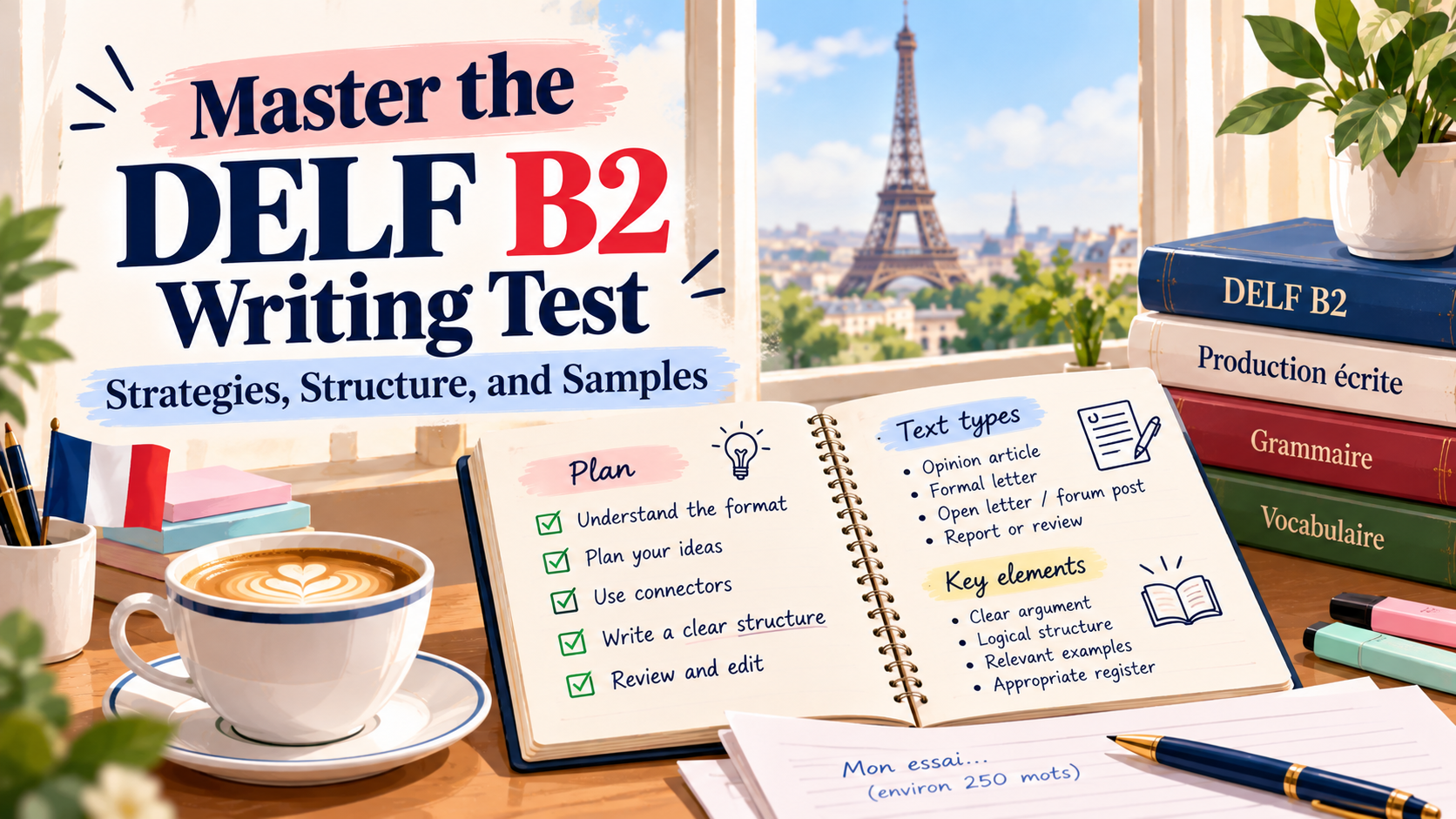
- Opinion article: present a clear thesis, develop two to three arguments, acknowledge a counterargument, and conclude with a strong closing statement.
- Formal letter: write to a newspaper, an organization, or a public authority to react to a situation, request information, or defend a viewpoint using a formal register.
- Open letter or forum post: similar to an opinion article but addressed to a specific audience or platform, usually semi-formal to formal.
- Report or review: summarize a situation or assess a book, film, or event, then argue a position based on criteria.
Length guideline: aim for about 250 words. You can write a little more if it is concise and relevant, but avoid very long texts that introduce errors or wander away from the task. Time limit: 60 minutes, which includes planning, writing, and proofreading.
If you want to see how these formats are taught in a structured way, browse our French courses and DELF-focused French lessons with PrepFrench Classes.
Scoring Breakdown
Your writing is graded using an official grid that totals 25 points for the production écrite. The exact phrasing of the grid can vary by session, but examiners consistently assess the following:
- Task fulfillment and relevance to the prompt: Did you answer the question fully and respect the instructions and text type?
- Organization, coherence, and cohesion: Is the structure clear, with logical paragraphs and effective connectors?
- Lexical range and precision: Do you use topic-appropriate vocabulary and avoid repetition?
- Grammatical accuracy: Are tenses, agreement, pronouns, and sentence structures correct and varied?
- Register and formatting: Is the tone appropriate for the task, and are conventions like salutations or titles respected?
What this means for you: if your ideas are strong but disorganized, or if your register is inappropriate, your score can suffer even with good grammar. PrepFrench integrates the marking grid into every exercise so you learn to think like an examiner and write like a B2 candidate with purpose.
Decoding the DELF B2 Marking Criteria
Understanding the marking grid is half the battle. Below is a simple decoding of each criterion and how it translates into DELF B2 writing tips you can apply immediately.
Importance of the Marking Grid
The grid is your roadmap. It tells you exactly how examiners think and where to invest your time. When your outline mirrors the grid, you write faster, stay focused, and avoid costly mistakes like drifting off-topic or mixing registers. At PrepFrench, every writing task is checked against the grid so you can self-assess with confidence at home and in our online French classes.
Breakdown of Each Criterion
- Task fulfillment: Address every element of the prompt. If asked to react to specific points or propose solutions, include them explicitly. A great trick: underline the key instructions before you plan.
- Coherence and cohesion: Organize your ideas into clear paragraphs: introduction, two or three argument paragraphs, and a conclusion. Use connectors to show contrast, cause, and consequence.
- Lexical range: Show control of topic-specific vocabulary. For a prompt on environment, words like tri sélectif, empreinte carbone, or énergie renouvelable boost credibility.
- Grammatical accuracy: Use a range of structures that B2 examiners expect: complex sentences with relatives (qui, que, dont), conditionals for hypothesis, subjunctive after expressions of opinion or necessity, and correct agreement.
- Register and conventions: Formal letters require standard salutations and closings. Opinion articles need a catchy opening and a decisive conclusion. Consistency matters from start to finish.
Score impact example: imagine two candidates with similar grammar. Candidate A writes a formal letter but uses a casual closing and misses one requested point. Candidate B respects all conventions and responds to each instruction. Candidate B will score higher, even if both made a few minor grammatical slips. Think complete and appropriate first, then accurate and stylish.
The 60-Minute Writing Strategy
This time-tested workflow keeps you in control from the first minute to the last. Set a timer during practice to build rhythm and confidence for exam day.
-
Planning, 12 to 15 minutes:
- Read the prompt twice, underline the required elements, audience, and text type.
- Decide your position quickly. Choose two or three strong arguments and one anticipated counterargument.
- Draft a skeleton outline: intro sentence, argument headings with one example each, a short response to a likely objection, and a closing line.
- Note must-use vocabulary and 2 to 3 key connectors for each paragraph.
-
Writing, 35 to 40 minutes:
- Write the introduction in 3 to 4 sentences: a brief context, a clear thesis, and a roadmap of arguments.
- Develop each body paragraph: topic sentence, explanation, example, and mini-conclusion that points back to the thesis.
- Handle the counterargument in one short paragraph, then refute it with evidence or logic.
- Finish with a concise conclusion that reaffirms your stance and suggests an implication or call to action.
-
Proofreading, 5 to 8 minutes:
- Check instructions: text type respected, all requested elements included.
- Scan connectors, verb endings, agreements, and accents. Replace any risky structure with a clean B2-friendly alternative.
- Remove repetition. Swap repeated common words with precise synonyms.
| Phase | Minutes | Focus |
|---|---|---|
| Planning | 12 to 15 | Understand the task, choose stance, outline 3 body points, list connectors |
| Writing | 35 to 40 | Intro, 2 to 3 argument paragraphs, counterargument + refutation, conclusion |
| Proofreading | 5 to 8 | Task check, grammar and spelling scan, replace risky sentences |
Practice tip: use the same watch, pens, and page layout you plan to use during the exam. Routine frees mental energy for ideas and language quality. If you want guided timed drills, join our DELF-specific writing workshops through PrepFrench Classes, or book a free demo to see the method in action.
Structured French Courses
Stop learning French the slow way.
Apps and random videos keep you stuck at beginner level forever. PrepFrench Classes gives you a structured path, a real teacher, and speaking practice that moves you forward at every lesson.
Available for: beginners · TEF/TCF exam prep · Canadian PR · work and daily French
Text-Type Conventions and Structures
Knowing the structure of each text type saves time and boosts your score on register and organization. Below are practical frameworks and mini samples you can apply to DELF B2 writing immediately.
Formal Letter Structure
Use this framework when the prompt requires a formal letter to a newspaper editor, organization, or public authority. Keep a respectful tone and clear formatting.
- Header: your city and date on the right; recipient on the left if required by the prompt.
- Salutation: Madame, Monsieur, or a named title if provided.
- Opening: state your context and purpose in one or two sentences.
- Body: present two or three arguments, each in a short paragraph with examples. Use formal connectors like par conséquent, toutefois, en outre.
- Closing request or proposal: clearly indicate what you seek, such as information, action, or a change.
- Polite closing and signature: Je vous prie d’agréer, Madame, Monsieur, l’expression de mes salutations distinguées. Then your name.
Mini sample opening for a DELF B2 formal letter:
Madame, Monsieur,
Je me permets de réagir à votre article consacré aux transports publics dans notre ville. En tant que résidente quotidienne, je souhaite attirer votre attention sur deux améliorations urgentes: l’accessibilité pour les personnes à mobilité réduite et la fréquence des bus en soirée.
Writing an Opinion Article
When the prompt asks for a tribune, article d’opinion, or forum post, follow this clear outline to keep the argument concise and persuasive.
- Title: short and impactful, reflecting your stance.
- Introduction: present the topic, state your thesis, and preview your two or three main arguments.
- Body paragraphs: each starts with a topic sentence, followed by explanation and one example. Use contrast and cause-consequence connectors.
- Counterargument paragraph: acknowledge a common objection and refute it logically.
- Conclusion: restate your position and suggest a recommendation or broader implication.
Mini sample opening for a DELF B2 argumentative essay:
Télétravail: une chance pour tous, à condition d’être encadré. Le travail à distance offre flexibilité et réduction des trajets, ce qui améliore la qualité de vie. Toutefois, sans règles claires sur la déconnexion et la charge de travail, les salariés risquent l’épuisement. Il faut donc encourager le télétravail, mais avec des protections précises pour garantir un équilibre durable.
Practice these ready-made frameworks in your own French lessons or through PrepFrench Classes, where you can submit weekly texts and get targeted feedback on structure and register.
Effective Connectors and Cohesion
Connectors are the signposts of your argument. They tell the examiner where the text is going and how each idea relates to the next. Great connectors also prevent repetition and raise your score for coherence and cohesion.
Connector Types
- Addition: de plus, en outre, par ailleurs, de surcroît
- Example: De plus, cette mesure réduira considérablement les coûts pour les familles.
- Contrast: cependant, toutefois, en revanche, au contraire
- Example: Cependant, cette solution ne convient pas aux habitants des zones rurales.
- Cause: parce que, puisque, car, en raison de
- Example: En raison du manque d’infrastructures, les usagers attendent plus de trente minutes.
- Consequence: donc, ainsi, par conséquent, c’est pourquoi
- Example: Par conséquent, il est nécessaire d’augmenter la fréquence des bus aux heures de pointe.
- Concession: bien que, même si, quoique
- Example: Bien que le budget soit limité, des solutions à faible coût existent déjà.
- Example or illustration: par exemple, notamment, entre autres
- Example: Par exemple, plusieurs villes européennes ont déjà adopté ce modèle avec succès.
- Sequencing: d’abord, ensuite, puis, enfin
- Example: D’abord, informons les citoyens. Ensuite, organisons une consultation publique.
- Opinion markers: à mon avis, selon moi, il me semble que, je suis convaincu que
- Example: À mon avis, une politique équilibrée doit concilier économie et bien-être.
Common Pitfalls to Avoid
- Overusing one connector: vary your choices to avoid sounding repetitive.
- Forgetting commas: punctuation helps the reader follow your logic.
- Mixing formal and informal markers: keep register consistent based on task type.
- Using literal translations from English: prefer natural French sequences like d’une part... d’autre part or non seulement... mais aussi.
- Using connectors without logic: each connector must reflect a real relation between ideas. Do not add them randomly.
Want a focused drill on DELF B2 connectors and cohesion? Our French course modules include targeted practice lists, fill-in tasks, and feedback to build natural flow.
Practice and Self-Assessment
Consistent practice turns technique into habit. Use official-style prompts, write under time pressure, and evaluate your work using the marking grid. Here is how to practice DELF B2 writing effectively at home or in online French classes.
Practicing with Past Prompts
- Set up a mock exam once per week: 60 minutes, one text, 250 words, no dictionary.
- Alternate task types: one week an opinion article, the next a formal letter.
- Create a bank of ready-to-use phrases for introductions, counterarguments, and conclusions.
- Analyze high-scoring samples: underline how they introduce arguments and handle objections.
- Peer exchange: swap texts with a friend at B2 level and give feedback on the grid. Short on partners? PrepFrench offers peer-review groups inside our courses.
If your long-term aim includes immigration or professional goals, writing discipline from DELF B2 also helps with other exams. For example, our Full TEF Canada Course trains similar clarity and structure that reinforce your overall French.
Creating a Self-Assessment Rubric
Score your own work against the examiner’s lens. Build a checklist you can run in three minutes after every draft:
- Task: Did I address every instruction and respect the text type?
- Organization: Clear intro, 2 to 3 body paragraphs, counterargument and refutation, conclusion.
- Coherence: Each paragraph has a topic sentence, logical development, and relevant example.
- Connectors: At least 2 to 3 varied connectors per body paragraph used correctly.
- Lexis: Topic vocabulary present, repetition replaced with synonyms.
- Grammar: Tenses appropriate, agreements checked, risky structures simplified.
- Register: Consistently formal or semi-formal based on task, proper formatting included.
Track your progress in a simple log: date, prompt, word count, self-score per criterion, and one concrete improvement for next time. If you want guided feedback from a French teacher, join PrepFrench Classes. Book your free demo to get a plan tailored to your exam date and current level, or explore our course options.
PrepFrench Classes
Ready to start French with a clear plan?
Book a FREE demo class and get a personalized roadmap for your level, goal, and timeline. No pressure, no obligation.
Explore courses:
All French Courses · Full TCF Canada Course · Full TEF Canada Course
DELF B2 Writing: FAQs
What are the types of writing tasks in the DELF B2 exam?
In DELF B2 writing, you typically produce one text of about 250 words in 60 minutes. Common task types include an opinion article, a formal letter to an organization or editor, an open letter or forum post, or a short report or review. All tasks require a clear stance, logical structure, and appropriate register. You will argue your point of view, support it with examples, and respond to potential counterarguments. In PrepFrench Classes, our French lessons simulate these formats so you can learn French writing conventions and exam strategies with confidence.
How can I manage my time during the writing task?
Use a simple plan: 12 to 15 minutes for planning, 35 to 40 for writing, and 5 to 8 for proofreading. During planning, underline every instruction, choose your thesis, and outline two or three arguments plus one counterargument. Writing time should follow your outline strictly: intro, body paragraphs with examples, brief counterargument paragraph, and a concise conclusion. Proofread for connectors, agreements, and register consistency. For practice, set a timer in each session or join our online French classes where timed DELF B2 drills are built into the French course structure.
What criteria are used to score DELF B2 writing?
Examiners use a marking grid totaling 25 points for production écrite. They evaluate task fulfillment and relevance, organization and cohesion, lexical range, grammatical accuracy, and register or text conventions. A high-scoring text answers every part of the prompt, follows the correct format, uses a variety of connectors, applies topic-appropriate vocabulary, and demonstrates good control of grammar across complex sentences. PrepFrench Classes teaches you to self-assess with this grid so your practice directly matches what examiners expect.
What are common mistakes to avoid in DELF B2 writing?
Top mistakes include drifting off-topic, mixing formal and informal register, weak paragraphing, overusing the same connector, and letting grammar slip under time pressure. Candidates also lose points by ignoring specific instructions, such as writing a letter without proper salutations and closings. A strong tip: write a clear thesis, use topic sentences for each paragraph, and build a quick checklist for proofreading. If you need structure, consider a guided French course with PrepFrench where you submit texts weekly and get actionable corrections from a French teacher.
How can I improve my use of connectors in writing?
Create a category-based list: addition, contrast, cause, consequence, concession, examples, sequencing, and opinion markers. Learn two or three from each group, then practice them in short paragraphs before full essays. Replace repeated basic links like “mais” or “parce que” with higher-level options such as “cependant,” “par conséquent,” and “bien que.” During proofreading, scan your connectors for logic and variety. For targeted drills, join PrepFrench Classes or our online French classes where each lesson builds connector control step by step within real exam tasks.
Final Thoughts
Mastering DELF B2 writing is a skill you can build with clear structure, smart time management, and consistent practice. Start by understanding the format and marking grid, then follow a reliable 60-minute workflow: plan with the prompt in mind, write to your outline, and proofread with a sharp checklist. Respect the conventions of each task type, especially for the DELF B2 formal letter and the opinion article format. Strengthen your cohesion with varied connectors, and upgrade your lexical range with topic-specific vocabulary.
If you want a structured path instead of trial and error, PrepFrench Classes can help. Our French courses integrate DELF B2 writing tips, timed tasks, and individual feedback so you learn French faster and more confidently. You will not only gain points on the exam, you will also improve real-world writing: emails, proposals, and persuasive arguments in the French language.
Explore programs that fit your schedule and goals on our courses page or reach out for guidance on the best next step for your level.
✅ Next Step: Book a free demo class with PrepFrench Classes and start learning French the right way.
Keep going: practice one prompt today using the 60-minute plan above, then score yourself with the grid. Small, consistent sessions beat last-minute cramming, especially for writing.
Written by
Platform Administrator
Practical ideas from the Prep French team for learners building confidence, preparing for exams, and planning their next step in Canada.
Join the discussion
Leave a thoughtful comment.
Your email address will not be published. Comments are reviewed before appearing.