DELF B2 Reading Test: Effective Strategies & Resources
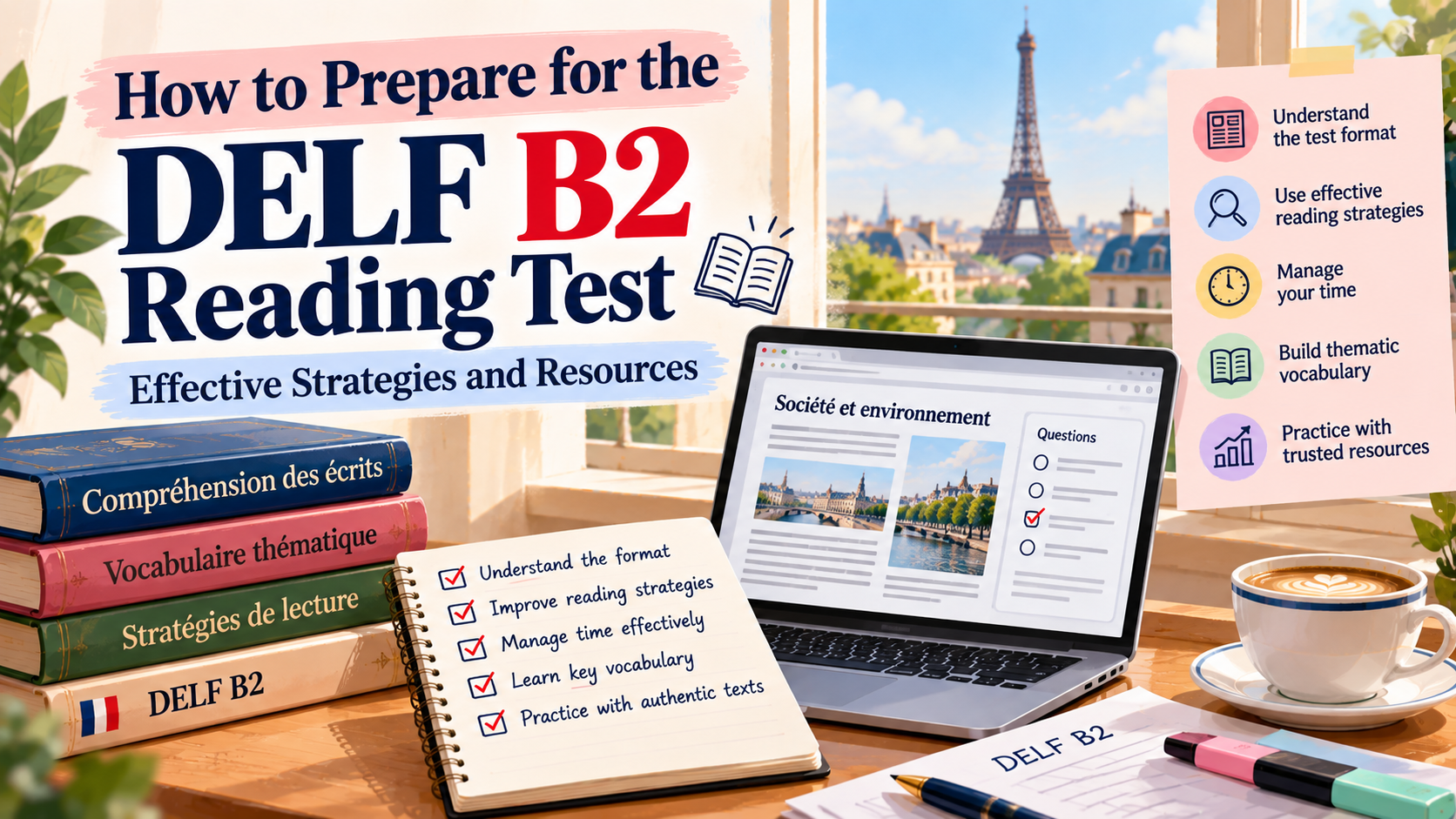
The DELF B2 reading test, known as compréhension des écrits, measures your ability to understand complex, authentic French texts and extract precise information under time pressure. If you want to study, work, or live in a French-speaking context, this paper is a critical checkpoint. In this guide, you will learn the DELF B2 format in detail, see exactly what the exam expects, and get a practical preparation plan that blends official guidance with field-tested strategies from PrepFrench Classes. If you prefer a structured French course and a real teacher, you can also study this paper as part of our French courses or book a free demo through our contact page.
- Clear overview of the DELF B2 format and scoring
- Practical strategies: skimming, scanning, inference, context clues
- Time management framework for a 60-minute paper
- Thematic vocabulary lists and reading sources to build speed
- Trusted practice platforms and a 4 to 8 week study plan
- How PrepFrench Classes and online French classes help you prepare with confidence
Free First Step
Take the guesswork out of learning French.
Not sure where to begin, which course fits your goal, or how long it will take? Book a free demo class with PrepFrench Classes and get a personalized plan built around your level, schedule, and goals.
Understanding the DELF B2 Reading Test
The DELF B2 reading section tests your ability to process opinionated articles, reports, and informational documents. Successful candidates read with purpose, identify an author’s viewpoint, and extract details quickly. Below is a concise breakdown based on official DELF guidance and CEFR B2 descriptors, with added notes on how PrepFrench Classes integrates these expectations into a guided French course.
Test Format Overview
- Duration: approximately 60 minutes for compréhension des écrits.
- Structure: typically two tasks based on two to three authentic texts.
- Length and density: articles and documents are longer and more opinion-driven than A2 or B1, with higher lexical variety.
- Aim: assess your ability to grasp main ideas, key details, structure, argumentation, and implied meaning.
At PrepFrench, we model your practice on the official task types and simulate the 60-minute pressure through timed drills and mock tests. If you prefer a structured path rather than self-study, explore PrepFrench Classes to learn French with a clear plan.
Text Types and Question Formats
- Text types: newspaper editorials, magazine features, expert blog posts, interviews, reports, infographics with commentary, and institutional texts.
- Question formats: multiple choice, matching headings, true or false with justification, short answers, and sometimes table completion.
- Skills evaluated: identifying the author’s stance, separating fact from opinion, recognizing connectors and logic, and interpreting nuance or implied meaning.
CEFR B2 descriptors emphasize understanding articles on contemporary issues where authors adopt particular viewpoints. This means you should expect arguments, counterarguments, and subtle qualifiers in DELF B2 reading questions.
Scoring Breakdown
- Marks: the reading paper is scored out of 25 points, contributing to the overall DELF B2 total of 100 points.
- Passing criteria: you generally need at least 50 out of 100 overall and a minimum of 5 out of 25 in each skill to pass.
- Marking logic: accuracy of information, correct interpretation of viewpoint, and evidence-based answers are rewarded.
Understanding the scoring helps you prioritize. For example, if a question asks for a justification, quote or paraphrase precisely from the text. PrepFrench teachers train you to back up your answers with targeted citations, a habit that significantly boosts reliability under exam timing.
Effective Reading Strategies for DELF B2
Success on DELF B2 reading depends on efficient strategies more than slow, word-by-word reading. Below are the core DELF B2 reading strategies we teach in our online French classes, with direct application tips you can practice today.
Skimming and Scanning Techniques
Skimming is fast reading to understand the overall message. Scanning is targeted reading to find specific details. You will often skim first, then scan strategically while answering questions.
- Skim in 90 seconds: read the title, subheadings, first sentence of each paragraph, and concluding lines. Circle names, dates, and bolded phrases.
- Map the structure: quickly label paragraphs, for example: intro, problem, example, counterargument, conclusion.
- Scan with a purpose: when a question mentions a date, statistic, or name, track those markers visually before reading the sentence fully.
- Use question order: most exam sets keep questions roughly aligned with text order. Move through the text progressively to save time.
Inference and Context Clues
B2 often tests what is implied, not just what is stated. You must read between the lines and detect stance and tone.
- Identify stance: mark positive, negative, or neutral language near claims. Words like pourtant, néanmoins, toutefois often signal nuanced views.
- Context clues: if you do not know a word, examine the sentence before and after, synonyms or antonyms nearby, and the author’s goal.
- Connector awareness: logical connectors reveal relationships like cause, consequence, concession, and comparison. They guide inference.
- Avoid assumptions: base your answer strictly on text evidence unless the task explicitly calls for interpretation.
Strategies for Unfamiliar Vocabulary
Unknown words will appear, even for strong candidates. DELF B2 evaluates your ability to cope without losing the main thread.
- Ignore non-essential words: if a word does not affect the logic of the argument, move on and keep your pace.
- Use morphology: prefixes like sur-, sous-, anti-, pro- and suffixes like -ment, -tion, -able provide strong clues.
- Leverage cognates carefully: many academic French words have English or Latin cousins. Verify with context to avoid false friends.
- Paraphrase mentally: rephrase a difficult sentence in simpler French. This checks if you truly grasp the meaning.
In PrepFrench Classes, you will practice these skills in guided exercises, then apply them in realistic mock tests to make the strategies automatic by exam day.
Structured French Courses
Stop learning French the slow way.
Apps and random videos keep you stuck at beginner level forever. PrepFrench Classes gives you a structured path, a real teacher, and speaking practice that moves you forward at every lesson.
Available for: beginners · TEF/TCF exam prep · Canadian PR · work and daily French
Time Management for the DELF B2 Reading Test
Even strong readers lose marks if they mismanage the clock. DELF B2 reading is tight on time, so you need a clear plan before you start. Below is a practical framework many successful candidates use during our PrepFrench mock exams.
Optimal Time Allocation
- Global skim: 6 to 8 minutes for all texts and all questions, just to map structure and difficulty.
- Task 1: around 20 minutes, answering in sequence and scanning precisely.
- Task 2: around 26 to 28 minutes, since the second task is often longer or more inferential.
- Final check: 4 to 6 minutes to verify justifications, names, numbers, and any earlier guesses.
Techniques to Keep Track of Time
- Set mini-deadlines: write target end times for each task in the margin at the start.
- Answer in pencil first: mark your best choice quickly, then add justifications as needed.
- Skip and return: leave time-consuming questions, mark them clearly, and come back at the end.
- Use question anchors: for scanning, highlight keywords that are easy to spot, for example, numbers, capitals, and words with hyphens.
- Do not reread everything: reread only the exact segment tied to the question and one sentence before or after.
Coping with Time Pressure
- Build stamina: practice with 60 minute mocks twice a week during the final month.
- Start with an easy win: if a task looks simpler, begin there to gain momentum and confidence.
- Calm the eyes: when stress rises, pause, breathe, and refocus on the question’s keyword. Then scan again.
- Keep an error log: track where you lost time in practice and fix one bottleneck per session.
Our timed mocks inside PrepFrench Courses train your pacing under realistic pressure. If you want a personalized plan, book a free session through our contact page.
Thematic Vocabulary Development
Vocabulary breadth is a decisive factor in DELF B2 reading. The exam often uses high-frequency academic words and topic-specific terms. Focus your study on the most common DELF B2 themes and build a system for retention.
Key Themes to Focus On
- Society and citizenship: rights, participation, inclusion, public policy
- Work and economy: employment, entrepreneurship, remote work, inflation, globalization
- Education and youth: schooling, higher education, digital learning, academic policy
- Health and lifestyle: public health, nutrition, mental wellbeing, healthcare policy
- Environment and energy: climate change, sustainability, transport, urban planning
- Technology and media: AI, data privacy, social networks, misinformation
- Culture and arts: heritage, festivals, literature, cinema, cultural policy
Recommended Reading Materials
- TV5MONDE Apprendre: graded news-based exercises aligned with CEFR levels.
- RFI Savoirs: audio-plus-text articles with vocabulary activities and comprehension questions.
- France 24 and Euronews en français: concise news summaries ideal for skimming practice.
- Le Monde Campus or Courrier International: opinionated pieces that mirror DELF B2 tone.
- The Conversation France: expert commentary with accessible academic vocabulary.
PrepFrench integrates authentic articles into French lessons, so you learn vocabulary in context. If you prefer a guided approach, explore our French courses that include DELF preparation pathways.
Vocabulary Building Techniques
- Topic decks: create Anki or Quizlet decks per theme, for example, environment, education, technology.
- Word families: group verbs, nouns, adjectives, and adverbs, for example, éduquer, éducation, éducatif, éducativement.
- Collocations and chunks: record phrases, not just words, for example, mettre en évidence, à l’échelle mondiale, remettre en cause.
- Weekly recycling: revisit last week’s words before adding new ones. Use spaced repetition.
- Mini-production: summarize one article per day using the new words to make them active.
Practice Resources and Study Plan
Your DELF B2 preparation gains speed when you rely on credible sources and a clear weekly schedule. Below you will find trusted platforms and a flexible 6 week plan that you can compress to 4 weeks or extend to 8 weeks depending on your starting level. PrepFrench Classes can also provide a customized French course plan that matches your calendar and exam date.
Trusted Practice Platforms
- France Éducation International: official DELF sample papers and rubrics for accurate exam modeling.
- TV5MONDE Apprendre: current affairs texts with graded activities by CEFR level, ideal for daily practice.
- RFI Savoirs: combined audio and reading tasks with comprehension checks to build inference and detail-finding.
- France 24, Le Monde, Courrier International, The Conversation France: authentic reading for topic coverage and higher-level vocabulary.
Outline of a Study Plan
Use this 6 week sample schedule as a template. If you need help adjusting it to your available hours, reach out to us through the PrepFrench contact page for a tailored plan.
| Week | Focus | What to Do | Outcome |
|---|---|---|---|
| 1 | Format & baseline | Study DELF B2 format, take a diagnostic reading test, build a vocabulary notebook, start daily skimming of short articles. | Know your level, set time targets, identify weak themes. |
| 2 | Skimming & scanning | Practice 4 articles using skimming maps, then answer detail questions by scanning. Add 40 to 60 new topic words. | Faster identification of structure and key ideas. |
| 3 | Inference & connectors | Work on implied meaning and author stance. Create a mini-list of logical connectors with examples from texts. | Better interpretation of tone and nuance, fewer guess-based errors. |
| 4 | Timed practice 1 | Two full 60-minute reading mocks, error log, review of justifications, targeted vocabulary on weak themes. | Stable pacing, clear evidence-based approach to answers. |
| 5 | Advanced texts | Longer, argument-heavy texts from opinion pages. Practice distinguishing claims from examples and data. | Higher accuracy on complex argumentation and mixed question sets. |
| 6 | Timed practice 2 & final review | Two to three mocks, strict timing, final vocabulary consolidation, review of all error logs. | Exam-ready pace and confidence under 60-minute conditions. |
Self-Assessment Techniques
- Error log: record the question, your answer, the correct answer, and why you missed it. Categorize errors, for example, vocabulary gap, inference, misread connector, time pressure.
- Evidence habit: for any answer that requires justification, underline or copy the exact fragment that supports it.
- Weekly checkpoint: every week, retake one prior mock to confirm improvement in the exact weak category.
- Mock-to-real calibration: compare your mock scores to target passing levels. Adjust time targets or strategies accordingly.
Need a tailored French lesson plan and regular feedback from a French teacher? See how our online French classes guide you from strategy to execution with accountability.
PrepFrench Classes
Ready to start French with a clear plan?
Book a FREE demo class and get a personalized roadmap for your level, goal, and timeline. No pressure, no obligation.
Explore courses:
All French Courses · Full TCF Canada Course · Full TEF Canada Course
FAQ: DELF B2 Reading
What is the DELF B2 reading exam format?
The DELF B2 reading exam, or compréhension des écrits, typically lasts about 60 minutes and includes two tasks based on two to three authentic texts. You will answer multiple choice, matching, true or false with justification, or short-answer questions. The paper tests your ability to grasp main ideas, locate precise information, understand the author’s stance, and interpret implied meaning. It is marked out of 25 points. In PrepFrench Classes, we mirror the official DELF B2 format in our French lessons to ensure you build both speed and accuracy within 60 minutes.
How long is the DELF B2 reading test?
You have approximately 60 minutes for DELF B2 reading. Successful candidates plan the hour carefully: a global skim in 6 to 8 minutes, Task 1 in about 20 minutes, Task 2 in about 26 to 28 minutes, and a short review at the end. Practicing under real timing is essential. Our online French classes include regular 60 minute mock tests so you can fine tune pacing and finish with time to spare. If you want a personalized schedule, book a free demo and we will map it out for you.
How do I improve for DELF B2 reading?
Build a simple routine: daily skimming of one news article, targeted scanning practice with questions, weekly work on connectors, and two timed mocks every week in the final month. Expand thematic vocabulary through TV5MONDE, RFI Savoirs, and opinion pages. Keep an error log to track patterns, for example, inference or speed. A structured French course helps you focus on what matters. PrepFrench Classes provide step-by-step reading strategies, feedback from a French teacher, and a realistic study plan aligned to your exam date.
How should I divide my 60 minutes for maximum accuracy?
Try a four-part split: 6 to 8 minutes to skim texts and questions, 20 minutes for Task 1, 26 to 28 minutes for Task 2, and 4 to 6 minutes to review and add justifications. Use mini-deadlines and leave hard questions for the end. Scan for names, numbers, and unique keywords to locate answers quickly. This approach balances speed with careful checking. In PrepFrench Courses, you will rehearse this timing until it feels natural under exam pressure.
What types of texts and topics appear in the DELF B2 reading?
Expect press articles, opinion pieces, reports, interviews, and institutional texts. Topics often include society and citizenship, environment and energy, work and economy, education, health, technology and media, and culture. The language is opinionated and uses logical connectors that signal contrast, cause, and concession. Train with sources that match this style, such as TV5MONDE, RFI Savoirs, and major French news sites. If you want curated texts and guided practice, our French courses include DELF-focused reading modules.
Final Thoughts
The DELF B2 reading test rewards candidates who read with purpose, use smart strategies, and manage the 60 minute window with discipline. You now have a clear picture of the DELF B2 format, effective reading strategies like skimming, scanning, and inference, a thematic vocabulary roadmap, and a practical study plan with trusted resources. Combine consistent practice with timed mocks and a simple error log, and your score will move steadily upward.
If you would like expert guidance, PrepFrench Classes provides structured online French classes, a personalized French course plan, and mock tests that feel like the real exam. The goal is simple: build habits that make you faster, more precise, and confident on test day.
✅ Next Step: Book a free demo class with PrepFrench Classes and start learning French the right way.
Tip: Add short, daily reading to your routine and mix it with weekly 60 minute mocks. The combination builds both fluency and exam stamina.
Written by
Platform Administrator
Practical ideas from the Prep French team for learners building confidence, preparing for exams, and planning their next step in Canada.
Join the discussion
Leave a thoughtful comment.
Your email address will not be published. Comments are reviewed before appearing.