DELF A1 Writing Test: Preparation Guide & Study Plan
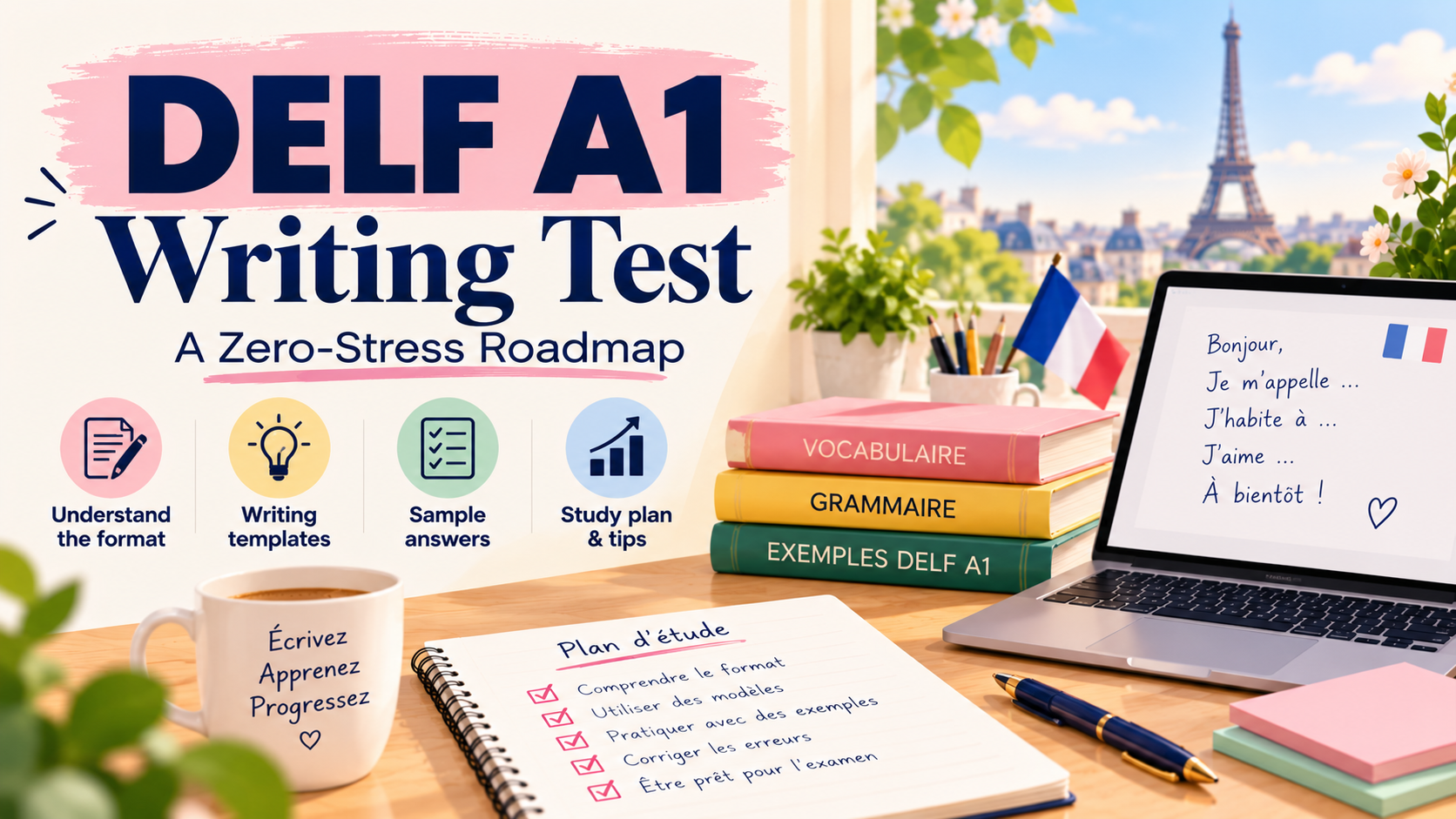
Starting your DELF A1 writing journey should feel simple and clear, not overwhelming. As a beginner, you only need to show that you can express basic ideas about familiar topics using simple sentences. This guide explains exactly how the DELF A1 writing test works, what examiners look for, and how to prepare the smart way. You will find plain-language scoring criteria, practical writing templates, DELF A1 writing examples with answers, and a focused study plan rooted in official expectations. If you prefer a guided path, PrepFrench Classes offers structured French classes and a DELF A1 French course that mirrors the official format so you can practice the right skills at the right time.
By the end, you will understand the DELF A1 writing test format, learn common task types, avoid typical mistakes, and know how to build short, accurate messages. If you want help building your preparation schedule or choosing the right French course, you can also book a free demo class with PrepFrench. That way, you can learn French with a clear plan that fits your goals and timeline.
Free First Step
Take the guesswork out of learning French.
Not sure where to begin, which course fits your goal, or how long it will take? Book a free demo class with PrepFrench Classes and get a personalized plan built around your level, schedule, and goals.
Understanding the DELF A1 Writing Test
The DELF A1 production écrite assesses your ability to write short, simple texts about everyday topics. You are evaluated on how clearly you answer the question, how well you organize ideas, and how accurate your vocabulary and grammar are. Knowing the structure in advance removes stress and helps you study exactly what matters. PrepFrench Classes aligns every A1 writing lesson with this structure so you can train like it is exam day.
Test Structure Overview
- Two tasks: a short form to fill out and a short message such as a postcard or email.
- Topics are familiar: personal details, family, daily routine, invitations, simple plans.
- Expected length for the message: around 40 to 60 words, the paper will specify.
- You can use simple sentences, lists, and basic connectors like et, mais, parce que.
Timing and Scoring Explained
DELF A1 has four papers worth 25 points each, for a total of 100 points. You need at least 50 out of 100 overall and at least 5 out of 25 in each paper. The writing paper typically lasts 30 minutes. This is enough if you plan your answer, write clearly, and check spelling at the end.
| Component | Typical Timing | Points | Notes |
|---|---|---|---|
| Listening (Compréhension de l'oral) | About 20 minutes | /25 | Short recordings, simple questions |
| Reading (Compréhension des écrits) | About 30 minutes | /25 | Notices, ads, emails, forms |
| Writing (Production écrite) | About 30 minutes | /25 | 2 tasks: form + short message |
| Speaking (Production orale) | About 5 to 7 minutes | /25 | Guided interview + role play |
Scoring focuses on four areas: task achievement, organization, vocabulary range, and accuracy. PrepFrench integrates these criteria into every practice so you learn to hit the target consistently. If you want to preview structured lessons, see our French courses or contact us for a free demo session.
Writing Tasks at DELF A1
At A1, writing is practical. You complete a simple form and write a short message to a friend, host family, teacher, or colleague. The best way to prepare is to study patterns that repeat across past papers, then use templates to respond quickly and clearly. Below are both tasks you will face, plus DELF A1 writing examples with answers to guide your practice.
Task 1: Form Filling Essentials
In Task 1 you copy basic personal details into a form. Spelling matters, accents matter, and capital letters in names matter. Read each field carefully and write exactly what is requested. Typical fields include:
- Nom, Prénom, Sexe, Nationalité
- Date de naissance, Lieu de naissance
- Adresse, Code postal, Ville, Pays
- Téléphone, E-mail
- Profession, Langue(s) parlée(s)
Example answer: Nom: Sharma. Prénom: Aditi. Nationalité: Indienne. Date de naissance: 14/09/2004. Adresse: 12, rue Victor Hugo, 06000 Nice. Téléphone: 06 12 34 56 78. E-mail: aditi.sharma@email.com.
Task 2: Short Messages (Postcard/Email)
In Task 2 you write a short message about everyday situations. The paper tells you who you are writing to, what information to include, and the word range. Use 3 to 5 short paragraphs or one tight block with clear sentences, and cover every point in the prompt.
- Introduce yourself or greet the person.
- State the main reason for writing.
- Answer the bullet points or questions from the prompt.
- Close politely with your name.
Common themes:
- Inviting a friend to a simple event: a picnic, a movie, a birthday.
- Describing your city, family, school, or daily routine.
- Thanking a host, apologizing for being late, or confirming a plan.
- Asking for basic information: prices, schedules, opening hours.
Example prompt and answer: You are on holiday in Marseille. Write 45 to 55 words to your friend Lila. Say: where you are, what the weather is like, what you did yesterday, and what you plan tomorrow.
Sample answer: Salut Lila, je suis à Marseille avec ma sœur. Il fait très beau et chaud. Hier, nous avons visité le Vieux-Port et nous avons mangé une bouillabaisse. C’était délicieux. Demain, je vais aller à la plage et faire des photos. Tu me manques. À bientôt, Rishav.
Why this works: It greets the reader, covers all four points, uses simple past and near future forms that are accepted at A1, and ends with a friendly closing. In PrepFrench Classes, we show you how to adapt one template to dozens of similar prompts so you save time and reduce mistakes.
Structured French Courses
Stop learning French the slow way.
Apps and random videos keep you stuck at beginner level forever. PrepFrench Classes gives you a structured path, a real teacher, and speaking practice that moves you forward at every lesson.
Available for: beginners · TEF/TCF exam prep · Canadian PR · work and daily French
Evaluation Criteria and Common Mistakes
Examiners use an official grid to score DELF A1 writing. The grid rewards candidates who follow instructions, communicate clearly, and use correct simple language. You do not need advanced grammar to get a good score. You do need to cover the points in the prompt, structure ideas logically, and make basic forms and spelling reliable. Here is how the scoring criteria typically translate for A1 candidates.
Scoring Breakdown: What Examiners Look For
- Task achievement: Did you answer every part of the question, and respect the word range?
- Organization and clarity: Is the message easy to follow, with a greeting, body, and closing?
- Vocabulary range: Do you use basic but appropriate words for the topic, including days, times, places, and common verbs?
- Grammar and spelling accuracy: Are simple sentences correct, are subjects and verbs matched, and are accents used where needed?
At PrepFrench, we train you to write in layers: first cover the prompt points, then organize, then check language. This simple order protects your score when time is short.
Common Mistakes to Avoid
- Ignoring a bullet point: Missing one required idea can cut task achievement significantly.
- Writing too few words: Stay within the requested range, for example 45 to 55 words, to show complete development.
- Using advanced grammar incorrectly: Simple and correct beats complex and wrong. Prefer present, near future, and very simple past expressions.
- Spelling names and places inconsistently: Copy exactly from the prompt. Pay attention to capital letters and accents.
- Forgetting connectors: Add a few basic linkers like et, mais, parce que, puis to improve flow.
- Writing like a text message: Avoid slang, abbreviations, or emojis. Use full words and polite closings.
- Skipping the final check: Two minutes to fix articles, agreement, and punctuation can lift your score.
Writing Strategies and Templates
Good DELF A1 writing is pattern-based. Learn a few reliable structures, memorize key phrases, then adapt them to any prompt. Below are simple templates and expressions that PrepFrench Classes uses in lessons so beginners can write quickly and confidently.
Simple Templates for Postcards and Emails
Use these as your starting point. Replace the bracketed parts with your details from the prompt.
- Invitation message: Bonjour [Prénom], je t’invite à [événement] le [jour] à [heure] chez [lieu]. Nous allons [activité simple]. Peux-tu venir, s’il te plaît? Dis-moi. À bientôt, [Ton prénom].
- Holiday postcard: Salut [Prénom], je suis à [ville/pays] avec [personne]. Il fait [météo]. Hier, j’ai [activité 1]. Demain, je vais [activité 2]. C’est très [adjectif]. À bientôt, [Ton prénom].
- Information request: Bonjour, je voudrais des informations sur [objet]. Quels sont les horaires et le prix, s’il vous plaît? Merci d’avance. Cordialement, [Nom].
- Apology and new plan: Bonjour [Prénom], désolé(e), je ne peux pas venir à [événement] parce que [raison simple]. Je propose [nouvelle date/heure]. Qu’en penses-tu? Merci, [Ton prénom].
These fit the DELF A1 production écrite across many past tasks. Keep sentences short. Each line should communicate one clear idea to reduce errors.
Key Phrases for A1 Writers
- Se présenter: Je m’appelle..., J’ai [âge] ans, Je suis [nationalité], J’habite à...
- Temps et lieu: aujourd’hui, demain, ce week-end, à [heure], le [jour], à [lieu]
- Goûts et activités: j’aime, je préfère, je regarde, je visite, je vais, je prends
- Connecteurs: et, mais, parce que, puis, après, aussi
- Formules de politesse: Bonjour, Salut, S’il te plaît, Merci, Cordialement, À bientôt
- Vérifications rapides: le/la/les, un/une, mon/ma/mes, au/à la/aux, de/du/de la
Tip: Build a mini phrase bank for common topics like family, food, transport, hobbies, weather, and school or work. In PrepFrench online French classes, your teacher helps you personalize this bank so it becomes automatic in the exam.
A Study Plan for the DELF A1 Writing Test
Here is a focused 3-week plan that fits most beginners. You can repeat weeks or stretch to 4 weeks if you have more time. Keep sessions short and consistent. Pair this with a structured French course for faster feedback and accountability.
Daily Micro-Tasks for Success
- Week 1: Foundations and accuracy
- Day 1: Copy a model postcard by hand. Focus on accents and punctuation.
- Day 2: Fill two sample forms using your real details and a friend’s details.
- Day 3: Learn 10 key verbs in present tense: être, avoir, aller, faire, vouloir, pouvoir, habiter, aimer, venir, prendre.
- Day 4: Write a 45-word invitation using the template. Check with a teacher or answer key.
- Day 5: Write a 50-word holiday message. Use et, mais, puis at least once.
- Day 6: Review: correct both pieces, highlight 3 recurring errors.
- Day 7: Rest or light review. Read 2 short emails in French for input.
- Week 2: Task coverage and speed
- Day 1: Write a 50-word apology and new plan. Time allowed: 12 minutes.
- Day 2: Form practice: 3 mini forms back to back. Aim for zero spelling errors.
- Day 3: Vocabulary bank: family, food, transport. Add 20 items with gender.
- Day 4: 2 short messages, 40 words each. Focus on covering all points.
- Day 5: Feedback day: edit both messages, underline connectors and articles.
- Day 6: Dictation of a short email to improve spelling and accents.
- Day 7: Light practice, read 2 model answers and note phrases to reuse.
- Week 3: Exam simulation and polishing
- Day 1: Full writing paper simulation, 30 minutes strict timing.
- Day 2: Error journal: list your 5 most common mistakes and correct forms.
- Day 3: Form + 45-word message with a new topic. Focus on clarity.
- Day 4: Read another model and rewrite it with your own details.
- Day 5: Full simulation again. Compare with Day 1. Aim for fewer errors.
- Day 6: Teacher review or self-check using criteria. Adjust templates.
- Day 7: Light revision and confidence building. Prepare exam-day checklist.
Checklist for Effective Revision
- I can fill any basic form without spelling mistakes.
- I use a greeting, short body, and closing in every message.
- I cover every bullet point from the prompt within the word range.
- I use 3 to 4 connectors and check articles and agreements.
- I keep sentences short and easy to mark.
- I leave 2 minutes to proofread at the end.
For guided practice and feedback, explore our courses or get a personalized plan in a free demo class. PrepFrench helps you learn French with structure, so every minute of study builds exam confidence.
Frequently Asked Questions About DELF A1 Writing
What is the DELF A1 writing format?
The DELF A1 writing test, also called production écrite, has two tasks in about 30 minutes. Task 1 is a simple form to fill in with information like name, address, nationality, and email. Task 2 is a short message of around 40 to 60 words, such as a postcard or email about daily life. You are scored on how well you follow instructions, how clear your message is, and your basic grammar and spelling. In PrepFrench Classes, our online French classes mirror this format so you practice exactly what appears on test day.
How many words should I write for the A1 message?
The exam paper usually specifies a small range, for example 45 to 55 words. Aim to stay inside that range. Writing too little can miss important details, while writing too much increases mistakes. A practical strategy is to plan 5 to 6 short sentences that each cover one clear idea. PrepFrench teachers help you build a flexible template so you can meet the word count every time without stress. If you follow a structured French course, word control quickly becomes automatic.
Is a dictionary allowed in the DELF A1 writing exam?
No, dictionaries, smartphones, or translation tools are not allowed during the DELF A1 writing exam. This is why building a small, reliable vocabulary bank is essential. Learn core verbs like être, avoir, aller, faire, and common nouns for family, time, places, and daily activities. In our French lessons at PrepFrench, we provide compact vocabulary lists and practice activities so you can write confidently without tools. Regular practice is the best substitute for a dictionary in the exam room.
What topics typically appear in A1 writing?
Topics are familiar and practical: introduce yourself, describe your city or family, invite a friend to an event, explain a plan for the weekend, say thank you to a host, or request basic information such as prices or opening hours. Expect prompts that ask for place, date and time, simple activities, and reasons. The best preparation is to learn a few templates and practice adapting them. PrepFrench Classes include many DELF A1 writing examples with answers so you can see how to cover each point clearly.
What are common mistakes A1 candidates make?
Frequent issues include missing a bullet point from the prompt, writing too few words, confusing articles and gender, forgetting accents, and trying complex grammar that leads to errors. Another common pitfall is weak organization, for example no greeting or closing. The solution is simple: use a clear template, short sentences, basic connectors, and a two-minute final check. If you learn French with a structured French course and teacher feedback, these errors drop quickly and your score rises.
PrepFrench Classes
Ready to start French with a clear plan?
Book a FREE demo class and get a personalized roadmap for your level, goal, and timeline. No pressure, no obligation.
Explore courses:
All French Courses · Full TCF Canada Course · Full TEF Canada Course
Final Thoughts
The DELF A1 writing test rewards clear communication, not complex grammar. If you understand the format, follow a simple template, and practice short messages on everyday topics, you can score well with less stress. Focus on what examiners want: answer all points, keep sentences short, use a few connectors, and proofread for basic accuracy.
PrepFrench Classes can be your preparation partner if you want structure and feedback. Our online French classes follow the official DELF A1 production écrite format step by step. You will practice real tasks, review model answers, and build a small but powerful phrase bank that works across topics. If you are exploring DELF A1 exam preparation, start with a free demo session to see how we plan your path from A1 to A2 and beyond.
✅ Next Step: Book a free demo class with PrepFrench Classes and start learning French the right way.
Consider the structured learning path through PrepFrench to master your A1 writing. Use the templates, examples, and study plan above, and combine them with live feedback for faster progress.
Written by
Platform Administrator
Practical ideas from the Prep French team for learners building confidence, preparing for exams, and planning their next step in Canada.
Join the discussion
Leave a thoughtful comment.
Your email address will not be published. Comments are reviewed before appearing.