DELF A1 Syllabus: Exam Structure, Topics & Study Plan

If you are starting French and want a clear, credible milestone, the DELF A1 syllabus is your first checkpoint. DELF A1 is the beginner-level certificate from France Éducation International that proves you can handle everyday French: introducing yourself, understanding basic information, and writing simple messages. This guide explains the full DELF A1 exam pattern and marking scheme, what to study, and how to build a step-by-step preparation plan. Along the way, you will find practical tips, examples, and trusted resources. If you want a structured path, PrepFrench Classes offers beginner-friendly French classes and online French classes that prepare you thoroughly for A1. You can browse our homepage or jump straight to courses to see your options.
Free First Step
Take the guesswork out of learning French.
Not sure where to begin, which course fits your goal, or how long it will take? Book a free demo class with PrepFrench Classes and get a personalized plan built around your level, schedule, and goals.
Overview of the DELF A1 Exam
What is the DELF A1 Exam?
DELF stands for Diplôme d’Études en Langue Française, the official diploma for non-native speakers administered by France Éducation International. A1 is the first level of the CEFR (Common European Framework of Reference for Languages), which describes basic user skills: you can understand and use familiar everyday expressions, introduce yourself, ask and answer simple questions, and interact in a simple way with patient speakers.
DELF A1 tests four skills: listening, reading, writing, and speaking. Each skill is scored out of 25 points for a total of 100. The exam is designed for beginners, so you are evaluated on clarity, accuracy with basic structures, and your ability to complete simple communicative tasks. You can view official CEFR level descriptors on the Council of Europe website.
Importance of DELF A1 for Beginners
Why start with DELF A1? It provides a real, internationally recognized milestone. A certificate gives you motivation, a deadline, and proof of progress. It also builds strong habits early: you learn how listening tasks work, how to structure short A1 writing, and how to handle a guided speaking interview. These habits pay off if you continue to A2 or B1 later.
PrepFrench Classes supports learners with beginner-friendly French lessons, including mock tests, vocabulary building, and grammar practice tailored to the A1 exam. If you prefer a guided path instead of piecing together apps and random videos, structured French courses with real teachers can save you time and uncertainty.
DELF A1 Exam Structure
The DELF A1 exam structure, sometimes called the DELF A1 exam pattern, covers four parts with set durations and a clear marking scheme. Below is a summary at a glance, followed by details and examples for each skill.
| Component | Time | Format | Points |
| Listening | About 20 minutes | 3 or 4 short recordings with questions | /25 |
| Reading | About 30 minutes | Short texts with MCQ or short-answer questions | /25 |
| Writing | About 30 minutes | 2 tasks: fill a form and write a short message | /25 |
| Speaking | 5 to 7 minutes (+ up to 10 min prep) | Guided interview, information exchange, role-play | /25 |
| Total | About 85-90 minutes + speaking | Four separate skills | /100 |
DELF A1 marking scheme: 25 points per skill, total 100. To pass you need at least 50 out of 100 overall, and typically a minimum of 5 out of 25 in each skill. You can explore official sample papers on the France Éducation International website.
Listening Section
The listening paper uses everyday contexts: announcements, short dialogues, basic instructions. Recordings are played twice. Your job is to recognize key information such as names, numbers, times, places, prices, and simple intentions.
- Typical tasks: match information to pictures, choose correct options, fill in short details.
- Example: A voicemail about a delivery time. Questions ask: What time is the delivery? What is the caller’s name?
- Strategy: Before the audio starts, scan questions and underline keywords. During the first play, listen for the general idea. During the second, confirm specific details like numbers and dates.
To prepare, practice with short, slow audios and focus on recurring patterns: greetings, days of the week, common verbs like aller, avoir, être. PrepFrench Classes includes listening drills aligned with the DELF A1 exam structure to help you learn French in realistic contexts.
Reading Section
Reading uses short, practical texts: website snippets, notices, menus, timetables, ads, or simple emails. Questions are usually MCQs or short answers based on exact information in the text.
- Typical tasks: identify prices on a menu, choose correct timetable information, understand a simple event notice.
- Example: A gym advertisement. Questions ask: How much is the monthly fee? What are weekend hours?
- Strategy: Skim first for structure (titles, bold words, numbers), then scan for keywords from the questions. Keep a mini list of common abbreviations like lun. for lundi.
Writing Section
Writing tests very simple production. You may fill a form with personal information and write a short message of about 40 to 60 words, for example an email or note to a friend, an invitation, a request for information, or a thank-you message.
- Task 1: Fill a form with basic details, such as name, nationality, date of birth, address, phone, email.
- Task 2: Write a short text. Example prompt: You are going to a museum on Saturday. Invite your friend. Give the time, place, and price. Ask a simple question.
- Marking focus: task completion, clarity, relevant content, simple grammar accuracy, basic connectors (et, mais, parce que), and correct polite forms where needed.
Tip: Write a two or three sentence plan before you start, then use simple, correct sentences. Avoid complicated structures that you are unsure about.
Speaking Section
Speaking at A1 has three parts with the examiner. You may receive a short preparation time, especially for the role-play.
- Part 1: Guided interview. Introduce yourself: name, age, nationality, job or studies, hobbies, family, where you live.
- Part 2: Information exchange. Answer and ask simple questions, for example about class schedules, transport, or prices.
- Part 3: Role-play. For example: ask for a room in a hotel, buy a ticket, make a doctor’s appointment. You use simple requests and polite phrases like Je voudrais…, S’il vous plaît, Merci.
Marking focuses on interaction, pronunciation, and intelligibility at a basic level. You are not expected to be perfect, only to communicate simple information clearly. Practicing with a French tutor or a speaking partner will dramatically increase your confidence before test day. PrepFrench offers mock speaking interviews to simulate the exam experience.
DELF A1 Syllabus and Content Overview
The DELF A1 syllabus covers highly practical vocabulary themes, essential grammar, and functional language for everyday tasks. Below are the core topics you should master before test day.
Core Vocabulary Themes
- Personal identity: name, age, nationality, languages, profession, contact details
- Family and relationships: family members, marital status, describing people simply
- Daily routines: times of day, common activities, days of the week, months, dates
- Numbers: 0 to 100 and beyond for prices, phone numbers, times, addresses
- Food and drink: groceries, meals, restaurants, menus, ordering
- Shopping and services: clothes, sizes, colors, prices, payments, appointments
- Housing and places in town: rooms, furniture, addresses, directions, public places
- Transport and travel: tickets, timetables, basic directions, city navigation
- Health and body: simple symptoms, medicines, doctor or pharmacy phrases
- Weather and seasons: basic weather phrases and forecasts
- Leisure and hobbies: sports, music, cinema, invitations, accepting or declining
- Education and work basics: school or work schedules, timetables, roles
- Communication tools: email, phone, messages, basic internet terms
Essential Grammar Elements
- Articles and gender: le, la, l’, les; un, une, des; partitives (du, de la, de l’, des)
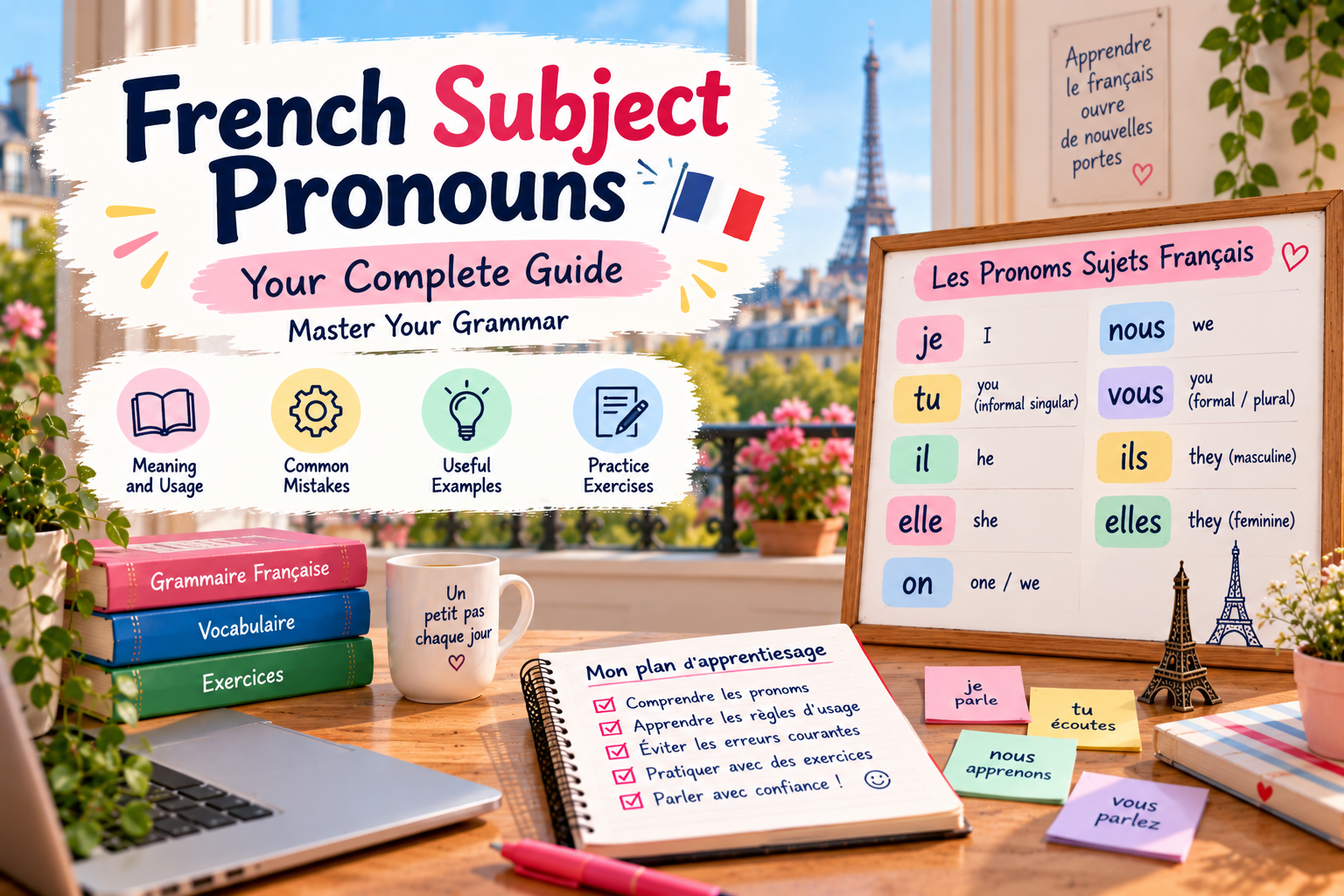
- Pronouns and determiners: je, tu, il/elle, nous, vous, ils/elles; mon/ma/mes; ce/cet/cette/ces
- Basic verbs: être, avoir, aller, faire, venir, prendre, vouloir, pouvoir, devoir (present tense)
- Regular verbs: -er (parler), -ir (finir), -re (vendre) in present tense
- Common irregulars: venir, sortir, partir, mettre, dire in present tense
- Reflexive verbs for routine: se lever, se coucher, s’appeler
- Negation: ne… pas, ne… jamais with simple sentences
- Interrogatives: est-ce que, inversion basics, qui, que, où, quand, comment, combien, pourquoi
- Possession and location: à, de, chez, en, sur, sous, devant, derrière, près de, loin de
- Demonstratives and quantities: ce, cette, ces; beaucoup de, un peu de, trop de
- Adjectives: common adjectives, placement, basic agreement, very common irregulars (beau, nouveau, vieux)
- Numbers and time: telling time, dates, age, prices, 24-hour clock
- Imperatives for simple requests: Venez, Regardez, Écoutez, S’il vous plaît
- Connectors: et, mais, ou, parce que, ensuite, puis, après
- Spelling and accents: é, è, à, ç, and basic punctuation conventions
Functional language is just as important as grammar. Learn set phrases for greetings, introducing yourself, asking for information, making appointments, apologizing, thanking, and asking prices. If you need structured guidance through these themes, our beginner-friendly French course outlines the exact order and practice you need to succeed at A1.
Structured French Courses
Stop learning French the slow way.
Apps and random videos keep you stuck at beginner level forever. PrepFrench Classes gives you a structured path, a real teacher, and speaking practice that moves you forward at every lesson.
Available for: beginners · TEF/TCF exam prep · Canadian PR · work and daily French
Preparing for the DELF A1 Exam
A smart plan keeps you consistent and focused on exam skills. Here is a realistic 6 to 8 week roadmap that fits busy schedules. Adjust the pace if you have more time or need extra consolidation.
6-8 Week Study Plan
-
Week 1: Foundations and sounds
- Alphabet, accents, French pronunciation basics, greetings, and introductions.
- Grammar: subject pronouns, être and avoir in present tense, articles.
- Listening: short greetings and names. Speaking: introduce yourself in 6-8 sentences.
-
Week 2: Numbers, time, and routine
- Numbers to 100, days, months, telling time, daily activities.
- Grammar: regular -er verbs, negation with ne… pas, basic questions with est-ce que.
- Writing: complete a personal information form. Reading: timetables and schedules.
-
Week 3: City life and shopping
- Places in town, directions, prices, colors, sizes, food items, menus.
- Grammar: prepositions of place (à, sur, sous, près de), demonstratives (ce, cette, ces).
- Task practice: order in a café, read a menu, fill a short order form.
-
Week 4: Family and leisure
- Family members, simple descriptions, hobbies, making invitations.
- Grammar: possessives (mon, ma, mes), adjective agreement, common irregular verbs.
- Writing: 50-word invitation email including time, place, and a question.
-
Week 5: Health, services, and appointments
- Symptoms, pharmacy basics, booking a table or doctor’s visit, polite requests.
- Grammar: imperative for simple instructions and requests, quantities (beaucoup de, un peu de).
- Speaking role-plays: at the doctor, at the hotel, at the station.
-
Week 6: Integration and mock tests
- Consolidate all themes. Do one full mock test under time limits.
- Check the DELF A1 marking scheme and revise weak areas, especially spelling accents and number listening.
-
Weeks 7-8: Optional extension
- Do two more mock tests, one per week. Focus on writing clarity and speaking fluency.
- Repeat listening to short audios until you can catch dates, times, and prices effortlessly.
Resources for Preparation
Use a blend of structured lessons, reference materials, and targeted practice. Official samples at France Éducation International show the exact exam style. Pair those with a beginner-friendly textbook or course and short daily listening like slow French clips or announcements. Above all, practice speaking every week. If you want a coach and ready-made plan, book a free demo with PrepFrench and see how our online French classes build your skills faster than solo study.
Tackling Common Challenges in the DELF A1 Exam
A1 tasks are simple but the format can still feel stressful. Here are targeted fixes for the most frequent issues we see with beginners in French language classes.
Managing Exam Anxiety
Nerves are normal. The best antidote is familiarity: know the exam structure and rehearse it. Try these habits in your DELF A1 preparation:
- Do at least two timed mock tests. Replicate the order of skills and the short breaks between them.
- Record yourself answering common speaking prompts: introduce yourself, describe your family, explain your routine. Play it back to notice clarity and pronunciation.
- Build a pre-exam ritual: 5 minutes of deep breathing, one simple success mantra, and a short warm-up with numbers and dates.
- Practice polite phrases until they are automatic: S’il vous plaît, Merci, Je voudrais, Pouvez-vous répéter, Je ne comprends pas.
If speaking scares you, remember the examiner expects basic accuracy, not complex grammar. Your goal is clear communication with short, correct sentences. PrepFrench tutors can run you through realistic interviews so you enter calm and prepared.
Time Management Tips
Time pressure often causes small but costly mistakes. Adopt these strategies for each part of the DELF A1 exam pattern:
- Listening: Read questions first and mark keywords. During the second play, focus only on what you missed. Do not rewrite everything.
- Reading: Skim the whole text in 20 to 30 seconds, then scan for specific words from the questions. If stuck, move on and return at the end.
- Writing: Spend 2 minutes planning, 18 to 20 minutes writing, and 5 minutes checking accents, capitalization, and punctuation.
- Speaking: In role-plays, ask one confirmation question if needed. It shows interaction skills and helps you avoid guessing.
Finally, keep answers tidy and legible. A1 marking rewards clarity. Short and correct is better than long and inaccurate.
Exam Day Tips and Final Checklists
Reduce surprise on exam day with a clear checklist and a simple warm-up routine.
Checklist for Exam Day
- Valid ID and exam confirmation documents
- Two pens and a pencil, eraser, small sharpener
- Water bottle and a light snack for the break
- Watch with no smart features, if allowed by your center
- Printed exam center address and contact number
- Simple warm-up sheet: numbers 0 to 100, days and months, polite phrases, question words
Tips for Staying Calm and Focused
- Arrive early and do a 5 minute pronunciation warm-up: alphabet, days, months, simple sentences.
- For listening, close your eyes for 3 seconds before the audio begins to reset attention.
- For writing, plan a mini-outline and keep sentences simple. Use connectors like et, mais, parce que.
- For speaking, smile, speak slowly, and use fillers if you search for words: Euh, je cherche le mot…, Pouvez-vous répéter s’il vous plaît.
- Accept small mistakes and move on. Communication first, perfection second.
PrepFrench often runs last-minute workshops and mock exams to help learners lock in confidence. If you want quick, targeted feedback on writing or speaking, reach out using our contact page.
PrepFrench Classes
Ready to start French with a clear plan?
Book a FREE demo class and get a personalized roadmap for your level, goal, and timeline. No pressure, no obligation.
Explore courses:
All French Courses · Full TCF Canada Course · Full TEF Canada Course
DELF A1 FAQ
How long should I prepare for the DELF A1 exam?
Most beginners can prepare for DELF A1 in 6 to 10 weeks with consistent daily study, about 45 to 60 minutes per day. If you already know some French, 4 to 6 weeks may be enough. Focus on the DELF A1 syllabus topics, do two or three timed mock tests, and practice speaking weekly. Structured French classes help you move faster because a teacher corrects mistakes and keeps you on track. PrepFrench offers a free demo to map a realistic timeline based on your current level and schedule.
What is the pass mark for DELF A1?
DELF A1 is scored out of 100, with 25 points per skill: listening, reading, writing, and speaking. The pass mark is at least 50 out of 100 overall. In addition, you typically need a minimum of 5 out of 25 in each skill. To reach this, concentrate on the core DELF A1 exam structure and practice tasks that mirror the test: short messages for writing and guided role-plays for speaking. PrepFrench Classes integrates the marking scheme into lessons so you always know what earns points.
Can you provide an example of a listening task?
Yes. Example: You hear a short announcement at a station. The speaker mentions a train to Lyon at 9:40 from platform 3, delayed by 10 minutes. Questions might ask: destination, departure time, platform number, and delay. At A1, you must catch numbers, times, and key nouns. During your DELF A1 preparation, practice listening twice: first for the general idea, then for specific details. PrepFrench French lessons include targeted listening drills that train numbers, dates, and prices, which are common in the exam.
What common mistakes do candidates make?
Typical mistakes include overcomplicating writing, ignoring accents, forgetting connectors like et and mais, and not asking clarification questions in speaking. Many learners also rush listening without underlining keywords first. The fix is simple: aim for short, correct sentences, review the DELF A1 grammar basics, and follow a time plan for each paper. Joining an online French class or a guided French course helps because a teacher spots bad habits early and models clear, A1-level answers.
Are there any special considerations for the exam day?
Arrive 20 to 30 minutes early with valid ID and your exam confirmation. Bring two pens and a pencil, water, and a small snack. Silence your phone and know the center rules. Warm up with numbers, dates, and polite phrases. For the speaking test, listen carefully to the examiner’s instructions and take the prep time to note key words and questions. If you feel nervous, breathe slowly and speak clearly. PrepFrench can provide a final mock interview the week before, which boosts calm and confidence.
Final Thoughts
DELF A1 is a friendly, achievable first step that proves you can communicate in basic French. With a clear understanding of the DELF A1 exam structure, the DELF A1 syllabus, and the marking scheme, you can design a short, focused plan that builds all four skills together. The key is consistency: a little study every day, weekly speaking practice, and two or three mock tests under time limits.
If you prefer a guided route, PrepFrench Classes offers structured French lessons and online French classes that match the exam exactly. You will know what to learn, how to practice each task type, and how to avoid common mistakes. When you finish A1, you will have a recognized certificate and the confidence to move up to A2 and beyond.
✅ Next Step: Book a free demo class with PrepFrench Classes and start learning French the right way.
Preparation works best with structure. Use official samples, keep sentences simple, and practice speaking regularly. If you need a coach, PrepFrench is ready to help you pass DELF A1 with confidence.
Written by
Platform Administrator
Practical ideas from the Prep French team for learners building confidence, preparing for exams, and planning their next step in Canada.
Join the discussion
Leave a thoughtful comment.
Your email address will not be published. Comments are reviewed before appearing.