Best French Movies and Books: A Guide for French Learners
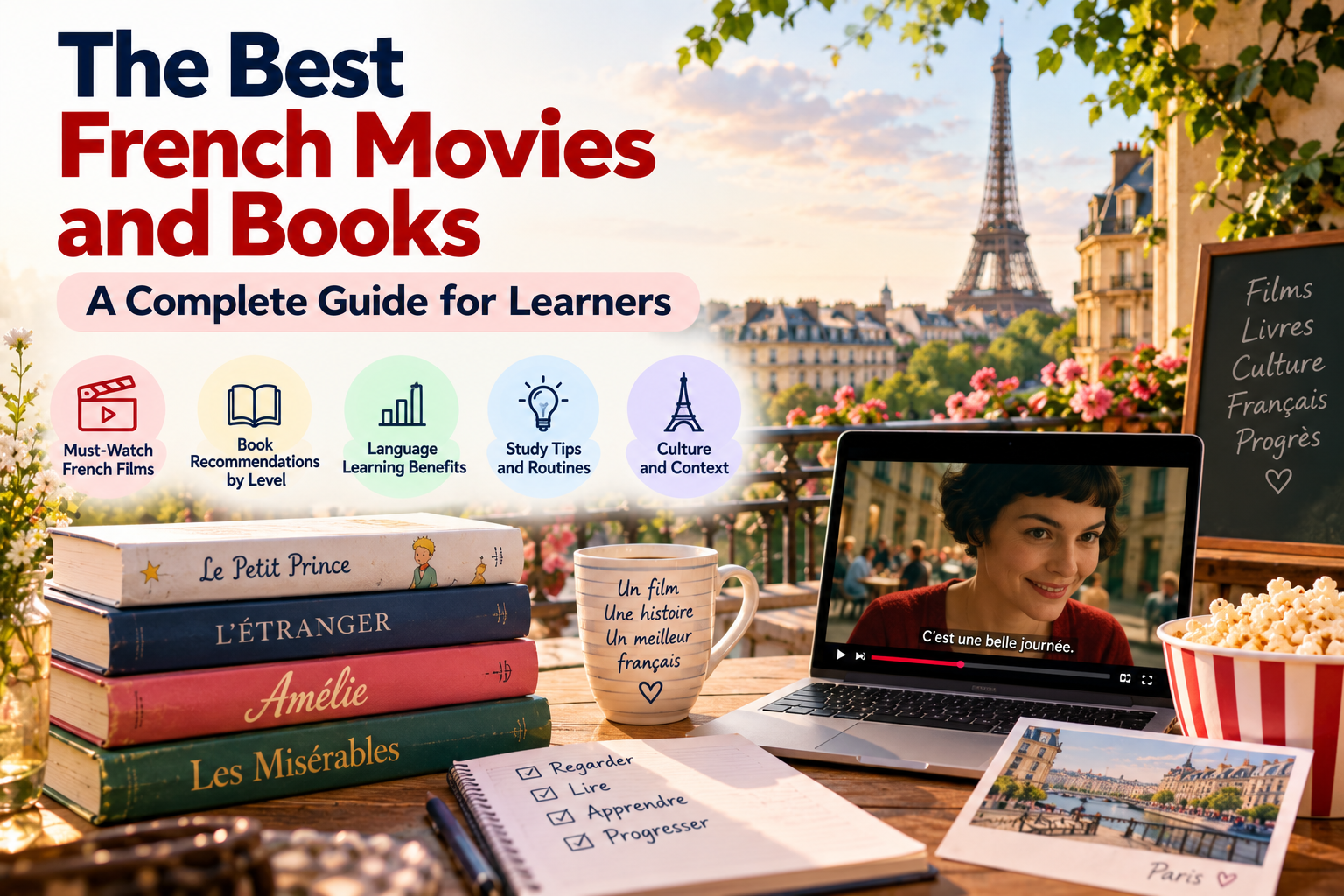
If you want to learn French with momentum, the best French movies and the best French books are more than entertainment. They are your most motivating teachers. Films sharpen your ear for real pronunciation and rhythm. Books, from graded readers to classics, build powerful vocabulary and natural sentence patterns. This comprehensive guide curates French films to watch and French book recommendations by CEFR level, genre, and cultural value. You will also find simple study routines, so your viewing and reading time turns into steady progress. And if you want structured support, PrepFrench Classes can help you pair culture with a clear plan. Explore our homepage to see how our French classes mix media with instruction.
Free First Step
Take the guesswork out of learning French.
Not sure where to begin, which course fits your goal, or how long it will take? Book a free demo class with PrepFrench Classes and get a personalized plan built around your level, schedule, and goals.
Why the Best French Movies and Books Matter
French media is a direct line into culture, identity, and real-life language use. In France, cinema and literature have long shaped public debate, storytelling traditions, and everyday expressions. Watching and reading in French gives you the cultural cues that textbooks alone cannot provide.
Cultural significance of film and literature in France
From the French New Wave to contemporary prize-winning novels, these works reflect social change, humor, and regional flavors. They teach you what French people reference in conversations, how tone and subtext work, and why certain topics matter nationally.
- Film culture is strong: festivals like Cannes shape global cinema trends and introduce bold visual storytelling.
- Literature is public life: prizes such as the Prix Goncourt spark nationwide discussion and influence what people read.
- Shared references build fluency: understanding cultural touchstones helps conversations flow naturally.
How media supports language development
Research on extensive input shows that story-driven listening and reading accelerate vocabulary growth, improve comprehension, and reduce anxiety. Films give you authentic speech, intonation, and body language. Books train your grammar sense through repeated patterns and context. Together, they build balanced skills.
- Films: sharpen listening, pronunciation awareness, and colloquial vocabulary.
- Books: expand vocabulary breadth, reinforce grammar, and improve writing intuition.
- Combining both: supports memory, because you encounter words in multiple contexts and formats.
At PrepFrench, we weave movies and books into our French courses, then guide you with level-appropriate tasks: scene breakdowns, shadowing, discussion prompts, and short writing to cement what you learn.
Quick-Start Recommendations: 6 Picks for the Weekend
You want results fast. Start with accessible stories that still feel rich. Below are three beginner-friendly films and three easy French books for beginners. Watch or read with simple routines: 30 to 45 minutes per day is enough to build a habit.
Best Beginners' Movies
- Les Choristes (2004): Clear dialogue, memorable music, and a heartwarming school setting. Great for A2 listening with French subtitles.
- Le Petit Nicolas (2009): Family humor and everyday vocabulary, perfect for learners who want simple, playful French.
- Intouchables (2011): Natural, modern French with strong emotional beats. Pause for slang and note useful expressions.
Best Beginners' Books
- Le Petit Prince by Antoine de Saint-Exupéry: Simple sentences with deeper meaning. Ideal from A2 with a glossary or teacher support.
- Astérix comics: Short dialogues, visual context, and recurring jokes make vocabulary sticky. Aim for A2 to early B1.
- Graded reader, A1 to A2: CLE or Hachette FLE series like Le fantôme de l’Opéra (simplified). Audio versions help pronunciation and pacing.
These picks align with the way PrepFrench Classes structure input for beginners. You can pair them with guided tasks in our online French classes to build listening and reading muscles, then practice speaking in live sessions.
Exploring French Cinema: Classic vs. Contemporary
Classic French Cinema: A Historical Perspective
Classic French cinema is a masterclass in character, mood, and visual language. The French New Wave, led by directors like Jean-Luc Godard, François Truffaut, and Agnès Varda, broke rules and reinvented storytelling. Going slightly earlier, filmmakers such as Jean Renoir and Marcel Carné shaped poetic realism with long takes and atmospheric sets.
For learners, classic films offer articulate diction and clear staging. Try accessible entries like Truffaut’s Les Quatre Cents Coups for its straightforward plot, or Varda’s Cléo de 5 à 7, which captures Parisian life in real time. Expect fewer slang-heavy scenes and more timeless themes: identity, freedom, love, and society.
The Rise of Contemporary French Films
Modern French films are genre-fluid: social dramas, intimate coming-of-age stories, thrillers, and comedies often sit side by side. Look for works by Céline Sciamma (Portrait de la jeune fille en feu, Bande de filles), Jacques Audiard (Un prophète), Ladj Ly (Les Misérables 2019), and Albert Dupontel (Au revoir là-haut). You will notice faster speech, regional accents, and colloquial turns of phrase that bring you closer to everyday French.
As a learner, balance challenge with clarity. Pick films with strong visual storytelling and familiar settings, then activate learning with French subtitles, short scene replays, and a vocabulary log. PrepFrench courses often assign a single pivotal scene for intensive work, followed by group discussion to turn passive input into speaking practice.
Structured French Courses
Stop learning French the slow way.
Apps and random videos keep you stuck at beginner level forever. PrepFrench Classes gives you a structured path, a real teacher, and speaking practice that moves you forward at every lesson.
Available for: beginners · TEF/TCF exam prep · Canadian PR · work and daily French
Must-Read French Literature: Classics and Contemporaries
To make French literature approachable, match books to your CEFR level and mix classics with contemporary voices. Use graded readers to build speed, then step into original texts that challenge and reward you with style and nuance.
French Literature Essentials: Graded Readers
- A1 to A2: CLE or Hachette FLE graded readers such as Le fantôme de l’Opéra (adapted), La Belle et la Bête (adapted). Pair text with audio tracks for listening practice.
- A2 to B1: Le Petit Nicolas by René Goscinny, short chapters with everyday vocabulary and humor. Astérix comics are great for visual support.
- B1 to B2: L’Étranger by Albert Camus, Bonjour Tristesse by Françoise Sagan, No et moi by Delphine de Vigan. Read a chapter per day and keep a vocabulary log.
- B2 to C1: Madame Bovary by Gustave Flaubert, L’Amant by Marguerite Duras, abridged editions of Les Misérables. Enjoy the prose, then discuss with a teacher to unpack style and context.
In PrepFrench Classes, we often assign a graded reader at your level, then transition to short stories or novella-length works to keep momentum high without burnout.
Celebrated Authors of Today
Contemporary French novels reveal current society: family, migration, identity, work, and politics. Many recent books are crisp and cinematic, which helps comprehension and keeps you turning pages.
- Leïla Slimani: Chanson douce (Prix Goncourt) for tight prose and gripping tension.
- Édouard Louis: En finir avec Eddy Bellegueule, direct style and social themes, accessible from B2.
- Delphine de Vigan: No et moi, emotional and clear, excellent for intermediate learners.
- Hervé Le Tellier: L’Anomalie (Prix Goncourt), playful structure that rewards careful reading.
- Maylis de Kerangal: Réparer les vivants, lyrical but readable with support at B2 to C1.
- Annie Ernaux: La Place, concise autobiographical style, great for advanced learners.
When in doubt, start with a modern novel that has been adapted to film. The cross-media familiarity helps both comprehension and motivation in your French course.
Francophone Cinema and Literature: Beyond France
To truly speak French with confidence, explore Francophone voices from Quebec, Africa, Belgium, and the Caribbean. You will meet new accents, idioms, and cultural references, which deepens your listening range and cultural awareness.
Key Francophone Filmmakers and Their Works
- Quebec: Xavier Dolan’s Mommy and J’ai tué ma mère, Denis Villeneuve’s Incendies. Emotional narratives with distinctive Quebec French.
- West and North Africa: Abderrahmane Sissako’s Timbuktu, Mati Diop’s Atlantique, Mahamat-Saleh Haroun’s Un homme qui crie. Themes include migration, identity, and resilience.
- Belgium: The Dardenne brothers’ Rosetta and Le Gamin au vélo, known for realism and clear, everyday language.
- Maghreb: Films such as Papicha by Mounia Meddour or works by Nabil Ayouch bring fresh social perspectives with accessible dialogue.
These films broaden your ear. You learn to parse different accents and rhythms, a vital skill for real-world conversation in global French communities.
Noteworthy Francophone Novels and Authors
- Congo: Alain Mabanckou’s Verre Cassé, playful voice and sharp humor, great for advanced learners.
- Rwanda: Scholastique Mukasonga’s Notre-Dame du Nil, a powerful school-setting novel with clear prose.
- Haiti-Quebec: Dany Laferrière’s L’énigme du retour, poetic but accessible with guidance.
- Belgium: Amélie Nothomb’s Stupeur et tremblements, short and addictive, ideal at B2.
- Caribbean: Patrick Chamoiseau’s Texaco for advanced readers interested in creole-influenced French.
- Quebec: Kim Thúy’s Ru, delicate vignettes that reward slow, thoughtful reading.
In our classes, these voices often anchor themed units on identity, migration, or work life. You build vocabulary that travels well across regions and professional settings.
How to Watch and Read for Language Learning Success
Best Practices for Watching French Films
- Pick the right level: choose story-first films with clear dialogue at your CEFR band. Start with 20 to 40 minutes per session.
- Subtitle ladder: first viewing with English subtitles for plot, second with French subtitles, final scene rewatch without subtitles for training.
- Active listening: pause, repeat, and shadow 10 to 20 second chunks. Mimic intonation and connected speech.
- Vocabulary capture: write 8 to 12 high-frequency words per session. Review them two days later and one week later.
- Focus on scenes: rewatch the same 2 to 3 scenes across a week. Depth beats breadth for listening gains.
- Where to watch French films: major streaming platforms, public libraries, and cultural institutes often carry French and Francophone catalogs.
Effective Reading Strategies for French Books
- Extensive first: read a chapter without stopping. Then do a quick intensive pass to clarify grammar and key vocabulary.
- Set a word budget: if a page has more than 5 unknown words that matter for meaning, choose an easier book or a graded edition.
- Use audio support: graded readers with audio guide your pacing and pronunciation. Read aloud short sections weekly.
- Micro-notes only: underline collocations and write one example sentence. Keep momentum to maintain motivation.
- Discuss to internalize: summarize the plot in 5 sentences, then talk it through with a teacher in your next lesson.
PrepFrench Classes integrate these techniques into weekly plans, so you know exactly what to watch or read, what to note, and how to turn input into speaking. If exams are on your horizon, our TCF course and TEF course show you how to leverage films and books for listening depth and argumentation practice.
PrepFrench Classes
Ready to start French with a clear plan?
Book a FREE demo class and get a personalized roadmap for your level, goal, and timeline. No pressure, no obligation.
Explore courses:
All French Courses · Full TCF Canada Course · Full TEF Canada Course
FAQ: Best French Movies, Books, and Study Tips
What are the best French movies for absolute beginners?
Pick story-first films with clear dialogue and familiar settings. Three good choices are Les Choristes for its music and school context, Le Petit Nicolas for simple family humor, and Intouchables for engaging modern French. Start with English subtitles to follow the plot, then rewatch key scenes with French subtitles. In PrepFrench Classes, we provide scene-by-scene tasks and vocabulary lists, which turn passive viewing into speaking practice. If you prefer animation, try Kirikou et la sorcière, which uses slower, distinct speech and strong visual storytelling.
Should I use French or English subtitles while learning?
Use a ladder approach. First viewing with English subtitles builds context. Second viewing with French subtitles connects sound to spelling. Final scene rewatch without subtitles strengthens listening. Research on bimodal input suggests that combining audio and matching text improves recognition and vocabulary retention. In our French lessons, we also encourage pausing to shadow short lines and capturing 8 to 12 new words per session. If you get lost, return to French subtitles rather than English to keep your ear tuned to the French language.
Which French books are easiest for A1–A2 learners?
Start with graded readers from CLE or Hachette FLE at A1 to A2 levels, ideally with audio. Adapted classics like La Belle et la Bête or Le fantôme de l’Opéra are designed for beginners. For short, fun reading, Astérix comics offer visual support and repetitive patterns. Move to Le Petit Prince at late A2 or early B1, ideally with a teacher. PrepFrench Classes often begin with a graded reader in your French course, so you build confidence and speed before tackling full originals.
What modern French films are great for culture and conversation?
Try Céline Sciamma’s Portrait de la jeune fille en feu for rich themes and clear dialogue, Ladj Ly’s Les Misérables for contemporary social context, and Albert Dupontel’s Au revoir là-haut for historical storytelling with modern pacing. For conversations, choose films you can describe easily and that spark opinions. PrepFrench teachers often use one pivotal scene for discussion prompts, role plays, and vocabulary recycling, which helps you speak French more naturally and confidently.
Are there kid-friendly French films or books for families?
Yes. Films like Le Petit Nicolas, Astérix: Le secret de la potion magique, and Kirikou et la sorcière are family-friendly and great for shared learning. For books, use Le Petit Nicolas stories, Astérix comics, or A1 to A2 graded readers with pictures and audio. Read or watch together, pause to repeat key lines, and keep a mini family word list on the fridge. If you want a gentle structure, our online French classes can create a family study plan around your schedule.
Final Thoughts: Learn French Through Culture, With a Plan
The fastest progress happens when motivation meets structure. The best French movies boost your listening and cultural awareness. The best French books build vocabulary depth and grammar intuition. Together, they help you learn French with joy and stay consistent week after week.
If you want a clear path, PrepFrench Classes can map films and books to your CEFR level, then turn each viewing or chapter into practical speaking and writing tasks. That balance of culture and coaching keeps you improving, not just consuming.
Ready to combine curated picks with guided practice? Explore our French courses, or book a free demo to get your personalized plan for movies, books, and lesson routines that fit your goals.
✅ Next Step: Book a free demo class with PrepFrench Classes and start learning French the right way.
Tip: Pair each weekend film with one chapter of a graded reader. Small, steady steps beat long, irregular sessions.
Written by
Platform Administrator
Practical ideas from the Prep French team for learners building confidence, preparing for exams, and planning their next step in Canada.
Join the discussion
Leave a thoughtful comment.
Your email address will not be published. Comments are reviewed before appearing.