50 Vegetables in French: Names, Pronunciation & Meanings
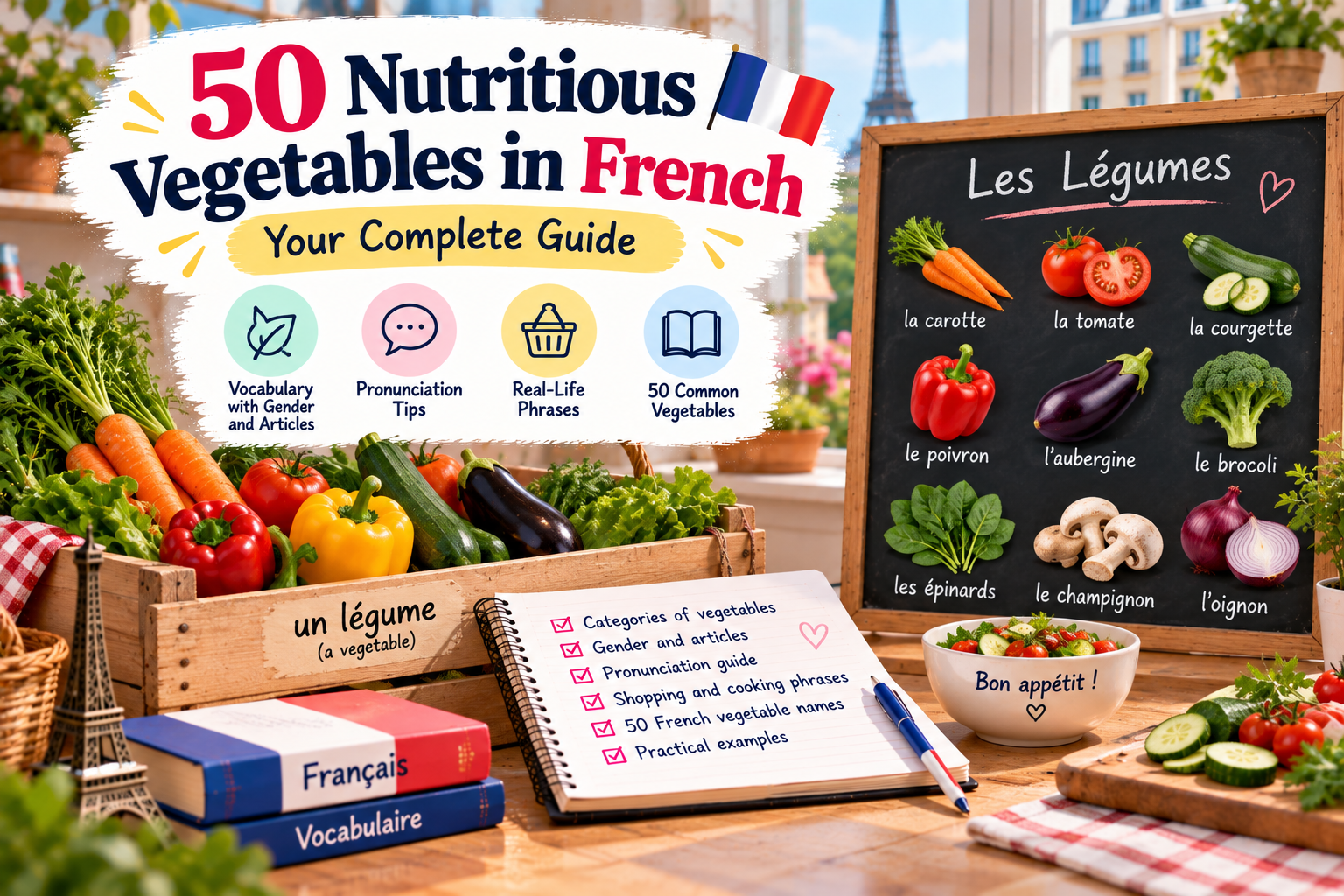
Learning the names of vegetables in French gives you practical vocabulary you will use constantly in daily life. In French, a vegetable is un légume, and you will see this word on menus, in recipes, and at markets across francophone regions. This complete guide covers légumes en français with clear categories, French vegetable names, gender and articles, and pronunciation notes. You will also get real-life phrases for shopping and cooking, plus a quick-reference table of 50 common items. If you want to speak French more confidently, building topic-based vocabulary like this is one of the fastest wins. PrepFrench Classes can help you connect these words to speaking practice inside a structured French course.
Before we begin, a quick distinction: French makes a practical difference between légumes (culinary vegetables such as carrot, tomato, onion) and légumineuses (pulses like chickpeas and lentils). This guide focuses on everyday vegetables used fresh in the kitchen. By the end, you will be able to recognize vegetables in French by category, pronounce them well, use the correct gender and articles, and apply them in natural phrases at a French market or in recipes. If you prefer to learn with visuals, you can pair this guide with names of vegetables in French with pictures using flashcards you create or download from your course resources.
Free First Step
Take the guesswork out of learning French.
Not sure where to begin, which course fits your goal, or how long it will take? Book a free demo class with PrepFrench Classes and get a personalized plan built around your level, schedule, and goals.
Understanding Vegetables in French
What is a Légume?
In everyday French, un légume refers to a vegetable from a culinary perspective, not a strict botanical definition. This matches how most people use the word in the kitchen. A tomato is therefore a légume in cooking, even though it is botanically a fruit. Dictionaries such as CNRTL describe légume in this practical way that reflects usage.
Légumes vs. Légumineuses
Légumineuses are pulses like pois chiches (chickpeas), lentilles (lentils), and haricots secs (dried beans). They are high in protein and often sold dry. Many nutrition sources, including the FAO, treat them separately from fresh vegetables. In contrast, légumes usually refers to fresh produce such as carottes, oignons, poivrons, and courgettes. Some items have both uses: haricots verts (green beans) are fresh vegetables, while haricots rouges are dried pulses. This guide focuses on the fresh vegetable side to build your practical French vocabulary.
Gender and Articles in French
Every French noun has a grammatical gender. You will need the right article:
- Definite: le (masculine), la (feminine), l’ (before vowel sound), les (plural). Example: le poireau, la carotte, l’oignon, les épinards.
- Indefinite: un (masculine), une (feminine), des (plural). Example: un concombre, une aubergine, des tomates.
- Partitive for quantities of non-count items: du (m), de la (f), de l’ (vowel), des (pl). Example: du céleri, de la laitue, de l’ail, des champignons.
Grammar tip: some names appear mainly in the plural in real life, for instance les épinards. Keep an eye on typical article pairings when you learn each noun. If you want a guided review of articles with hands-on practice, explore the grammar units inside our French courses or ask your PrepFrench teacher to add a custom drill set.
Categories of French Vegetables
Organizing vegetables by category helps you memorize faster and speak more naturally. Below are common types of vegetables in French with examples to anchor each group. You can add pictures to your flashcards to reinforce memory.
Leafy Greens
- la laitue, la roquette, la mâche, les épinards, la blette, l’endive, le chou frisé, le cresson
Root Vegetables
- la carotte, le navet, le panais, la betterave, le radis, la patate douce, le topinambour, le rutabaga, les salsifis
Alliums
- l’oignon, l’ail, le poireau, l’échalote, la ciboule
Cruciferous Vegetables
- le chou, le chou-fleur, le brocoli, les choux de Bruxelles, le chou-rave, le chou frisé
Nightshades
- la tomate, l’aubergine, le poivron, le piment, la pomme de terre
Gourds and Related
- la courgette, la courge, la citrouille, la courge butternut, la courge spaghetti, le concombre, le pak-choï
Pods and Green Vegetables
- les haricots verts, les petits pois, les pois mange-tout, l’asperge, le maïs, le gombo
Aromatics Used as Vegetables
- le céleri, le céleri-rave, le fenouil, l’oignon, l’ail, l’échalote, la ciboule, le champignon
For structured practice on this topic, many learners use PrepFrench flashcard sets aligned to each category, then consolidate with short speaking prompts in our online French classes.
Pronunciation and Gender of Vegetables
French pronunciation is consistent once you know the key sound patterns. Below is a quick mini-guide using IPA (International Phonetic Alphabet) alongside examples from our list of vegetables in French. Focus on vowel quality and nasal vowels such as an, on, in, which often cause difficulties at first.
Pronunciation Guide with IPA Patterns
| Sound | How to Say It | Vegetable Example |
|---|---|---|
| ou [u] | Like “oo” in “food” but shorter | chou [ʃu], courge [kuʁʒ] |
| oi [wa] | Like “wa” in “water” | oignon [ɔɲɔ̃], poivron [pwavʁɔ̃] |
| on [ɔ̃] nasal | Air flows through nose, lips rounded | oignon [ɔɲɔ̃], champignon [ʃɑ̃piɲɔ̃] |
| an/en [ɑ̃] nasal | Open, nasal “ah” sound | piment [pimɑ̃], endive [ɑ̃div] |
| in/ain [ɛ̃] nasal | Nasal version of “eh” plus a hint of n | radis [ʁadi] (note: not nasal), mâche [mɑʃ] (different vowel) |
| gn [ɲ] | Like “ny” in “canyon” | champignon [ʃɑ̃piɲɔ̃] |
| ch [ʃ] | Like English “sh” | chou [ʃu], artichaut [aʁtiʃo] |
Practice tip: say the French word smoothly from start to finish, rather than spelling it out letter by letter. A short daily pronunciation routine inside your PrepFrench study plan makes words stick fast.
Masculine and Feminine Identifiers
There is no universal rule that predicts gender for every vegetable. Learn nouns with their article and watch patterns within categories. For example: la carotte, la laitue, la courgette are feminine; le poireau, le navet, le poivron are masculine. Some nouns are typically plural in real life, such as les épinards or les haricots verts. Add the article to your flashcard front, like “la courgette,” to program gender from day one.
Common Learner Mistakes
- Confusing le poivron (bell pepper) with le poivre (ground pepper spice). For chilies, use le piment.
- Using singular for words that are normally plural: prefer les épinards and les haricots verts in most contexts.
- Mixing up la laitue (lettuce head) with la salade (the prepared dish or a mix of salad greens).
- For l’ail (garlic), count cloves with une gousse d’ail, not “un ail”.
- Translating literally from English: French often uses de with quantities, for example un kilo de tomates, une botte de radis.
If you want feedback on your pronunciation and gender usage, book your free demo class and test drive a lesson with a French teacher.
Structured French Courses
Stop learning French the slow way.
Apps and random videos keep you stuck at beginner level forever. PrepFrench Classes gives you a structured path, a real teacher, and speaking practice that moves you forward at every lesson.
Available for: beginners · TEF/TCF exam prep · Canadian PR · work and daily French
Nutrition of Common Vegetables
A quick nutrition snapshot makes your learning stick, because you connect each word to a real-life benefit. Global health guidelines, including advice from WHO and research summarized by Harvard, often highlight variety, color, and fiber. Here is a concise overview that you can remember while planning meals in French.
Nutritional Highlights for Leafy Greens
- Épinards, mâche, roquette, blette: typically rich in folate, vitamin K, and carotenoids like lutein and beta-carotene. These contribute to eye health and support normal blood function.
- Laitue and endive: light, hydrating, and easy to combine with other vegetables. Great volume with low calories, helpful for satiety in salads.
- Cresson and chou frisé: dense in micronutrients and phytochemicals. Cruciferous greens offer glucosinolates that research associates with protective effects when part of a balanced diet.
Benefits of Root Vegetables
- Carotte and patate douce: excellent sources of beta-carotene, which the body converts to vitamin A. Useful for vision and skin health.
- Betterave: noted for nitrates that may support normal blood flow during exercise. Also a source of folate and fiber.
- Navet, panais, salsifis, topinambour, rutabaga: good fiber sources and versatile in soups, roasts, and purees. Fiber supports digestion and keeps you full longer.
Key Nutritional Aspects of Nightshades and Others
- Tomate: contains lycopene, a red pigment with antioxidant properties. Cooking tomatoes in olive oil can help your body absorb lycopene.
- Poivron: high in vitamin C, especially red peppers. Adds color and crunch without heavy calories.
- Pomme de terre: a source of potassium and vitamin C. Balance portions and cooking methods, for example baked or steamed instead of deep fried.
- Alliums (oignon, ail, poireau): provide organosulfur compounds like allicin in garlic, appreciated for flavor and studied for health relevance.
- Champignons: low-calorie, contribute B vitamins and minerals. When exposed to light, mushrooms can provide some vitamin D2.
When you practice French in the kitchen, focus on colorful variety, portions that suit your energy needs, and simple cooking verbs in French. If you enjoy structured challenges, your teacher at PrepFrench can assign you a “market to table” mini project inside your French course.
Practical Usage: At the Market and in Cooking
Vocabulary only becomes yours when you use it. Try this short market dialogue, then the cooking verbs that show up in everyday recipes.
Ordering at a French Market
Client: Bonjour. Je voudrais une laitue, une botte de radis et un kilo de tomates, s’il vous plaît.
Vendeur: Très bien. Autre chose ?
Client: Oui, 500 grammes de champignons et deux poivrons rouges. C’est combien ?
Vendeur: Ça fait 9,80 euros. Vous payez en espèces ou par carte ?
Client: Par carte. Merci, bonne journée.
Vendeur: Merci à vous, bonne journée.
- Je voudrais…: I would like…
- Une botte de…: a bunch of…
- Un kilo de…, 500 grammes de…: weight-based ordering
- Autre chose ?: Anything else?
- C’est combien ?: How much is it?
For more natural conversation patterns, practice with a teacher in our online French classes and role-play markets, recipes, and restaurant ordering.
Common Cooking Verbs Related to Vegetables
- éplucher: to peel, émincer: to slice thinly, hacher: to chop, râper: to grate
- faire revenir: to sauté, faire cuire à la vapeur: to steam, rôtir: to roast, mijoter: to simmer
- assaisonner: to season, mélanger: to mix, ajouter: to add, servir: to serve
Example: Épluchez les carottes et les pommes de terre, puis faites-les rôtir avec du poivron et de l’ail. Assaisonnez avec du sel, du poivre et un filet d’huile d’olive.
The more you cook in French, the faster your vocabulary grows. Add these verbs to your flashcards alongside vegetables in French, and try a short recipe in French once per week.
Quick Reference: 50 Vegetables in French
Use this table as a study checklist. You will see gender, IPA for pronunciation, and English meanings. Read each French word out loud twice. Then cover the French and recall from English prompts. Repeat with pictures to deepen memory.
| French Vegetable | Gender | IPA | English |
|---|---|---|---|
| la carotte | f | [kaʁɔt] | carrot |
| la pomme de terre | f | [pɔm də tɛʁ] | potato |
| la tomate | f | [tɔmat] | tomato |
| l’oignon | m | [ɔɲɔ̃] | onion |
| l’ail | m | [aj] | garlic |
| le poireau | m | [pwaʁo] | leek |
| l’échalote | f | [eʃalɔt] | shallot |
| le chou | m | [ʃu] | cabbage |
| le chou-fleur | m | [ʃu flœʁ] | cauliflower |
| le brocoli | m | [bʁɔkɔli] | broccoli |
| le chou frisé | m | [ʃu fʁize] | kale |
| les épinards | mpl | [epinaʁ] | spinach |
| la laitue | f | [lɛty] | lettuce |
| la roquette | f | [ʁɔkɛt] | arugula, rocket |
| le concombre | m | [kɔ̃kɔ̃bʁ] | cucumber |
| la courgette | f | [kuʁʒɛt] | zucchini |
| l’aubergine | f | [obɛʁʒin] | eggplant |
| le poivron | m | [pwavʁɔ̃] | bell pepper |
| le piment | m | [pimɑ̃] | chili pepper |
| les haricots verts | mpl | [aʁiko vɛʁ] | green beans |
| les petits pois | mpl | [pəti pwa] | green peas |
| les pois mange-tout | mpl | [pwa mɑ̃ʒ tu] | snow peas |
| l’asperge | f | [aspɛʁʒ] | asparagus |
| le céleri | m | [selʁi] | celery |
| le céleri-rave | m | [selʁi ʁav] | celeriac |
| la betterave | f | [betʁav] | beetroot |
| le radis | m | [ʁadi] | radish |
| le navet | m | [navɛ] | turnip |
| le panais | m | [panɛ] | parsnip |
| la patate douce | f | [patat dus] | sweet potato |
| le topinambour | m | [tɔpinɑ̃buʁ] | Jerusalem artichoke |
| les salsifis | m (invar.) | [salsifi] | salsify |
| le rutabaga | m | [ʁytabaga] | rutabaga |
| les choux de Bruxelles | mpl | [ʃu də bʁysɛl] | Brussels sprouts |
| le chou-rave | m | [ʃu ʁav] | kohlrabi |
| la blette | f | [blɛt] | chard |
| le fenouil | m | [fənuj] | fennel |
| l’endive | f | [ɑ̃div] | endive, chicory |
| le cresson | m | [kʁɛsɔ̃] | watercress |
| la mâche | f | [mɑʃ] | lamb’s lettuce |
| l’artichaut | m | [aʁtiʃo] | artichoke |
| le champignon de Paris | m | [ʃɑ̃piɲɔ̃ də paʁi] | button mushroom |
| le maïs | m | [ma.is] | corn |
| le gombo | m | [gɔ̃bo] | okra |
| la courge | f | [kuʁʒ] | squash |
| la citrouille | f | [sitʁuj] | pumpkin |
| la courge butternut | f | [kuʁʒ bytɛʁnœt] | butternut squash |
| la courge spaghetti | f | [kuʁʒ spagɛti] | spaghetti squash |
| le pak-choï | m | [pak ʃɔj] | bok choy |
| la ciboule | f | [sibul] | spring onion, scallion |
Note on usage: some vegetables are frequently bought or discussed in the plural, such as les épinards or les haricots verts. Learn the most common article pairing with each word to sound natural from the start.
PrepFrench Classes
Ready to start French with a clear plan?
Book a FREE demo class and get a personalized roadmap for your level, goal, and timeline. No pressure, no obligation.
Explore courses:
All French Courses · Full TCF Canada Course · Full TEF Canada Course
FAQ: Vegetables in French, Usage, and Classes
What’s the difference between légumes and légumineuses in French?
In French, légumes are vegetables in the culinary sense, such as carottes, oignons, poivrons, and courgettes. Légumineuses refers to pulses like pois chiches, lentilles, and dried beans. Many nutrition organizations treat pulses as a separate group due to their protein content and typical dried form. When you learn French vocabulary for cooking and markets, légumes covers most fresh produce. If you want to add pulses to your vocabulary, learn them as légumineuses. PrepFrench Classes can build both into your lessons so you speak confidently about meals, recipes, and healthy eating.
How do I pronounce common French vegetable names?
Focus on key sounds: ch [ʃ] as in chou, nasal vowels like on [ɔ̃] in oignon, and oi [wa] in poivron. Use the IPA guide in this article to map letters to sounds. Say the full word smoothly, not letter by letter. A practical routine is shadowing: listen to a model, then repeat immediately. You can also record yourself and compare. In our online French classes, your teacher will correct tricky pairs like poivron vs piment and épinards vs épinard, and help you master flowing speech rather than isolated words.
Can you provide examples of market phrases using vegetable vocabulary?
Try: Je voudrais une laitue, s’il vous plaît. Un kilo de tomates et une botte de radis. Combien pour les poivrons rouges ? Vous avez des champignons frais ? To ask for quantities, use un kilo de…, 500 grammes de…, une barquette de…, or une botte de…. To be polite, add s’il vous plaît and finish with merci. In PrepFrench Classes, we practice short role-plays so you can order vegetables in French naturally and handle follow-up questions at real markets.
Which vegetables are masculine and which are feminine in French?
Learn nouns with their articles: le or la. Examples: la carotte, la courgette, la laitue are feminine. le poireau, le poivron, le concombre are masculine. Some are typically plural in daily speech, like les épinards or les haricots verts. When in doubt, check a trusted dictionary and add the article to your flashcards. Your French teacher can also drill gender with fill-in-the-blank exercises in a structured French course so you consistently choose le, la, l’, and les correctly in conversation.
How do I ask for vegetables at a French market?
Start with Bonjour and use Je voudrais… or J’aimerais… followed by quantity plus de. For example: Je voudrais deux courgettes et un kilo de tomates, s’il vous plaît. If you want something specific: Avez-vous des épinards frais ? To check the price: C’est combien, les poivrons ? End with Merci, bonne journée. Practice this short script aloud. In our French lessons at PrepFrench, we simulate market scenarios with realistic accents and follow-up questions so you feel comfortable speaking French in real life.
Final Thoughts
Mastering vegetables in French is more than a vocabulary list. It is a door to real conversations at markets, smoother cooking in French, and a richer understanding of food culture. You learned the difference between légumes and légumineuses, how to choose the right articles, and how to pronounce common French vegetable names with confidence. You also saw how nutrition highlights give each word a meaningful context you will remember.
Keep your momentum with small, repeatable habits: build flashcards with pictures, speak the words out loud daily, and role-play a quick market order every week. If you want a coach and a clear path, PrepFrench Classes offer a structured French course that ties vocabulary to real conversation practice from your first lesson. Ready to learn French the right way, with feedback and a plan that fits your life?
✅ Next Step: Book a free demo class with PrepFrench Classes and start learning French the right way.
Explore more on our Home page or see all French courses. If you have questions, reach out via our Contact page.
Written by
Platform Administrator
Practical ideas from the Prep French team for learners building confidence, preparing for exams, and planning their next step in Canada.
Join the discussion
Leave a thoughtful comment.
Your email address will not be published. Comments are reviewed before appearing.