
5 Best French Learning Apps to Try in 2026
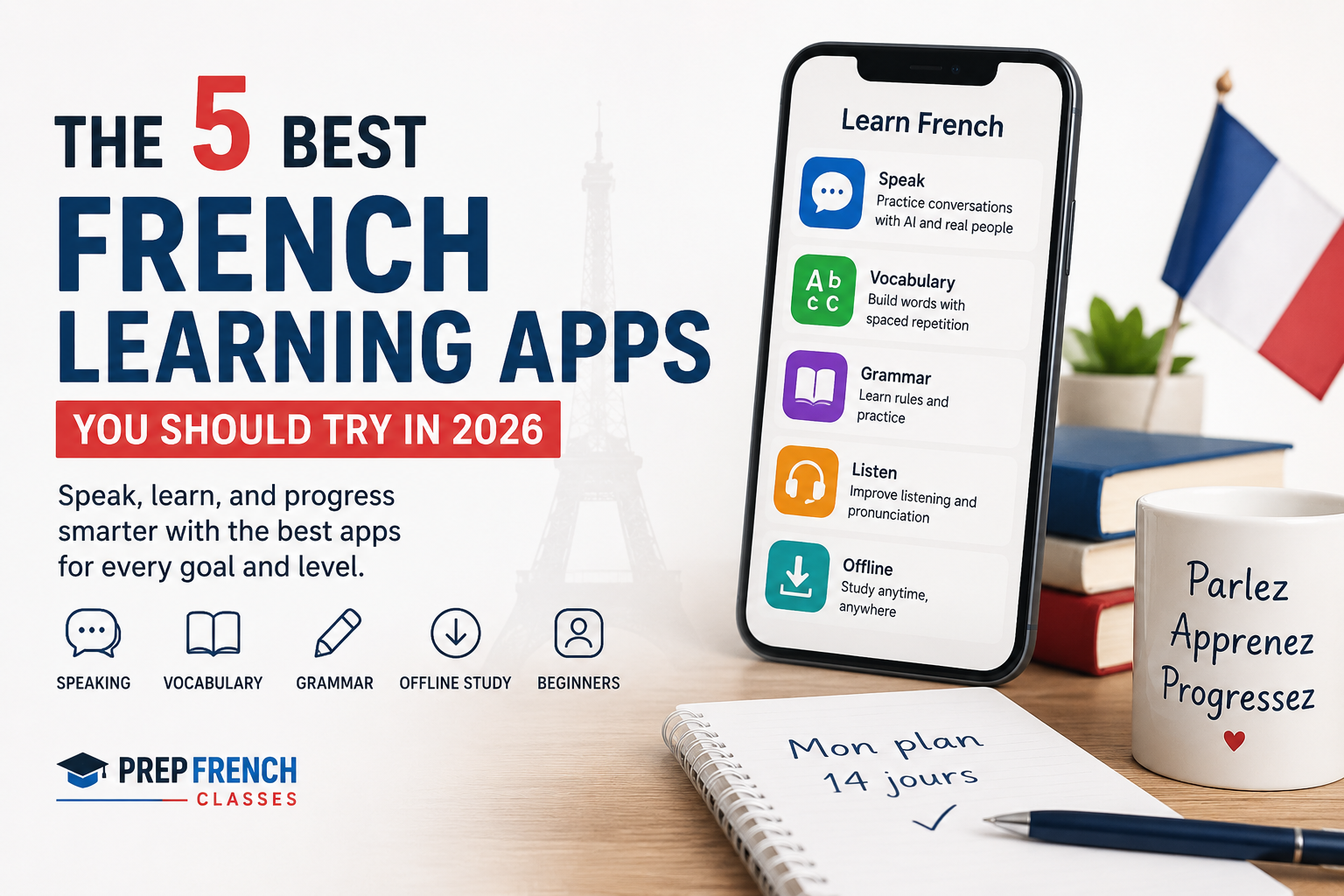
Looking for the best French learning apps 2026 learners are actually using to make real progress? You are in the right place. App learning has evolved quickly, and 2026 is a breakout year for smarter features: on-device speech recognition for instant pronunciation feedback, AI-driven conversation roleplays that adapt to your level, and offline study modes that finally work reliably on the go. Used strategically, these tools make it easier to learn French with an AI app, especially when paired with a structured French course and real speaking practice.
In this guide from PrepFrench, you will find a clear path. First, how to choose the best app to learn French based on your goal and budget. Next, a concise list of five app types that cover speaking, vocabulary, grammar, offline use, and French learning apps for beginners. Then, you will see how to combine apps with real-world practice, a 14-day quick-start plan, and a simple explanation of CEFR levels. If you want help building your path, PrepFrench Classes integrate app practice into live, guided French courses with a teacher who keeps you accountable. You can start right away with a free demo from our Home or Courses page.
Free First Step
Take the guesswork out of learning French.
Not sure where to begin, which course fits your goal, or how long it will take? Book a free demo class with PrepFrench Classes and get a personalized plan built around your level, schedule, and goals.
How to Choose the Right French Learning App
Before you download anything, pin down the result you want. The best app to learn French for a traveler is different from the best app for a grammar refresh or the best fit for a busy parent who needs an offline French learning app during commutes. Below are quick guidelines that we also use inside PrepFrench Classes when we set up students’ study plans.
Understanding Your Goals
- Speaking first: Choose a speaking exchange app that pairs you with partners, offers AI conversation roleplays, and gives pronunciation feedback. Aim for 10 to 15 minutes of speaking per day.
- Grammar foundation: Select a structured course app with short explanations, graded practice, and immediate feedback. Look for adaptive review so your weak points come back until mastered.
- Vocabulary growth: Go for a spaced repetition app with audio, images, and custom decks. If it supports example sentences and cloze deletions, even better.
- Listening and pronunciation: Pick an app with dictation, slow playback, and on-device speech recognition so you can practice French pronunciation privately and often.
- Exam goals: Choose apps that tag content to CEFR and provide DELF-style tasks. Pair with a live French teacher if you need targeted feedback on writing and speaking.
Budgeting for Your App
- Free tier only: Expect ads and limited features. Focus your time on one strong free app plus recorded podcasts or YouTube for listening.
- Low monthly plan: This unlocks AI features, fuller review modes, and downloadable lessons. A small spend goes a long way in 2026 due to major AI improvements.
- Annual subscription: Good if you have a clear plan. Combine with online French classes for scheduled accountability.
Time Commitment & Learning Expectations
- 15 minutes daily: Maintain vocabulary and review basics. Pair with a weekly speaking session to avoid fossilizing mistakes.
- 30 to 45 minutes daily: Noticeable growth in 8 to 12 weeks when you mix input, speaking, and grammar.
- 60 minutes daily: Fastest gains if you include deliberate speaking and feedback. This is where an organized path with PrepFrench Classes can make each minute count.
Not sure which path fits? A short strategy call can save months of trial and error. At PrepFrench, we help you set the right balance between apps and guided French lessons, then track your progress each week.
The 5 Best French Learning Apps for Every Goal in 2026
Instead of a bloated list, here is a focused stack of five app types that cover the essential skills. Each pick is based on 2026 updates like AI conversation partners, personalized review, and strong offline modes. Choose the one that matches your biggest gap today, then layer more as you progress. For deeper structure, pair your stack with a level-aligned French course inside PrepFrench Classes.
1) Best for Speaking: a community exchange app with AI roleplays
Purpose: real conversations with humans and instant practice with an AI partner that adapts to your level.
- Ideal use: daily voice messages, short calls, or AI chats about daily topics. Great for people who hesitate to speak.
- Why it works in 2026: smarter topic prompts, adaptive feedback on grammar slips, better noise handling, and diarized transcripts for self-review.
- Price range: free tier plus optional monthly upgrades.
- Pros: fast confidence building, real accents, flexible length, feedback history you can review.
- Cons: quality varies with partners. AI sometimes over-corrects. Schedule discipline is required.
- Best pairing: once a week, bring audio clips to your PrepFrench teacher for targeted pronunciation and grammar fixes.
2) Best for Vocabulary: a spaced repetition flashcard app with audio
Purpose: build durable French vocabulary using science-backed retrieval practice and spacing.
- Ideal use: daily 10 to 15 minute review sessions with audio and example sentences. Add cloze cards for common phrases.
- Why it works in 2026: smart deck recommendations from your reading history, auto-generated audio, and better tag filters for CEFR levels.
- Price range: free to low one-time or monthly cost.
- Pros: efficient memorization, custom decks, progress you can feel each week.
- Cons: shallow if you only memorize isolated words. Pair with listening and speaking to make it stick.
- Best pairing: use your grammar app’s example sentences as flashcards, then practice them out loud in speaking sessions.
3) Best for Grammar: a structured lesson app with adaptive practice
Purpose: build sentence-making power, not just vocabulary. Learn forms, then use them in context.
- Ideal use: short concept explanations followed by graded drills, writing prompts, and immediate feedback.
- Why it works in 2026: level-aware review, AI-generated micro-exercises targeting personal errors, and CEFR roadmaps you can follow.
- Price range: mid-level subscription.
- Pros: clarity, structure, and measurable progress when you study 3 to 4 days per week.
- Cons: can feel dry if used alone. Bring examples into real speech to avoid passive knowledge.
- Best pairing: your PrepFrench Classes teacher can assign precise lessons and check your written answers for nuanced errors.
4) Best for Offline Learning: an immersive course app with downloadable packs
Purpose: an offline French learning app that lets you continue daily streaks anywhere.
- Ideal use: airplane or metro sessions. Download audio lessons, dialogues, and exercises, then sync later.
- Why it works in 2026: improved offline voice recognition and reliable progress sync across devices.
- Price range: subscription, often with family or student discounts.
- Pros: consistent routine, strong listening input, good for busy schedules.
- Cons: pronunciation scoring can be less accurate offline. Double-check with live feedback when back online.
- Best pairing: share your saved recordings with your PrepFrench teacher to fine-tune French pronunciation and rhythm.
5) Best for Beginners: a gamified fundamentals app
Purpose: French learning apps for beginners that make starting feel light but consistent.
- Ideal use: 10 minute daily streaks to build basic words, phrases, and listening comfort.
- Why it works in 2026: friendly AI coach, micro-challenges, and smarter hints that explain why answers are right.
- Price range: free tier with optional premium for faster progress.
- Pros: low friction, motivational design, great on days you feel tired.
- Cons: plateaus quickly. Add speaking and grammar work within a month.
- Best pairing: move into a beginner-level French course for real dialogue practice and a roadmap to A1 and A2.
Structured French Courses
Stop learning French the slow way.
Apps and random videos keep you stuck at beginner level forever. PrepFrench Classes gives you a structured path, a real teacher, and speaking practice that moves you forward at every lesson.
Available for: beginners · TEF/TCF exam prep · Canadian PR · work and daily French
Combining App Learning with Real-World Practice
Apps are powerful, yet fluency comes from using French with people regularly. ACTFL guidance emphasizes frequent communicative practice across all modes: interpretive, interpersonal, and presentational. Here is how to connect those dots.
- Engage with easy native content: short YouTube videos with subtitles, news-in-simple-French, or children’s audiobooks. Your ear adapts faster than you think.
- Use conversation exchange apps or local meetups: 20 minutes weekly can unlock confidence. Record short voice notes, then relisten with transcripts.
- Shadow for pronunciation: echo native audio in real time. Focus on liaison, nasal vowels, and rhythm. Keep clips short so you can repeat several times.
- Speak to yourself: narrate your day out loud for 2 minutes. This builds agility when you later speak to a partner.
- Get corrective feedback: a trained French teacher can pinpoint recurring grammar slips you miss on your own.
Engaging with Native Speakers
Set one standing conversation session per week, even if it is just 20 minutes. Use prompts pulled from your grammar or vocabulary app. Afterward, write three short sentences summarizing what you said. This forces formality and improves recall. If you want helped pairings and guided topics, reach out to PrepFrench via our Contact page and we will align you with a teacher who fits your level and goal.
Using Conversation Exchange Apps
In 2026, the best exchange apps include AI roleplays, safer matching, and richer correction tools. Use the AI chat first to warm up, then send a real voice message to a partner. Save all transcripts and corrections in your notes. Convert tricky phrases into flashcards for spaced review. This builds a loop of input, output, and targeted reinforcement.
The Role of Structured Lessons in Fluency
Unstructured chatting does not guarantee progress. You improve faster when your French lessons target the exact grammar and pronunciation mistakes blocking you. PrepFrench Classes combine app-based drills with live coaching so each week has a clear objective: an A1 travel dialogue, an A2 narration in the past, or a B1 opinion with reasons. Over time, you will speak French with less effort and more accuracy.
Creating a 14-Day Quick-Start Plan
This plan blends apps and real practice. Adjust minutes if your schedule requires it, but keep the structure intact. Consistency beats intensity.
Daily Routine Breakdown
- Vocabulary, 10 minutes: spaced repetition review. Add 3 to 5 new items only.
- Grammar, 10 minutes: one micro-lesson with exercises.
- Listening, 5 to 10 minutes: short audio with transcript. Shadow one sentence.
- Speaking, 5 to 10 minutes: AI roleplay or a 1 to 2 minute voice note about your day.
- Once daily reflection, 2 minutes: write one new sentence you can use in life. Save it to your deck.
Combining Study with Practice
- Day 1 to 3: Follow the routine exactly. Keep speaking short to build momentum.
- Day 4: Add a 10 minute live exchange or record a longer monologue. Ask for one correction only.
- Day 5 to 7: Keep the routine. Convert every correction into a flashcard.
- Day 8: Do a mini review. Reattempt a Day 1 exercise and compare your score.
- Day 9 to 12: Increase speaking to 10 minutes. Use prompts from your grammar app.
- Day 13: Record a 2 minute self-introduction. Save transcript and note 3 improvements for next week.
- Day 14: Light day. Celebrate streak, tidy your flashcards, and plan your next two weeks.
Setting Short-Term Goals
- Outcome goals: for example, introduce yourself with name, job, city, and two hobbies without pausing.
- Process goals: 12 sessions completed, 120 new reviews, 3 speaking clips recorded.
- Review checkpoint: at the end of Day 14, book a free demo with PrepFrench to get a next-step roadmap aligned to your level. We can connect you with the right French classes to keep momentum going.
Understanding CEFR Levels and Learning Expectations
CEFR levels give you a shared language for goals. Apps in 2026 often tag lessons A1 through B2, and some offer progress projections based on your study time. Use the ranges below as a general guide. Your background, language proximity, and study habits can shift timelines up or down.
What is CEFR?
CEFR is a European framework that describes language ability from A1 to C2. It is widely used to design French courses, exams like DELF, and app roadmaps. For most adult learners, the big milestones are A1 for basic survival French, A2 for routine tasks, B1 for independent everyday conversation, and B2 for more confident work or academic use.
| Level | What you can typically do | Typical hours to reach | Best app focus |
|---|---|---|---|
| A1 | Introduce yourself, order food, handle very simple exchanges. | 80 to 120 hours total | Gamified beginner app + vocabulary SRS + short speaking prompts |
| A2 | Talk about routine tasks, family, work, and plans in basic terms. | 180 to 250 hours total | Grammar app + conversation exchange + offline audio lessons |
| B1 | Describe experiences, give reasons, handle most travel situations. | 350 to 450 hours total | Grammar drills + topic-focused speaking + reading with SRS phrases |
| B2 | Interact fluently on familiar topics, argue a point, follow complex ideas. | 600 to 800 hours total | Debate prompts + long listening + targeted pronunciation feedback |
Mapping Apps to CEFR Levels
- A1: prioritize a friendly beginner app and short AI roleplays. Keep grammar light and practical.
- A2: increase grammar structure and start regular conversation exchanges. Use offline lessons for daily input.
- B1: shift toward real materials, topic-based speaking tasks, and writing short summaries for correction.
- B2: practice stance-taking, counterarguments, and clarity of pronunciation in fast speech.
Typical Time Commitment
With 30 to 45 minutes of daily focused study plus one weekly speaking session, many learners go from zero to A2 in about 6 to 9 months. From A2 to B1 can take another 6 to 9 months, depending on your starting point and how regularly you receive corrective feedback. Apps accelerate exposure. Live teaching accelerates accuracy. PrepFrench Classes combine both so your time translates into level gains you can trust.
PrepFrench Classes
Ready to start French with a clear plan?
Book a FREE demo class and get a personalized roadmap for your level, goal, and timeline. No pressure, no obligation.
Explore courses:
All French Courses · Full TCF Canada Course · Full TEF Canada Course
FAQs: Best French Learning Apps 2026
Can I learn French fluently using apps alone?
Apps are great for input, vocabulary, and guided drills, but fluency comes from regular speaking and feedback. If you use a learn French with AI app for roleplays plus a conversation exchange weekly, you will grow faster. To reach B1 or B2, you usually need structured French lessons with a teacher who corrects your recurring mistakes and pushes you to produce longer, clearer speech. Many learners combine apps daily with PrepFrench Classes twice a week for the best results.
How do I choose an app suitable for my learning level?
Match your current CEFR level and goal. A1 learners benefit from a gamified beginner app plus a vocabulary SRS. A2 learners need a grammar app with adaptive practice and a weekly speaking exchange. B1 learners should add real content, longer listening, and opinion speaking tasks. If you are unsure about your level, book a free demo with PrepFrench and we will align you to an app stack and a French course that fit your timeline.
What is the best app for pronunciation practice?
In 2026, look for on-device speech recognition, syllable-level feedback, and sentence shadowing with slow playback. Use short daily clips. Record yourself, then compare to a native model. For accuracy improvements, schedule occasional checks with a French teacher who can refine vowels, liaison, and rhythm. Inside PrepFrench Classes, we listen to your clips, correct recurring issues, and assign micro-drills that fix specific sounds efficiently.
How can I use apps to prepare for the DELF?
Choose an app that tags content by CEFR and includes task types like roleplays, emails, and short presentations. Combine that with a vocabulary SRS focused on exam topics. Then add weekly timed practice for listening and reading. For speaking and writing, get feedback from a qualified teacher. PrepFrench offers CEFR-aligned French classes and practice packs that mirror DELF tasks so you can study smarter, not longer.
Are there offline options for learning French with apps?
Yes. Many 2026 apps let you download lessons, dialogues, and even speech exercises. Use an offline French learning app on commutes or flights, then sync progress later. For pronunciation, offline scoring is improving, but confirm with live feedback when you are back online. Offline study is perfect for building a habit. Add live PrepFrench lessons for targeted corrections and your progress will stay steady regardless of your schedule.
Final Thoughts
The best French learning apps 2026 learners choose share three traits: focused goals, AI features that adapt to your level, and reliable offline options to keep your streak alive. Pick one category to solve your biggest gap, stick with it for two weeks, then add the next tool. Most important, treat apps as your daily gym and live practice as your match day. That combination makes improvement visible.
If you want a plan that respects your time, PrepFrench Classes provide a structured path with human feedback and accountability. We integrate apps into your routine, assign the right lessons for your CEFR level, and help you speak French with confidence. Learn French in a way that fits your life, with a clear roadmap and milestones you can celebrate.
✅ Next Step: Book a free demo class with PrepFrench Classes and start learning French the right way.
Balance your app learning with structured support. When you are ready, visit our Home page or browse all French courses to see how PrepFrench can guide your next milestone.
Written by
Platform Administrator
Practical ideas from the Prep French team for learners building confidence, preparing for exams, and planning their next step in Canada.
Join the discussion
Leave a thoughtful comment.
Your email address will not be published. Comments are reviewed before appearing.