30+ Fruits in French: Essential Vocabulary & Pronunciation
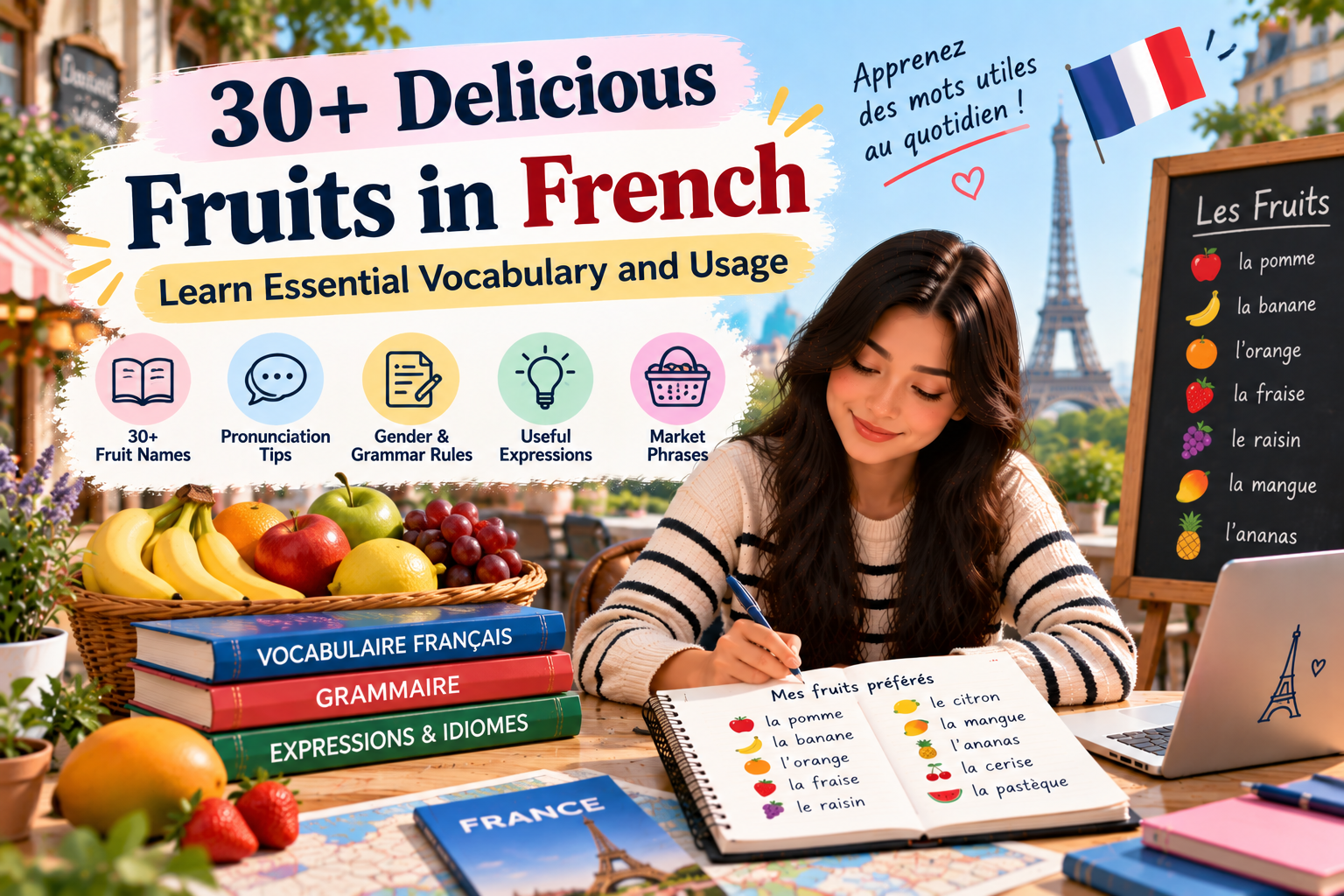
Want a fun, useful way to grow your French vocabulary? Learning fruits in French gives you instant words for daily life, market trips, recipes, and small talk. In this guide, you will learn 30+ fruit names with gender, simple pronunciation tips, and example sentences you can use right away. We will also cover regional variations, common traps like false friends, and practical phrases for buying fruit in a market. If you are following a French course or taking online French classes, these words are perfect for quick wins that build confidence. At PrepFrench Classes, our French lessons combine vocabulary with pronunciation and real-life usage, so you can speak French more naturally and with less guesswork. If you want a structured path to learn French, you can also explore our French courses and see how we teach vocabulary with context.
Free First Step
Take the guesswork out of learning French.
Not sure where to begin, which course fits your goal, or how long it will take? Book a free demo class with PrepFrench Classes and get a personalized plan built around your level, schedule, and goals.
Understanding Fruits in French
Fruit words in French behave like other nouns: each fruit has a grammatical gender, either masculine or feminine, and that gender controls the article you use. Knowing the gender matters for accuracy, but it also helps with pronunciation and linking sounds in sentences. For example: la pomme is feminine, le kiwi is masculine. Some fruits use the partitive article to talk about an unspecified quantity, for example du raisin for grapes in general. To make vocabulary stick, pair each word with an article and a short phrase you can reuse in real life.
Gender of French Fruits
Here are quick examples to see how gender appears in context:
- Feminine: la pomme, l’orange, la fraise, la mangue, la pastèque
- Masculine: le kiwi, le citron, le raisin, l’ananas, le pamplemousse
- Collective or mass usage: du raisin (grapes in general), de la noix de coco râpée
If gender rules feel abstract, learn them as fixed pairs: la pomme, le citron, l’orange. In PrepFrench Classes, we teach genders through short patterns plus repetition in guided conversation, which helps you choose the right article automatically. If you want to see how we teach grammar inside a structured program, explore our French courses.
Common Patterns and Exceptions
- Words ending in -e are often feminine, for example la poire, la banane, la cerise, but there are exceptions like le pamplemousse.
- Nouns with a clear Latin origin or ending in -us can be masculine, for example le citrus is not used, but le pamplemousse is masculine and follows the pattern.
- When referring to fruit in general, use the plural: J’aime les mangues, or a partitive for an unspecified amount: Je prends du raisin.
- Elision with vowels: l’orange, l’abricot. The noun still has gender even when the article is l’, for example l’orange is feminine.
Fruits in French: Core Names, Pronunciation, and Usage
Below is a comprehensive French vocabulary list of fruits with gender, simplified pronunciation, English meaning, and a short example sentence. Use the examples as ready-made mini phrases for practice in your French lessons or daily review.
| Fruit (French) | Gender | Pronunciation | English | Example |
|---|---|---|---|---|
| la pomme | F | pohm [pɔm] | apple | J’achète des pommes. |
| la poire | F | pwar [pwaʁ] | pear | Cette poire est juteuse. |
| la banane | F | ba-nan [banan] | banana | Je mange une banane. |
| l’orange | F (l’) | o-ronj [ɔʁɑ̃ʒ] | orange | Les oranges sont sucrées. |
| le citron | M | see-tron [sitʁɔ̃] | lemon | Ajoute du citron. |
| le citron vert / la lime (QC) | M / F (QC) | see-tron vair / leem | lime | Je presse un citron vert. |
| la fraise | F | frez [fʁɛz] | strawberry | Une barquette de fraises, s’il vous plaît. |
| la framboise | F | fran-bwaz [fʁɑ̃bwaz] | raspberry | Des framboises fraîches. |
| le raisin | M (mass) | reh-zin [ʁɛzɛ̃] | grapes | Je mange du raisin. |
| la myrtille / le bleuet (QC) | F / M (QC) | meer-tee / blu-eh | blueberry | Les myrtilles sont délicieuses. |
| la cerise | F | suh-reez [səʁiz] | cherry | J’adore les cerises. |
| la mûre | F | myur [myʁ] | blackberry | Des mûres sauvages. |
| la groseille (rouge) | F | gro-zay [gʁɔzɛj] | red currant | De la gelée de groseilles. |
| la groseille à maquereau | F | gro-zay a ma-kro | gooseberry | Des groseilles à maquereau du jardin. |
| la canneberge (QC: canneberge, airelle rouge) | F | kan-berj [kanbɛʁʒ] | cranberry | Le jus de canneberge est acidulé. |
| la pastèque / le melon d’eau (QC) | F / M (QC) | pas-tek / muh-lon do | watermelon | Nous partageons une pastèque. |
| le melon (Cantaloup au QC parfois) | M | muh-lon [məlɔ̃] | melon, cantaloupe | Un melon bien mûr. |
| la mangue | F | mong [mɑ̃g] | mango | J’aime les mangues. |
| l’ananas | M (l’) | a-na-nas [anana] | pineapple | Un ananas entier. |
| la papaye | F | pa-pie [papaj] | papaya | De la papaye fraîche. |
| la pêche | F | pesh [pɛʃ] | peach | Une pêche bien mûre. |
| la nectarine | F | nek-ta-reen [nɛktaʁin] | nectarine | Je prends deux nectarines. |
| l’abricot | M (l’) | a-bree-ko [abʁiko] | apricot | Des abricots bien sucrés. |
| la prune / le pruneau (sec) | F / M | prun / pru-no | plum / prune | Une tarte aux prunes. |
| la grenade | F | gruh-nad [gʁənad] | pomegranate | Les graines de grenade. |
| le pamplemousse / le pomélo | M / M | pam-pluh-moos / po-mé-lo | grapefruit / pomelo | Un jus de pamplemousse. |
| la clémentine / la mandarine | F / F | kle-mon-teen / man-da-reen | clementine / mandarin | Des clémentines pour l’hiver. |
| la goyave | F | go-yav [gɔjav] | guava | De la goyave bien mûre. |
| le litchi (letchi) | M | lee-chee [litʃi] | lychee | Des litchis au dessert. |
| la figue | F | feeg [fig] | fig | Une figue fraîche. |
| le kiwi | M | kee-wee [kiwi] | kiwi fruit | Un kiwi vert. |
| le coing | M | kwang [kwɛ̃] | quince | De la pâte de coing. |
| la datte | F | dat [dat] | date (fruit) | Des dattes Medjool. |
| la noix de coco | F (phrase) | nwah d’ koh-koh | coconut | Du lait de noix de coco. |
| le fruit de la passion (passion) | M (phrase) | frwee d’ la pa-syon | passion fruit | Du jus de fruit de la passion. |
| la carambole | F | ka-ram-bol [kaʁɑ̃bɔl] | star fruit | Une carambole bien mûre. |
| le kaki (plaqueminier) | M | ka-kee [kaki] | persimmon | Un kaki bien mûr. |
Usage notes to sound natural:
- Use plural for general likes: J’aime les mangues. J’adore les cerises.
- Use partitives for an unspecified amount: Je prends du raisin, de la pastèque, de la papaye.
- For quantities, pair with measurement words: un kilo de pommes, une barquette de fraises, une tranche de melon.
- Remember that le raisin is grapes, and raisin sec is a dried grape, a raisin in English. More in the mistakes section below.
In PrepFrench Classes, we build short speaking drills around vocabulary like this, then expand into market dialogues and recipe instructions. If you prefer a structured path with a real teacher, explore how our French courses develop pronunciation and confidence lesson by lesson.
Structured French Courses
Stop learning French the slow way.
Apps and random videos keep you stuck at beginner level forever. PrepFrench Classes gives you a structured path, a real teacher, and speaking practice that moves you forward at every lesson.
Available for: beginners · TEF/TCF exam prep · Canadian PR · work and daily French
Regional Variants in French Fruit Vocabulary
French is spoken worldwide, so some fruit names change by region. France and Quebec often use different words for everyday produce. Knowing both helps you understand menus, shop abroad, and watch Canadian content without confusion.
Quebec vs. France Vocabulary
- Blueberry: France uses la myrtille, Quebec uses le bleuet.
- Watermelon: France uses la pastèque, Quebec uses le melon d’eau.
- Lime: France says le citron vert, Quebec commonly says la lime.
- Cantaloupe: Commonly called le melon in France, you may hear le cantaloup in Quebec.
- Cranberry: la canneberge is widely understood, airelle rouge appears in some contexts.
Other Regional Variations
- Grapefruit vs. Pomelo: le pamplemousse often refers to grapefruit in France, while le pomélo specifically names the larger, less bitter pomelo fruit.
- Blackcurrant and Redcurrant: le cassis is blackcurrant, la groseille is redcurrant. Do not mix these up when reading labels for sirop or confiture.
- Plantain: la banane plantain is common in African and Caribbean contexts. It is a cooking banana, not eaten raw like la banane.
At PrepFrench, we include regional terms when relevant, so you can understand both European and Canadian usage. If Canada is part of your plan, you can also look at our exam prep options for TEF Canada or TCF Canada inside the courses page.
Common Mistakes and False Friends in French Fruit Vocabulary
Some fruit words look or sound like English, but they do not mean what you expect. Others have a subtle change that creates a different meaning entirely. Here are the most common traps, with fixes to keep your French clean and clear.
Understanding False Friends
- raisin vs. raisin sec: le raisin means grapes, a fresh fruit on the vine. Un raisin sec is a dried grape, a raisin in English.
- prune vs. pruneau: la prune is a plum, le pruneau is a dried plum. Do not order pruneaux if you want fresh plums.
- date vs. datte: la datte is the fruit. La date refers to a day of the month or an appointment.
- mûre vs. mur: la mûre is blackberry, mur means wall. Watch the accent on the vowel.
- coco vs. noix de coco: coco alone is informal and can be confusing. Use la noix de coco for the fruit.
Avoiding Common Mistakes
- Lime confusion: In France say le citron vert. In Quebec la lime is common. If unsure, say citron vert, it is understood everywhere.
- Grapefruit mix-up: In shops, pamplemousse usually means grapefruit. Pomélo names the larger citrus with sweeter flesh.
- Blackberry vs. blueberry: la mûre is blackberry, la myrtille is blueberry in France. In Quebec, blueberry is le bleuet.
- Mass vs. count: Say du raisin for some grapes. If you want bunches, ask for une grappe de raisin.
- Seeds and pits: un pépin is a small seed in citrus or grapes, un noyau is a stone or pit in fruits like la pêche or l’abricot.
If you often second-guess yourself, build a personal glossary, or let a French teacher correct you in short speaking drills. Our French lessons include targeted pronunciation and real-time feedback that help these small details stick.
Practical Phrases for Buying Fruit
Use these ready phrases at markets, grocery stores, or in role plays during your online French classes. They cover quantities, ripeness, price, and polite interaction.
Common Phrases for Markets
- Bonjour, je voudrais un kilo de pommes, s’il vous plaît.
- Je prends une barquette de fraises et deux mangues.
- Vous avez des myrtilles bio aujourd’hui ?
- Je peux goûter un morceau de melon, s’il vous plaît ?
- Je vais prendre une grappe de raisin noir, bien sucré.
- Je prends une demi-douzaine d’oranges.
- Vous les faites à combien, les clémentines ?
Key Questions to Ask
- C’est combien le kilo, s’il vous plaît ?
- Est-ce que c’est bien mûr, ou plutôt ferme ?
- Vous pouvez choisir des avocats plus mûrs, s’il vous plaît ?
- Ils viennent d’où, ces mangues ?
- Je cherche des fruits sans pépins, vous me conseillez quoi ?
For conversation flow, start with Bonjour, add s’il vous plaît, and end with Merci, bonne journée. Practice these inside a guided role play, or book a free session to try them with a teacher through our contact page.
Pronunciation Tips for Fruit Names
French pronunciation looks intimidating at first, yet it follows consistent patterns. Focus on a handful of sounds you see often in fruit names, then drill short word groups. In PrepFrench Classes, we use quick, repeatable drills that target one sound at a time, which helps you progress faster without overwhelm.
Key Sounds in Fruit Names
- Nasal vowels: an, en, on, in produce air through the nose.
- an, en as in mangue [mɑ̃g], pamplemousse [pɑ̃pləmus]
- in, ain as in raisin [ʁɛzɛ̃]
- on as in citron [sitʁɔ̃], melon [məlɔ̃]
- oi makes a wa sound: poire [pwaʁ], poivron is wa, even though poivron is not a fruit.
- ou is a pure oo: pamplemousse [mus], prune [pʁyn] has the u sound [y], which is different from ou.
- Final consonants: many are silent, for example, ananas is usually [anana]. Do not release a strong final s.
- Elision and linking: l’orange, l’abricot. In rhythm, link phrases: une barquette de fraises sounds like [yn baʁkɛt də fʁɛz].
Practice Exercises
- Minimal pairs for u vs. ou: prune [pyʁyn] vs. proue [pʁu]. Say each three times.
- Nasal chain: mangue, pamplemousse, raisin, melon. Read slowly, then at natural speed.
- oi loop: poire, poivron, boîte. Feel the wa each time.
- Phrase rhythm: Je voudrais un kilo de pommes. Une barquette de fraises, s’il vous plaît.
- Record and compare. Small tweaks in vowel length and mouth shape create big gains in clarity.
For guided pronunciation drills and feedback, join our online French classes. A French tutor will adjust your mouth shape, vowels, and linking so your speech sounds natural, not forced.
PrepFrench Classes
Ready to start French with a clear plan?
Book a FREE demo class and get a personalized roadmap for your level, goal, and timeline. No pressure, no obligation.
Explore courses:
All French Courses · Full TCF Canada Course · Full TEF Canada Course
Conclusion
You now have a practical list of 30+ fruits in French, complete with gender, pronunciation help, usage notes, and real phrases for the market. These words appear in daily conversation, recipes, and menus, so they are perfect building blocks for your French vocabulary. Keep gender attached to each noun, notice partitive usage like du raisin, and stay aware of regional differences such as myrtille versus bleuet. If you keep pronunciation simple and consistent, words like pamplemousse, orange, and raisin become easy and automatic. To go further, use these fruits in short dialogues, ask real questions about price and ripeness, and speak them out loud. PrepFrench Classes is here to help you learn French with structure, accountability, and a friendly French teacher. Explore our French courses to continue building a strong foundation.
FAQ
Is fruit masculine or feminine in French?
Fruit nouns in French can be masculine or feminine, there is no single rule for all fruits. Many fruits ending in -e are feminine, for example la pomme, la banane, la fraise, but there are exceptions such as le pamplemousse. Some words use l’ before vowels, for example l’orange, which is feminine. Learn each fruit with its article, like le citron, la pêche, l’abricot. If you follow a structured French course, your French teacher will help you notice patterns and exceptions while you practice speaking. PrepFrench offers online French classes that reinforce gender through real-life phrases.
What is the difference between raisin and raisin sec?
In French, le raisin refers to the fresh fruit grapes, often used as a mass noun, for example du raisin. A raisin in English is a dried grape, which in French is un raisin sec. The s in raisin is pronounced like a z, and the in makes a nasal sound: [ʁɛzɛ̃]. To avoid confusion, remember: raisin equals grapes, raisin sec equals dried grape. In PrepFrench Classes, we use quick comparisons like this to help you avoid common mistakes and speak French with confidence.
How do you pronounce challenging fruit names like pamplemousse?
Pamplemousse is pronounced [pɑ̃pləmus]: start with a nasal an [ɑ̃], then ple, then a clear oo [u] in mousse. Break it into parts: pam-ple-mooss. For orange [ɔʁɑ̃ʒ], keep the second vowel nasal [ɑ̃] and finish with the soft zh sound [ʒ]. For raisin [ʁɛzɛ̃], the in is nasal again. Slow practice helps. Record yourself repeating mangue, pamplemousse, raisin, orange in rhythm. If you want guided correction from a French tutor, join our online French classes.
What's the French word for blueberry—myrtille or bleuet?
Both are correct depending on the region. In France, blueberry is usually la myrtille. In Quebec, people commonly say le bleuet. If you are traveling or consuming Canadian media, you will hear bleuet often. For international clarity, you can say myrtille in Europe and bleuet in Quebec. PrepFrench helps you learn regional variants during French lessons, which is useful if you plan to study or work in Canada. You can browse our courses to see regional coverage.
How do I ask about quantities of fruit in French at the market?
Use measurement words with de: un kilo de pommes, une barquette de fraises, une grappe de raisin, une douzaine d’œufs. To ask the price, say C’est combien le kilo, s’il vous plaît ? To request ripeness: Je les voudrais bien mûrs, s’il vous plaît. To get a sample: Je peux goûter ? Be polite with Bonjour and Merci. Practice these lines in a structured French course, or book a free demo with PrepFrench to try a market role play with a teacher.
✅ Next Step: Book a free demo class with PrepFrench Classes and start learning French the right way.
Keep these words close by for your next lesson or grocery run. A few minutes a day with a focused vocabulary set, plus real speaking practice, will help you speak French with ease.
Written by
Platform Administrator
Practical ideas from the Prep French team for learners building confidence, preparing for exams, and planning their next step in Canada.
Join the discussion
Leave a thoughtful comment.
Your email address will not be published. Comments are reviewed before appearing.