15 Common Paris Scams to Avoid: Tourist Safety Guide
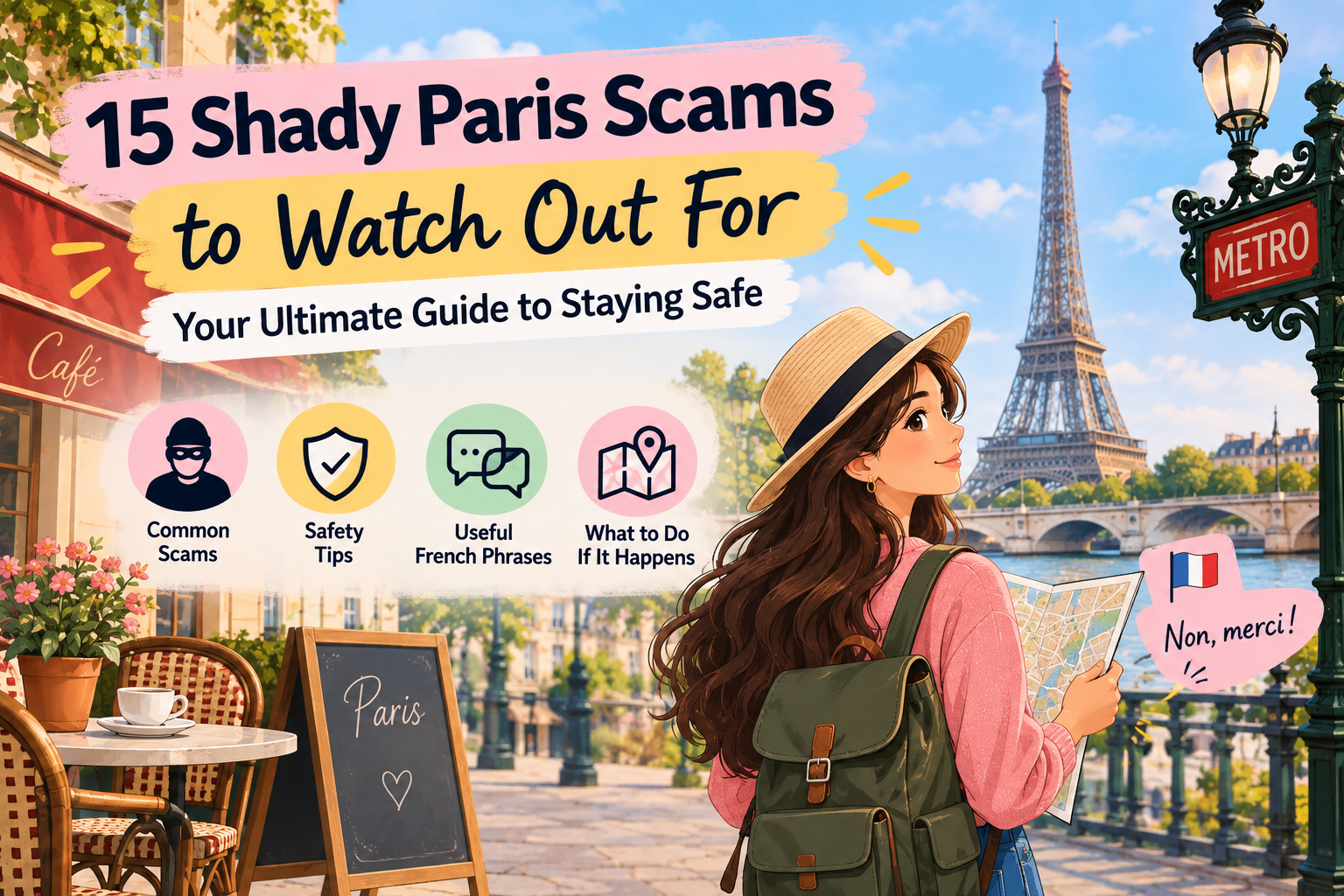
Paris is unforgettable for all the right reasons: iconic views, world-class food, long river walks. Yet the city’s popularity also attracts opportunists. Paris scams are not a reason to cancel your trip, they are simply a reason to be prepared. In this practical field guide, you will learn how to spot the most common Paris tourist scams, what to say in French to disengage politely, and the exact steps to take if something happens. With a few smart habits and some travel-ready phrases, you can enjoy Paris safely and confidently.
Scams in Paris tend to cluster around crowded, high-traffic spots: the Eiffel Tower, Montmartre, Sacré-Cœur, the Louvre, Notre-Dame, the Champs-Élysées, the Seine riverbanks, and busy metro lines such as 1, 4, 9, and RER B to the airports. The patterns are simple: create a distraction, separate a traveler from their attention or their money, move on fast. The good news is that a bit of situational awareness and a couple of firm French phrases go a long way. At PrepFrench, we teach practical language you can use immediately, from refusing pushy street offers to verifying a taxi or speaking clearly with hotel staff and authorities. If you want structured support, our French courses and PrepFrench Classes focus on real-world French so you can travel smarter, speak French with confidence, and avoid common traps.
Free First Step
Take the guesswork out of learning French.
Not sure where to begin, which course fits your goal, or how long it will take? Book a free demo class with PrepFrench Classes and get a personalized plan built around your level, schedule, and goals.
Quick Reference: Top Signs of a Scam
Typical behaviors of scammers
- Unsolicited “help” that feels too eager: strangers who insist on guiding you at ticket machines, ATMs, or taxi ranks.
- Forced friendliness: a bracelet suddenly tied to your wrist or a “gift” placed in your hand, followed by a demand for money.
- Clipboard teams: groups asking you to sign petitions for a cause, then requesting a donation or using distraction to pickpocket.
- Street games with a crowd: shell games and cup-and-ball setups where you never win, and accomplices act as fake winners.
- Pressure or guilt language: “It is for charity,” “You are rude if you refuse,” or “You already agreed.”
- Price surprises: menus or photo ops without visible prices, then a sudden high bill or “per person” charge.
- Identity checks on the street: someone claiming to be police demanding to see your wallet instead of an ID card.
Situational red flags
- Crowded pinch points: metro doors as they close, escalators, and busy stairs where pickpockets bump and block.
- Airport arrivals: anyone approaching you inside the terminal for a “taxi” instead of directing you to the official taxi rank.
- ATMs in isolated spots: people hovering behind you, or card slots and keypads that look loose or tampered with.
- Distraction pairings: one person shows you a petition or asks for directions while an accomplice targets your bag.
- Too-good-to-be-true deals: fake “VIP tours,” “free” roses, or super-cheap ticket offers sold on the street.
Fast scripts you can use: “Non, merci” (No, thank you). “Je ne suis pas intéressé(e)” (I am not interested). “Laissez-moi, s’il vous plaît” (Please leave me alone). If you want travel-ready French quickly, our online French classes teach exactly these practical lines and pronunciation.
Popular Paris Street Scams to Avoid
Here are nine highly reported street-level scams in Paris. Recognize the pattern, respond briefly, and move on.
-
Friendship Bracelet Scam (Montmartre): A person grabs your wrist near Sacré-Cœur and knots a “free” bracelet. Once it is on, they demand payment. Response: keep your hands close to your body and say, “Non, merci.” If someone grabs your wrist, pull back firmly and walk away without arguing.
-
The Gold Ring Drop: A “helpful” stranger pretends to find a gold ring near you, claims it is too small, and offers it to you for a “small reward.” Decline and continue walking. Script: “Ce n’est pas à moi. Merci, au revoir.”
-
Fake Charity Petition: Often teenagers with clipboards ask you to sign for a cause, sometimes pretending to be deaf-mute. After you sign, they pressure you for cash or pickpocket you while distracted. Do not take the pen or clipboard. Script: “Je ne signe pas. Merci.”
-
The Shell Game (Bonneteau): Street dealers shuffle a pea under cups, with accomplices cheering and placing fake bets. You cannot win. Move past without stopping. Script: “Je n’ai pas le temps.”
-
Rose Seller Pressure: A “gifted” rose quickly turns into a demand for payment, sometimes after a posed photo. Do not take items you did not ask for. Script: “Je ne veux pas de rose. Non, merci.”
-
Costumed Character Photo Fee: Around major sights, costumed performers invite a photo, then demand an inflated fee afterward. Ask the price first or decline. Script: “Combien ça coûte, s’il vous plaît ?” If unclear, say “Non, merci” and walk on.
-
Polaroid or Phone Photo Upsell: Someone offers to take a “nice couple photo,” then pushes a paid print or aggressive tipping. Keep your phone in your hand and refuse unsolicited offers. Script: “C’est gentil, mais non merci.”
-
Café Menu Switch or Hidden “Per Person” Charges: A server shows a special or tourist menu without clear pricing, then the final bill includes unexpected fees. Always ask for a printed menu with prices. Script: “Pouvez-vous me montrer la carte avec les prix ?” Check the bill before paying.
-
“Free Gift” Sellers: Bracelets, trinkets, or keychains are placed in your hand as a “present,” then the seller demands money, sometimes with a guilt trip. Do not accept the item. Script: “Ce n’est pas gratuit. Je refuse.”
Knowing a few direct French lines lets you disengage quickly and confidently. If you want a simple, structured way to learn them, try a free demo class with PrepFrench Classes and get a short travel-French plan tailored to your trip length.
Structured French Courses
Stop learning French the slow way.
Apps and random videos keep you stuck at beginner level forever. PrepFrench Classes gives you a structured path, a real teacher, and speaking practice that moves you forward at every lesson.
Available for: beginners · TEF/TCF exam prep · Canadian PR · work and daily French
Navigating Transport and Taxi Scams
Transport-related scams center on unlicensed taxis, inflated fares, and pickpocketing on the metro. Use the official system and keep your bag secure at pinch points.
How to Identify Licensed Taxi Services
At CDG and Orly airports, only take taxis from the official ranks outside arrivals. Ignore anyone who approaches you inside the terminal offering a ride. Licensed Paris taxis display a “TAXI Parisien” roof sign, a meter inside, and a small illuminated light that shows availability. Airport rides have official flat fares to the city, which are publicly posted. If a driver tries to negotiate a higher “flat” fee or refuses to use the meter in the city, find another taxi or use a ride-hailing app with upfront pricing.
- Scam 10: Airport Taxi Touts: Inside-arrivals “agents” who lead you to unlicensed cars with inflated prices. Solution: follow airport signs to the official taxi queue.
- Scam 11: Taxi Overcharge or Detour: A driver refuses the meter, claims a fake flat fare, or takes a long route. Solution: “Veuillez mettre le compteur, s’il vous plaît.” If they refuse, get out at a safe spot and take another taxi.
Useful phrases: “C’est un tarif forfaitaire officiel ?” (Is this an official flat fare?). “Je préfère le compteur.” (I prefer the meter.)
Safe Practices on the Metro
Paris metro is efficient and widely used, but pickpockets target crowded lines and tourist stops. They often work in teams: one distracts, one takes, one blocks the door.
- Scam 12: Metro Pickpocket Teams: Blocking doors at closing, bag slashing in crowds, or bumping on escalators. Solution: wear crossbody bags zipped in front, keep phones out of back pockets, and step away from doorways if possible.
- Stand with your bag in front, a hand on the zipper. Avoid opening your purse or wallet on the platform. If approached by a clipboard team inside the station, keep moving.
- If someone spills something or points out a stain, assume it might be a distraction. Politely decline help and check your belongings later in a safe spot.
Knowing transit vocabulary helps you ask for help and read signs quickly. In our French lessons, we cover ticket machines, line announcements, and polite refusal phrases so you can move through the system with ease.
Money and Card Scam Awareness
Money-related scams are designed to capture your card data or catch you off-guard during payment. Simple checks and a few habits reduce the risk significantly.
Recognizing ATM Skimming
Scam 13: ATM Skimming and the “Helpful Stranger”: Criminals place a fake card slot over the real one, or stand nearby to shoulder-surf your PIN. Sometimes a person offers “help” at the machine and swaps your card in the confusion.
- Use ATMs inside bank branches during business hours when possible.
- Inspect the card slot and keypad. If anything is loose or misaligned, walk away.
- Cover the keypad fully while entering your PIN, even if you are alone.
- Decline all unsolicited help: “Non, merci.” Cancel the transaction if someone stands too close.
If your card is captured or compromised, contact your bank immediately using the number on the back of the card. In France, you can also call your card network’s international emergency line to block the card fast. File a police report for insurance documentation.
Best Practices for Using Your Card
Scam 14: Portable POS Overcharge or Tip Traps: In touristy areas, a server might quietly add a big “tip” line or an extra zero before handing you a wireless card reader. Always verify the amount on the device before tapping or inserting your card. If the amount is wrong, say “Ce n’est pas le bon montant.” Ask them to cancel and re-enter correctly.
- Check receipts, especially for “service” or “per person” fees. In many Paris cafés, service is included in menu prices.
- Use contactless for small amounts, but be mindful of the screen. Do not tap if the amount looks unusual.
- For larger purchases, consider paying inside the store or at the counter, not outdoors or at a street stall.
- Separate payment cards, keeping a backup card and a small amount of cash stored securely in your hotel safe.
Learning essential French banking terms helps you react faster. Our PrepFrench teachers build quick role-plays like “asking for the bill,” “correcting a charge,” and “refusing help at an ATM,” so you are ready for real life, not just grammar rules.
Dealing with Authorities: Verify and Report
Fraudsters sometimes exploit the authority of a uniform or badge. Learn how to verify an officer, refuse a street wallet check, and report a scam correctly.
How to Validate Police Credentials
Scam 15: Fake Police Wallet Inspection: Someone in plain clothes flashes a badge and demands to see your passport or wallet to “check counterfeit money.” Real officers do not perform random wallet checks on the street in this manner.
- Ask to see the officer’s professional ID: “Votre carte professionnelle, s’il vous plaît.” A genuine card has official markings and a photo.
- Offer to go to the nearest police station to verify identity: “Allons au commissariat le plus proche.” Scammers usually refuse.
- Do not hand over your wallet. Show ID without giving physical control of your valuables.
Reporting Scams in Paris
-
Get to a safe place: Step into a shop, café, hotel lobby, or a staffed metro station kiosk.
-
Call appropriate services: For emergencies dial 112 from any phone, or 17 for police. Explain the situation calmly.
-
File a police report: Go to the nearest commissariat (police station). A report helps with insurance and card chargebacks. Bring your ID, any transaction records, and details like time and location.
-
Contact your bank and phone carrier: Block compromised cards and consider freezing your mobile SIM if your phone was taken. Monitor accounts for suspicious activity.
-
Document everything: Write down what happened, describe the people involved, and note any witnesses or CCTV locations. Save receipts or screenshots.
Key French phrases for reporting: “On m’a volé mon portefeuille” (My wallet was stolen). “Je voudrais faire une déclaration” (I would like to make a report). “C’était près de…” (It was near…). If you prefer guided practice, our French language classes include short police-station role-plays to reduce stress in urgent moments.
Tips for a Safe Experience in Paris
Best Practices for Keeping Valuables Safe
- Wear a crossbody bag that zips, and keep it in front of you in crowds. Use a small luggage lock for zippers if needed.
- Carry only what you need that day: one card, a copy of your ID, and limited cash. Store backups in your hotel safe.
- Keep phones off café tabletops on sidewalks. Thieves sometimes grab and run.
- Use a money belt or an inside jacket pocket for passports on travel days, then leave them locked up at your accommodation.
Going Off the Beaten Path
- Avoid lingering in dense tourist clusters where scammers work in teams. Explore side streets and local neighborhoods at a relaxed pace.
- Plan routes in advance so you are not checking your phone at every corner. Confidence reduces targeting.
- Learn a handful of travel phrases to say “no,” ask for prices, and get directions quickly. A short French course focused on traveler needs can pay for itself in avoided hassles.
Smart moves are simple: walk with purpose, keep valuables secure, and use clear, polite language. If someone pressures you, disengage and move to a busier or staffed area.
PrepFrench Classes
Ready to start French with a clear plan?
Book a FREE demo class and get a personalized roadmap for your level, goal, and timeline. No pressure, no obligation.
Explore courses:
All French Courses · Full TCF Canada Course · Full TEF Canada Course
FAQ: Paris scams, transport, and safe money handling
What should I do immediately if I’m pickpocketed in Paris?
Act fast. Move to a safe, well-lit spot and call 112 or 17 for police if needed. Lock down your accounts: use your banking app to freeze cards, or call your bank’s emergency line. If your phone was stolen, log in from another device to track or remotely wipe it. Next, go to the nearest commissariat to file a police report, which helps with insurance and card chargebacks. When reporting, provide the location, time, and any details about the suspects. If you know basic French, say “On m’a volé mon portefeuille” to start. Consider short, practical French lessons that cover these emergency phrases.
How can I tell if a taxi at CDG/Orly is legitimate?
Only use the official taxi ranks outside arrivals. Legit taxis display a “TAXI Parisien” roof sign and a meter. Do not accept rides from people who approach you inside the terminal. Airport rides to central Paris have official flat fares posted at the rank, and drivers must issue a receipt on request. If a driver pushes a higher “cash-only” fare or refuses the meter in town, decline and take another taxi. Useful lines: “C’est un taxi officiel ?” and “Veuillez mettre le compteur.” For more travel-ready phrases, try an online French class with PrepFrench.
If someone claiming to be police asks to see my wallet, how do I verify they’re real?
Ask to see their professional ID: “Votre carte professionnelle, s’il vous plaît.” A real officer can show an official card with photo and clear insignia. Suggest going to the nearest police station: “Allons au commissariat.” Never hand over your wallet on the street. Show your ID without letting anyone take it. If they refuse station verification or appear aggressive, walk to a busy area and call 17. Learning a few verification lines in French through a short French course increases your confidence in the moment.
What are the safest ways to handle money in Paris?
Carry one main card and a backup stored separately, keep cash modest, and use ATMs inside bank branches during business hours. Shield your PIN and decline “help” at machines. In cafés and shops, verify the amount on the card reader before tapping. Ask for a printed menu with prices, and check receipts for unexpected “per person” fees. Use crossbody bags that zip, and keep them in front of you. Prep essential phrases like “Ce n’est pas le bon montant” in our PrepFrench Classes to handle payment issues smoothly.
Are there emergency numbers I should memorize while in Paris?
Yes. Dial 112 for any emergency from any phone. Dial 17 to reach the police directly, 15 for medical emergencies (SAMU), and 18 for fire. If your card is stolen, contact your bank immediately to block it, then file a police report. Save your hotel’s phone number and address in your phone and on paper. For smoother communication, consider quick online French classes that teach emergency phrases and pronunciation, so you can speak clearly under pressure.
Final Thoughts
Paris rewards awareness. With the right habits, you can avoid the most common Paris scams, steer clear of pushy street tactics, and travel with a relaxed mindset. Keep your bag zipped in front, avoid unsolicited “help,” use official taxi ranks, and verify prices before paying. If someone pressures you, a calm “Non, merci” and a decisive step away is usually all it takes.
Language makes everything easier. Knowing how to refuse politely, ask for the bill, verify a taxi, or report a problem turns stressful moments into manageable ones. PrepFrench focuses on practical speaking from Lesson 1, so you can learn French for real travel needs: short scripts, correct pronunciation, and role-plays that mirror what you will face around the Eiffel Tower, the metro, and cafés.
Plan your visit, trust your instincts, and keep your attention on what you came for: the art, the food, and the memories you will keep long after the trip. If you want a straightforward way to prepare, book a free demo with PrepFrench Classes and get a personalized travel-French plan designed for your dates and goals.
✅ Next Step: Book a free demo class with PrepFrench Classes and start learning French the right way.
Consider learning essential phrases to enhance your safety in Paris. Even 5 to 10 travel-focused lessons can dramatically increase your confidence in real situations.
Written by
Platform Administrator
Practical ideas from the Prep French team for learners building confidence, preparing for exams, and planning their next step in Canada.
Join the discussion
Leave a thoughtful comment.
Your email address will not be published. Comments are reviewed before appearing.