15 Common French Verbs That Are Also Nouns: Practical Guide
French surprises learners in the best ways, and one of the most practical surprises is this: many French verbs are also nouns. Understanding French verbs that are also nouns helps you read faster, write more precisely, and speak with nuance. In grammar, you will see two related ideas: the infinitive used as a noun, and nouns that are formed from verbs, which are often called deverbal nouns. This guide explains both, shows you high-frequency verb-noun pairs, and gives you strategies to master gender and pluralization without guesswork. If you want a structured path to learn French, you can always start with the PrepFrench homepage and explore how our French classes turn grammar into practical communication.
Free First Step
Take the guesswork out of learning French.
Not sure where to begin, which course fits your goal, or how long it will take? Book a free demo class with PrepFrench Classes and get a personalized plan built around your level, schedule, and goals.
Understanding Infinitives as Nouns
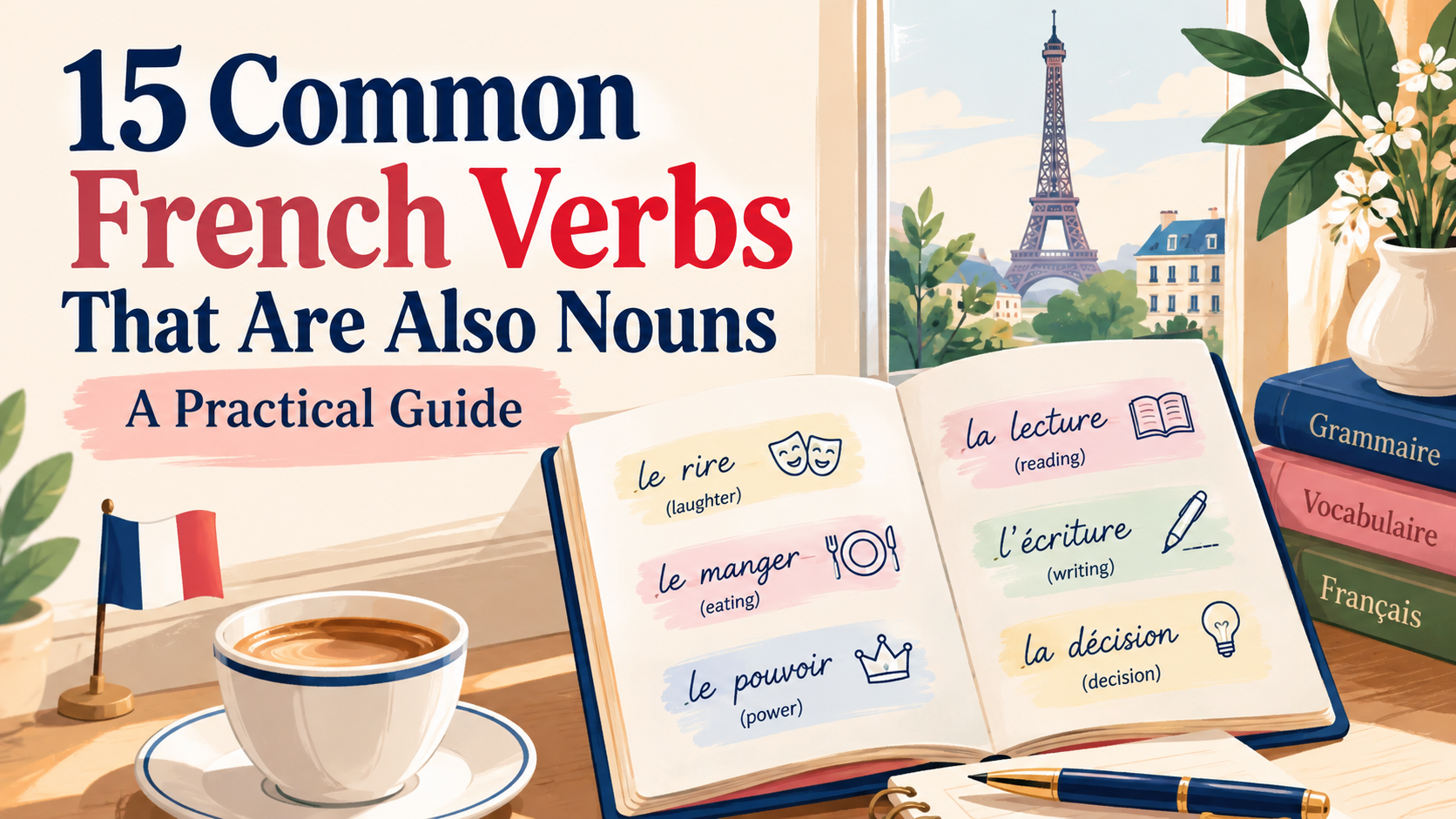
The infinitive can function as a noun in French, a point often called l’infinitif substantivé. This is incredibly useful for speaking about actions in a general or abstract way: le rire (laughter), le manger (eating, often culinary register), le vivre (the act of living, literary). You will also meet nouns that look exactly like an infinitive, such as le devoir (duty or homework) and le pouvoir (power). Some grammars treat these as lexicalized nouns rather than a bare infinitive used as a noun, but for learners the key is mastering how they behave in real sentences.
What is an infinitive noun?
An infinitive noun is an infinitive verb form used as a noun in a sentence. It can take determiners and function like a subject or object. Examples:
- Le rire est contagieux. (Laughter is contagious.)
- Le manger occupe une place importante dans la culture. (Eating occupies an important place in culture.)
- Son pouvoir augmente. (His power increases.) Here pouvoir is a noun that shares the verb’s form.
In practice, you will also find many deverbal nouns that are not identical to the infinitive, such as la lecture from lire and l’écriture from écrire. PrepFrench Classes emphasizes both patterns in our French courses, because learners see them everywhere in news articles, literature, and daily conversation.
Typical gender and pluralization rules
When the infinitive itself is used as a noun in an abstract sense, it is typically masculine and usually not pluralized, since the meaning is general: le rire, le dormir, le manger. When the language has a lexicalized noun identical to the infinitive, it follows normal noun behavior. For instance, le pouvoir has a regular plural, les pouvoirs, and le devoir has the very common plural les devoirs (homework). For deverbal nouns that change shape, endings often hint at gender: -tion and -ure are usually feminine (la décision, la lecture), -ment and -age are often masculine (le traitement, le nettoyage), while exceptions exist. Learning the article with the noun is the safest habit.
Common Deverbal Nouns vs. Infinitives
Deverbal nouns are formed from verbs, sometimes with a suffix, sometimes with a small stem change. They often differ from the infinitive in both form and meaning shift. Compare this with the bare infinitive used as a noun, which keeps the verb’s infinitive spelling. Distinguishing the two helps you choose the right register and the right article during French lessons and real-world use.
Common examples of deverbal nouns
- lire → la lecture (reading)
- écrire → l’écriture (writing)
- traduire → la traduction (translation)
- choisir → le choix (choice)
- arriver → l’arrivée (arrival)
- partir → le départ (departure)
- décider → la décision (decision)
- marcher → la marche (walking, a step, or a march)
Each noun has a specific gender and often a slightly different nuance. For example, écrire describes the action of writing, while l’écriture can refer to the activity, the product, or even handwriting. PrepFrench Classes shows you which collocations are most common with each noun, so your usage matches native patterns and not just dictionary definitions.
Semantic shifts: How meaning changes
- choisir vs. le choix: the verb is the act of choosing, the noun is the decision or option selected.
- courir vs. la course: courir is to run, la course often means running as a sport, a race, or even groceries, as in faire les courses.
- marcher vs. la marche: marcher is to walk or function, la marche can be walking as an activity, a political march, or a step on a staircase.
- écrire vs. l’écriture: écrire is to write, l’écriture can mean writing in general, a style of writing, or a script system.
Why it matters: small shifts in meaning alter article choice and collocations. This is where guided practice helps. If you want a clear path for mastering these forms and growing your vocabulary with evidence-based sequences, our courses cover deverbal nouns alongside verbs in a way that sticks.
Structured French Courses
Stop learning French the slow way.
Apps and random videos keep you stuck at beginner level forever. PrepFrench Classes gives you a structured path, a real teacher, and speaking practice that moves you forward at every lesson.
Available for: beginners · TEF/TCF exam prep · Canadian PR · work and daily French
15 Practical French Verbs That Are Also Nouns
Below is a curated list of common French verb-noun pairs. Learn them with their article and a typical use case, then practice contrasting the verb and the noun in your own sentences. This simple routine pays off in reading, listening, and conversation.
Top 5 high-frequency pairs
- choisir → le choix (choice). Example: Nous devons choisir aujourd’hui, car le choix final part demain à l’imprimerie.
- lire → la lecture (reading). Example: Ils aiment lire le soir, et la lecture les aide à se détendre.
- écrire → l’écriture (writing, handwriting). Example: J’adore écrire des lettres, et l’écriture manuscrite a plus d’impact.
- travailler → le travail (work). Example: Elle travaille chez Airbus, et son travail lui plaît.
- décider → la décision (decision). Example: Il décide vite, mais la décision appartient au comité.
Use cases for each pair
- arriver → l’arrivée (arrival, f): Le train arrive à 18 h. L’arrivée est prévue voie B.
- partir → le départ (departure, m): Nous partons à midi. Le départ officiel est à 12 h 15.
- traduire → la traduction (translation, f): Elle traduit des romans. La traduction exige de la précision.
- découvrir → la découverte (discovery, f): Ils découvrent une nouvelle molécule. La découverte pourrait sauver des vies.
- courir → la course (running, race, f): Je cours tous les matins. La course de 10 km commence à 9 h.
- aider → l’aide (help, f): Il aide souvent ses voisins. L’aide de la mairie est disponible.
- jouer → le jeu (game, play, m): Les enfants jouent au parc. Le jeu favorise la créativité.
- retourner → le retour (return, m): Nous retournons à Paris dimanche. Le retour se fera en train.
- rire → le rire (laughter, m, infinitive used as noun): Ils rient beaucoup. Le rire réduit le stress.
- marcher → la marche (walking, march, step, f): Elle marche 10 000 pas par jour. La marche est bonne pour la santé.
Pro tip: memorize each pair with one natural collocation. For example, la décision finale, un choix stratégique, la traduction automatique, l’arrivée en gare. This gives you ready-to-use chunks that make sentences flow. In our online French classes, we build these pairs into speaking prompts so you can switch between the verb and the noun quickly.
Common Pitfalls and Pro Tips
Common mistakes and how to avoid them
- Gender mix-ups: Saying “le décision” instead of “la décision”. Solution: learn the article with the noun and group by suffix family, for instance -tion, -sion, -ure often feminine.
- Using the verb where a noun fits: “La courir est difficile.” Correct: “La course est difficile.” Choose the set noun when it exists and is common.
- Overusing the infinitive noun: “Le marcher est bon” sounds odd. Prefer “La marche est bonne” or “Marcher est bon pour la santé” without the article when using the infinitive as subject.
- Pluralization errors: Many abstract deverbal nouns stay uncountable. “Des lectures intéressantes” is fine, but “des décisions” and “des choix” are countable while “l’aide” usually is not plural in the sense of assistance.
- Register mismatch: “Le manger” is stylistically marked, often culinary or literary. In daily speech, choose “la nourriture” for food or “manger” as a verb.
Practical tips for mastering these forms
- Pair them: always study “verb + noun + one collocation” together, for example “décider, la décision, la décision finale”.
- Sort by suffix families: -tion, -ure, -age, -ment, -ée. This creates strong gender memory.
- Collect contrasts: write one sentence with the verb, one with the noun. Repeat with 5 pairs a week.
- Listen for headlines: news and signage love deverbal nouns, like “Arrivée”, “Départ”, “Traduction”, “Écriture inclusive”.
- Get feedback: a French teacher will refine your collocations quickly, especially for tricky pairs. See available paths in our French courses.
Compound Nouns and Their Pluralization
French builds many compound nouns from a verb plus another element. Pluralization depends on the structure. A few practical patterns cover most everyday words.
Examples of common French compound nouns
| Compound noun | Literal parts | Meaning | Plural form | Notes |
|---|---|---|---|---|
| un aller-retour | aller + retour | round trip | des allers-retours | Both nouns usually pluralize. |
| un savoir-faire | savoir + faire | know-how, skill set | des savoir-faire | Often treated as invariable. |
| un ouvre-bouteille | ouvre + bouteille | bottle opener | des ouvre-bouteilles | Verb part stays invariable, noun pluralizes. |
| un tire-bouchon | tire + bouchon | corkscrew | des tire-bouchons | Same pattern as above. |
| un porte-monnaie | porte + monnaie | wallet, coin purse | des porte-monnaie | Often invariable in the plural. |
Tips for pluralizing compound nouns effectively
- Verb + noun compounds: the verb element is invariable, the noun typically takes the plural, for example des ouvre-bouteilles.
- Noun + noun compounds linked by a hyphen: both may pluralize, for example des allers-retours, though some remain invariable by convention.
- If in doubt, check a reputable dictionary and then memorize the pattern with a sample sentence.
PrepFrench integrates these tricky forms into communicative tasks, so you practice them in context instead of memorizing rules in isolation. Explore how we structure this inside our French language classes.
Practice Exercises: Try It Now!
Fill-in-the-blank exercise instructions
For each sentence, choose the correct form, verb or noun. Write the full sentence.
- Ils vont ______ chaque soir, et ______ du soir les aide à dormir. (lire / la lecture)
- Nous devons ______ avant que ______ officielle soit annoncée. (décider / la décision)
- Elle aime ______, mais ______ de son médecin n’est pas très lisible. (écrire / l’écriture)
- Ils vont ______ à 7 h, et ______ aura lieu à 7 h 15. (partir / le départ)
- Tout le monde ______ quand la blague est bonne, car ______ est communicatif. (rire / le rire)
Answer key
- Ils vont lire chaque soir, et la lecture du soir les aide à dormir.
- Nous devons décider avant que la décision officielle soit annoncée.
- Elle aime écrire, mais l’écriture de son médecin n’est pas très lisible.
- Ils vont partir à 7 h, et le départ aura lieu à 7 h 15.
- Tout le monde rit quand la blague est bonne, car le rire est communicatif.
If you want feedback on your answers or extra practice with custom drills, send us a quick message through our Contact / Free Demo page. We will help you refine your usage and build speed.
PrepFrench Classes
Ready to start French with a clear plan?
Book a FREE demo class and get a personalized roadmap for your level, goal, and timeline. No pressure, no obligation.
Explore courses:
All French Courses · Full TCF Canada Course · Full TEF Canada Course
Conclusion: Turn Verb-Noun Pairs into Everyday Power
French nominalization is a clear advantage once you spot the patterns. You learned how the infinitive can function as a noun, how deverbal nouns differ, and why gender matters for clarity. The 15 French verb-noun pairs above are a compact toolbox for reading the news, writing emails, and sounding natural in conversation. Avoid the common pitfalls by memorizing articles, collocations, and the most frequent compounds with their pluralization. If you want consistent progress, structured French lessons with PrepFrench Classes are a reliable next step to refine your understanding and build confident speaking.
✅ Next Step: Book a free demo class with PrepFrench Classes and start learning French the right way.
Keep your list of pairs handy for a week. Use two pairs each day in short sentences, one with the verb and one with the noun. Small, consistent practice wins.
FAQ
What does “infinitive as a noun” mean in French?
The infinitive can function as a noun in French, often called l’infinitif substantivé. It lets you talk about actions abstractly, for example: le rire (laughter), le manger (eating). In many cases the form is masculine and used without a plural. You will also see nouns that look identical to the infinitive, like le devoir or le pouvoir, which are standard nouns with regular plural forms. In PrepFrench Classes, we teach when to prefer the infinitive as a noun and when to choose a deverbal noun such as la lecture or l’écriture during real speaking activities.
Can the infinitive be pluralized in French?
When the bare infinitive is used as a noun in its abstract sense, it is usually not pluralized, for example le rire, le dormir. However, some nouns that share the infinitive’s spelling are regular, lexicalized nouns and can take a plural: le devoir → les devoirs, le pouvoir → les pouvoirs. The distinction is practical, not just theoretical. In our online French classes, we highlight common expressions, so you know which forms are countable, which are mass nouns, and which are stylistically marked in everyday French.
What are some examples of verb-noun pairs in French?
Useful pairs include: lire → la lecture, écrire → l’écriture, choisir → le choix, décider → la décision, arriver → l’arrivée, partir → le départ, traduire → la traduction, découvrir → la découverte, courir → la course, aider → l’aide, jouer → le jeu, travailler → le travail, retourner → le retour, rire → le rire, marcher → la marche. Learn each with its article and one collocation, for example la décision finale or la course de 10 km. A structured French course helps you practice these in real sentences for fast recall.
How do I know the gender of nouns derived from verbs?
Suffix clues are your friend. Common endings like -tion, -sion, -ure, -ée are often feminine, while -age and -ment are often masculine. There are exceptions, so memorize each noun with its article and a short phrase: la traduction technique, le traitement rapide, la lecture du soir. Over time you will recognize families by sight and sound. If you study with a French tutor at PrepFrench, your teacher will group vocabulary by pattern and help you build robust gender memory with targeted drills.
What are the common mistakes with French verbs that are also nouns?
Frequent issues include gender errors (le décision instead of la décision), using an infinitive noun where a lexicalized noun is standard (le marcher instead of la marche), and pluralizing mass nouns incorrectly. Another pitfall is ignoring register, for example overusing le manger in casual speech where la nourriture or simply manger is better. The fix: learn pairs with collocations, practice verb versus noun contrasts, and get feedback in French lessons. PrepFrench courses build these steps into interactive tasks, so correct usage becomes automatic.
Written by
Platform Administrator
Practical ideas from the Prep French team for learners building confidence, preparing for exams, and planning their next step in Canada.
Join the discussion
Leave a thoughtful comment.
Your email address will not be published. Comments are reviewed before appearing.