Understanding Iconic Masterpieces: Historical Significance & Culture
Why do some images feel familiar even when you have never stood before them in a museum? This guide explores iconic masterpieces and their historical significance, showing how innovation, power, belief, and circulation converge to shape what the world calls “great art.” By the end, you will have a practical framework to read famous artworks and their meaning, beyond first impressions. We will look at case studies from different cultures and eras, consider why famous paintings are famous, and learn how cultural significance grows over time. If you love French art in particular, learning the French language can deepen cultural comprehension, help you decode labels and catalogues, and connect ideas across history. For an easy next step, you can always return to the PrepFrench Home page for more cultural learning tips and structured language support.
Free First Step
Take the guesswork out of learning French.
Not sure where to begin, which course fits your goal, or how long it will take? Book a free demo class with PrepFrench Classes and get a personalized plan built around your level, schedule, and goals.
What Makes an Artwork Iconic?
Across cultures, certain objects rise above their time and place. They become shared reference points for identity, memory, and taste. What makes iconic artworks so enduring is rarely one trait. It is a powerful mix: originality, technique, emotion, representation of a culture, and the ways those images travel through time. To study cultural significance, we should look at both the artwork and the networks that keep it alive: patrons, museums, media, and viewers.
Below are common characteristics that contribute to icon status. As you read, think of examples: Leonardo da Vinci’s Mona Lisa, Hokusai’s The Great Wave off Kanagawa, Pablo Picasso’s Guernica, or Jan van Eyck’s Arnolfini Portrait. If you want structured learning support, our French courses also include modules that help you recognize French art terms, read labels, and hold a confident conversation about art in French.
- Innovation: Introduces a new technique or idea that shifts later art. Example: oil glazing in the Northern Renaissance or Cubist fragmentation.
- Technical mastery: Exceptional control of materials, composition, and light that artists study for generations.
- Emotional resonance: Viewers feel awe, grief, joy, or curiosity that lasts beyond fashion cycles.
- Cultural representation: Encodes values, beliefs, or anxieties of a community, city, or nation.
- Reproducibility and reach: Prints, posters, textbooks, memes, and museum shows that multiply the audience.
- Historical timing: Art that meets a social turning point, then becomes a symbol of it.
- Conservation and visibility: Museums, careful restoration, and strategic display keep the work in public view.
Innovative Techniques
Innovation can be visible, like a new pigment or printing method, or conceptual, like a radical composition. Hokusai’s use of Prussian blue in woodblock prints changed color possibilities in Japan. Leonardo’s sfumato blended tones without hard outlines, creating realistic softness on skin. When you spot a technique that later artists adopt, you are likely looking at a seed of icon status.
Emotional Resonance
Emotion glues memory to image. Viewers return to works that make them feel. Think of the silent tension in Vermeer’s interiors or the piercing grief in Picasso’s Guernica. An iconic work often speaks to private feelings and public history at the same time.
Cultural Representation
Artworks carry identity. The Great Wave has traveled as a sign of Japanese aesthetics, nature’s power, and global exchange. The Arnolfini Portrait carries layers of mercantile ambition, marriage customs, and spiritual belief. In PrepFrench Classes, our teachers build French art terms into conversation practice, which helps you name these layers precisely during museum visits or online tours.
Analyzing Iconic Masterpieces and Their Historical Significance: A Framework
To understand why famous paintings are famous, study them through five complementary lenses. This analysis framework helps you move from raw admiration to informed insight, which is the heart of art history masterpieces study. We will return to these lenses in the case studies below.
- Innovation and technique: What is new here? How does the artist handle materials, light, space, or color?
- Patronage and power: Who paid for this work, and why? What social class or political force is reflected?
- Religion and politics: Which beliefs, conflicts, or ideologies shape its content or reception?
- Circulation and reproduction: How did prints, photographs, textbooks, media, or memes spread the image?
- Conservation and exhibition: Where was it displayed, how was it protected or restored, and how visible is it today?
You can practice this framework in any museum. Switch languages if you can. Reading a French wall label at the Louvre or Musée d’Orsay is a meaningful step toward deeper cultural comprehension. Our online French classes often incorporate authentic museum texts so you develop vocabulary and confidence in real contexts.
The Role of Patronage
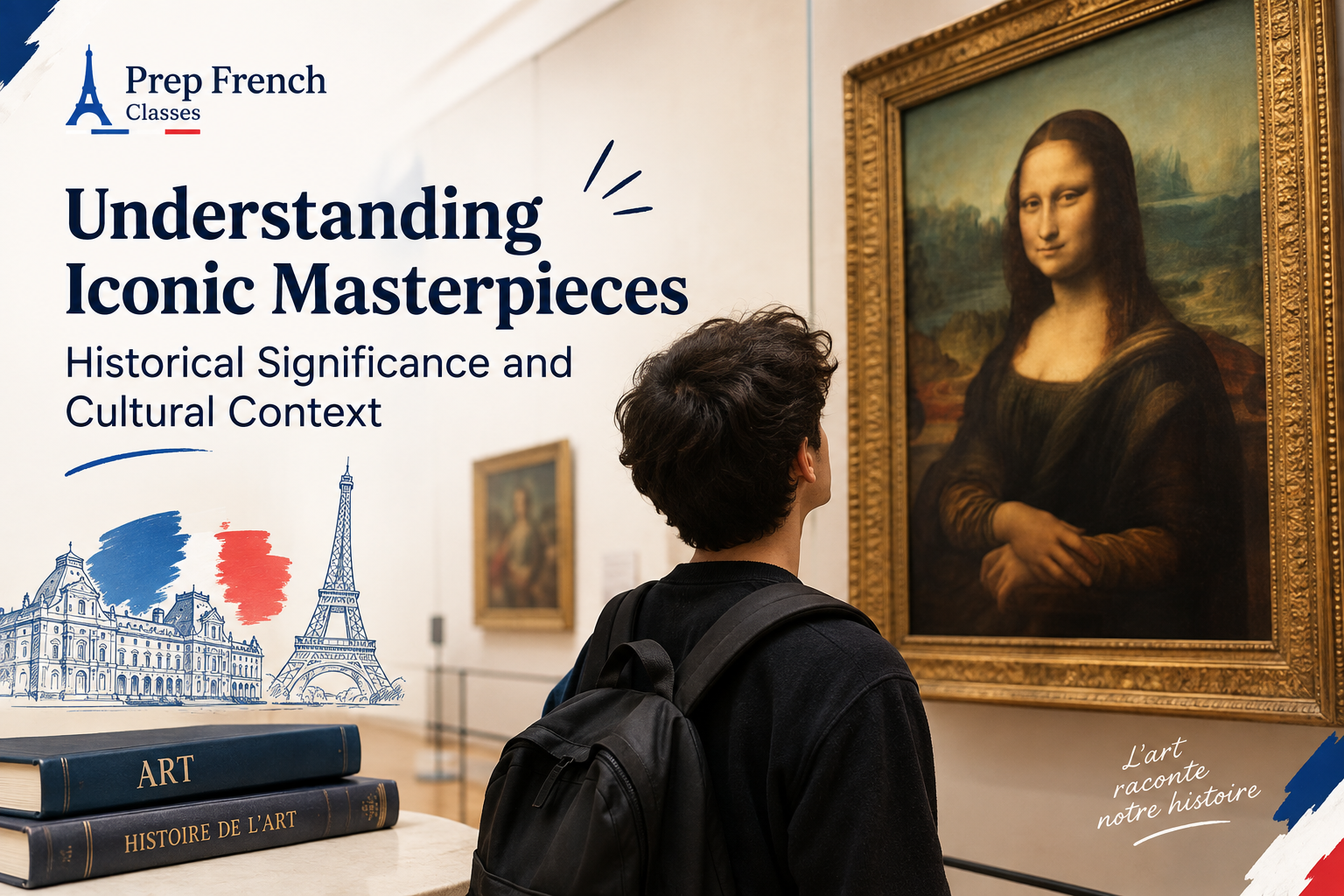
Patronage shapes content and ambition. The Mona Lisa, known in French as La Joconde, likely began as a private commission. Royal collections later amplified its status, and the French state ultimately made it public at the Louvre. Across history, patrons have used art to signal power, piety, and prestige. Track the journey from commissioning to public display if you want to understand long-term influence.
Political Context and Art
Picasso’s Guernica is a direct response to the 1937 bombing of a Basque town. It moved from political indictment to universal antiwar symbol because its abstracted grief travels across languages and regimes. When you analyze art, ask which events or ideologies form the backdrop, then observe how those forces appear in symbols, gestures, and choices of scale.
Techniques that Changed Art
Some techniques open a new visual vocabulary. Oil glazing unlocked realistic textures in the fifteenth century. Japanese ukiyo-e prints revolutionized Western perspectives on cropping and flat color in the nineteenth century, influencing Impressionists and Post-Impressionists. A small technical change often has vast ripple effects, and that ripple is one reason certain works turn iconic.
If you would like a teacher to guide you through this framework in French, you can always reach out for a free consultation on our Contact page. A focused French course makes museum texts and critical essays much easier to enjoy.
Structured French Courses
Stop learning French the slow way.
Apps and random videos keep you stuck at beginner level forever. PrepFrench Classes gives you a structured path, a real teacher, and speaking practice that moves you forward at every lesson.
Available for: beginners · TEF/TCF exam prep · Canadian PR · work and daily French
Case Studies: Iconic Artworks in Diverse Contexts
Let’s apply the framework to several masterpieces from different cultures. Each short study uses the five lenses, showing how historical context and technique combine to create lasting significance. Where relevant, you will also see a few useful French terms in parentheses to support museum reading during your French lessons.
Mona Lisa: Renaissance and Beyond
Innovation and technique: Leonardo’s sfumato softens edges and models form with delicate tonal shifts. Patronage and power: likely a private commission, later absorbed into royal and then national collections in France. Religion and politics: not overtly religious, yet steeped in humanist ideals of the Renaissance. Circulation and reproduction: engravings, posters, newspapers, and especially the 1911 theft made La Joconde a global media sensation. Conservation and exhibition: permanent display at the Louvre gives unmatched visibility. Together, these forces made the Mona Lisa a symbol of art itself.
Guernica: A Response to War
Innovation and technique: Cubist fragmentation compresses time and space to convey violence. Patronage and power: commissioned for the Spanish Pavilion at the 1937 Paris World’s Fair, then traveled widely. Religion and politics: it is political art, a protest against the bombing of Guernica. Circulation and reproduction: photographs and touring exhibitions multiplied its audience. Conservation and exhibition: now at the Museo Reina Sofía in Madrid, where it anchors collective memory. Guernica’s harsh grays and shattered forms turned a specific atrocity into a universal indictment of war, or in French, an oeuvre engagée (socially engaged work).
The Great Wave: Nature and Balance
Innovation and technique: Prussian blue pigment and masterful woodblock printing. Patronage and power: popular prints sold to a broad public, reflecting changing urban markets in Edo Japan. Religion and politics: indirect, through Shinto-inflected respect for nature and the realities of a seafaring society. Circulation and reproduction: prints were made for wide distribution, then inspired European artists. Conservation and exhibition: museums worldwide elevate a once-popular print to master status. The result is a visual shorthand for Japan’s cultural poise and the ocean’s sublime force.
Starry Night: Inner Vision on the Canvas
Innovation and technique: Van Gogh’s thick impasto and swirling rhythms turn the sky into movement. Patronage and power: produced in modest conditions without powerful patrons, later embraced by museums. Religion and politics: personal spirituality rather than dogmatic religion. Circulation and reproduction: prints, calendars, and education materials carried it everywhere. Conservation and exhibition: the Museum of Modern Art in New York gives iconic visibility. Starry Night shows how an individual’s inner life can become a shared language across cultures.
The Arnolfini Portrait: Wealth, Ritual, and Seeing
Innovation and technique: oil glazing by Jan van Eyck delivers glass-like surfaces and microscopic detail. Patronage and power: celebrates mercantile status. Religion and politics: symbols of faith and marriage customs quietly structure the room. Circulation and reproduction: art history textbooks and museum guides made it a key early modern work. Conservation and exhibition: The National Gallery, London ensures public access. The convex mirror invites us into the image, a reminder that art often stages a performance of looking, or in French, le regard (the gaze).
Benin Bronzes: Power, Craft, and Repatriation Debates
Innovation and technique: sophisticated brass casting with intricate relief. Patronage and power: royal court of the Kingdom of Benin used these works as palace decorations and records of history. Religion and politics: anchored in beliefs and royal cults, later entangled in colonial looting. Circulation and reproduction: held across European and American museums after colonial seizures. Conservation and exhibition: international displays built fame, while current repatriation efforts reshape narratives. Their story shows how museum histories and ethics contribute to what the world hails as “masterpieces.”
Las Meninas: Painting, Power, and Perception
Innovation and technique: Velázquez layers realities, placing himself in the act of painting. Patronage and power: Spanish royal court portrait that visualizes hierarchy and intimacy. Religion and politics: court culture, etiquette, and sovereignty frame the scene. Circulation and reproduction: studied by artists for centuries, reproduced in countless books. Conservation and exhibition: The Prado’s stewardship cements its centrality. The work anticipates modern questions about who is seen and who sees, which many museum labels in France summarize as mise en abyme (a picture within a picture).
The Persistence of Memory: Time That Melts
Innovation and technique: Dalí’s hyperreal technique applies to dreamlike objects. Patronage and power: early twentieth century patrons and galleries propelled Surrealism. Religion and politics: explores the psyche more than politics. Circulation and reproduction: the melting clock became an icon in pop culture. Conservation and exhibition: MoMA ensures massive visibility. The image shows how a single, unforgettable motif can carry philosophical weight across generations.
The Role of Museums and Media in Art Fame
Iconic status is never only about the studio. Museums, media, and public events carry artworks into common memory. Here are key forces that shape reputations, including dramatic moments that changed how we view cultural treasures. If you want to build vocabulary for museum visits in France, our French classes include practical museum language, from cartel (label) to prêt (loan).
Famous Thefts and Their Impact
- 1911 theft of the Mona Lisa: Global headlines turned a Renaissance portrait into a modern celebrity.
- The Scream thefts: Multiple thefts in the 1990s and 2000s sparked new media coverage and conservation awareness.
- Isabella Stewart Gardner heist (1990): Empty frames became symbols of cultural loss, raising questions about security and provenance.
Exhibition Practices
- Blockbuster shows: Themed exhibitions generate long lines, heavy press, and a snowball effect of fame.
- Global loans: When star pieces tour, audiences grow and new contexts appear.
- Curatorial framing: Wall texts and layouts guide interpretation, shaping collective understanding of meaning and value.
The Influence of Media
- Reproduction technologies: Printing, photography, and now high-resolution imaging expand access.
- Education: Textbooks and online courses stabilize a “canon” that many revisit.
- Social media: Memes and viral moments keep icons present for new generations, sometimes altering meaning in the process.
If museum culture intrigues you, structured language learning can make it more rewarding. The right French course lets you read catalogues and exhibition essays without always switching to translations.
A Beginner’s Toolkit for Art Analysis
Use this simple process to approach any artwork with confidence. The more you practice, the more fluent your eye becomes. You can even do this in French for extra challenge, then check vocabulary with your PrepFrench teacher.
How to Analyze a Painting in 5 Steps
- Look slowly: Spend at least 60 seconds observing before reading the label. Note composition, color, light, and focal points.
- Describe, then interpret: Say what you see first, then propose meanings. Separate observation from opinion.
- Apply the five lenses: Technique, patronage, religion or politics, circulation, and conservation or display.
- Context check: Read the label or catalogue. If it is in French, underline unfamiliar terms and ask your French teacher later.
- Compare and connect: Link the work to others from the same era or theme. Look for influence and dialogue across time.
Essential Art Terms (with French translations)
- Medium: technique or médium
- Oil on canvas: huile sur toile
- Woodcut or woodblock print: gravure sur bois
- Composition: composition
- Light and shadow: clair-obscur
- Iconography: iconographie
- Label: cartel
- On loan: en prêt
- Provenance: provenance
Building this vocabulary in your French lessons helps you move from passive viewing to active conversation. Explore our Courses to find a French class that pairs language growth with cultural content.
Cultural Learning in a Global Context
Art thrives on exchange. You can explore masterpieces from anywhere with digital collections, virtual tours, and open-access images. Pair these with consistent language practice so you can enjoy French catalogues, audio guides, and museum signage with ease.
Recommended Virtual Art Tours
- Musée du Louvre Online Tours
- Google Arts & Culture for high-resolution images and guided exhibits
- Musée d’Orsay collection highlights and resources
- The Met online features and timelines
Online Resources for Art Lovers
- Museum blogs, conservator notes, and open-access catalogues
- Short lecture series and MOOCs on art history
- Podcast interviews with curators and artists
Visiting Museums in France
If you plan a museum trip to France, prepare a small phrasebook of art terms and practice directions or questions with a French tutor. PrepFrench Classes can design a mini French course that targets museum interactions, from ticket counters to guided tours, so your visit runs smoothly and your conversations feel natural.
PrepFrench Classes
Ready to start French with a clear plan?
Book a FREE demo class and get a personalized roadmap for your level, goal, and timeline. No pressure, no obligation.
Explore courses:
All French Courses · Full TCF Canada Course · Full TEF Canada Course
Conclusion: Why Historical Significance Matters
Iconic masterpieces become shared language. They knit people across borders through images that hold memory, technique, and belief at once. When you analyze famous artworks and their meaning with a clear framework, you see more. You notice how innovation meets power, how politics and religion shape symbols, how reproductions build audiences, and how conservation chooses what survives. The case studies above show that “why are famous paintings famous” is really a story of networks across time.
Keep exploring: read in multiple languages, visit museums in person and online, and talk with others. If you want to strengthen your cultural exploration in French, PrepFrench Classes can guide you. Our French courses blend language, culture, and practical skills for travel, study, or work. Master the vocabulary, ask sharper questions, and enjoy art on its own terms in the language of its labels and archives.
FAQ
What makes an artwork “iconic,” and how is that different from “popular”?
“Iconic” suggests enduring cultural significance, not just short-term attention. An iconic work changes how later artists think, carries symbolic weight for a community, and remains visible across generations through museums, education, and media. “Popular” can be immediate and fleeting. A viral image may be popular today, but if it does not influence technique, meaning, or institutions, it may not become iconic. Learning art vocabulary through French classes helps you recognize museum terms used to explain why a piece has lasting value rather than momentary fame.
How do historical events shape the meaning of artworks?
Historical context reframes images. Guernica reads as a universal antiwar statement because it answered a specific 1937 atrocity. The Great Wave gained new meanings as Japan modernized and globalized. Political shifts, religious reforms, or scientific advances influence what artists portray and how audiences interpret it. When you learn French, you can read original catalogues and essays from French museums, which often trace these links between events and imagery. A structured French course makes those texts more accessible and rewarding.
How can I analyze a painting’s historical significance in simple steps?
Start with observation, then apply five lenses: technique, patronage, religion or politics, circulation, and conservation or display. Ask: What was new here? Who paid for it and why? Which beliefs or debates shape it? How did reproductions or exhibitions spread it? Where can I see it now? These questions reveal a work’s cultural significance. If you want feedback on your analysis in French, consider an online French class with PrepFrench. You will gain the vocabulary to read wall labels and discuss your ideas clearly.
Why are some masterpieces so small yet so famous?
Size does not determine impact. A small painting can transform technique, capture public imagination through media, or mark a political moment. The Mona Lisa is modest in scale, yet its innovation, theft history, and Louvre display make it globally known. Reproductions, postcards, and textbooks reinforce recognition. With the right French vocabulary from PrepFrench lessons, you can decode labels that explain how even tiny works achieved large cultural reach through circulation and exhibition strategies.
How do museums protect and conserve fragile masterpieces?
Museums combine preventive care and active treatment. They control temperature, humidity, and light, use archival materials, and stabilize objects with reversible methods. Conservators document every intervention. High-value pieces often have protective glazing and careful display schedules. When you visit museums in France, you will see terms like conservation, restauration, and conditions climatiques on labels and audio guides. A focused French course helps you understand these details so you can appreciate what it takes to keep masterpieces visible for the future.
✅ Next Step: Book a free demo class with PrepFrench Classes and start learning French the right way.
Art and culture are always evolving. Keep returning to these frameworks as new exhibitions, research, and technologies reveal more about the images we share.
Written by
Platform Administrator
Practical ideas from the Prep French team for learners building confidence, preparing for exams, and planning their next step in Canada.
Join the discussion
Leave a thoughtful comment.
Your email address will not be published. Comments are reviewed before appearing.