TEF Canada Registration 2026: Steps, Documents and Fees
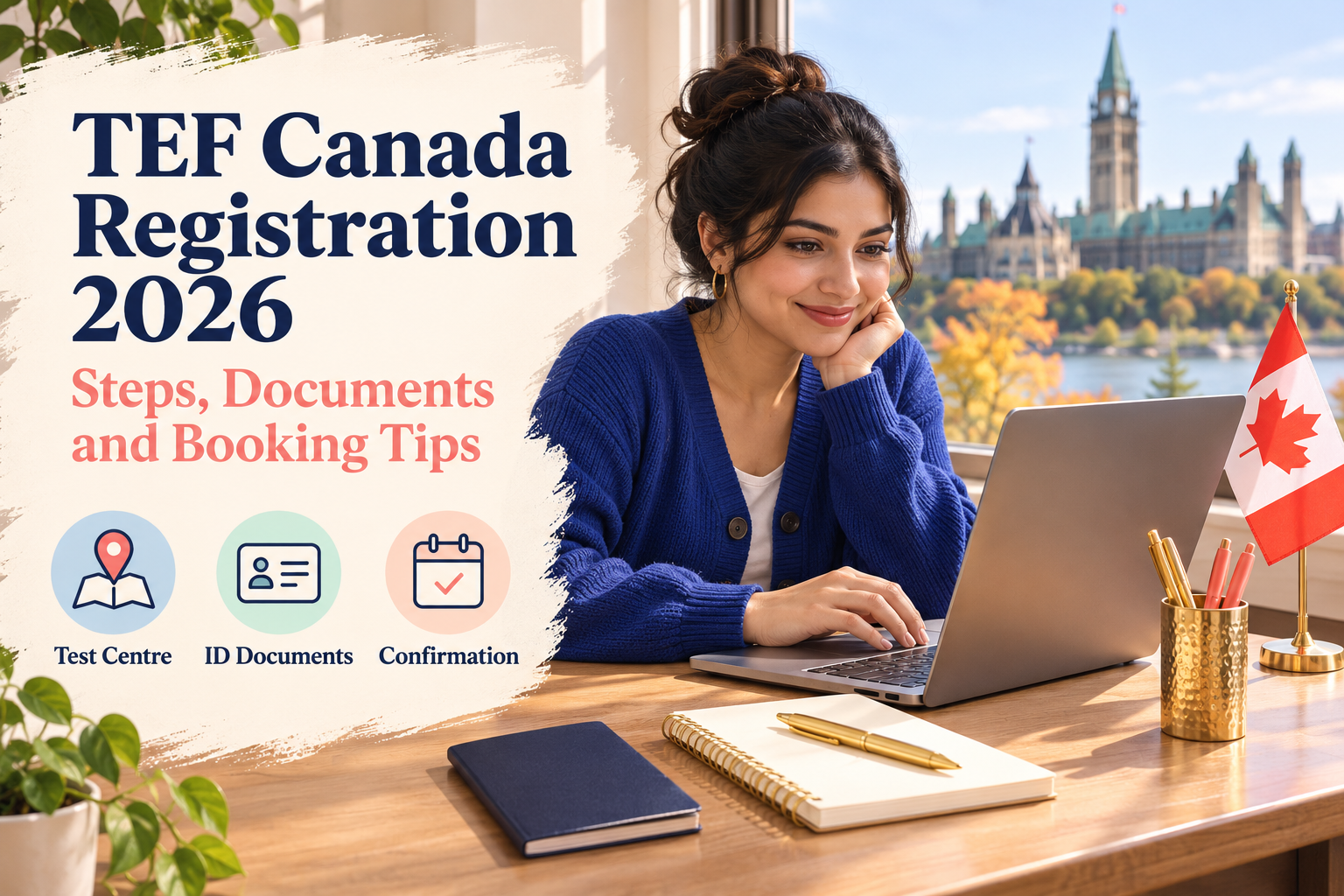
If you plan to prove your French proficiency for Canadian immigration in 2026, TEF Canada is one of the most widely accepted options. This guide explains the full TEF Canada registration process for 2026, from finding test centers to paying fees and choosing exam dates. You will also learn which TEF Canada modules are required for immigration, what documents you must prepare, and how to avoid common mistakes that can delay your application. Throughout, we will point to official resources and share practical tips used by PrepFrench students in our Full TEF Canada Course. Whether you need a refresher through structured French classes or a complete exam strategy, this article will help you register on time and show up confident on exam day.
Free First Step
Take the guesswork out of learning French.
Not sure where to begin, which course fits your goal, or how long it will take? Book a free demo class with PrepFrench Classes and get a personalized plan built around your level, schedule, and goals.
What is TEF Canada?
TEF Canada is an international test that certifies your level of French for Canadian immigration and citizenship applications. It is administered by the Chambre de commerce et d’industrie de Paris Ile-de-France (Le français des affaires). Immigration authorities evaluate your results using Canadian Language Benchmarks (CLB) or Niveaux de compétence linguistique canadiens (NCLC). For most immigration pathways, the four language skills are required: listening, reading, speaking, and writing.
Components of TEF Canada
For immigration, you must typically register for all four mandatory modules:
- Compréhension de l’oral (Listening)
- Compréhension de l’écrit (Reading)
- Expression orale (Speaking)
- Expression écrite (Writing)
There is also a Lexique et structure component in some TEF formats, but TEF Canada for immigration focuses on the four skills above. Always verify with your chosen test center to ensure you are booking the correct TEF Canada package that includes all modules needed for your application.
Who needs TEF Canada?
TEF Canada is accepted for Express Entry programs, several Provincial Nominee Programs, Quebec programs when specified, and for Canadian citizenship language proof. If your aim is Canadian PR, the TEF Canada exam can significantly improve your Comprehensive Ranking System (CRS) score when you target CLB 7 or above across modules. If you need structured preparation in a focused timeline, PrepFrench’s Full TEF Canada Course is designed to build the skills and strategies you need, with live French lessons and practice feedback that mirrors the real test.
TEF Canada Registration Steps for 2026
The TEF Canada registration process is handled by authorized centers worldwide. While the official test standards are centralized, your booking, fees, and exam dates are managed locally. Follow these steps to secure your 2026 test date without surprises.
- Confirm you need TEF Canada: For immigration, you must register for the four-module package. If your program accepts TCF Canada as well, compare schedules and locations. PrepFrench also offers targeted TCF Canada preparation if that is a better fit for your timeline.
- Find an authorized test center: Use the official TEF center directory on Le français des affaires to search by country and city. Shortlist two or three centers in case your first choice is full.
- Check upcoming TEF Canada exam dates: Dates are posted by each center, often one to four sessions per month in major cities. Book early, especially if you aim for CLB 7 or higher by a specific immigration deadline.
- Prepare your ID and details: Your registration name must match your primary ID exactly. Most centers require a valid passport. Gather contact details and a recent photo if requested.
- Complete the online application: Many centers offer online booking forms. Others accept in-person registration. Select TEF Canada and the four modules, then choose your time slot if offered.
- Pay the TEF Canada fees: Payment methods vary by center. You may pay online by card, bank transfer, or in person. Keep the receipt for your records.
- Watch for confirmation: You should receive a confirmation email with your registration number, exam address, reporting time, and rules. Contact the center if you do not receive confirmation within a few business days.
- Plan a study timeline: Most candidates need 6 to 12 weeks of focused practice to move up a band. Structured French courses with a teacher are much more efficient than scattered self-study.
Finding Approved TEF Centers
Use the official directory from Le français des affaires to verify approved centers in your city or nearby regions. If your city has limited seats, consider booking in a neighboring city with better availability. Always check recent reviews and ask the center about typical waiting times, test format used on site, and average time to receive results.
How to Choose Your Test Date
Pick a date that gives you enough time for targeted preparation. For CLB 7 or above, plan backward from your immigration deadline. Schedule diagnostic practice early and book the test once you see consistent practice scores near your goal. Avoid last-minute registrations if possible. Popular centers can fill up 3 to 6 weeks in advance, sometimes more during peak seasons.
What to Expect During Registration
Most centers will ask for:
- Your full legal name as it appears on your passport
- Date of birth and contact details
- A recent passport-style photo if required by the center
- Module selection: ensure TEF Canada, all four skills
- Preferred test date or session choice
- Immediate payment or proof of upcoming bank transfer
Registration is complete only after you receive a formal confirmation. If anything looks incorrect, such as a name spelling or a missing module, contact the center immediately so they can correct it before the test day. PrepFrench students receive a registration checklist and live guidance to make this part simple and accurate.
Structured French Courses
Stop learning French the slow way.
Apps and random videos keep you stuck at beginner level forever. PrepFrench Classes gives you a structured path, a real teacher, and speaking practice that moves you forward at every lesson.
Available for: beginners · TEF/TCF exam prep · Canadian PR · work and daily French
Required Documents and ID
Accurate identification is critical for TEF Canada registration. Name or ID issues are the top reason candidates face delays or get turned away on exam day. Plan ahead and use the same valid ID from registration through test day.
ID Requirements for Registration
Check with your local center, but in most countries the following are accepted:
- Valid passport (most widely accepted, strongly recommended)
- National ID card with photo and signature, if recognized in your country
- Canadian Permanent Resident card or driver’s license may be accepted in Canada, but confirm with the center
Key rules to remember:
- Your registration name must match your ID exactly, including full legal names and sequence.
- Bring the same original ID to the test that you used for registration, not a photocopy or expired document.
- For any name change, bring official proof, such as a marriage certificate, if the center requests it.
Common Issues with Documentation
- Name mismatch across documents: Use your passport as your single source of truth. Update the booking if you notice a spelling or order difference.
- Expired or soon-to-expire ID: Renew your ID before registering, or use a different valid document approved by the center.
- Using a nickname or initials: Avoid abbreviations. Register with your full legal name exactly as printed on your passport.
- Photo requirements not met: If the center requests a photo, follow the exact size and background rules to prevent delays.
PrepFrench students receive a simple ID checklist and a quick review before registering, which removes most avoidable errors. If you are unsure about your documents, contact your center directly or message us via the PrepFrench contact page.
Fees, Timelines, and Policies
TEF Canada fees are set by local centers and vary by country and currency. Registration opens on a rolling basis, and seats are first come, first served. Below is a helpful overview of how fees and timelines usually work, with a sample comparison across regions. Always verify the latest details with your chosen center.
TEF Canada Fee Breakdown
Most centers charge a package fee that includes all four modules required for immigration. Some may also list per-module prices if you need to retake a specific skill. Expect additional charges for rescheduling or late changes.
| Region or City (example) | Typical Package | Indicative Fee Range | Notes |
|---|---|---|---|
| Toronto or Vancouver | All 4 modules | CAD 350 to 450 | Prices vary by center and format. Check local policy for rescheduling fees. |
| Montreal or Ottawa | All 4 modules | CAD 320 to 430 | French demand is high. Book several weeks in advance. |
| Paris or Lyon | All 4 modules | EUR 240 to 320 | Fees can be slightly lower in university centers. |
| Dubai or Abu Dhabi | All 4 modules | AED 1100 to 1600 | Slots can fill quickly in peak months. Confirm payment options. |
| New Delhi, Mumbai, or Bengaluru | All 4 modules | INR 12,000 to 25,000 | Range depends on center and tax. Verify final price before paying. |
| Lagos or Abuja | All 4 modules | NGN 120,000 to 210,000 | Currency fluctuations affect fees. Check the current exchange rate. |
These are indicative ranges only. Your exact TEF Canada fees will depend on the center, local taxes, and whether you choose add-ons such as express results shipping. Always confirm the latest price and policies directly with the center before you pay.
Expected Timelines for Registration and Results
- Booking window: 3 to 8 weeks before your target date is typical. Some centers open multiple sessions per month.
- Confirmation email: Usually within 1 to 5 business days after payment is processed.
- Results timeline: Often 10 to 15 business days for electronic processing, sometimes up to 2 to 4 weeks depending on volume and center workflow.
- Document validity: TEF Canada results are valid for 2 years from the test date for immigration purposes.
For the most current testing policies, refer to the official TEF Canada page on Le français des affaires: official TEF Canada information.
Special Considerations and Common Issues
TEF Canada registration is straightforward when your documents and modules are correct. The following pitfalls are common, especially for first-time test takers. Here is how to handle them quickly.
Handling Name Mismatches
- Use your passport as the reference: Align all registration fields with your passport exactly, including middle names.
- Accents and diacritics: If your passport shows accented characters, ask the center how to enter them in the registration form. Consistency is key.
- Legal changes: If your name changed, notify the center before test day and provide the official document requested.
Accommodations for Disabilities
- Request early: Contact your center at least 4 to 6 weeks before the test. Provide medical documentation that specifies needed accommodations.
- Examples of accommodations: Extra time, separate room, assistive devices as permitted. Approval depends on official guidelines.
- Written confirmation: Obtain a written confirmation of approved accommodations before exam day.
Rescheduling and Cancellation Policies
- Deadlines vary by center: Many require notice 7 to 15 days before your test to change your date.
- Fees may apply: Some centers charge a change fee or retain part of your payment if you cancel late.
- Medical emergencies: Ask about documentation required to request a fee waiver or reschedule due to illness.
PrepFrench helps students plan their timeline realistically, minimizing the risk of reschedules. If you are unsure how a policy applies, call the center directly and keep a record of your conversation.
Preparing for Exam Day
Good logistics reduce stress and protect your score. Prepare what you will bring, plan travel, and review the center’s rules the night before. Small details add up to a smooth test day.
What to Bring on Test Day
- Original ID used at registration, usually your passport
- Printed confirmation email or digital copy on your phone if permitted
- Two pens and a pencil if allowed, some centers provide writing tools
- A clear water bottle if the center permits it
- Simple snack for the break, only if allowed by your center
Check-in Process Explained
- Arrival time: Arrive at least 30 to 45 minutes early to complete ID checks.
- Storage: All bags, phones, and smartwatches must be turned off and stored as instructed.
- Seating and instructions: Follow the invigilator’s guidance, keep silence in the room, and ask procedural questions before the test starts.
- During the test: No communication with other candidates. Use only allowed materials. Any violation can void your test.
PrepFrench integrates exam-day simulations into our online French classes, so you know exactly how to pace listening, structure writing answers, and deliver strong spoken responses under time pressure.
PrepFrench Classes
Ready to start French with a clear plan?
Book a FREE demo class and get a personalized roadmap for your level, goal, and timeline. No pressure, no obligation.
Explore courses:
All French Courses · Full TCF Canada Course · Full TEF Canada Course
TEF Canada Registration 2026: FAQs
Which TEF Canada modules must I register for if my goal is Canadian immigration?
For Canadian immigration, register for the TEF Canada package that includes all four modules: Listening, Reading, Speaking, and Writing. These are needed to calculate your Canadian Language Benchmarks (CLB or NCLC). Booking fewer than four will not provide a complete profile for Express Entry or most Provincial Nominee Programs. If you are unsure which package your local center offers, ask for the TEF Canada immigration set. PrepFrench Classes can also confirm the correct choice and guide your preparation inside our Full TEF Canada Course.
Can I take TEF Canada online from home, or is it only in-person?
TEF Canada is administered in person at authorized test centers. Some centers may deliver the test on computers at the venue, but you cannot take it from home. The format and delivery method depend on each center’s facilities, and security procedures are always in place. To plan your schedule, look up local TEF Canada exam dates and book as early as possible. If you want to learn French and practice with real speaking simulations, structured online French classes with PrepFrench replicate exam-day conditions.
What ID documents are accepted, and must the registration name match the passport?
Most centers require a valid passport. Some may accept a national ID card or driver’s license in specific countries, but confirm locally. Your registration name must exactly match your ID, including full legal names and order. If your name changed, inform the center and provide official proof. Bring the same original ID on exam day that you used to register. PrepFrench offers a quick ID checklist during enrollment to keep your TEF Canada registration documents flawless.
How long do TEF Canada results take, and how long are they valid?
Results are usually available within 10 to 15 business days, though some centers quote 2 to 4 weeks depending on volume. Your official certificate indicates your scores by module and your level on the TEF scale. For Canadian immigration purposes, TEF Canada results are valid for 2 years from the test date. If you are targeting CLB 7 or higher across all modules, plan at least 6 to 12 weeks of preparation, or join a focused French course with mock tests and feedback.
Can I reschedule or cancel my test? Are there fees or deadlines?
Policies vary by center. Many allow rescheduling up to 7 to 15 days before the exam, sometimes with a change fee. Late cancellations may forfeit part or all of your fee. For documented medical emergencies, centers might offer options on a case-by-case basis. Always read the center’s policy before paying. If you think you might need flexibility, book a date that leaves margin for study and unplanned events, and coordinate with your PrepFrench teacher for a safe timeline.
Final Thoughts
Successful TEF Canada registration in 2026 comes down to three essentials: book early, bring the correct documents, and prepare with a realistic plan. Choose an authorized center with dates that fit your immigration timeline, register for all four modules, and double-check your name and ID details. Most issues we see are preventable, such as incomplete module selection or name mismatches across documents.
On the preparation side, consistency beats intensity. Build a weekly rhythm that covers listening, reading, speaking, and writing with timed tasks. If your goal is CLB 7 or higher, a structured TEF Canada course with real speaking drills and writing feedback is the most reliable path to improvement. PrepFrench Classes gives you an organized plan, expert teachers, and mock tests that mirror the exam experience.
If you are still comparing TEF and TCF or finalizing your dates, we can help you evaluate options and build a schedule that reduces stress and improves your odds of hitting your target score on the first attempt.
✅ Next Step: Book a free demo class with PrepFrench Classes and start learning French the right way.
Strong preparation and a clean registration make TEF Canada feel manageable. Keep your documents consistent, reserve your seat early, and practice with intention. We are here to help when you are ready.
Written by
Platform Administrator
Practical ideas from the Prep French team for learners building confidence, preparing for exams, and planning their next step in Canada.
Join the discussion
Leave a thoughtful comment.
Your email address will not be published. Comments are reviewed before appearing.