20 Classic French Desserts: Names, Traditions and Tips
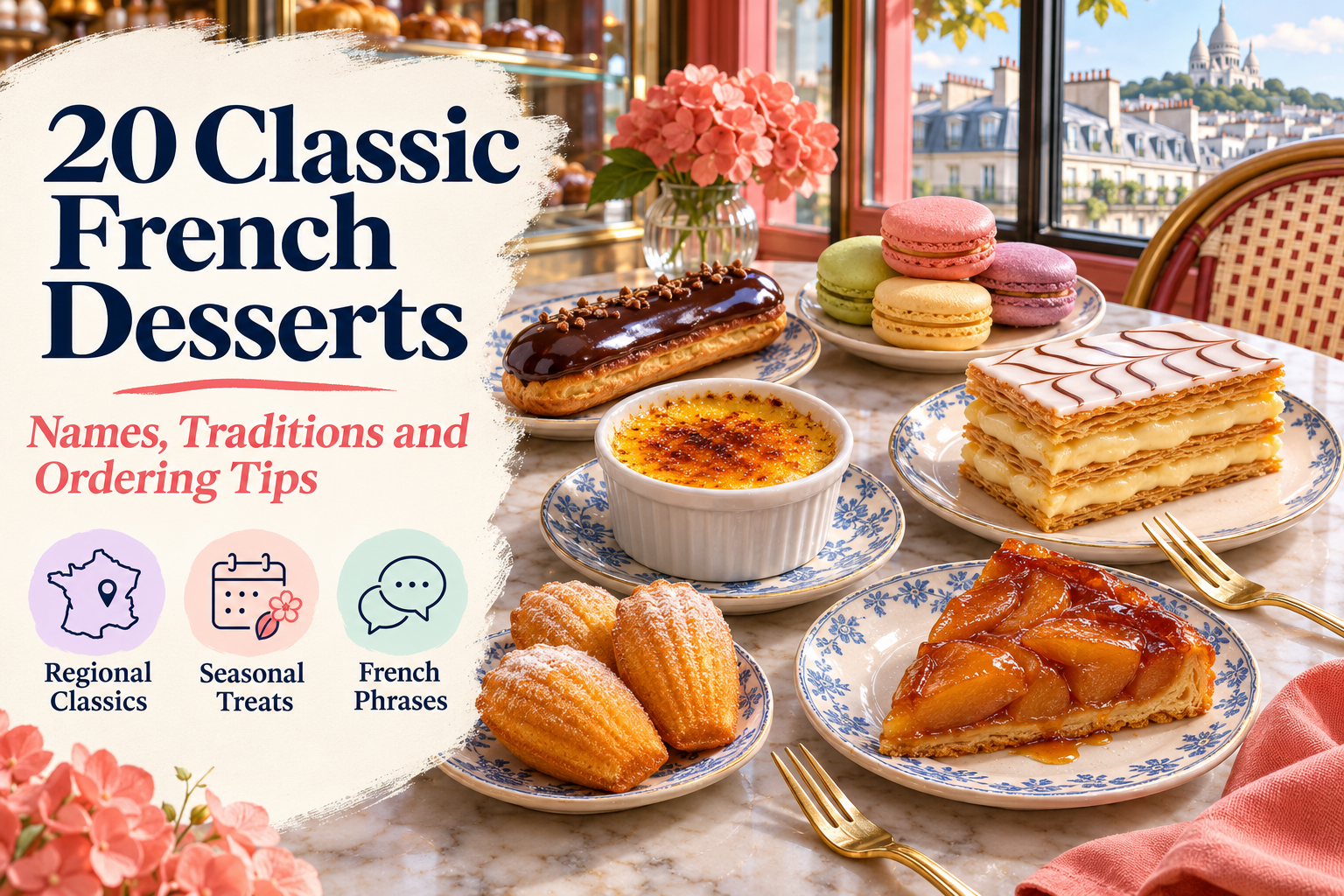
French desserts sit at the heart of everyday life in France, from Sunday lunches to neighborhood fêtes. Learning about classic French desserts is more than a foodie checklist, it is a shortcut to understanding French culture, celebrations, and daily conversation. As you learn French, dessert names, regional stories, and ordering etiquette give you authentic vocabulary that you will actually use in cafés, pâtisseries, and restaurants. This guide blends culture and practicality: discover the famous and traditional French desserts, learn how to pronounce and order them, and see how sweets connect to seasons and festivals across France.
At PrepFrench, we believe cultural immersion speeds up language learning. When you pair vocabulary with taste, places, and people, you remember faster and speak more naturally. Use this guide alongside your French lessons, and the next time you step into a pâtisserie, you will know exactly what to ask for, how to say it, and what it means to locals. If you are new here, start on our Home page or explore our structured French courses to turn your interest in French desserts into everyday French you can use.
Free First Step
Take the guesswork out of learning French.
Not sure where to begin, which course fits your goal, or how long it will take? Book a free demo class with PrepFrench Classes and get a personalized plan built around your level, schedule, and goals.
What is French Cuisine?
French cuisine is a living tapestry of regions, rituals, and recipes that shape how people eat and celebrate. In 2010, UNESCO recognized “the gastronomic meal of the French” as Intangible Cultural Heritage for its social customs, presentation, and sequence. Desserts play a key role in that sequence, often closing a meal with fruit, cheese, or a sweet pastry that reflects the season.
Culinary Heritage
Classic French desserts are not just recipes, they are storytellers. A canelé whispers of Bordeaux’s wine trade, a kouign-amann brings Breton seafaring butter to your plate, and a tarte Tatin retells a delicious kitchen accident. These desserts are also a practical gateway to French vocabulary, pronunciation, and polite conversation. When you learn where a dessert comes from and how people enjoy it, you instantly gain cultural context that sticks.
Multi-Course Dining
Traditional French meals value rhythm and balance. A typical structure looks like this:
- Apéritif: a small drink to open the appetite.
- Entrée: the starter, often light or seasonal.
- Plat: the main dish, warm and satisfying.
- Fromage: cheese course, sometimes before dessert.
- Dessert: fruit, tart, mousse, or a regional specialty.
- Café and Digestif: coffee and an optional small liqueur.
For learners, this sequence provides ready-made vocabulary and set phrases you can practice in our French classes. At PrepFrench, we often use food menus and dessert cases to teach pronunciation, numbers, and polite requests, since these are the conversations you will have on any trip to France.
20 Iconic French Desserts
Below is a cultural tour of classic French desserts: what they are, where they come from, and why locals love them. Use it as a tasting checklist, a vocabulary set for your French course, and a friendly map for your next pâtisserie visit.
Regional Highlights
- Bordeaux: Canelé, crisp outside with a custardy heart.
- Brittany: Kouign-amann and buckwheat crêpes, buttery and rustic.
- Normandy: Apple-rich tarts and calvados-flavored sweets.
- Île-de-France: Pâtisserie classics such as mille-feuille and Paris-Brest.
- Provence and the South: Nougat, fruit tarts, and sun-soaked flavors.
Seasonal Desserts
- Winter: Bûche de Noël at Christmas, Galette des Rois in January.
- Spring: Strawberry and rhubarb tarts begin to appear.
- Summer: Clafoutis and peach, apricot, or berry tarts.
- Autumn: Apple-forward desserts like tarte Tatin shine.
- Crème brûlée (nationwide): Silky custard capped with a brittle caramel top you crack with a spoon. Vanilla is classic, though citrus or coffee versions appear. It is a refined yet simple dessert that shows off perfect texture control.
- Tarte Tatin (Loir-et-Cher): Caramelized apples baked under pastry, then flipped to serve. Legend says it began as a happy mistake at the Tatin sisters’ inn. It is best slightly warm with crème fraîche.
- Mille-feuille (Paris): Literally “a thousand leaves,” this pastry stacks flaky puff pastry with pastry cream. Expect a crisp bite, custardy layers, and a glossy top. Bakeries often offer vanilla, coffee, or praline flavors.
- Éclair (Paris): An oblong choux pastry filled with cream and topped with icing. Chocolate and coffee are the classics. A perfect éclair balances a thin shell, smooth filling, and a not-too-sweet glaze.
- Paris-Brest (Île-de-France): A round choux pastry filled with praline cream, created to celebrate the Paris-Brest-Paris bicycle race. Its ring shape nods to a bicycle wheel. Praline lovers consider this a must-try.
- Macaron (Paris): Two almond meringue shells sandwiching ganache, jam, or buttercream. From pistachio to passion fruit, flavors are wide-ranging. Look for a delicate “foot,” a smooth shell, and a soft chew.
- Canelé (Bordeaux): Small fluted cakes with a dark, caramelized crust and tender, rum-vanilla center. Traditionally baked in copper molds, canelés pair perfectly with coffee or tea.
- Clafoutis (Limousin): A rustic baked custard studded with cherries. When made with other fruit, it is sometimes called flognarde. Served warm or at room temperature, it is homely in the best way.
- Île flottante (nationwide): Poached meringue “islands” floating on a pool of crème anglaise, often with caramel. Light, airy, and nostalgic, it appears on many bistro menus.
- Baba au rhum (Lorraine and Paris): A yeast cake soaked in rum syrup, sometimes filled with whipped cream or pastry cream. Moist and boozy, it bridges dessert and digestif in one bite.
- Madeleine (Lorraine): Shell-shaped sponge cakes scented with lemon or vanilla. Soft, buttery, and perfect for dipping in tea, they are as iconic as they are simple.
- Profiteroles (nationwide): Choux puffs filled with vanilla ice cream and topped with warm chocolate sauce. The temperature contrast and texture play make them a favorite.
- Kouign-amann (Brittany): A laminated dough heavy with butter and sugar that caramelizes as it bakes. Flaky, sweet, and a bit salty, it is a Breton celebration of butter.
- Galette des Rois (nationwide, January): A puff pastry cake with almond frangipane, eaten for Epiphany. A small charm, the fève, hides inside. Whoever finds it becomes king or queen for the day.
- Crêpes Suzette (French Riviera legend, modern Paris): Thin crêpes in a sauce of butter, sugar, orange, and often Grand Marnier. Tableside flambé is a theatrical classic in restaurants.
- Tarte au citron (nationwide): A bright lemon tart balancing tangy curd with a crisp crust. Some versions use Italian meringue on top. It is a perfect palate cleanser after rich mains.
- Opéra (Paris): A layered almond sponge with coffee syrup, coffee buttercream, and chocolate ganache. Sleek and elegant, it showcases French pastry precision.
- Saint-Honoré (Paris): A puff pastry base crowned with caramel-dipped choux puffs and filled with Chantilly or diplomat cream. Named for the patron saint of bakers, it is a showpiece dessert for celebrations.
- Soufflé au chocolat (nationwide): A hot chocolate soufflé that rises tall with a delicate crust and molten interior. Timing is everything, so order early in the meal if the menu suggests it.
- Bûche de Noël (nationwide, Christmas): A rolled sponge cake decorated like a Yule log, filled with buttercream or mousse. Bakeries release creative seasonal flavors each December.
As you learn these names and stories in your French lessons, you also unlock practical vocabulary, from ingredients to textures and polite requests. Pair what you read here with a guided speaking session in our online French classes and you will be ready to order with confidence.
Structured French Courses
Stop learning French the slow way.
Apps and random videos keep you stuck at beginner level forever. PrepFrench Classes gives you a structured path, a real teacher, and speaking practice that moves you forward at every lesson.
Available for: beginners · TEF/TCF exam prep · Canadian PR · work and daily French
How to Pronounce and Order French Desserts
The quickest confidence boost in a French bakery comes from clear pronunciation and a few polite phrases. French pronunciation follows consistent rules, though silent letters and liaison can be tricky at first. Use the phonetic hints below as a guide, then practice aloud with a French tutor for feedback on stress and rhythm.
- Crème brûlée: krehm broo-lay
- Tarte Tatin: tart tah-tan
- Mille-feuille: meel foy
- Éclair: ay-klair
- Paris-Brest: pah-ree brest
- Macaron: mah-kah-ron
- Canelé: kah-nuh-lay
- Clafoutis: klah-foo-tee
- Île flottante: eel floh-tahnt
- Baba au rhum: bah-bah oh rum
- Madeleine: mad-uh-len
- Profiteroles: pro-fee-teh-roll
- Kouign-amann: queen ah-mon
- Galette des Rois: gah-let day rwah
- Crêpes Suzette: kreps soo-zet
- Tarte au citron: tart oh see-tron
- Opéra: oh-pay-rah
- Saint-Honoré: san oh-no-ray
- Soufflé au chocolat: soo-flay oh shoh-koh-lah
- Bûche de Noël: boosh duh noh-el
Common Mistakes in Pronunciation
- Do not pronounce final consonants like “t” in “mille-feuille” or “s” in “Rois,” unless followed by a vowel link.
- Keep vowels short and crisp: citron is see-tron, not see-trow-n.
- R is produced in the throat, softly, not rolled on the tongue.
- Accents matter: brûlée changes the sound of the u, and bûche softens the vowel.
Tips for Ordering in a Pâtisserie
A smile and a bonjour go a long way. Start polite, indicate quantity, and specify flavors. Here are practical phrases you can rehearse in your next French lesson:
- Bonjour, je voudrais une part de tarte Tatin, s’il vous plaît. (Hello, I would like a slice of tarte Tatin, please.)
- Je vais prendre deux éclairs au chocolat. (I will take two chocolate éclairs.)
- Avez-vous des desserts sans gluten ou sans noix. (Do you have gluten-free or nut-free desserts.)
- Qu’est-ce que vous recommandez aujourd’hui. (What do you recommend today.)
- C’est pour manger sur place ou à emporter. À emporter, s’il vous plaît. (For here or take away. Take away, please.)
- Est-ce que je peux avoir une boîte, s’il vous plaît. (May I have a box, please.)
Practicing these lines with a French teacher builds automaticity. In PrepFrench Classes, we simulate real bakery interactions, so you get immediate feedback on pronunciation, grammar, and politeness formulas.
Dietary Considerations in French Desserts
French pastries are rich in butter, cream, eggs, and wheat flour. If you have dietary needs, communicate clearly and look for labels in the display case. Use these helpful tags when evaluating classic French desserts:
- [G] contains gluten, [GF] gluten-free option possible
- [D] contains dairy, [E] contains eggs
- [N] contains nuts, usually almonds or hazelnuts
- [A] contains alcohol
- [V] vegetarian-friendly
Quick guide to popular items:
- Crème brûlée: [D][E][V]
- Tarte Tatin: [G][D][V] often butter and wheat pastry
- Mille-feuille: [G][D][E][V]
- Éclair: [G][D][E][V]
- Paris-Brest: [G][D][E][N][V] praline uses nuts
- Macaron: [N][E][D][GF][V] almond flour is gluten-free, fillings vary
- Canelé: [G][D][E][A][V] traditionally with rum
- Clafoutis: [G][D][E][V]
- Île flottante: [D][E][V]
- Baba au rhum: [G][D][E][A][V]
- Madeleine: [G][D][E][V]
- Profiteroles: [G][D][E][V]
- Kouign-amann: [G][D][V]
- Galette des Rois: [G][D][E][N][V]
- Crêpes Suzette: [G][D][E][A][V] buckwheat crêpes can reduce gluten
- Tarte au citron: [G][D][E][V]
- Opéra: [G][D][E][N][V] almond sponge
- Saint-Honoré: [G][D][E][V]
- Soufflé au chocolat: [D][E][V]
- Bûche de Noël: [G][D][E][V] fillings vary
Vegetarian-friendly desserts are common, though vegan options are still specialty items in traditional shops. For gluten-free choices, macarons are a reliable pick since they use almond flour. If you need help asking about allergens in French, practice those questions inside a structured French course so you can navigate pâtisseries safely and confidently.
Celebrating French Desserts: Seasonal and Festive Events
Many traditional French desserts are tied to the calendar. Tasting them at the right moment adds meaning and conversation starters. Locals expect certain sweets at specific times, which gives you both a cultural and linguistic edge when you speak French about food.
Holiday Traditions
- Epiphany in January: Galette des Rois is shared with family and colleagues. One slice contains a fève charm, and the person who finds it wears a paper crown.
- Chandeleur in February: Crêpes are flipped for good luck, often with sweet fillings at home. It is a fun vocabulary moment for toppings, from sucre and citron to Nutella.
- Christmas season: Bûche de Noël leads the dessert table. Artisan pâtissiers unveil limited-edition flavors and designs each year.
- Easter: Chocolate eggs, bells, and rabbits fill shop windows. Some regions feature pralines or candied fruits as part of the celebration.
- Summer festivals: Fruit tarts and clafoutis follow the markets, from strawberries in late spring to apricots and peaches in midsummer.
Regional Celebrations
- Bordeaux: Canelés appear in cafés and markets, often gifted in pretty boxes.
- Brittany: Kouign-amann and butter-rich pastries are local pride, alongside buckwheat galettes.
- Normandy: Apple tarts and calvados-infused sweets fit the orchard landscape.
- Montélimar and Drôme: Nougat festivals and confiserie culture highlight almonds and honey, a sweet detour if you head south.
Learning these associations helps with small talk in French and makes restaurant chats easier. When a server mentions a seasonal dessert, you will understand the reference and have the words to respond naturally.
Frequently Asked Questions on French Desserts
What are the most popular French desserts?
Some of the most popular French desserts include crème brûlée, tarte Tatin, mille-feuille, macarons, éclairs, and Paris-Brest. In winter, Bûche de Noël dominates, while January belongs to Galette des Rois. For a rustic classic, try clafoutis in summer. If you want to learn French dessert names with correct pronunciation and ordering phrases, join our online French classes at PrepFrench. We use real menus and bakery scenarios so you can order confidently on your next trip.
Why are some desserts regional specialties?
Regional French desserts reflect local ingredients, history, and trade routes. Canelés rose near Bordeaux’s wine trade, kouign-amann celebrates Breton butter, and almond-rich nougat hints at southern orchards. Geography shapes flavor. When you learn French, linking vocabulary to place anchors memory and sparks conversation. PrepFrench Classes often include regional maps and stories, which make new words stick and help you speak French more naturally.
How do you properly pronounce “mille-feuille”?
Mille-feuille is pronounced “meel foy.” Keep vowels short, and do not pronounce the final “lle” or “ille” as in English. The second word, feuille, rhymes with “foy,” with a soft y-glide. To improve your French pronunciation, practice minimal pairs, slow repetition, and record yourself. A French tutor can fine-tune your R, vowel length, and stress. Try a free demo with PrepFrench Classes to get personalized tips in one session.
Which French desserts are gluten-free?
Classic macarons are a good gluten-free pick because they use almond flour, though fillings may contain dairy or nuts. Crème brûlée is also gluten-free by default, since it is a baked custard. Île flottante and chocolate mousse tend to be gluten-free, yet always confirm cross-contact in a bakery. If you have allergies, learn key phrases in a structured French course so you can ask confidently about “sans gluten,” “sans noix,” or “sans lactose.”
Where can I try authentic French desserts in India?
Look for artisan bakeries and hotel pâtisseries in major cities, French-themed cafés, and weekend markets with European bakers. Cultural centers and embassy zones sometimes host French food events. Ask for classic items like mille-feuille, Paris-Brest, macarons, and tarte au citron, then judge quality by texture and flavor balance. While you taste, build the language side too: our French lessons teach pronunciation and polite ordering, so your experience feels truly French.
PrepFrench Classes
Ready to start French with a clear plan?
Book a FREE demo class and get a personalized roadmap for your level, goal, and timeline. No pressure, no obligation.
Explore courses:
All French Courses · Full TCF Canada Course · Full TEF Canada Course
Final Thoughts
Learning about French desserts is a delicious way to learn French. Since each dessert carries a region, a season, and a story, you get cultural context that turns vocabulary into real-life language. You learn how to read a display card, how to ask for recommendations, and how to talk about taste, texture, and tradition with confidence.
Use this guide as a companion to structured study. Learn five dessert names a week, practice pronunciation out loud, then simulate bakery dialogues. The next step is to make it practical: in PrepFrench Classes, we build real ordering scenarios and seasonal menus into your French lessons so that words stick and speaking feels natural. When you can discuss classic French desserts with ease, you will notice that everyday French, from small talk to restaurant chats, becomes more enjoyable.
If you are ready to combine culture with speaking practice, explore our courses or book a free demo. Bon appétit, and bon courage for your learning journey.
✅ Next Step: Book a free demo class with PrepFrench Classes and start learning French the right way.
Tip: Pair cultural reading with short audio practice. Read a dessert name, listen to it, and repeat. Small daily habits build lasting French pronunciation.
Written by
Platform Administrator
Practical ideas from the Prep French team for learners building confidence, preparing for exams, and planning their next step in Canada.
Join the discussion
Leave a thoughtful comment.
Your email address will not be published. Comments are reviewed before appearing.