French Reading Comprehension for Beginners: A1–A2 Guide
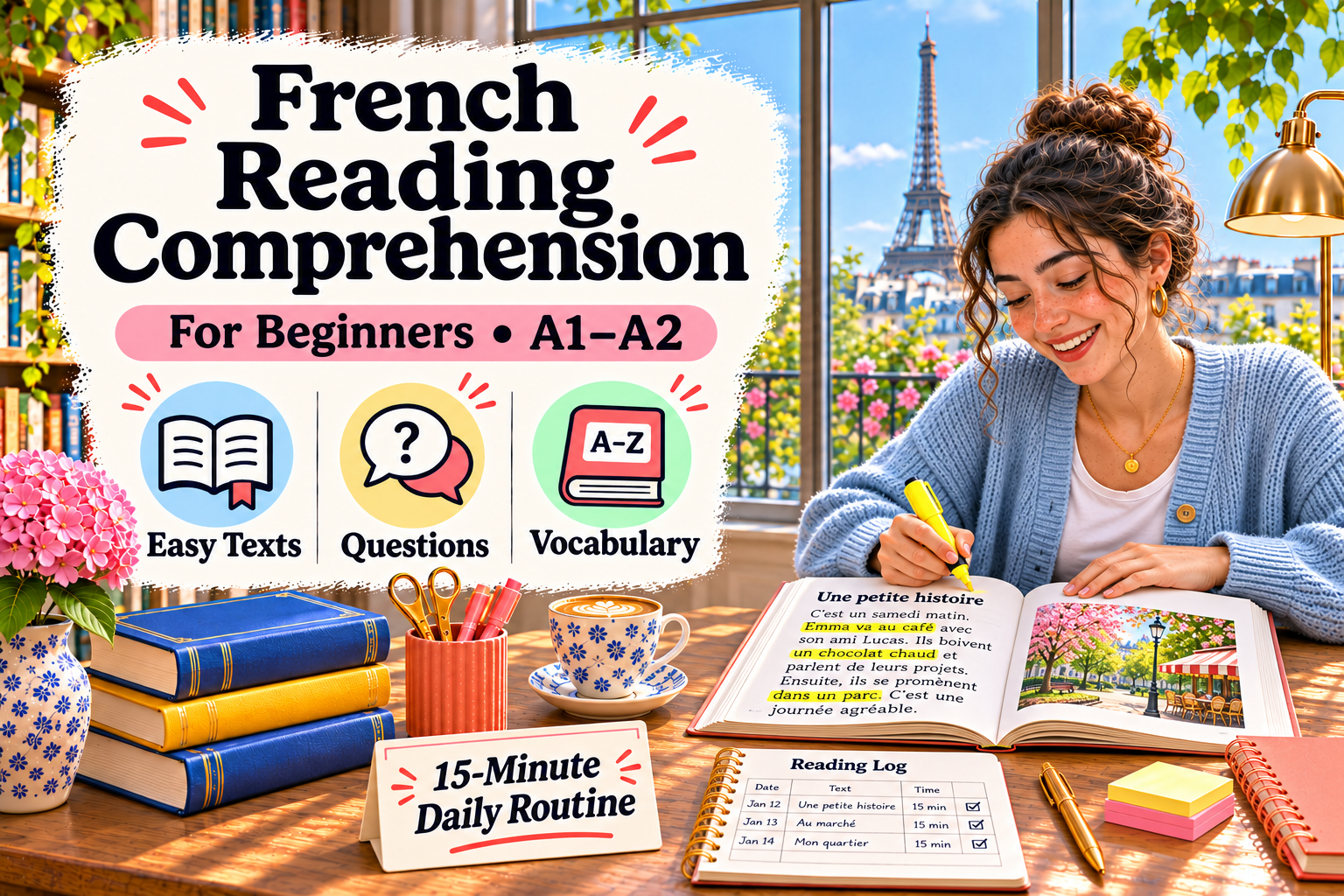
If you are just starting to learn French, reading is your fastest path to vocabulary growth, grammar intuition, and real-world confidence. This guide gives you a complete roadmap for French reading comprehension for beginners: how A1-A2 levels work, how to choose easy texts, and exactly what strategies to practice each day. You will also find two original beginner French reading passages with questions, so you can apply everything immediately. Throughout, we will show how PrepFrench Classes can support you with a structured French course, graded materials, and teacher feedback, all aligned with CEFR A1-A2 levels.
Reading builds language in a unique way. You see words in context, you meet the same grammar patterns repeatedly, and you get dependable input that your brain can process at your own pace. Whether your goal is to speak French with ease or to move toward A2 French reading comprehension, the steps below will keep your progress steady and measurable.
Free First Step
Take the guesswork out of learning French.
Not sure where to begin, which course fits your goal, or how long it will take? Book a free demo class with PrepFrench Classes and get a personalized plan built around your level, schedule, and goals.
Understanding A1-A2 French Reading Levels
The CEFR (Common European Framework of Reference) describes what learners can do at each stage. PrepFrench aligns every French course with CEFR standards so that your reading materials match your level. Here is what beginner French reading looks like at A1 and A2, with practical text types you can use today.
What is A1-level reading?
At A1, you can understand very short, simple texts about familiar topics, often supported by pictures or predictable formats. You recognize everyday words and basic phrases related to yourself, your family, daily routines, times, prices, weather, and simple directions.
Typical A1 text types:
- Short messages, labels, store signs, menus, schedules
- Very simple emails or chats from friends with clear context
- Easy French reading exercises with one or two sentences per line
- Simple French texts with questions that focus on main ideas
Vocabulary focus: greetings, numbers, days and months, basic adjectives (grand, petit, bon, mauvais), everyday verbs in the present (être, avoir, aller, faire, aimer), and common nouns (maison, école, travail, ami).
What is A2-level reading?
At A2, you can understand short, straightforward texts that describe routine matters. You handle more complete sentences, frequent connectors (mais, parce que, alors), and predictable narratives or dialogues. You still rely on familiar topics but can tolerate a few unknown words when the context is clear.
Typical A2 text types:
- Short articles on daily life, hobbies, food, school, or work
- Notices and instructions with step-by-step format
- Beginner French reading passages of one to three short paragraphs
- A2 French reading comprehension worksheets with gist and detail questions
Vocabulary focus: topics expand to shopping, health basics, public transport, making plans, simple past events using passé composé, and more adjectives for descriptions. In PrepFrench Classes, materials are graded so you move from A1 to A2 with confidence and without overwhelm. To see the levels covered in our programs, visit our French courses page.
Choosing Beginner-Friendly French Texts
Picking the right text is half the battle. If the text is too hard, you spend all your energy decoding and none building fluency. If it is too easy, you do not stretch. Use the checklist below to select simple French texts with questions that challenge you just enough. This reduces cognitive load, which means your brain has more space to notice patterns and remember new words, especially at A1.
Familiarity with the topic
Start with what you know. Daily routines, food, family, school, weekend plans, and shopping are perfect. Familiar topics help you predict vocabulary and structure, which speeds up comprehension. For French reading practice A1, content familiarity is more valuable than novelty.
Sentence length and complexity
Short sentences win. Prefer one idea per sentence, clear punctuation, and minimal subordinate clauses. At A1, aim for 5 to 12 words per sentence. At A2, you can handle slightly longer lines and connectors such as mais, parce que, quand, and alors.
Recommended text formats
The format changes how easy a text feels. Try:
- Dialogues with speaker names, which break text visually
- Lists, bullet points, and schedules with clear structure
- Short stories with one scene or one main action
- Easy French reading exercises with line breaks and margin notes
Quick difficulty checklist:
- I understand the topic before I read.
- Most sentences are short and direct.
- Only a few unknown words per paragraph.
- There are helpful clues: headings, speaker names, images, or lists.
- I can answer simple what, who, when questions after one pass.
PrepFrench provides graded reading materials inside our beginner French classes, so you always practice at the right level and speed. If you prefer a guided path with teacher feedback, explore our online French classes.
Core Strategies for French Reading Comprehension for Beginners
Reading is a skill you can train. Use the strategies below to read faster, understand more, and avoid common traps like over-translation and false friends.
- Skimming for gist
Skimming means reading quickly to capture the big picture. Look at the title, names, numbers, and the first sentence of each paragraph. Ask: who, where, and what is happening. For A1-A2 French, 20 to 40 seconds of skimming can double your comprehension because you anchor the main idea before reading line by line.
- Scanning for details
Scanning is targeted searching. After you know the topic, scan for specific words: times, dates, prices, names, colors, places. For example, if a question asks, “À quelle heure?” scan only for times like 8h30 or 14h. This prevents you from re-reading everything and keeps your focus sharp.
- Utilizing cognates effectively
Cognates are words that look similar in French and English: télévision, normal, musique. Use them for quick wins, but stay alert to false friends. Common traps include actuellement (currently, not actually), librairie (bookshop, not library), blessé (injured, not blessed), and journée (daytime, not journey). Mark suspicious words with a question mark, then confirm with a dictionary if they affect meaning.
- Dictionary strategies
Do not look up every word. First, guess from context. Second, confirm only key words that block meaning. Use a bilingual dictionary at A1, then try a simple monolingual one at A2 for frequent words. Save 5 to 8 new words after each session, write a short example sentence, and review the next day. This small habit builds durable French vocabulary.
- Chunking and reading aloud
Many beginners read word by word. Instead, read in chunks: Je vais au marché, avec ma soeur, ce matin. Say short lines aloud to connect spelling to French pronunciation and rhythm. You will notice patterns like verb plus infinitive (je veux aller) and preposition plus noun (à la maison), which makes future texts easier.
- Question-first reading
If your text has questions, read them first. This primes your brain for scanning and keeps you focused on what matters. It is especially efficient with simple French texts with questions or beginner French reading passages designed for A1-A2 practice.
These strategies are part of how we teach inside PrepFrench Classes. You practice with a teacher, apply them to graded texts, and get feedback so your reading speed and confidence grow every week. To see how our structured approach works, visit the courses page or book a free demo class.
Structured French Courses
Stop learning French the slow way.
Apps and random videos keep you stuck at beginner level forever. PrepFrench Classes gives you a structured path, a real teacher, and speaking practice that moves you forward at every lesson.
Available for: beginners · TEF/TCF exam prep · Canadian PR · work and daily French
A Simple Daily Reading Routine
You do not need long study marathons. You need short, consistent sessions that compound. Here is a practical routine that fits busy schedules and supports daily practice for A1-A2 learners.
Setting realistic daily goals
Aim for 15 to 25 minutes a day. Measure success by actions, not perfection: read one short text, answer three questions, save five words. Consistency is the goal. If you miss a day, return the next day without guilt. Momentum matters more than intensity.
Time allocation for reading (15 mins/day)
- Minute 1 to 2: Skim the text for gist.
- Minute 3 to 7: Read line by line, underline key ideas.
- Minute 8 to 10: Scan for details and answer 3 to 5 questions.
- Minute 11 to 13: Note 5 useful words and 2 example sentences.
- Minute 14 to 15: Read one or two lines aloud for pronunciation and rhythm.
Tips for consistency
- Keep texts short and predictable on weekdays. Save longer tasks for weekends.
- Use a tracking sheet. Record date, text title, score on questions, and 5 new words.
- Bundle cues: read right after breakfast or just before bed to make it a habit.
- Alternate formats: stories one day, dialogues the next, a menu or schedule on Friday.
- Mix active and passive: listen to the text audio if available, then re-read to connect sound and spelling.
| Day | Text Type | Goal |
| Mon | Short dialogue (A1) | Skim, answer 3 questions, save 5 words |
| Tue | List or menu (A1) | Scan for prices, times, or items |
| Wed | Short story (A1-A2) | Identify who, where, and what happened |
| Thu | Notice or instruction (A2) | Find key steps and warnings |
| Fri | Email or message (A1) | Summarize in one English line, then one French line |
| Sat | Two-paragraph article (A2) | Full routine plus read aloud |
| Sun | Review day | Re-read two texts and recycle vocabulary |
Want a printable reading log and teacher tips tailored to your level? Request it through our contact page, or join our beginner-friendly French lessons to receive graded daily practice.
Two Original Beginner Passages with Comprehension Questions
Text 1: A simple story
Bonjour, je m’appelle Lina. Je suis étudiante et j’habite près de mon université. Le lundi, je me lève tôt et je prends un petit café. Ensuite, je marche dix minutes jusqu’à la bibliothèque. J’adore lire, surtout les histoires courtes.
Aujourd’hui, il fait beau. Après les cours, je retrouve mon ami Karim au parc. Nous parlons de nos projets pour le week-end. Il veut cuisiner un plat marocain, et moi, je veux regarder un film français. Le soir, je rentre chez moi. Je prépare un thé, j’écris un message à ma sœur, puis je lis encore un peu avant de dormir. C’est une journée simple, mais je suis contente.
Questions (A1)
- Comment s’appelle la narratrice ?
- Où habite Lina ?
- Où va-t-elle le matin ?
- Avec qui Lina parle-t-elle au parc ?
- Que veut faire Lina le week-end ?
- Comment Lina termine sa journée ?
Vocabulaire utile
- se lever: to get up
- ensuite: then
- retrouver: to meet up with
- projets: plans
- rentrer: to go back home
- avant de: before doing
Answer key
- Elle s’appelle Lina.
- Elle habite près de son université.
- Elle va à la bibliothèque.
- Elle parle avec son ami Karim.
- Elle veut regarder un film français.
- Elle prépare un thé, envoie un message à sa sœur, et lit un peu.
Text 2: A dialogue
Au marché
Vendeuse: Bonjour, vous cherchez quelque chose en particulier ?
Max: Bonjour. Oui, je voudrais des pommes et un peu de fromage, s’il vous plaît.
Vendeuse: Les pommes rouges sont à 2 euros le kilo. Combien voulez-vous ?
Max: Un kilo, merci. Et le fromage, il est à combien ?
Vendeuse: Le fromage de chèvre est à 4 euros la pièce.
Max: D’accord, j’en prends un. Est-ce que vous avez aussi du pain ?
Vendeuse: Oui, il reste deux baguettes.
Max: Super, je prends une baguette. Ça fait combien en tout ?
Vendeuse: Ça fait 7 euros. Vous payez par carte ou en espèces ?
Max: En espèces. Merci et bonne journée.
Vendeuse: Merci à vous. Bonne journée.
Questions (A1-A2)
- Que veut acheter Max au début ?
- Combien coûtent les pommes rouges ?
- Quel type de fromage choisit Max ?
- Combien d’articles Max achète-t-il au total ?
- Combien paie-t-il, et comment ?
Vocabulaire utile
- à combien: how much
- la pièce: per item
- il reste: there remain
- en tout: in total
- en espèces: in cash
Answer key
- Il veut des pommes et du fromage.
- 2 euros le kilo.
- Du fromage de chèvre.
- Trois: des pommes, un fromage, une baguette.
- Il paie 7 euros en espèces.
Practice tip: try the question-first approach, then re-read each text aloud. If you would like more beginner French reading passages and easy French reading exercises with teacher feedback, you can join our starter-friendly French course at PrepFrench.
PrepFrench Classes
Ready to start French with a clear plan?
Book a FREE demo class and get a personalized roadmap for your level, goal, and timeline. No pressure, no obligation.
Explore courses:
All French Courses · Full TCF Canada Course · Full TEF Canada Course
FAQ: French Reading for Beginners
What does A1 or A2 reading level mean in practice?
A1 reading covers very short, simple texts about daily life, such as signs, menus, messages, and short dialogues. You rely on familiar vocabulary and clear context to understand the main idea. A2 reading adds slightly longer texts with basic connectors like mais and parce que, plus short articles, notices, and two-paragraph stories. In PrepFrench Classes, our beginner French lessons use graded texts that match A1-A2 descriptors so you build comprehension step by step. You can see the level coverage on our French courses page.
How can I effectively track my reading progress as a beginner?
Keep a simple reading log. For each text, note the date, title, time spent, your score on 3 to 5 questions, and five new words with example sentences. Revisit the log weekly to see your speed and accuracy improve. If you study with PrepFrench, your French teacher will share a structured template and review your log during online French classes. To request a starter log, contact us via the free demo form.
What are some common pitfalls to avoid when learning to read in French?
Common mistakes include translating every word, ignoring skimming and scanning, and overusing a dictionary. Another trap is false friends, such as actuellement (currently) and librairie (bookshop). Choose easy French reading exercises with familiar topics, track only five to eight new words per session, and read questions first when available. A structured French course helps you avoid these pitfalls early. In PrepFrench Classes, teachers guide you to build habits that lead to real progress.
Are there specific resources recommended for beginners?
Start with graded readers and short dialogues written for A1-A2 levels, menus and schedules for scanning practice, and simple French texts with questions for comprehension checks. Pair these with a reliable bilingual dictionary and a spaced-repetition app to review your saved words. If you prefer a curated path, our beginner-friendly French lessons include weekly texts, vocabulary lists, and teacher feedback. You can also book a free demo class to get a personalized plan.
How long should I spend reading each day?
Fifteen to twenty minutes a day is ideal for beginners. Use a clear routine: skim for gist, read line by line, answer a few questions, save five words, then read aloud for a minute. This short format builds strong habits without mental fatigue. If you have more time on weekends, add one longer A2 French reading comprehension text. Consistency beats intensity. PrepFrench’s online French classes can integrate this daily reading routine into your broader study plan.
Final Thoughts
Reading is the anchor skill that accelerates every part of your French, from vocabulary and grammar to listening and speaking. Start at the right level, keep texts short and familiar, and use strategies like skimming, scanning, and selective dictionary use. With 15 minutes a day, you can steadily improve French reading comprehension while enjoying meaningful content.
Use the daily routine above, choose beginner-friendly formats, and practice with simple French texts with questions. If you want structure and teacher guidance, PrepFrench Classes offers graded materials, clear milestones, and live support that keeps you motivated. Explore our courses or claim your free demo class to get a personalized plan for A1-A2 success.
✅ Next Step: Book a free demo class with PrepFrench Classes and start learning French the right way.
Your reading journey does not need to be complicated. Small daily steps, the right texts, and a supportive French teacher will take you from hesitant decoding to confident comprehension.
Written by
Platform Administrator
Practical ideas from the Prep French team for learners building confidence, preparing for exams, and planning their next step in Canada.
Join the discussion
Leave a thoughtful comment.
Your email address will not be published. Comments are reviewed before appearing.