French Prepositions: Meaning, Types and Examples for Beginners
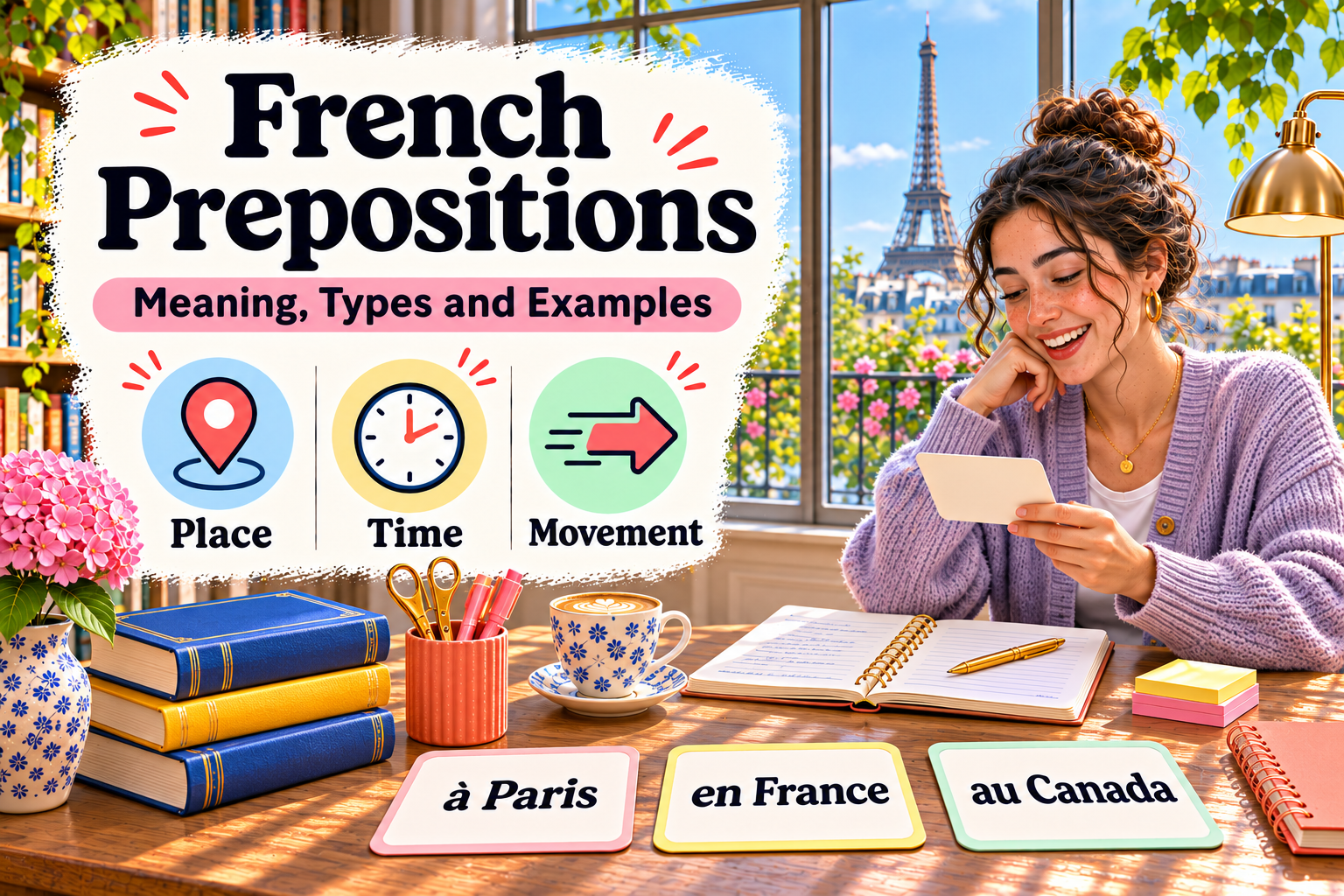
French prepositions are short words that do big jobs. They tell you where, when, how, and why things happen, and they glue a sentence together so your meaning is clear. If you want to speak French naturally, you must master prepositions in French, from everyday essentials like à, de, en, and dans to trickier pairs such as depuis vs pendant and dans vs en. In this beginner friendly guide from PrepFrench, you will learn what prepositions are, how they work, and how to avoid the most common mistakes. You will also see practical examples, contrasts, and easy rules you can apply right away in conversation or writing. If you prefer structured practice, our French courses and online French classes take you step by step from basics to confident usage.
Free First Step
Take the guesswork out of learning French.
Not sure where to begin, which course fits your goal, or how long it will take? Book a free demo class with PrepFrench Classes and get a personalized plan built around your level, schedule, and goals.
What Are French Prepositions?
Definition and Function
Prepositions are short words placed before a noun or pronoun to show the relationship between that word and the rest of the sentence. In French, they locate things in space and time, introduce objects, indicate means or manner, and connect ideas. Think of them as signposts that tell your listener where to look for meaning.
Function of prepositions: they help you answer questions like where, when, how, with whom, and about what. Without good control of prepositions, your sentences stay vague or inaccurate, which blocks fluency.
Common Simple Prepositions
- à: to, at, in
- de: of, from, about
- en: in, by
- dans: in, inside
- sur: on
- sous: under
- chez: at the home or place of
- avec: with
- pour: for
- sans: without
- par: by, through
- vers: toward
- entre: between
- pendant: during
- depuis: since, for (ongoing)
Examples in Sentences
Here are a few everyday sentences that show how French prepositions work:
- Je vais à Paris demain. I am going to Paris tomorrow.
- Le livre sur la table est à moi. The book on the table is mine.
- Elle habite en France. She lives in France.
- Nous parlons de voyage. We are talking about travel.
- Il travaille depuis 2019. He has been working since 2019.
If you want a structured start with feedback from a French teacher, PrepFrench Classes offers guided lessons that help you apply prepositions correctly from day one.
Types of French Prepositions
Grouping prepositions by meaning helps you learn faster. Below is a quick reference for French prepositions of place, time, and movement, followed by common complex prepositions that act like fixed expressions. Compare usage and memorize with examples, then reinforce with short speaking drills in your French lessons.
| Category | Key Prepositions | Meaning | Example |
|---|---|---|---|
| Place | à, en, dans, sur, sous, chez, entre, derrière, devant, près de, loin de | Location, position, proximity | Nous sommes dans la salle. We are in the room. |
| Time | à, en, pendant, depuis, pour, vers, avant, après, dès | Point in time, duration, starting point | Il part à 8h. He leaves at 8. |
| Movement / Direction | à, vers, de, jusqu’à, par | Destination, origin, route | Elle va vers la gare. She is going toward the station. |
| Complex Prepositions | près de, loin de, à côté de, au milieu de, au sujet de, à cause de, grâce à, en face de | Fixed multi word forms, often with de or à | La banque est en face de l’école. The bank is opposite the school. |
Practice tip: read the example aloud, then replace the noun with others. For example: Nous sommes dans la salle becomes Nous sommes dans le bus, dans la cuisine, dans le parc. In PrepFrench courses you will drill these patterns in short speaking bursts to make them automatic.
Structured French Courses
Stop learning French the slow way.
Apps and random videos keep you stuck at beginner level forever. PrepFrench Classes gives you a structured path, a real teacher, and speaking practice that moves you forward at every lesson.
Available for: beginners · TEF/TCF exam prep · Canadian PR · work and daily French
Key Rules for Using French Prepositions
Contractions with à and de
Two of the most frequent words in French, à and de, combine with the definite articles le and les. This contraction is mandatory in writing and speaking.
- à + le = au: Je vais au parc. I am going to the park.
- à + les = aux: Elle parle aux voisins. She is speaking to the neighbors.
- de + le = du: Il revient du supermarché. He is coming back from the supermarket.
- de + les = des: La couleur des murs. The color of the walls.
Note: There is no contraction with la or l’. Example: à + la = à la, de + l’ = de l’.
à vs de in French often confuses learners, especially before infinitives. See the pattern list under Infinitive Patterns below and add them to your flashcards or your PrepFrench practice set.
Country and City Rules
Use à for cities, en or au or aux for countries depending on gender and number. This is one of the most useful sets of French country prepositions to learn early.
- Cities: à Paris, à Delhi, à Toronto
- Feminine countries and masculine countries starting with a vowel: en France, en Inde, en Iran
- Masculine countries starting with a consonant: au Canada, au Japon
- Plural countries: aux États Unis, aux Pays Bas
- From: de or d’ for feminine or vowel countries, du for masculine, des for plural: Je viens de France, du Brésil, des Pays Bas.
Extra tips: Use chez for people or a professional’s place, not a country or city: Je vais chez le dentiste. I am going to the dentist.
Transport Prepositions: en vs à
For transport, the contrast en vs à in French follows a simple logic: enclosed or seated transport uses en, while open or individual transport often uses à.
- en train, en bus, en voiture, en avion, en métro, en bateau
- à pied, à vélo, à moto, à cheval
Use par to mean by when focusing on the route or channel: Envoyer le document par email. Send the document by email.
Infinitive Patterns: verbs + à or de
Some verbs require à before an infinitive, others require de. Learn the most frequent ones first. This is a core à vs de French pattern set to internalize.
- Verbs taking à: aider à, apprendre à, commencer à, réussir à, inviter à
- Verbs taking de: arrêter de, essayer de, oublier de, éviter de, décider de, finir de
Examples: Elle commence à lire. She is starting to read. Il a décidé de partir. He decided to leave.
Pro tip: Build two columns in your notebook labeled à and de and add new verbs as you meet them. In PrepFrench Classes, your French teacher will help you select high frequency verbs that fit your goals.
Common Mistakes with Prepositions
Confusing Prepositions
- dans vs en: Use dans for physical inside or scheduled time in the future, and en for general location within a space or to talk about travel time. Examples: Je suis dans la voiture. I am in the car. Il arrive dans 10 minutes. He arrives in 10 minutes. Elle vit en ville. She lives in the city. J’ai fini en 10 minutes. I finished in 10 minutes.
- depuis vs pendant: depuis describes an action that started in the past and continues now, pendant is a completed duration. Examples: J’habite ici depuis 2018. I have lived here since 2018. J’ai voyagé pendant deux semaines. I traveled for two weeks.
- à vs en with transport: en bus, à pied, not à bus or en pied.
Misleading Examples
- Parler à vs parler de: Je parle à Marie. I am speaking to Marie. Je parle de Marie. I am speaking about Marie.
- Penser à vs penser de: Penser à is to think about in a neutral way, Penser de asks for an opinion. Tu penses à lui souvent. You think about him often. Qu’est ce que tu penses de ce film. What do you think of this movie.
- Bon vs bien with prepositions: C’est bon pour la santé. It is good for health, but Je me sens bien dans cette ville. I feel good in this city.
Tips to Avoid Errors
- Learn contrasts in pairs: dans vs en, depuis vs pendant, à vs de.
- Memorize common verb preposition pairs with example sentences.
- When in doubt, check a reliable source or ask your French tutor during a free demo to build a personal cheat sheet.
- Practice out loud with mini substitution drills to make patterns automatic.
Practice Makes Perfect: Exercises on Prepositions
Use these short exercises to apply what you learned. Say your answers aloud to build speaking confidence, then check with the key below.
Fill in the Blank
- Nous allons ___ Italie cet été. (en, au, aux)
- Il parle ___ son frère de son projet. (à, de)
- Je travaille ___ lundi matin. (depuis, pendant)
- Elle est ___ la cuisine. (dans, en)
- Ils voyagent ___ train et je viens ___ pied. (en, à)
- Il revient ___ bureau vers 19h. (du, de la)
- J’ai réussi ___ finir le rapport hier. (à, de)
- La banque est ___ l’école. (en face de, près)
- Nous pensons souvent ___ nos vacances. (à, de)
- Tu vas ___ Paris ou ___ Canada cet hiver. (à, au)
Sentence Construction
Build one correct sentence for each prompt, using the preposition indicated.
- chez: visit your dentist tomorrow
- grâce à: you improved because of your teacher
- par: send the document by email
- pendant: studied for two hours last night
- jusqu’à: open until 9 pm
Real Life Scenarios
- You are giving directions to a friend. Use vers, à, and en face de in two or three short sentences.
- You describe your commute. Use en, à, and pendant in three sentences.
- You talk about your home country and city. Use de, du, des, à, and en correctly.
Answer Key
Fill in the Blank: 1. en 2. à 3. depuis 4. dans 5. en, à 6. du 7. à 8. en face de 9. à 10. à, au
Sample sentences: 1) Je vais chez le dentiste demain. 2) J’ai progressé grâce à mon professeur. 3) Envoie le document par email. 4) J’ai étudié pendant deux heures hier soir. 5) Le magasin est ouvert jusqu’à 21h.
For more practice, check the exercise sets included in our online French classes.
From Prepositions to Pronouns: Understanding y and en
As you progress, you will replace certain prepositional phrases with object pronouns. Two that connect directly to prepositions are y and en. Learning them improves fluency because your sentences become shorter and more natural.
Using y in Sentences
Use y to replace a place introduced by à, or more broadly à + thing. It usually means there or to it.
- Tu vas à la bibliothèque. Tu y vas quand. You are going to the library. When are you going there.
- Je pense à mon avenir. J’y pense souvent. I think about my future. I often think about it.
Form: y comes before the conjugated verb, or before the infinitive with a modal: Je vais y aller. I am going to go there.
Using en in Sentences
Use en to replace de + thing, quantities, and partitive articles. It often means of it, from it, some, or any.
- Tu parles de ce projet. Tu en parles souvent. You talk about this project. You talk about it often.
- Je veux du pain. J’en veux. I want bread. I want some.
- Il revient de Paris. Il en revient demain. He is coming back from Paris. He is coming back from there tomorrow.
Order with quantities: Il a trois pommes. Il en a trois. Keep the number after the verb when you use en.
Common Mistakes
- Mixing y and en: à + thing prefers y, de + thing prefers en.
- Replacing people with y or en: do not. Use stressed pronouns with prepositions for people, for example avec lui, chez elle, pour eux.
- Position errors: y and en come before the conjugated verb, except in the affirmative imperative where they follow the verb with a hyphen, for example Vas y, Parles en.
Want guided drills that connect prepositions and pronouns smoothly. Try a free session with PrepFrench Classes to get a personal practice plan.
PrepFrench Classes
Ready to start French with a clear plan?
Book a FREE demo class and get a personalized roadmap for your level, goal, and timeline. No pressure, no obligation.
Explore courses:
All French Courses · Full TCF Canada Course · Full TEF Canada Course
FAQ: French Prepositions Explained
What is the difference between dans and en, and when should I use each?
Use dans for physical inside or for specific future time. Examples: Je suis dans la voiture. I am in the car. Il part dans dix minutes. He leaves in ten minutes. Use en for general location or how long something takes. Elle habite en ville. She lives in the city. J’ai fini en dix minutes. I finished in ten minutes. For countries, en often means in and is used with feminine or vowel starting country names, for example en France. In PrepFrench Classes you will practice quick contrasts to make dans vs en automatic in real speech.
How do I choose between depuis, pendant, and pour for time expressions?
Depuis marks an action that started in the past and continues now: J’étudie le français depuis 2022. Pendant is a completed duration in the past or future: J’ai voyagé pendant deux semaines. Pour shows an intended duration, often in the future: Je pars pour deux mois. Beginners usually confuse depuis and pendant. A simple test: if the action is still true now, prefer depuis. Learn French with guided timelines in a structured French course to master these nuances faster.
When do I use en, au, or aux with countries?
Use en for feminine countries and masculine countries that start with a vowel: en France, en Inde, en Iran. Use au for masculine countries starting with a consonant: au Canada, au Japon. Use aux for plural names: aux États Unis, aux Pays Bas. For origin, use de or d’ for feminine and vowel countries, du for masculine, and des for plural: Je viens de France, du Brésil, des Pays Bas. This set of French prepositions is key for travel talk, and our French lessons include targeted drills for quick recall.
Which verbs require à or de before an infinitive in French?
Common verbs with à: aider à, apprendre à, commencer à, réussir à, inviter à. Common verbs with de: arrêter de, essayer de, oublier de, éviter de, décider de, finir de. Example: Il commence à travailler. He starts working. Elle a décidé de partir. She decided to leave. Build two columns in your notebook and add new verbs as you meet them. In online French classes at PrepFrench, you will practice with high frequency verbs and get feedback from a French teacher to lock in the patterns.
How do I form phrases with après and the infinitive?
Use après + past infinitive to show a prior action. The past infinitive is formed with avoir or être in the infinitive, plus the past participle: après avoir mangé, after eating, après être arrivé, after arriving. Agreement rules follow the auxiliary, for example après s’être levée for a feminine subject with reflexive verbs. Example sentence: Après avoir étudié, je me repose. After studying, I rest. You will meet this often in narratives and exam tasks, so practice set phrases in your French course to gain confidence.
Final Thoughts
French prepositions carry meaning that affects clarity, tone, and accuracy. Once you know the main categories, the key contrasts like dans vs en and depuis vs pendant, and the rules for à vs de with verbs and places, you will hear patterns everywhere. Your sentences will sound cleaner, and you will understand native speech more easily.
The fastest progress comes from short, focused practice every day. Use the exercises above, speak your answers out loud, and keep a running list of verb plus preposition pairs with your own examples. If you want a guided path with accountability, PrepFrench Classes offers a structured French course with feedback, pronunciation support, and real conversation practice so you can learn French with confidence.
✅ Next Step: Book a free demo class with PrepFrench Classes and start learning French the right way.
Keep this guide handy and revisit it after a week of practice. You will notice that many choices, from en vs à in transport to y and en, feel easier and more natural with repetition.
Written by
Platform Administrator
Practical ideas from the Prep French team for learners building confidence, preparing for exams, and planning their next step in Canada.
Join the discussion
Leave a thoughtful comment.
Your email address will not be published. Comments are reviewed before appearing.