
French Homophones: A Beginner's Guide to Common Pairs
Mastering French Homophones: A Beginner’s Guide to Words That Sound Alike
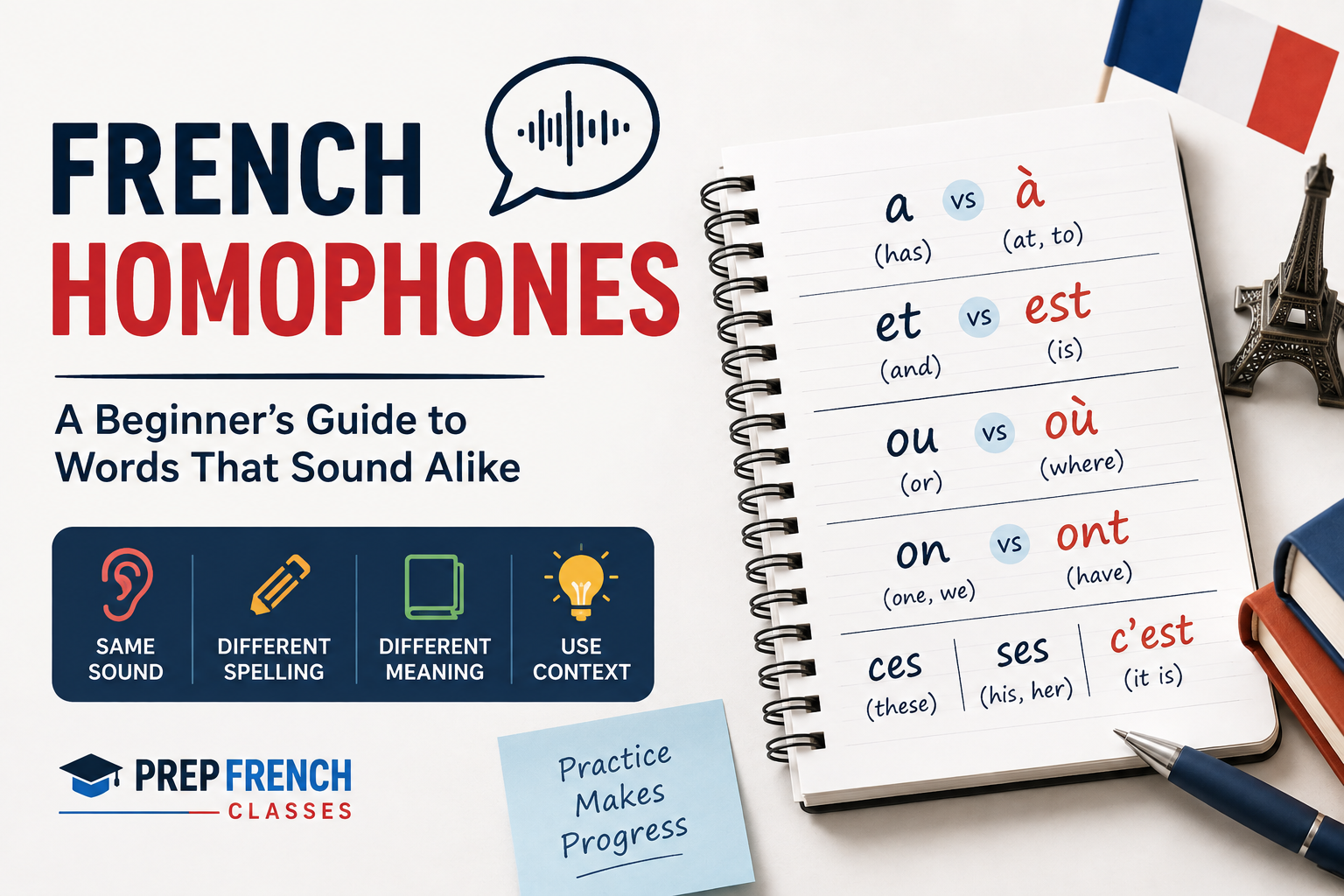
French homophones are words that sound the same but have different spellings and meanings. They confuse beginners quickly, yet they appear everywhere: in messages, exams, songs, and conversations. If you want to write accurate French and speak clearly, you must learn to spot and choose the right homophone. In this beginner-friendly guide, you will discover the most common homophones in French, simple decision rules you can use in seconds, and practice exercises with answers. As you learn French with a structured French course or French lessons, mastering these will save you from the classic mistakes that weaken otherwise good writing. PrepFrench Classes teaches these distinctions with practical drills, and this article gives you a strong head start.
Here is the plan: you will see clear definitions, why homophones matter, fast rules for common pairs like a vs à and et vs est, a handy French homophones list with examples, a short section on accents that change meaning, and mini-exercises to check your progress. If you want a teacher to check your writing and help you memorize quickly, our French courses include guided practice on homophones, spelling, and pronunciation. You can also explore more about PrepFrench on our home page and see how our online French classes are structured.
Free First Step
Take the guesswork out of learning French.
Not sure where to begin, which course fits your goal, or how long it will take? Book a free demo class with PrepFrench Classes and get a personalized plan built around your level, schedule, and goals.
What Are French Homophones?
Definitions of Homophones
Homophones are words that are pronounced the same but have different spellings and meanings. In French, this includes pairs like mer, mère, and maire. They sound identical but mean sea, mother, and mayor. When you hear them, only the context tells you which one is correct. In writing, you must choose the right spelling yourself. That is why homophones challenge beginners: your ear hears one sound, but your hand must choose from several spellings.
PrepFrench teachers teach homophones early because they improve your writing quality quickly. If you plan to join online French classes, ask for targeted homophone drills in your French lessons.
Differences from Homographs and Homonyms
It helps to separate three terms you will meet in French grammar:
- Homophones: same pronunciation, different spellings and meanings. Example: ou (or) vs où (where).
- Homographs: same spelling, possibly different pronunciation and different meanings. Example: moule can mean mold or mussel. The spelling is the same, the meaning depends on context.
- Homonyms: same spelling and same pronunciation, different meanings. Example: livre can be book or pound depending on gender. Context clarifies meaning.
Why this matters: when you write, homophones are the ones most likely to cause errors because your ear cannot help you. PrepFrench Classes cover these distinctions in early modules so you build good habits from day one.
Why Understanding Homophones Matters
Common Mistakes with Homophones
Beginners often write et instead of est, à instead of a, and ses instead of ces. In spoken French, this rarely causes confusion because tone and context guide the listener. In writing, the wrong spelling changes the sentence type or meaning. For example, Il est ici means he is here, while Il et ici is simply wrong. Similarly, Elle a fini means she has finished, while Elle à fini is incorrect. These are easy mistakes to fix if you have fast decision rules, which you will learn below.
Even native speakers slip on a few, especially with voire/voir, sur/sûr, and du/dû. That should reassure you. You are not alone, and practice works. With the right checks, your error rate drops quickly during email writing, exam essays, and notes.
Impact on Communication
Accurate homophone choice makes your French look educated and trustworthy. In exams, it protects writing points you already earned through good ideas. In professional contexts, it shows care and clarity. In daily messages, it prevents misunderstandings. For instance, on vs ont changes a subject to a verb form: On parle means one or we speak, while Ils ont parlé means they have spoken. These are not small details. They are the difference between correct grammar and easy-to-spot mistakes.
If you learn with a structured French course, this topic is built into your writing routine. PrepFrench gives quick rules, targeted practice, and teacher feedback so you communicate effectively from the start. If you prefer a customized plan, you can also book a free demo and talk to a French teacher about your goals.
Structured French Courses
Stop learning French the slow way.
Apps and random videos keep you stuck at beginner level forever. PrepFrench Classes gives you a structured path, a real teacher, and speaking practice that moves you forward at every lesson.
Available for: beginners · TEF/TCF exam prep · Canadian PR · work and daily French
Fast Rules for Choosing the Right Homophone
Use these mini decision tests when you are unsure. They take seconds and fix most mistakes.
Quick Tests for “a” vs “à”
- a is a verb: il ou elle a. Test: replace with avait (had). If it still works, use a.
- à is a preposition: to, at, in. Test: try replacing with dans or au(x). If a preposition is needed, use à.
Examples:
- Elle a un chien. Test: Elle avait un chien. Correct.
- Je vais à Paris. Preposition of destination. Correct.
Decision Strategies for “et” vs “est”
- et means and. Test: replace with a comma or and. If the meaning is addition, choose et.
- est is is, from être. Test: replace with était or était-ce in a question. If it works, choose est.
Examples:
- Paul et Marie arrivent. Addition. Correct.
- Le film est long. Test: Le film était long. Correct.
More fast tests you will use often:
- ou vs où: ou means or. Replace with ou bien. où means where, introduce a place or time. Example: Tu veux du thé ou du café ? Où où habites-tu ?
- on vs ont: on is a subject pronoun. Replace with nous to test. ont is have, third person plural of avoir. Replace with avaient. Example: On arrive à 8 h. Ils ont mangé.
- son vs sont: son is possessive his or her before a masculine noun. sont is are from être. Test: replace sont with étaient. Example: son livre, Ils sont prêts.
- ces vs ses vs c’est vs s’est:
- ces means these or those. Replace with ces-là to test.
- ses means his or her (plural). Replace with les siens/les siennes.
- c’est equals cela est. If you can say cela est, use c’est.
- s’est is reflexive: se est. Usually before a past participle. Example: Il s’est levé.
- la vs là: la article or direct object pronoun. là means there. Replace with ici to test là. Example: Mets la clé là.
- leur vs leurs: leur is singular before a singular noun. leurs before a plural noun. Test by checking the noun. Example: leur voiture, leurs voitures.
- du vs dû: du equals de le contraction. If you can expand to de le, choose du. dû is the past participle of devoir with a circumflex, often after a or avoir. Example: Il a dû partir.
All these decision rules are practiced repeatedly in PrepFrench Classes so that you can apply them automatically during writing and speaking tasks.
Commonly Confused French Homophones
Classic Homophone Groups
Here is a focused French homophones list with clear sentence examples. Read each pair aloud and notice how the context forces the correct spelling.
- a vs à:
- Elle a faim.
- Je parle à mon frère.
- et vs est:
- Le café et le thé sont prêts.
- Le serveur est aimable.
- ou vs où:
- Tu veux du sucre ou du miel ?
- Où allez-vous ce soir ?
- on vs ont:
- On dîne tôt le lundi.
- Ils ont gagné le match.
- son vs sont:
- Elle cherche son portable.
- Les enfants sont dehors.
- ces vs ses vs c’est vs s’est:
- Ces fleurs sont magnifiques.
- Il a oublié ses clés.
- C’est une bonne idée.
- Elle s’est réveillée tard.
- la vs là:
- J’aime la musique classique.
- Pose ton sac là, sur la chaise.
- leur vs leurs:
- C’est leur maison.
- Ce sont leurs enfants.
- du vs dû:
- Il vient du nord.
- J’ai dû partir tôt.
- sur vs sûr:
- Le livre est sur la table.
- Je suis sûr de ma réponse.
- mer vs mère vs maire:
- La mer est calme.
- Ma mère cuisine ce soir.
- Le maire parle à la télé.
- voire vs voir:
- C’est compliqué, voire impossible.
- Je veux voir le film.
Examples in Sentences
Short dialogues help too:
- Tu es prêt ou pas ? Où est ta veste ?
- Paul a un vélo et une trottinette.
- Ces cafés sont chers, mais c’est normal ici.
When you learn French, collect your own mini list of phrases that you often write. Then add the correct homophone form next to each. In PrepFrench Classes, we turn your list into a five-minute daily drill so the correct form becomes automatic.
Effects of Accents on Meaning
French accents are not decoration. They change meaning, sometimes grammar, and sometimes pronunciation. Many homophones involve an accented version with a different function from the unaccented one. Here is how to think about it.
Circumflex and Grave Accents
The circumflex accent (â, ê, î, ô, û) can indicate a historical letter that disappeared, and it often separates look-alike words. The grave accent (à, è, ù) changes the vowel quality and sometimes distinguishes two function words that are pronounced the same. Focus on these practical pairs first:
- du vs dû: contraction vs past participle: Il vient du stade. Il a dû s’arrêter.
- ou vs où: or vs where: Thé ou café ? Où allez-vous ?
- a vs à: verb vs preposition: Elle a faim. Elle pense à ses amis.
- la vs là: article/pronoun vs adverb: J’aime la ville. Viens là !
- sur vs sûr: on vs sure: Le livre est sur la table. Je suis sûr de moi.
- mur vs mûr: wall vs ripe: Le mur est blanc. Un fruit mûr est sucré.
- jeune vs jeûne: young vs a fast: Il est jeune. Le jeûne commence demain.
Impact in Communication
An accent can flip meaning completely. Writing Il a du partir is wrong, while Il a dû partir is correct and means he had to leave. Accents also help the reader parse function quickly, especially with short words like à and ou. In PrepFrench Classes, we pair accent practice with pronunciation, so learners see how spelling and sound work together. If you want structured accent and spelling practice, consider an online French class that includes weekly writing and speaking checks.
Mini-Exercises for Practice
Try these short drills to test your instincts. Answers are below each exercise so you can self-check. If you struggle, note which decision tests to review. Consistency beats intensity here: one page a day improves your accuracy quickly.
Exercise 1: Fill-in-the-Blanks
Choose the correct homophone for each sentence.
- Il (a / à) toujours son carnet.
- Tu viens (ou / où) tu restes ?
- Le train (et / est) en retard.
- (Ces / Ses) idées sont originales.
- (C’est / S’est) bien passé hier.
- Elle (s’est / c’est) coupée en cuisinant.
- Ils (on / ont) terminé le travail.
- Je vais (la / là) chercher tout de suite.
- Ils sont sûrs de (leur / leurs) choix.
- J’ai (du / dû) annuler la réunion.
- Marie cherche (son / sont) stylo.
- Nous allons (à / a) Nice demain.
Answer key, Exercise 1: 1 a, 2 ou, 3 est, 4 Ces, 5 C’est, 6 s’est, 7 ont, 8 la, 9 leur, 10 dû, 11 son, 12 à.
Exercise 2: Multiple-Choice Questions
Select the correct option.
- Paul et Léa ____ déjà partis.
- a) sont
- b) son
- Tu habites ____ ?
- a) ou
- b) où
- Il ____ un nouveau projet.
- a) a
- b) à
- Je préfère ____ gâteaux.
- a) ces
- b) ses
- Elle ____ sûre d’elle.
- a) sur
- b) sûr
- Il ____ payer l’addition.
- a) a dû
- b) a du
- Nous allons ____ la gare.
- a) à
- b) a
- ____ une bonne nouvelle pour toi.
- a) C’est
- b) S’est
- Ils posent leurs sacs ____.
- a) la
- b) là
- Ils ____ reçu des messages.
- a) on
- b) ont
Answer key, Exercise 2: 1 a, 2 b, 3 a, 4 a, 5 b, 6 a, 7 a, 8 a, 9 b, 10 b.
Want a teacher to check your answers and explain your errors in simple steps? Join our guided practice inside a PrepFrench French course and build accuracy week by week.
PrepFrench Classes
Ready to start French with a clear plan?
Book a FREE demo class and get a personalized roadmap for your level, goal, and timeline. No pressure, no obligation.
Explore courses:
All French Courses · Full TCF Canada Course · Full TEF Canada Course
FAQ: French Homophones for Beginners
What exactly is a homophone in French, and how is it different from a homograph or homonym?
A homophone in French is a word that sounds the same as another word but has a different spelling and meaning, like ou and où. A homograph shares the same spelling but may carry different meanings, for example moule as mold or mussel. A homonym is a word that has the same spelling and pronunciation yet different meanings, such as livre for book or pound. When you learn French in structured French classes, you will practice homophones most, since they cause the majority of writing mistakes. PrepFrench lessons include simple decision tests so you can choose quickly and correctly.
How can I quickly decide between a and à?
Use the substitution test. If you can replace the word with avait, choose a because it is the verb avoir, third person singular. Example: Elle a un stylo, Elle avait un stylo still works. If the word marks direction, place, or a complement, choose à because it is a preposition. Example: Je vais à Paris or Il pense à son travail. This single rule solves nearly all a vs à decisions. In a French course with a teacher, you will drill this until it becomes automatic in emails and short texts.
What’s the fastest way to choose et vs est in a sentence?
Two checks work instantly. First, try replacing the word with and. If that makes sense, use et. Second, try replacing with était. If that works, use est because it is the verb être. Examples: Paul et Marie arrivent, addition of two items. Le film est long, test with Le film était long. These micro-tests will keep your French grammar clean. PrepFrench Classes include quick-writing drills that make this choice natural under time pressure.
Are ou and où pronounced the same? When do I use the accent?
Yes, ou and où are pronounced the same in standard French. The accent changes meaning, not sound. Use ou without accent for or, as in Thé ou café ?. Use où with an accent for where, as in Où vas-tu ?. A reliable trick: if you can replace the word with ou bien, you want ou. If you can replace it with dans quel endroit, you want où. In online French classes, teachers repeat this check during dictations and messages to lock it in.
What are the most common French homophone mistakes?
Beginners most often confuse a vs à, et vs est, on vs ont, son vs sont, ces vs ses vs c’est vs s’est, and ou vs où. Accent pairs like du vs dû and sur vs sûr also cause trouble. The fastest fix is to use substitution tests: avait for a, était for est, ou bien for ou, and de le for du. Consistent practice in a structured French course improves accuracy quickly. PrepFrench offers targeted exercises inside our French lessons so you can communicate effectively and avoid these errors in real writing.
Final Thoughts
French homophones challenge every learner, yet they are completely manageable with two tools: quick decision tests and short daily practice. Start with the essential pairs, keep a personal list of examples that match your own writing, and check your work with simple substitutions. You will see fewer red marks and clearer sentences within weeks.
If you want a smoother path, learn French with structured guidance. In PrepFrench Classes, you get a real plan, weekly feedback from a French teacher, and exercises that improve your writing, speaking, and listening together. You can review our French courses any time or book a free demo to receive a personalized study roadmap. Strong control of homophones is a small skill that delivers big results in how confidently you communicate.
✅ Next Step: Book a free demo class with PrepFrench Classes and start learning French the right way.
Tip: Add 5 minutes of audio practice daily. Read your homophone examples aloud, then listen to a native model and repeat. Pair sound with spelling to speed up learning.
Written by
Platform Administrator
Practical ideas from the Prep French team for learners building confidence, preparing for exams, and planning their next step in Canada.
Join the discussion
Leave a thoughtful comment.
Your email address will not be published. Comments are reviewed before appearing.