French Celebrities: Icons Who Shaped Global Culture
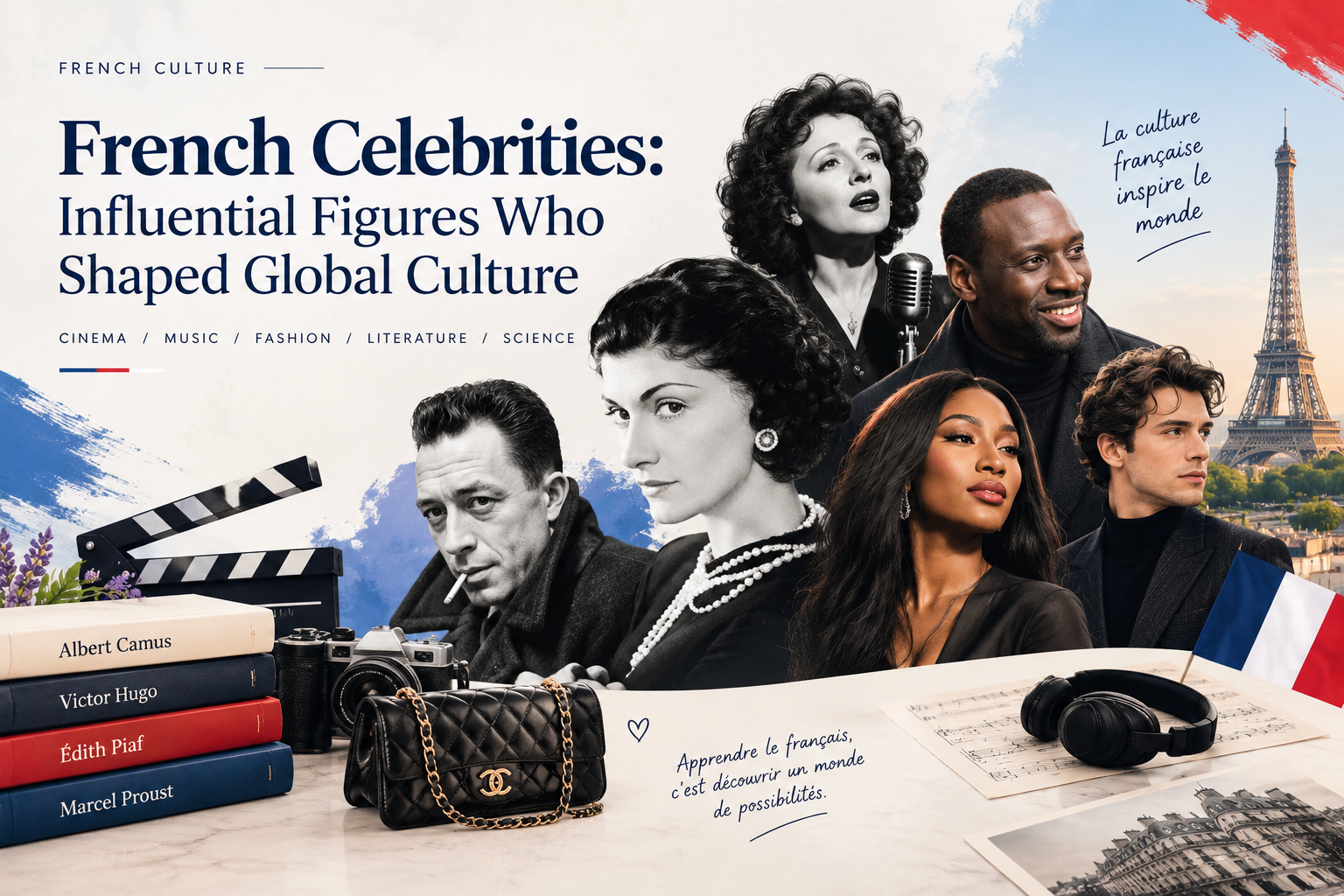
French celebrities have long served as cultural icons, carrying the spirit of France to screens, stages, runways, and bookshelves worldwide. From the poetry of Edith Piaf’s voice to the cinematic innovation of the Nouvelle Vague, from Coco Chanel’s timeless silhouettes to Albert Camus’s philosophical clarity, influential French figures keep redefining how the world imagines art, ideas, and lifestyle. This guide curates French and Francophone celebrities across cinema, music, fashion, literature, and science, then shows you how to use their work to learn French with purpose. If you love culture-driven learning, this is your map. And if you want structure plus inspiration, PrepFrench Classes gives you both: real French lessons shaped around films, music, and texts you actually care about. Want to start exploring? Begin at the PrepFrench homepage for a quick overview of our approach.
Why focus on cultural icons when you want to learn French? Because stories, songs, and style give vocabulary meaning, and context speeds up memory. Watching Omar Sy steal scenes in Lupin, reading a poem by Jacques Prévert, or following a Dior runway review in French, these are not distractions. They are accelerators that teach rhythm, register, and real-world expression. In short, learning through culture is not a detour. It is a shortcut to confidence.
Free First Step
Take the guesswork out of learning French.
Not sure where to begin, which course fits your goal, or how long it will take? Book a free demo class with PrepFrench Classes and get a personalized plan built around your level, schedule, and goals.
The Global Reach of French Culture
French culture travels far beyond Paris. The language itself connects communities on multiple continents, and Francophone artists influence everything from global fashion cycles to streaming charts. When you follow French celebrities, you are stepping into a vast network: music festivals in Montreal and Dakar, film awards in Cannes, and book fairs in Brussels. For learners, that means more entry points into real French usage and more motivation to keep going.
Linguistic Landscape: The Francophonie
The Organization internationale de la Francophonie estimates that there are over 320 million French speakers worldwide, with French used as an official language across parts of Europe, Africa, North America, and the Caribbean. This Francophone web amplifies the reach of French cultural icons, often blending regional styles that keep the language dynamic.
- Francophone artists collaborate across borders, like Belgian-Rwandan star Stromae and Ivorian-French singer Aya Nakamura.
- Film co-productions and festivals create international platforms for rising French actors and directors.
- Literary prizes such as the Prix Goncourt introduce authors to global readers in translation and in French.
If your goal is to speak French confidently, culture is a powerful ally. In our French courses, we often use short cultural clips and excerpts. Learners retain grammar faster when it is tied to a voice, a scene, or a lyric they love.
Cultural Influence: From Art to Science
French influence spans classical painting, couture, cinema, gastronomy, pop music, and major scientific breakthroughs. This breadth explains why French celebrities resonate across age groups and interests. Whether you admire Marie Curie’s scientific rigor or savor Angèle’s poetic pop, there is a doorway into the language that fits your taste.
- Art and design: the language of textures, colors, and silhouettes helps learners pick up concrete vocabulary.
- Film and TV: dialogue reveals tone, idioms, and how to handle real conversations.
- Music: repeated choruses and hooks make pronunciation and rhythm feel natural.
- Literature and philosophy: essays and novels sharpen comprehension and nuanced expression.
- Science and tech: specialized French expands career options and academic paths.
Cinema: French Celebrities Shaping Film
French cinema punched far above its weight long before streaming. From silent-era pioneers to Oscar winners, the country has given the world fresh genres, enduring stars, and brave storytelling. These figures do not only shape film history, they give learners rich, memorable French to imitate and analyze.
Icons of French Cinema: Historical Context
The Nouvelle Vague, led by Jean-Luc Godard and François Truffaut, redefined camera movement, narrative flow, and character psychology. Their influence runs through film schools worldwide. Legendary actors such as Catherine Deneuve and Alain Delon embodied a cool, luminous style that filmmakers still reference.
- Jean Dujardin won the Academy Award for Best Actor for The Artist, a tribute to silent film that charmed global audiences.
- Marion Cotillard won Best Actress for La Vie en Rose, bringing Edith Piaf’s story to millions.
- Isabelle Huppert, Juliette Binoche, and Audrey Tautou continue to connect with international viewers.
- Cannes Film Festival remains a global stage for French directors and actors to debut bold work.
Learning tip: choose one film scene and shadow the dialogue line by line. Pause, repeat, and record yourself. In many PrepFrench Classes, we use short scenes with transcripts to build pronunciation, intonation, and confidence, step by step.
Modern Milestones: Netflix and Beyond
Contemporary French screen culture thrives on streaming. Lupin, led by Omar Sy, became a global hit for its clever heists and playful French. Series like Call My Agent! introduced viewers to fast, funny Parisian dialogue and a cast of celebrity cameos. Filmmakers such as Céline Sciamma, Jacques Audiard, and Julia Ducournau keep pushing boundaries at festivals and on streaming platforms.
- Omar Sy’s Lupin spotlighted modern colloquial French with crisp, learnable phrases.
- Céline Sciamma’s Portrait of a Lady on Fire offered quiet, lyrical language and unforgettable imagery.
- Julia Ducournau’s Titane won the Palme d’Or, signaling France’s daring storytelling streak.
For learners, films provide natural repetition. Rewatch a favorite scene with French subtitles, then with no subtitles. In our online French classes, we teach students how to mine scenes for vocabulary and expressions they can use immediately in conversation.
Music: The Sounds of France
French music stretches from cabaret and chanson to hip-hop and electronic. That variety makes it a perfect language-learning lab, because melody anchors meaning and rhythm boosts memory. The best part: ten minutes with a song can teach you as much natural phrasing as an hour with a textbook.
Legendary Voices: Edith Piaf and Beyond
Chanson, the poetic heart of French music, finds its emblem in Edith Piaf. Her diction, emotion, and storytelling make lyrics accessible for learners. Serge Gainsbourg’s smoky wordplay influenced generations, while Jacques Brel, Charles Aznavour, and Barbara set the standard for lyrical depth and vocal clarity.
- Edith Piaf: study Non, je ne regrette rien for clear vowel sounds and dramatic phrasing.
- Charles Aznavour: listen to La Bohème for narrative vocabulary about art and memory.
- Serge Gainsbourg: explore La Javanaise for playful grammar and poetic turns.
Learning tip: print lyrics, underline verb forms, and highlight idioms. Sing along slowly, then at full tempo. This tightens French pronunciation and rhythm naturally.
Contemporary Icons: Daft Punk and More
Modern French music has global presence. Electronic duo Daft Punk collected multiple Grammys, including Album of the Year for Random Access Memories. Hip-hop and pop artists such as Aya Nakamura, Orelsan, Angèle, and PNL command massive audiences. DJs like David Guetta and DJ Snake dominate festivals and charts worldwide.
- Daft Punk: a gateway to French music culture, even with mostly English lyrics and French aesthetics.
- Aya Nakamura: teaches slang, modern expressions, and a relaxed delivery that many learners love.
- Angèle: clear enunciation and playful puns, great for intermediate learners.
- Stromae: intricate wordplay that rewards careful listening and lyric study.
Try a weekly routine: one new song on Monday, annotate lyrics on Tuesday, sing along on Wednesday, and use two new expressions in conversation by Friday. Music-themed activities are a staple in our French lessons, because they unlock steady, joyful practice.
Structured French Courses
Stop learning French the slow way.
Apps and random videos keep you stuck at beginner level forever. PrepFrench Classes gives you a structured path, a real teacher, and speaking practice that moves you forward at every lesson.
Available for: beginners · TEF/TCF exam prep · Canadian PR · work and daily French
Fashion: French Designers Rewriting Style
From haute couture to ready-to-wear, French fashion designers built the vocabulary of modern elegance. They did more than invent silhouettes, they popularized a lifestyle that balances restraint and creative risk. For learners, fashion journalism and runway interviews are rich sources of adjectives, textures, and opinion language.
Historical Impact: Chanel to Dior
Coco Chanel championed ease and simplicity: the little black dress, tweed jackets, pearls. Christian Dior’s New Look restored drama after wartime austerity. Yves Saint Laurent brought masculine tailoring to women and elevated prêt-à-porter. These shifts did not only transform closets, they reshaped how the world talks about beauty and identity.
- Coco Chanel: modern lines, functional elegance, and a new freedom for women’s fashion.
- Christian Dior: the New Look, cinched waists and full skirts, a return to opulence.
- Yves Saint Laurent: Le Smoking suit, prêt-à-porter, and fearless color.
- Hubert de Givenchy: refined minimalism and timeless gowns.
Learning tip: follow a French runway review and extract five descriptive adjectives. Practice turning them into comparative and superlative forms, then summarize a look in three sentences. This solidifies adjective agreement and style vocabulary quickly.
Modern Innovations: Sustainability in Paris Fashion
Modern Paris fashion houses are pivoting toward sustainability. Designers such as Marine Serre popularize upcycling, while heritage brands invest in traceable materials and craftsmanship. Interviews and brand manifestos offer accessible French, packed with words about materials, ethics, and production cycles.
- Marine Serre: distinctive crescent prints and upcycled textiles.
- Isabel Marant: wearable Parisian ease with bohemian notes.
- Christian Louboutin: instantly recognizable red soles and design storytelling.
Try a vocabulary sprint: matières, coupe, silhouette, couture, durable, artisanal, défilé, broderie, tailleur. Make two example sentences for each. Fashion themes appear frequently in our French course activities, since they train descriptive language you can use in any conversation.
Literature & Philosophy: The French Literary Giants
French literature and philosophy shaped global debates on freedom, love, morality, and society. Studying these voices cultivates nuance and critical thinking, which are essential for advanced speaking and writing. Even at beginner level, bilingual editions and simplified summaries make big ideas approachable.
Classics: Hugo, Camus, and de Beauvoir
Start with authors who frame moral questions in vivid scenes. Victor Hugo’s storytelling fuels empathy and vocabulary growth. Albert Camus, a Nobel laureate, writes with lucid sentences ideal for intermediate learners. Simone de Beauvoir’s essays open space for precise, persuasive French.
- Victor Hugo: Les Misérables and Notre-Dame de Paris, rich narratives and social themes.
- Albert Camus: L’Étranger and La Peste, clear prose that invites reflection.
- Simone de Beauvoir: Le Deuxième Sexe, influential feminist philosophy and argumentation.
- Marcel Proust: À la recherche du temps perdu, advanced but rewarding for style and memory.
Learning tip: read one paragraph aloud daily, annotate two expressions, and rewrite one sentence in your own words. This routine compounds quickly and stabilizes grammar intuition.
Modern Writers: Influence and Reception
Contemporary authors keep French literature energetic. Annie Ernaux and Patrick Modiano, both Nobel laureates, write with crystal clarity about memory and identity. Leïla Slimani’s novels blend social issues with propulsive plots. Michel Houellebecq, often controversial, sparks debates that teach argumentative vocabulary.
- Annie Ernaux: spare, autobiographical style that is excellent for focused reading practice.
- Patrick Modiano: elegant, concise prose and recurring themes of memory and place.
- Leïla Slimani: accessible sentences with strong narrative drive.
- Marguerite Duras: lyrical, minimalist experimentation with voice.
If you want structure while reading, join literature modules inside our online French classes. You will learn strategies to decode style, spot register, and reuse expressions in your own writing and speech.
Scientific & Intellectual Contributions
French science and philosophy underpin much of our modern understanding of health, mathematics, and human thought. Studying these figures not only expands knowledge, it also equips you with specialized French vocabulary for academic and professional contexts.
Pioneering Scientists: Pasteur to Curie
Louis Pasteur’s work in microbiology and vaccination revolutionized medicine. Marie Curie, a naturalized French scientist, earned two Nobel Prizes for research on radioactivity. Their legacies continue to shape how we approach disease, chemistry, and physics. Modern laureates and innovators maintain the tradition of rigorous inquiry.
- Louis Pasteur: pasteurization, vaccines, and germ theory.
- Marie Curie: discoveries on radioactivity, Nobel Prizes in Physics and Chemistry.
- Pierre Curie and Henri Becquerel: foundational work in radioactivity.
- Blaise Pascal: mathematics and early computing concepts.
- Cédric Villani: Fields Medalist known for kinetic theory and public science communication.
Learning tip: pick a three-minute interview with a French scientist, list ten domain words, then write a five-sentence summary in French. This exercise strengthens listening, technical vocabulary, and coherence.
Philosophical Innovations: From Descartes to Sartre
French philosophy developed clear frameworks for thinking about self, society, and knowledge. René Descartes championed method and doubt. Enlightenment figures like Voltaire, Rousseau, and Montesquieu influenced modern democracies. Twentieth-century voices such as Sartre, Beauvoir, Foucault, and Derrida reframed ethics, power, and language.
- René Descartes: rational method and the cogito.
- Montesquieu and Voltaire: political thought and civil liberty debates.
- Jean-Jacques Rousseau: social contract and education theory.
- Jean-Paul Sartre and Simone de Beauvoir: existentialism and freedom.
- Michel Foucault and Jacques Derrida: power, discourse, and deconstruction.
To build intellectual French, summarize a philosopher’s idea in one sentence, then create a two-sentence example from everyday life. In advanced French language classes, we use this method to turn abstract reading into active speaking practice.
PrepFrench Classes
Ready to start French with a clear plan?
Book a FREE demo class and get a personalized roadmap for your level, goal, and timeline. No pressure, no obligation.
Explore courses:
All French Courses · Full TCF Canada Course · Full TEF Canada Course
FAQ: French Celebrities, Culture, and Learning
Who are the most famous French cultural icons today?
Some of the most visible French celebrities today include Omar Sy (Lupin), Marion Cotillard, and Adèle Haenel in cinema, Aya Nakamura, Angèle, David Guetta, and Stromae in music, and designers like Isabel Marant and Marine Serre in fashion. In literature and thought, Annie Ernaux and Leïla Slimani are widely read. If your goal is to learn French, following these cultural icons gives you real language in action. Build a routine around short clips, lyrics, and interviews, then reinforce it through structured French classes with a teacher.
Which French filmmakers have received international recognition?
Historically, François Truffaut and Jean-Luc Godard shaped the Nouvelle Vague. More recently, Céline Sciamma, Jacques Audiard, and Julia Ducournau have earned major festival honors. Actors like Jean Dujardin and Marion Cotillard have won Academy Awards. For language learners, films provide high-quality input with authentic expressions. Combine curated film scenes with a guided French course to practice listening, shadowing, and speaking drills inspired by real dialogue.
How did French music influence global trends?
France impacted global music through chanson’s poetic storytelling, electronic innovation, and pop’s cross-border appeal. Edith Piaf and Charles Aznavour shaped vocal style and narrative songwriting. Later, Daft Punk, David Guetta, and DJ Snake fueled electronic and festival culture worldwide. Today, Aya Nakamura and Angèle dominate streaming. To learn French through music, annotate lyrics, sing along for pronunciation, and turn key phrases into mini speaking prompts in your online French classes.
What classic French literature should I read?
Start with Albert Camus’s L’Étranger for clear prose, then explore Victor Hugo’s Les Misérables or Shorter selections from Notre-Dame de Paris. Simone de Beauvoir’s essays build persuasive vocabulary, while Guy de Maupassant’s short stories are digestible for busy learners. Use bilingual editions initially, then switch to monolingual French. Read aloud to train pronunciation and rhythm. A structured reading plan inside PrepFrench Classes can match texts to your level and goals.
How can I learn French through cultural engagement?
Pick one cultural lane to start, then expand: a weekly film scene, a song with lyrics, or a short article about a fashion show. Follow the 3-step loop: consume a short piece, extract 8 to 12 expressions, then use two of them in a speaking or writing task. Repeat weekly. Culture keeps motivation high and vocabulary memorable. For a complete path, pair this routine with a guided French course where a teacher corrects pronunciation, grammar, and usage.
Final Thoughts
French celebrities carry more than star power. They give shape to how we imagine love, rebellion, elegance, humor, and discovery. When you engage with these cultural icons intentionally, you do not just learn French vocabulary, you gain a living context that anchors grammar and builds a lasting voice in the language. Start small, stay consistent, and keep your learning joyful.
PrepFrench Classes turns that inspiration into a plan. We teach you how to mine films, songs, runway reviews, and short texts for phrases that convert quickly into speaking confidence. With a teacher guiding each step, you will move beyond passive input and start using French actively in every lesson.
✅ Next Step: Book a free demo class with PrepFrench Classes and start learning French the right way.
Explore the celebrities and works mentioned here, then bring your notes to class. Culture sets the spark, and a structured path keeps the flame bright.
Written by
Platform Administrator
Practical ideas from the Prep French team for learners building confidence, preparing for exams, and planning their next step in Canada.
Join the discussion
Leave a thoughtful comment.
Your email address will not be published. Comments are reviewed before appearing.