French Accent Marks: A Beginner’s Guide to Rules and Usage
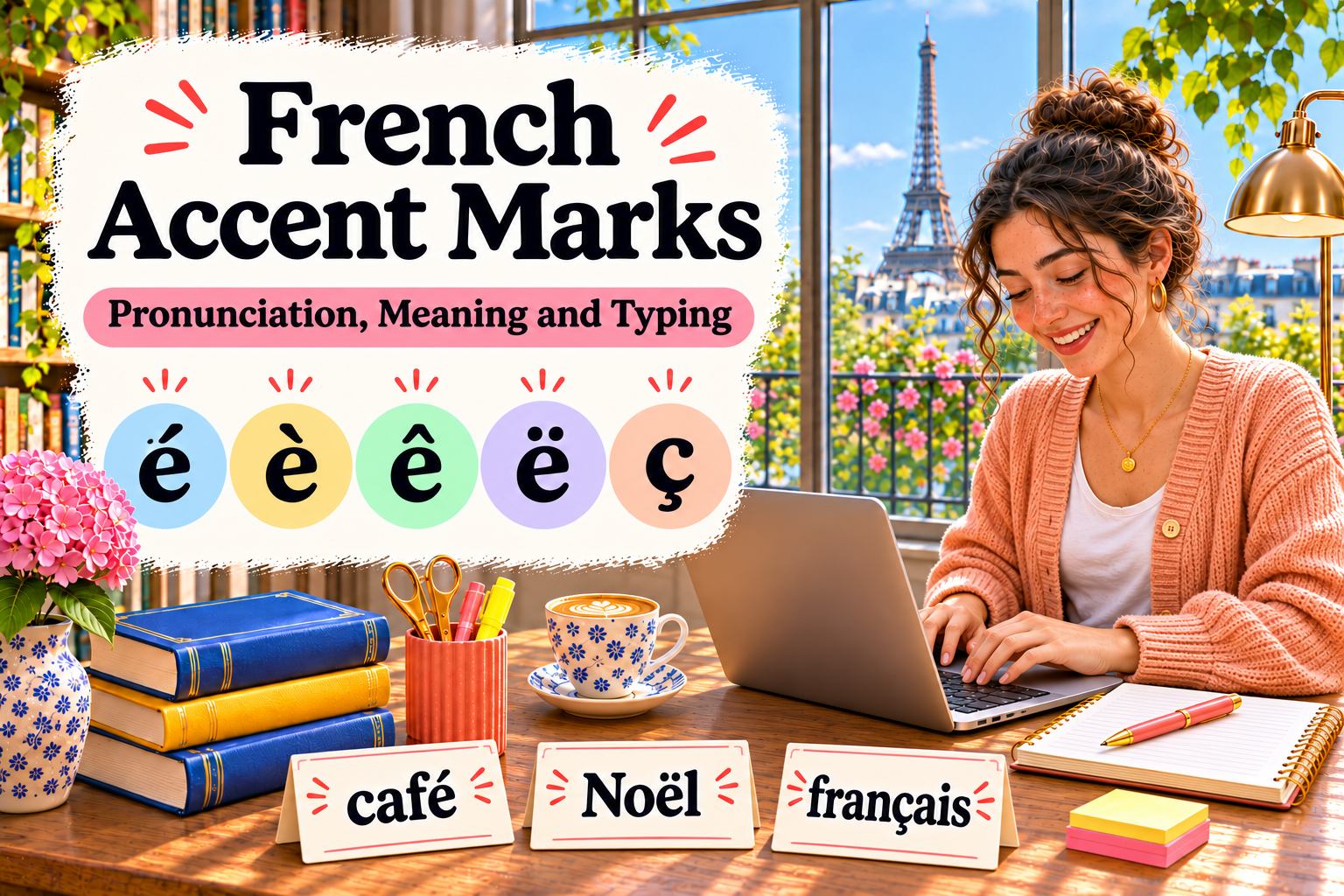
The Complete Beginner's Guide to French Accent Marks
French accent marks are small signs with big impact. For beginners in French classes, these accents shape pronunciation, guide stress, and change meaning. Write cote instead of côte or côté, and you do not just miss a decoration, you create a new word. In this beginner-friendly guide, you will learn what the five French accents are, why they matter, and how to type them on any device. You will also see the current French accent rules for capital letters and the key takeaways from the 1990 spelling reforms that affect accents. Throughout, we will give examples, practical tips, and a quick reference chart you can return to while you learn French with PrepFrench Classes.
Whether you are taking an online French course, preparing for daily conversation, or starting French for beginners, mastering French accents is part of building accuracy and confidence. If you want structured help, PrepFrench offers clear, practice-based lessons that make French pronunciation and writing feel logical.
Free First Step
Take the guesswork out of learning French.
Not sure where to begin, which course fits your goal, or how long it will take? Book a free demo class with PrepFrench Classes and get a personalized plan built around your level, schedule, and goals.
What Are French Accent Marks?
Overview of the Five Accent Marks
French accent marks, also called French diacritics, are symbols that appear above or below letters to indicate pronunciation or meaning. There are five in total. Four of them sit on vowels, and one appears under the letter c.
- Accent aigu (é): found only on e. It usually signals the closed sound like in café, été, école.
- Accent grave (è, à, ù): found on e, a, u. On e it opens the vowel, like père or très. On a and u, it generally distinguishes meaning, like à versus a, où versus ou.
- Accent circonflexe (â, ê, î, ô, û): can sit on all five vowels. It often marks historical spelling where an s used to follow the vowel, like forêt from Latin forest. It may distinguish meaning, like sur versus sûr.
- Tréma (ë, ï, ü, ä, ö in borrowings): signals that two adjacent vowels must be pronounced separately, like Noël or maïs.
- Cédille (ç): placed under c before a, o, u to give it the soft s sound, like français or leçon.
In French orthography accents are part of correct spelling, not optional decorations. They guide pronunciation, avoid ambiguity, and sometimes encode grammar. For learners in a French course, getting them right early will save time and corrections later. PrepFrench covers these accents in our beginner French lessons, then revisits them in writing and pronunciation drills so that knowledge turns into habit. Explore how our French courses sequence these skills for faster progress.
The Importance of Accents in French
Why do French accents matter so much? Three reasons: pronunciation clarity, meaning, and credibility in writing.
- Pronunciation: é and è are not the same sound. The wrong accent can mislead your listener. Accents help you read new words correctly when you meet them in texts or exercises.
- Meaning: à versus a, ou versus où, du versus dû. One small sign can flip a sentence.
- Credibility: In emails, CVs, and exams, missing accents signal carelessness. Good control of French accents shows that you respect the language and your reader.
How French Accents Change Meaning
Common Minimal Pairs
Many short French words are identical except for one accent. Change the accent, change the function or the meaning. Here are pairs beginners meet often in French lessons.
- a versus à: a is the third person of avoir, as in il a un livre. à is the preposition to or at, as in il va à Paris.
- ou versus où: ou means or, as in thé ou café. où means where, as in où est la gare ?
- la versus là: la is the article the for feminine singular, as in la fille. là means there, as in mets-le là.
- du versus dû: du is a contraction of de + le or a partitive article, as in du pain. dû is the past participle of devoir, as in j’ai dû partir.
- sur versus sûr: sur means on, as in sur la table. sûr means sure or certain, as in je suis sûr.
- mur versus mûr: mur is a wall. mûr means ripe or mature.
- tache versus tâche: tache is a stain. tâche is a task.
Examples of Meaning Changes
French accent marks also split families of words that look similar. Circonflexe often indicates a historical s, which still appears in related forms. Recognizing this link helps with vocabulary building.
- forêt (forest) relates to forestier. The circonflexe on ô or ê often maps to an old s in a related word.
- hôtel links to hospitalité historically. You will see this pattern with others like côte and côtier.
- cote, côte, côté: three distinct words. cote is a rating or quotation, côte is a coast or rib, côté is a side.
- jeune versus jeûne: jeune means young. jeûne means a fast, as in Ramadan or intermittent fasting.
In PrepFrench Classes, we practice minimal pairs aloud and in short dictations to synchronize your ear, your hand, and your eye. That makes accents feel like normal spelling choices rather than extra rules to memorize. If pronunciation is a pain point, tell your French teacher during your free demo, and we will tailor exercises to target your needs.
Quick Guide to Typing French Accents
Typing French accents fast removes the biggest barrier to correct writing. Here is how to add French accents on Windows, Mac, iPhone, and Android, with easy options for any setup. In our online French classes we recommend choosing one method and practicing until it is automatic.
Typing Accents on Windows
- Use the US International layout:
- Go to Settings, Time & Language, Language & Region.
- Add a keyboard: choose English - United States - International.
- Type using dead keys:
- ' then e gives é. ` then e gives è. ^ then e gives ê. " then e gives ë. Right Alt + c gives ç.
- For uppercase, hold Shift as needed: ' then Shift + E gives É.
- Use Alt codes on the numeric keypad:
- Hold Alt and type a code on the numpad: é = Alt+0233, è = Alt+0232, ê = Alt+0234, ë = Alt+0235, à = Alt+0224, â = Alt+0226, ù = Alt+0249, û = Alt+0251, ô = Alt+0244, î = Alt+0238, ï = Alt+0239, ç = Alt+0231.
- Uppercase versions use different codes: É = Alt+0201, À = Alt+0192, Ç = Alt+0199.
- Install a French keyboard:
- Add French keyboard in Settings. Choose French - France or Canadian French.
- Learn key positions quickly, or place a small sticker guide. Accents are direct keys in this layout.
Typing Accents on Mac
- Long press on a letter: Hold e to see a popup, then press the number for é, è, ê, ë. Works for a, i, o, u, c as well.
- Use Option key shortcuts:
- Option + e, then letter gives acute: Option + e, then e gives é.
- Option + `, then letter gives grave: Option + `, then e gives è, then a gives à.
- Option + i, then letter gives circumflex: Option + i, then e gives ê.
- Option + u, then letter gives tréma: Option + u, then e gives ë.
- Option + c gives ç. Shift for uppercase: Shift + Option + c gives Ç.
- Switch to French layout if you prefer: System Settings, Keyboard, Input Sources, add French. The layout provides direct keys for accents.
Typing Accents on Mobile Devices
- iPhone and iPad: Long press a letter to display accent options, then slide to the character you want: é, è, ê, ë, à, â, ù, û, ô, î, ï, ç. Enable French autocorrect if you text in French often.
- Android phones and tablets: Long press a letter for the accent menu. Slide to the accented character. You can add a French keyboard in Settings, System, Languages & Input for better suggestions and spellcheck.
- Practice tip: In PrepFrench Classes we give a two-minute daily typing drill that cycles through é, è, ê, ç, à, ù. After one week, most learners type accents without thinking.
Prefer guided practice and accountability? Browse our structured French courses or ask for a quick typing walk-through during your demo lesson with PrepFrench.
Structured French Courses
Stop learning French the slow way.
Apps and random videos keep you stuck at beginner level forever. PrepFrench Classes gives you a structured path, a real teacher, and speaking practice that moves you forward at every lesson.
Available for: beginners · TEF/TCF exam prep · Canadian PR · work and daily French
Current Rules and Norms About French Accents
Rules around French accents are stable, yet modern usage includes a few helpful updates. Two topics matter most for learners: accents on capital letters and the optional use of certain circumflex accents after the 1990 orthographic reforms. At PrepFrench we teach the current standard, while also showing what you are likely to see in newspapers and online.
Capitalization and Accents
Do capital letters in French take accents? Yes. They should. Accents are part of the spelling of words in both lowercase and uppercase. That means École, À Paris, and ÇA are correct. Omitting accents on capitals is a typographical limitation from old typewriters, not a rule of French orthography. Many style guides and dictionaries emphasize this point for clear reading and correct meaning.
- Write État and États-Unis, not ETAT or Etats-Unis.
- Write À bientôt and Ça va ? with correct diacritics.
- In headlines, keep accents on capitals whenever your tool or font allows it. Modern tools do.
The 1990 Orthographic Reforms
The 1990 reforms, proposed by the Conseil supérieur de la langue française and acknowledged by major references, made some spellings simpler or more consistent. Both traditional and reformed spellings are generally accepted today. For French accent marks, the most visible changes involve the circumflex on i and u.
- Circumflex on i and u often optional: For many words, like coût or goûter, you may write cout or gouter. The version with the accent is still common. Choose one style and stay consistent in a document.
- Circumflex retained where meaning may change: Keep it in forms like dû (past participle of devoir) to avoid confusion with du, and mûr to distinguish from mur.
- é/è variants accepted in some words: Traditional événement and reformed évènement both appear. You will see event spelled both ways in quality publications.
- Hyphen and compound updates: While not only about accents, the reforms standardized compounds and numerals. This affects overall spelling habits in French writing classes.
PrepFrench integrates these updates into our writing modules. We show you the form you will meet most in daily life, and we explain when the alternative is acceptable. If you write for a company or an exam, follow the style they prefer, and use accents consistently throughout.
Common Mistakes and How to Avoid Them
Here are frequent errors with French accents, plus memory cues to stop repeating them. Building a short checklist in your notebook is a good habit during French lessons.
Mistakes with Capitalization
- Dropping accents on capitals: Incorrect: ETE, A PARIS, CA VA. Correct: ÉTÉ, À PARIS, ÇA VA.
- Using the wrong accent on uppercase É: Do not replace é with e on capitals. Learn to type É on your device to keep titles and names correct.
- Inconsistent style: Mixing États-Unis and Etats-Unis in the same document looks careless. Choose the accented standard throughout.
Typing Errors with Accents
- é vs è confusion: Think of café and père. Café is a sharp, closed sound (é). Père is a more open sound (è). Hearing the difference gets easier with minimal pair practice.
- Forgetting the cedilla: Write ça, garçon, leçon. Without ç before a, o, u, c becomes a hard k sound.
- Ignoring the tréma: Noël, Haïti, maïs. The tréma tells you to pronounce vowels separately.
- Skipping à and ù: à and ù rarely change sound, yet they change meaning. Keep them in short words like à and où.
- Autocorrect issues: Set your device language to French when you write in French. Otherwise, English autocorrect often strips accents.
Tip: Create a personal “accent watchlist” with 10 high-frequency words you often miss: déjà, très, où, à, ça, sûr, côté, hôtel, français, Noël. Write them three times each at the end of a study session. In two weeks you will stop making those slips. If you want accountability and correction, join an online French class at PrepFrench and ask your French tutor to track accent errors in your writing.
Quick Reference Chart
Use this chart to review the five French accents, their functions, and quick examples. Save it or print it as a study aid alongside your French vocabulary list.
| Accent | Shape | Letters | Key Function | Examples | Notes |
|---|---|---|---|---|---|
| Accent aigu | é | e only | Closed e sound, often marks past participles or set spellings | café, été, fêté, étudiant | Common in word endings -é and -ée |
| Accent grave | è, à, ù | e, a, u | Open e sound on è, meaning distinction on à and ù | père, très, à, où | à vs a, où vs ou are classic minimal pairs |
| Accent circonflexe | â, ê, î, ô, û | a, e, i, o, u | Historical marker, sometimes meaning distinction | forêt, hôtel, sûr, tâche, mûr | Often optional on i and u since 1990, except where needed for meaning |
| Tréma | ë, ï, ü | e, i, u (also a, o in borrowings) | Indicates two vowels are pronounced separately | Noël, maïs, haïr, aiguë | Helps avoid diphthongs where French expects two beats |
| Cédille | ç | c before a, o, u | Turns c into an s sound before back vowels | garçon, leçon, ça, français | Never used before e or i, because ce and ci are already soft |
Want printable practice and a teacher to review your writing? The easiest next step is to try a class with PrepFrench. Our French teachers give targeted feedback on accents until they become automatic.
PrepFrench Classes
Ready to start French with a clear plan?
Book a FREE demo class and get a personalized roadmap for your level, goal, and timeline. No pressure, no obligation.
Explore courses:
All French Courses · Full TCF Canada Course · Full TEF Canada Course
FAQ: French Accent Marks and Practical Use
Do capital letters in French take accents, and why does it matter?
Yes, capital letters in French must take accents. Accents are part of standard spelling in French orthography, not optional add-ons. Writing École, À Paris, and Ça va keeps meaning clear and pronunciation predictable. Without accents, readers may stumble or misunderstand, especially in minimal pairs like A versus À. Modern keyboards and fonts fully support uppercase accents, so there is no technical reason to omit them. In French classes and professional writing, keeping accents on capitals shows accuracy and respect for the language.
What’s the difference between é and è in pronunciation and usage?
É (accent aigu) is a closed e, similar to the vowel in café. È (accent grave) is an open e, as in père or très. In usage, é often appears in set spellings and past participles, like parlé or décidé, whereas è appears in words with open e, like mère, après, and collège. Getting this contrast right helps your French pronunciation sound natural. In PrepFrench lessons, we practice minimal pairs and short readings, training your ear to hear and produce both sounds easily while you learn French.
When must I use the circumflex (â, ê, î, ô, û), and when is it optional after the 1990 reform?
Use the circumflex when it distinguishes meaning or is part of the common standard, as in sûr versus sur, mûr versus mur, and the past participle dû versus du. After the 1990 reform, the circumflex on i and u is often optional in words like cout or gouter, though accented forms coût and goûter remain frequent. On a, e, o, the circumflex still appears widely in words like hôtel, forêt, or tâche. In a French course, your teacher will help you choose a consistent style that fits your goals and readers.
How do I type French accents on Windows, Mac, iPhone, and Android?
Windows: use the US International layout for easy dead keys, or type Alt codes like Alt+0233 for é. Mac: long press letters, or use Option shortcuts, for example Option+e then e gives é. iPhone and iPad: long press a letter, then slide to the accent you need. Android: long press letters as well, or add a French keyboard for better suggestions. In PrepFrench Classes we teach one reliable method, then use short drills until typing accents becomes automatic in your French writing.
When do I use the cedilla (ç), and can it appear before e or i?
Use the cedilla under c before a, o, or u to create a soft s sound: ça, garçon, leçon, français. You never need ç before e or i, because ce and ci are already soft. So write ce, ceci, and merci without a cedilla. If you add the cedilla in the wrong place, you double-mark a sound and create a spelling error. A simple memory trick from French lessons: think “ça” and “garçon” as anchor words, then apply the same rule anywhere you see ca, co, cu with a soft s sound.
Final Thoughts
French accent marks are not a bonus skill, they are the spelling system in action. Once you know what each accent does, how it changes meaning, and how to type it quickly, your French writing and pronunciation improve together. Follow the current rules for capitals, apply the practical updates from the 1990 reforms, and keep a small watchlist of words you miss often. With a few weeks of guided practice, accents stop feeling like rules and start feeling like muscle memory.
If you want a structured path, a supportive French teacher, and regular correction, join PrepFrench Classes. Our online French classes give you step-by-step lessons, speaking practice, and writing feedback that accelerate progress. Whether you are just starting to learn French or refreshing your skills for work and life, we will help you master accents and much more.
✅ Next Step: Book a free demo class with PrepFrench Classes and start learning French the right way.
Want study structure and consistent practice with feedback? Browse our French courses or say hello on the PrepFrench homepage.
Written by
Platform Administrator
Practical ideas from the Prep French team for learners building confidence, preparing for exams, and planning their next step in Canada.
Join the discussion
Leave a thoughtful comment.
Your email address will not be published. Comments are reviewed before appearing.