
English vs French: Similarities and Key Differences Explained
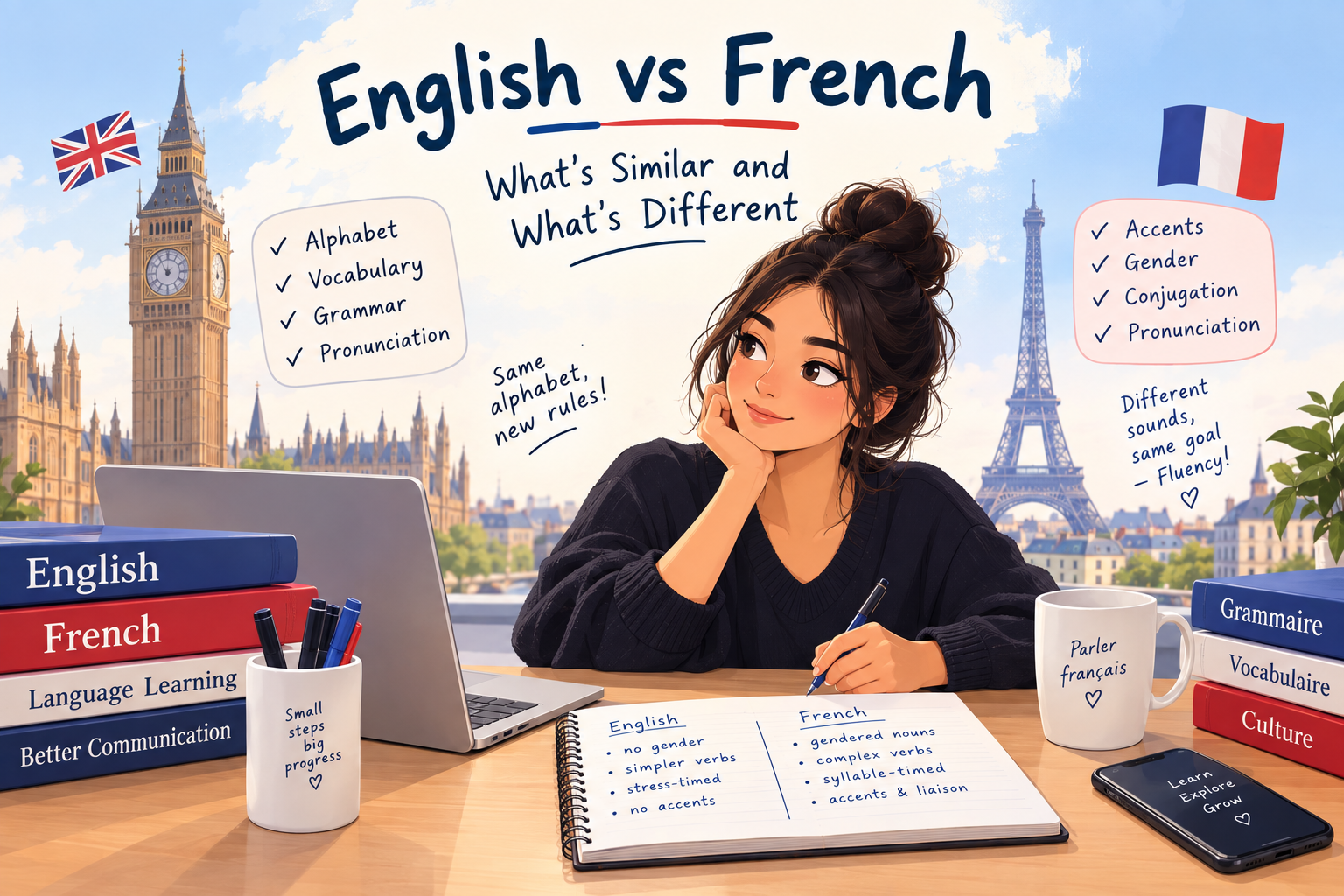
English vs French is a comparison many learners make on day one. Both languages use the Latin alphabet and share a lot of vocabulary, yet they diverge in pronunciation, grammar, and writing habits. Understanding the similarities between English and French helps you learn faster. Knowing the key differences between English and French prevents common mistakes that stall progress. This guide gives you a practical, example-rich tour of pronunciation, grammar, vocabulary, and the writing system, with clear tips and mini-exercises you can start today. Throughout, you will see how PrepFrench Classes structures its French lessons for English speakers and where to find the right French course to match your goals.
- Alphabet and writing: Latin script for both, but French uses accents and slightly different punctuation rules.
- Pronunciation: French has nasal vowels, predictable stress, and liaison, while English relies on stress timing and varied vowel quality.
- Grammar: French has gender, richer verb conjugations, agreement rules, and flexible question formats.
- Vocabulary: Many cognates exist, yet false friends can mislead beginners if not handled carefully.
- Learning approach: Focus on sounds early, learn vocabulary with gender, and practice consistently with feedback.
Want structured support built for English speakers? PrepFrench offers French courses and free demo classes to help you learn French with a clear plan.
Free First Step
Take the guesswork out of learning French.
Not sure where to begin, which course fits your goal, or how long it will take? Book a free demo class with PrepFrench Classes and get a personalized plan built around your level, schedule, and goals.
The Alphabet and Writing System
Both English and French use the Latin alphabet, which is a big advantage for learners. The difference appears in how French marks sounds and meaning with diacritics. Understanding the French alphabet and accents will help you read correctly and avoid confusing similar words. You will also need to adjust capitalization and punctuation habits that feel natural in English but incorrect in French.
Diacritics in French
French uses accents that change pronunciation, sometimes meaning. Mastering them early is worth it, because they guide you toward the right sound and help you guess grammar patterns.
- Acute accent (é): café, étudiant. It often signals a closed sound similar to the vowel in “they,” without the off-glide.
- Grave accent (è, à, ù): père, très. For e, it opens the sound, closer to “bed.” On à and ù, it distinguishes words (a vs à, ou vs où).
- Circumflex (â, ê, î, ô, û): hôpital, forêt. Often shows a historical missing s, and may lengthen or round the vowel slightly.
- Diaeresis or trema (ë, ï, ü): naïf, maïs. It separates vowels so both are pronounced.
- Cedilla (ç): garçon, façade. It makes c sound like s before a, o, u.
Meaning changes with accents: cote, côté, and côte are three different words. Likewise ou means or, while où means where. PrepFrench lessons spend time on these from day one, since accurate reading connects directly to accurate speaking.
Capitalization Rules
French capitalization is lighter than English. This reduces visual noise and tells you important grammar cues.
- Days, months, languages, and nationalities are not capitalized: lundi, janvier, le français, un étudiant américain.
- Titles use sentence-style capitalization: Le seigneur des anneaux, not The Lord of the Rings style capitalization.
- Formal you (vous) is not capitalized unless at the start of a sentence.
Punctuation Differences
French punctuation spacing and symbols can surprise English speakers. Getting them right improves readability and looks professional in emails or exams.
- Before ; : ? ! you add a thin space in standard French typography: Bonjour ! Comment ça va ?
- Quotation marks often use guillemets: « Bonjour », dit-elle.
- Decimals use a comma, and thousands often use a space: 3,14 and 1 000.
In PrepFrench Classes, we cover these writing conventions inside every beginner French course and reinforce them with short email and message practice. You can explore our French courses to see how we build reading and writing together with speaking.
English vs French: Pronunciation and Phonetics
French pronunciation vs English brings two big shifts: vowel quality and rhythm. French is more syllable timed, with even beats, while English is stress timed, with reductions on unstressed syllables. French also has nasal vowels and regular final-sound patterns, plus liaison between words. Once you learn the system, French becomes more predictable than it first appears.
Common Pronunciation Challenges
- Nasal vowels: an, en, in, ain, un, on. Compare pain [pan nasal], pin [pan with a different nasal vowel], and pont [po nasal]. Air comes through the nose without closing the mouth.
- Final consonants: often silent. Parlez ends in a silent z, grand drops the final d in isolation, but liaison can bring it back before a vowel, as in grand ami [gran ta mi].
- French u vs ou: u in tu is a fronted sound, different from ou in tout, which sounds like the oo in “food.”
- Steady vowels: avoid the off-glides common in English. French é is pure, not “ay-uh.”
- Even rhythm: each syllable gets time. Avoid strong-schwa reduction habits like in American English.
Unique Sounds in French
- Front rounded vowels: u [y] in tu and eu [ø, œ] in deux and soeur. Shape your lips as for “oo,” but push the tongue forward as in “ee.”
- Nasal vowels: un [œ̃], on [ɔ̃], an/en [ɑ̃]. Minimal pairs help: beau [bo] vs bon [bɔ̃].
- R sound: a back-of-the-throat fricative. Practice with rire, trois, très, arriver, starting gently to avoid tension.
- Liaison: link final consonants to following vowel-initial words: les amis [lez ami], vous avez [vu zave]. It improves flow and comprehension.
Good news: French spelling closely mirrors pronunciation rules once you learn the patterns. PrepFrench Classes includes targeted pronunciation coaching inside all beginner French lessons, with feedback that trains your ear and your mouth quickly. To compare programs, visit our courses page or message us for a free demo class.
Structured French Courses
Stop learning French the slow way.
Apps and random videos keep you stuck at beginner level forever. PrepFrench Classes gives you a structured path, a real teacher, and speaking practice that moves you forward at every lesson.
Available for: beginners · TEF/TCF exam prep · Canadian PR · work and daily French
Grammar Differences
English and French grammar differences show up early: grammatical gender, agreement, richer verb conjugations, and multiple ways to form questions and negatives. Once you see the patterns, they repeat predictably and give your French real precision.
Gender and Agreement
Every French noun has a gender, masculine or feminine. Articles, adjectives, and some pronouns must agree with that gender and with number. You will hear and see these agreements, which helps comprehension.
- Articles: le livre, la voiture, les enfants.
- Adjective agreement: un livre rouge, une voiture rouge; un petit chien, une petite maison, des petites maisons.
- Possessives follow the noun’s gender and number, not the owner: mon ami, ma sœur, mes parents. Before a feminine noun starting with a vowel, use mon for easier sound flow: mon amie.
Strategy: learn nouns with their articles, color code masculine and feminine in your notes, and practice short description phrases so agreement becomes automatic.
Verb Conjugation Overview
French verbs change form with each subject. Regular patterns make most of it learnable with focused practice. Here is a quick present-tense snapshot of speak vs parler.
| Subject | English | French | Pronunciation tip |
|---|---|---|---|
| I / je | I speak | je parle | Final e is silent, say [parl]. |
| You / tu | You speak | tu parles | -s is silent in isolation. |
| He/She / il, elle | He speaks | il/elle parle | Same sound as je parle. |
| We / nous | We speak | nous parlons | Pronounce -ons as [ɔ̃]. |
| You / vous | You speak | vous parlez | -ez sounds like [e]. |
| They / ils, elles | They speak | ils/elles parlent | -ent is silent, say [parl]. |
Two more quick contrasts:
- Progressive aspect: English uses I am speaking. French usually uses the simple present, je parle, or je suis en train de parler for emphasis.
- Past events: French often uses the compound past, passé composé: j’ai parlé, literally I have spoken.
French also has many reflexive verbs, which express actions done to oneself: je me lève, je m’appelle. These add variety but follow stable patterns once you learn placement and agreement.
Formulating Questions
French offers three main ways to ask questions. All are correct in the right context, and all appear in real life.
- Rising intonation: Tu parles français ? Natural and common in speech.
- Est-ce que: Est-ce que tu parles français ? Clear and neutral for learners.
- Inversion: Parles-tu français ? More formal or written, also common with adverbs: Où habites-tu ?
Negation wraps around the conjugated verb: Je ne parle pas. In casual speech, ne often drops: Je parle pas. Object pronouns sit before the verb, or before the auxiliary in compound tenses: Je le vois, Je l’ai vu. PrepFrench Classes teach these in short, memorable drills, then move immediately to conversation practice so the rules stick. Browse our online French classes to see the full grammar path.
Vocabulary: Cognates and False Friends
English and French share thousands of cognates thanks to history. This is a gift for learners, because it accelerates reading and listening. At the same time, false friends between English and French can cause confusion. A practical approach is to use cognates for speed while double-checking words that look similar but behave differently.
Common Cognates
- Restaurant, minute, musicien, important, animal, télévision, hôpital, université, culture, naturel.
- Verb families: préparer, organiser, terminer, discuter, accepter, téléphoner.
- Abstract nouns: information, invitation, décision, motivation, communication.
Watch for small spelling or accent shifts, then confirm pronunciation rules you learned earlier.
Hazards of False Friends
- Actuellement = currently, not actually. Réellement is actually.
- Librairie = bookstore, not library. Bibliothèque is library.
- Sensible = sensitive, not sensible. Raisonnable is sensible.
- Assister à = to attend, not to assist. Aider is to assist.
- Collège = middle school, not college. Université is college or university.
- Blessé = injured, not blessed. Bénit is blessed.
- Location = rental, not location. Lieu or emplacement is location.
- Réaliser = to achieve or carry out, not to realize mentally. Se rendre compte means to realize.
- Préservatif = condom, not preservative. Conservateur is preservative.
Strategy: add a short example sentence to each new word to lock meaning. PrepFrench builds vocabulary sets that pair high-value cognates with the top false friends, so you get speed without traps. Explore how we teach vocabulary inside our French courses.
Learning Strategies for English Speakers
- Prioritize sounds: train u, ou, eu, and the French r during week one. Short daily drills beat long weekend sessions.
- Learn nouns with gender: always store words with an article, for example le temps, la chance, l’eau.
- Use frequency: master the top 30 verbs in present and passé composé, then add common reflexives.
- Shadow for rhythm: repeat short audio exactly, matching syllable timing, intonation, and liaison.
- Write to speak: compose three short messages per week, then read them aloud and record yourself.
- Chunk grammar: learn question formats and negation as templates, then plug in new verbs and objects.
- Build cognate speed, but flag false friends: make a two-column list and review weekly.
- Get feedback: a teacher corrects small habits before they solidify. It saves months of relearning.
When you learn French with guidance, progress compounds quickly. PrepFrench Classes offers structured paths for complete beginners, with bite-size pronunciation coaching and conversation practice from lesson one. If you want a personal roadmap, request a free demo class and we will map your next 8 weeks clearly.
Mini Practice Section
Try these short drills to apply what you just read. Keep them simple and focused. Five minutes per item is enough to feel the system work.
Pronunciation Drills
-
Front vowels: u vs ou vs eu. Read aloud: tu, tout, deux, rue, nous, bleu. Record yourself and compare to a native model. Tip: for u, round lips as for “oo,” move tongue forward as for “ee.”
-
Nasal sets: an/en, in/ain, on, un. Minimal pairs: beau vs bon, plat vs plan, tu vs un. Hold the vowel, then release the consonant cleanly.
-
Liaison: read these phrases smoothly with linking where marked: les‿amis, vous‿avez, petit‿enfant, un‿excellent café. Keep rhythm even.
Grammar Exercises
-
Agreement: complete with correct article and adjective form.
- ___ maison est ___ (petit). Answer: La maison est petite.
- Ce sont ___ (nouveau) étudiants. Answer: Ce sont de nouveaux étudiants.
- J’ai ___ (beau) idées. Answer: J’ai de belles idées.
-
Negation and questions: transform.
- Tu aimes le café, in negation: Tu n’aimes pas le café.
- Il travaille ici, with est-ce que: Est-ce qu’il travaille ici ?
- Vous parlez anglais, with inversion: Parlez-vous anglais ?
-
Cognates or false friends: label and correct if needed.
- Assister à un cours = attend a class, true friend in meaning but not in form.
- Actuellement, je vis à Paris = currently, not actually, false friend alert.
- La librairie du coin = the bookstore, not the library, false friend.
If you want more structured drills with feedback, PrepFrench runs short practice blocks inside every lesson. You can explore the approach on the PrepFrench homepage and the courses page.
PrepFrench Classes
Ready to start French with a clear plan?
Book a FREE demo class and get a personalized roadmap for your level, goal, and timeline. No pressure, no obligation.
Explore courses:
All French Courses · Full TCF Canada Course · Full TEF Canada Course
FAQ: English vs French for Learners
Do English and French share the same alphabet?
Yes, both use the Latin alphabet, which makes reading less intimidating at first. The difference is that French adds diacritics to letters, for example é, è, â, ç, and ï, which guide pronunciation and sometimes meaning. Learners should focus on the French alphabet and accents early, because they help you sound out words accurately and avoid confusion with lookalike words. In PrepFrench Classes, we teach reading, accents, and common spelling patterns in the first few French lessons so that learners can read menus, signs, and messages with confidence.
What are the biggest pronunciation differences between English and French?
French has nasal vowels, front rounded vowels like u in tu and eu in deux, and a back-of-the-throat r. Stress and rhythm also differ: French is more syllable timed, with even beats, while English is stress timed with reductions. Many final consonants are silent, and liaison links words for smooth flow. If you want faster results, practice minimal pairs, record yourself daily, and work with a French teacher who can correct mouth and tongue placement. PrepFrench offers pronunciation coaching inside every beginner French course.
How do French verb conjugations differ from English?
English verbs change minimally, for example speak and speaks, while French verbs change for every subject. Regular -er verbs like parler have endings that repeat across thousands of verbs, which means you can learn the pattern and reuse it. French also uses compound tenses like passé composé with auxiliaries avoir and être, as in j’ai parlé or je suis allé. You can learn French conjugations efficiently by mastering the top 30 verbs first, then adding past and future forms. Structured French classes help you practice these patterns in real sentences.
What are common French–English false friends?
Some high-frequency traps include actuellement, which means currently, not actually, librairie, bookstore, not library, sensible, sensitive, not sensible, assister à, attend, not assist, and préservatif, condom, not preservative. Others are collège, middle school, not college, blessé, injured, not blessed, and location, rental, not location. The best approach is to add example sentences and review them weekly. In PrepFrench Courses, we pair each false friend with a correct English partner and quick practice so you remember the difference when speaking or writing.
Why does French have grammatical gender?
French inherited grammatical gender from Latin and earlier stages of the language. Gender is not about biological sex, it is a grammatical system that organizes nouns and triggers agreement on articles, adjectives, and some pronouns. While it feels unfamiliar for English speakers, it follows patterns that become predictable with practice. Learn each noun with its article and notice common endings that tend to be masculine or feminine. In online French classes with PrepFrench, we teach gender using color coding, sound cues, and quick repetition so agreement becomes automatic in conversation.
Final Thoughts
When you compare English vs French carefully, you see a balanced picture. There are real similarities between English and French that speed up reading and vocabulary growth, while predictable differences in pronunciation and grammar demand focused practice. With a clear plan, you can turn these contrasts into stepping stones.
Start with sounds, add gender-coded vocabulary, and build verb patterns in short daily sessions. Use cognates for momentum, but keep a running list of false friends. Most importantly, get feedback through structured French lessons so you do not reinforce avoidable mistakes. PrepFrench Classes is built around this approach, combining pronunciation, grammar, and conversation from the first class.
If you want guidance that fits your goals, timeline, and level, explore the PrepFrench homepage or book a free demo to get your custom learning plan.
✅ Next Step: Book a free demo class with PrepFrench Classes and start learning French the right way.
If you have more questions or need personalized guidance, feel free to reach out to PrepFrench. We are here to help you learn French with clarity and confidence.
Written by
Platform Administrator
Practical ideas from the Prep French team for learners building confidence, preparing for exams, and planning their next step in Canada.
Join the discussion
Leave a thoughtful comment.
Your email address will not be published. Comments are reviewed before appearing.