
French Education System: Schools, Grading and Academic Standards
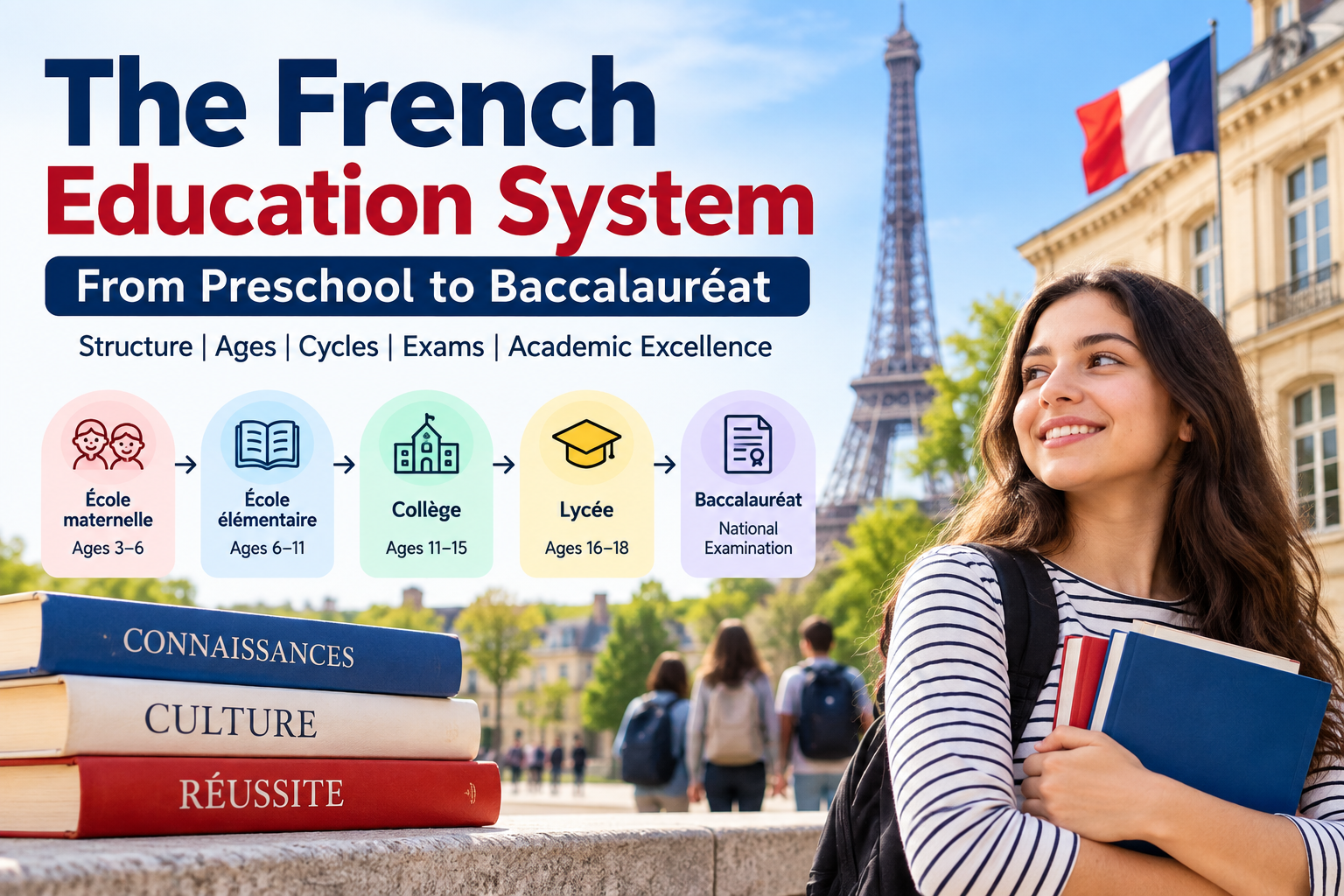
The French education system is known for its structure, high expectations, and national standards that aim for rigorous academic excellence. If you are a parent, student, or language learner exploring education in France, understanding how the French school system is organized will help you make confident decisions and speak about it accurately in French. This guide maps the stages from preschool to the baccalauréat, clarifies evaluations and grading, and shows how excellence is defined through curriculum frameworks and national assessments. For learners, we also highlight core French vocabulary so you can discuss schools, exams, and pathways with precision. If you want a structured way to learn French alongside this topic, PrepFrench Classes can guide you with tailored French courses and live practice.
Free First Step
Take the guesswork out of learning French.
Not sure where to begin, which course fits your goal, or how long it will take? Book a free demo class with PrepFrench Classes and get a personalized plan built around your level, schedule, and goals.
Overview of the French Education System
The French school system is national, centralized, and organized into clear stages with common academic benchmarks. Families benefit from consistency across regions, and students progress through defined “cycles” that align content, skills, and expectations.
Compulsory Education Ages
Schooling is compulsory from age 3 to 16 in France. From 16 to 18, young people have an “obligation of training,” which can be fulfilled by staying in school, entering apprenticeships, or pursuing other approved learning paths. Public education is free, and many private schools operate “sous contrat,” following the national curriculum.
Educational Cycles Explained
- Cycle 1: École maternelle, ages 3 to 6, language development and early socialization
- Cycle 2: CP to CE2, ages 6 to 9, foundational literacy and numeracy
- Cycle 3: CM1 to 6e, ages 9 to 12, transition from primary to lower secondary
- Cycle 4: 5e to 3e, ages 12 to 15, consolidation of core knowledge at collège
- Cycle terminal: Première and Terminale at lycée, ages 16 to 18, specializations and baccalauréat
Structure of French Schools
- École maternelle and élémentaire: preschool and primary
- Collège: lower secondary, ends with the Diplôme national du brevet (DNB)
- Lycée: upper secondary, general, technological, or vocational, ends with the baccalauréat
| Stage | Approx. Age | Grades | Cycle | Key Evaluation |
|---|---|---|---|---|
| École maternelle | 3 to 6 | PS, MS, GS | Cycle 1 | Observation-based |
| École élémentaire | 6 to 11 | CP to CM2 | Cycles 2 and 3 | National checks in early years |
| Collège | 11 to 15 | 6e to 3e | Cycle 3 end and Cycle 4 | Diplôme national du brevet |
| Lycée | 15 to 18 | Seconde, Première, Terminale | Cycle terminal | Baccalauréat |
Key terms to know for language learners include: école maternelle (preschool), école élémentaire (primary school), collège (middle school), lycée (high school), mentions (honors), rattrapage (resit), and Parcoursup (university admissions platform). A structured PrepFrench program helps you master this vocabulary and speak confidently about education in France.
Curriculum and Standards of Excellence
French curriculum standards are anchored in a national framework that defines what students should know and be able to do. Excellence is not just high grades, it is measured against clear reference levels, consistent expectations, and shared definitions of mastery across subjects.
Understanding the “Socle Commun”
The “socle commun de connaissances, de compétences et de culture,” often called the common core, sets essential knowledge and competencies to be acquired by the end of compulsory education. It is organized around five domains:
- Languages for thinking and communicating, literacy, French, foreign languages, digital expression
- Methods and tools for learning, study skills, research, digital literacy
- Personal and civic education, values, health, teamwork
- Understanding natural and technical systems, science and technology foundations
- Representations of the world and human activity, history, geography, arts
The socle commun clarifies progression from Cycle 1 to Cycle 4. Teachers use it to design lessons and evaluate mastery levels, which anchor academic excellence standards nationwide.
Expectations by Educational Stage
- Primary: strong focus on reading, writing, arithmetic, and early scientific inquiry
- Collège: consolidation across French, math, sciences, history, geography, languages, arts, PE, technology
- Lycée: specialization through pathways and “enseignements de spécialité,” leading to the French baccalauréat
National evaluations at selected points help track progress and guide support. Continuous assessment and national exams together indicate how well students meet French curriculum standards. Building the right French vocabulary, like socle commun, compétences, and évaluation, makes it easier to discuss these topics in class, in meetings, or during parent-teacher interviews. If you want guidance, our online French classes integrate real education contexts so you learn the language and the system side by side.
Structured French Courses
Stop learning French the slow way.
Apps and random videos keep you stuck at beginner level forever. PrepFrench Classes gives you a structured path, a real teacher, and speaking practice that moves you forward at every lesson.
Available for: beginners · TEF/TCF exam prep · Canadian PR · work and daily French
National Assessments and Certifications
Two milestones structure secondary education in France: the Diplôme national du brevet at the end of collège and the baccalauréat at the end of lycée. Both reflect national standards, incorporate continuous assessment, and use the French grading scale out of 20.
The Diplôme National du Brevet (DNB)
The DNB certifies mastery of the socle commun at the end of troisième. It combines continuous assessment with written exams in French, mathematics, history-geography-civics, and sciences, plus an oral exam often centered on a project. Results are reported with mentions that indicate levels of excellence. The DNB does not determine lycée admission on its own, yet it is an important marker of readiness and academic habits.
Overview of the Baccalauréat
The French baccalaureate is the high school leaving certificate and a university entrance qualification. After recent reforms, about 40 percent of the final mark comes from continuous assessment and 60 percent from national exams. Key components include specialty subject exams in Terminale, philosophy, a major oral exam, and French exams in Première. Different versions exist: general, technological, and vocational. Success at the bac opens access to university, selective higher education pathways, or direct entry into the workforce depending on the track.
Evaluations and Honors (Mentions)
- French grading scale: 0 to 20, with 10 considered a passing mark
- Mentions at the bac: Assez bien from 12, Bien from 14, Très bien from 16 and up
- Oral retakes: students near the pass threshold can sit “oraux de rattrapage” to improve results
- Coefficients: subjects have different weights, so strategic strengths matter
Understanding how grades and mentions work helps families interpret report cards and exam results accurately. If you want to practice this language in context, our French lessons can simulate parent-teacher discussions and exam debriefs so you can speak French with confidence about real school matters.
Pathways at Lycée
Upper secondary education offers three broad routes: general, technological, and vocational. Each pathway has a distinct purpose, curriculum, and set of higher education or employment outcomes. Excellence is expressed differently across these tracks, yet all are aligned to national standards.
General vs. Technological vs. Vocational Pathways
- Lycée général: academic curriculum with chosen “enseignements de spécialité,” ideal for university, classes préparatoires, and grandes écoles
- Lycée technologique: applied sciences and professional fields, such as STMG, STI2D, ST2S, STL, STHR, STD2A, TMD, often leading to IUT programs or BTS
- Lycée professionnel: workplace skills and extended internships, culminating in a vocational baccalauréat or CAP, with direct employment or BTS as next steps
Choice of pathway typically happens at the end of collège and is refined in Seconde. Students in the general track select specialties in Première and keep two in Terminale, which weigh heavily in the bac results. In technological and vocational routes, coursework emphasizes applied projects, lab work, and industry partnerships that signal excellence in professional competence as well as academic knowledge.
Impact on University Admissions
University applications go through Parcoursup, where grades, subject choices, personal projects, and school reports are considered. In the general track, the strength of chosen specialties matters, for example mathematics or physics for selective science programs. In the technological track, sector alignment supports entry to IUT or BTS. In the vocational track, strong internships, certifications, and recommendations can secure direct employment or a place in a BTS. To talk through these options in French, targeted vocabulary practice in our French course makes a real difference.
Quality Assurance in the French Education System
France maintains academic excellence through national frameworks, inspection bodies, and international benchmarks. Together, these mechanisms promote consistency and continuous improvement at local and global levels.
The Role of IGÉSR
The General Inspectorate for Education, Sport and Research, known as IGÉSR, oversees evaluation and inspection in schools and higher education. Inspectors visit classrooms, review programs, and advise on pedagogy and policy. Their work supports consistent application of curriculum standards and helps teachers align practice with national objectives for excellence.
International Benchmarking (OECD PISA)
France participates in the OECD’s PISA assessments in reading, mathematics, and science. Recent cycles show performance around the OECD average with strengths in science and ongoing efforts to address gaps in mathematics and equity. Policymakers use these findings to refine curricula and support initiatives that reduce disparities. For learners and parents, PISA offers a reference point for how education in France compares globally.
Quality Assurance Abroad (AEFE)
The AEFE network coordinates French schools abroad, ensuring that children outside France can follow the same curriculum and sit the same exams. Accreditation, staff development, and program audits help maintain high standards internationally. This global consistency is a hallmark of the French education system and provides stability for mobile families.
To engage in informed conversation about quality, learn keywords like inspection, référentiels, évaluation externe, and indicateurs. PrepFrench Classes weave these terms into practical speaking activities so you can discuss education policy and school quality in clear, accurate French.
PrepFrench Classes
Ready to start French with a clear plan?
Book a FREE demo class and get a personalized roadmap for your level, goal, and timeline. No pressure, no obligation.
Explore courses:
All French Courses · Full TCF Canada Course · Full TEF Canada Course
FAQs: The French Education System Explained
What age is school compulsory in France?
In the French education system, school is compulsory from age 3 to 16. From 16 to 18, young people must remain in education, training, or approved programs under an “obligation de formation.” This structure ensures that education in France builds strong foundations early, with preschool fully integrated into the public system. If you are relocating or navigating the French school system for the first time, learning key vocabulary with online French classes at PrepFrench will help you communicate clearly with schools and teachers.
How is academic excellence measured in the French education system?
Excellence is measured against national curriculum standards through continuous assessment and national exams. The French grading scale runs from 0 to 20, with 10 as a pass and mentions starting from 12. Mastery is judged using reference frameworks such as the socle commun, specialty subject expectations at lycée, and results in the DNB and baccalauréat. Class rankings, subject coefficients, and rigorous marking also contribute. To discuss these standards confidently, try a structured French lesson focused on education topics.
What are the differences between the baccalauréat and the DNB?
The Diplôme national du brevet is taken at the end of collège and certifies mastery of the common core. It includes written exams, an oral, and continuous assessment. The French baccalaureate is taken at the end of lycée and is the key qualification for university entry. It combines continuous assessment with national exams in specialty subjects, philosophy, and a major oral. In short, the DNB confirms readiness for upper secondary school, while the bac shapes higher education pathways and career choices.
How does the French grading scale work?
Grades in French schools use a 0 to 20 scale. A 10 indicates a pass, while 12, 14, and 16 mark the thresholds for Assez bien, Bien, and Très bien. Teachers grade analytically and often strictly, using rubrics and detailed marking schemes. Final results factor in subject coefficients, so some courses weigh more than others. Continuous assessment contributes significantly, especially for the baccalauréat. If you learned in a percentage or GPA system, understanding this scale is essential, and a focused French course can help you adapt the vocabulary and expectations.
What are the different lycée pathways in the French education system?
Lycée offers three routes: general, technological, and vocational. The general pathway uses academic specialties and leads broadly to universities, classes préparatoires, and grandes écoles. The technological pathway emphasizes applied disciplines and commonly leads to IUT programs or BTS. The vocational pathway focuses on employability through internships and sector skills, moving to direct work or BTS. Each route follows national standards, and your choice affects exams, coursework, and admissions through Parcoursup. To learn how to talk about these options in French, consider live PrepFrench Classes with a teacher.
Final Thoughts
The French education system stands out for its clarity of structure, national curriculum standards, and shared definitions of excellence. From the socle commun in compulsory schooling to the specialized pathways of lycée, students progress through well-defined stages anchored by common assessments such as the DNB and the baccalauréat. The French grading scale and the system of mentions provide a transparent language for evaluating achievement across the country and abroad.
For language learners, mastering school-related French vocabulary is a powerful way to gain real-world confidence. With PrepFrench Classes, you can learn French through practical contexts, like parent-teacher meetings, report cards, and university admissions. Explore our French courses to build both your language skills and your understanding of education in France. If you have questions or want a personalized roadmap, visit the PrepFrench homepage or book a free demo today.
✅ Next Step: Book a free demo class with PrepFrench Classes and start learning French the right way.
Learning with structure accelerates everything. When you pair real-world topics like the French school system with targeted vocabulary and speaking practice, your French improves faster and feels more useful from day one.
Written by
Platform Administrator
Practical ideas from the Prep French team for learners building confidence, preparing for exams, and planning their next step in Canada.
Join the discussion
Leave a thoughtful comment.
Your email address will not be published. Comments are reviewed before appearing.